2 layers81 × 57.7 mm
Hermes
GodOfStrategy/GYACSPEED
Speedometer, accelerometer and a gyroscope for my bicycle, with the XIAO RP2040 as the MCU, with a 1.3" OLED display for the information.
33 parts

 Scrubs22/Vibrometer-II1
A LSM6DS3 based vibration monitor, using RP2040 and a CR2032 cell for the MCU and power respectively. For more details see README
PCB SCHEM MAIN(V II) is an open-source printed circuit board by Scrubs22, from the Scrubs22/Vibrometer-II repository on GitHub, published under the CERN-OHL-W-2.0 licence. It is a 2-layer board of 84 × 36 mm with 28 parts on 61 nets, routed with 419 tracks and 41 vias.
It is built around the RP2040, LSM6DS3 and SS14. Its parts include 9 resistors, 5 capacitors, 5 ICs, 2 diodes and 1 connector. It belongs with the RP2040 boards of this library.


⚠️ Status: Work in Progress (WIP)
This project is actively being developed and is currently in the development phase. The hardware schematics, 3D enclosures, and firmware files are subject to frequent changes until a complete, fully tested working prototype is validated. Use with caution!
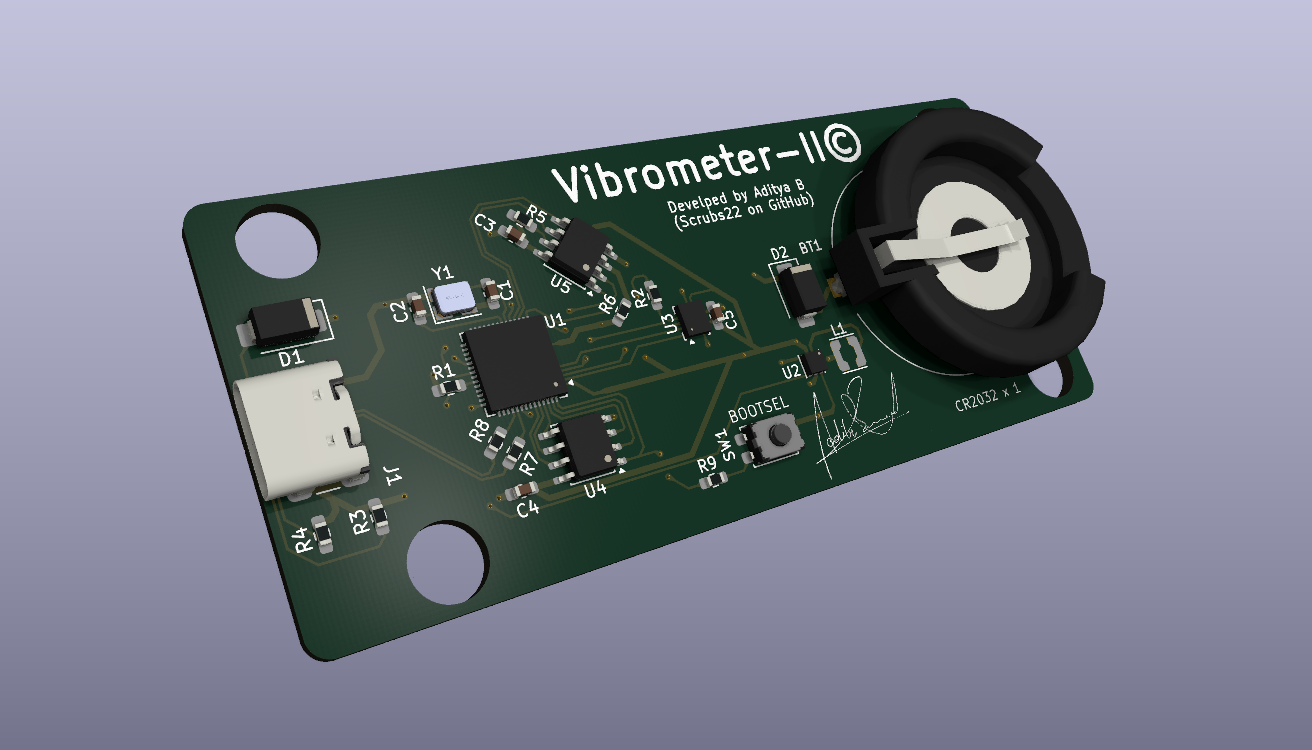
Vibrometer-II is an advanced, high-performance upgrade to my original vibration monitor project.
The previous version relied on an ATmega328-P architecture powered by twin CR2032 cells. While functional, it suffered from a bulky form factor, increased mass, and inherent measurement inaccuracies.
To overcome these constraints, Vibrometer-II implements a much cleaner and faster Raspberry Pi RP2040 core. This hardware migration achieves:
The Vibrometer-II uses the LSM6DS3 as its main IMU, and the RP2040 as the MCU. For memory, two MX25L3233FM1 each featuring 4MB or storage.
| Qty | Value | Footprint | References |
|---|---|---|---|
| 4 | 10K | Resistor_SMD:R_0603_1608Metric_Pad0.98x0.95mm_HandSolder | R1, R2, R5, R6 |
| 3 | 100nf | Capacitor_SMD:C_0603_1608Metric_Pad1.08x0.95mm_HandSolder | C3, C4, C5 |
| 2 | 22pf | Capacitor_SMD:C_0603_1608Metric_Pad1.08x0.95mm_HandSolder | C1, C2 |
| 2 | 27 | Resistor_SMD:R_0603_1608Metric_Pad0.98x0.95mm_HandSolder | R7, R8 |
| 2 | 5K1 | Resistor_SMD:R_0603_1608Metric_Pad0.98x0.95mm_HandSolder | R3, R4 |
| 2 | MX25L3233FM1 | Package_SO:JEITA_SOIC-8_3.9x4.9mm_P1.27mm | U4, U5 |
| 1 | 1K | Resistor_SMD:R_0603_1608Metric_Pad0.98x0.95mm_HandSolder | R9 |
| 1 | 3u3 | Inductor_SMD:L_Coilcraft_LPS3010 | L1 |
| 1 | Battery_Cell | Battery:BatteryHolder_MYOUNG_BS-07-A1BJ001_CR2032 | BT1 |
| 1 | Crystal_GND24 | Crystal:Crystal_SMD_Abracon_ABM8AIG-4Pin_3.2x2.5mm | Y1 |
| 1 | D | Diode_SMD:D_SMA | D2 |
| 1 | LOGO | KiCAD projects:Sign_Back_20x20.3 | G*** |
| 1 | LOGO | KiCAD projects:Sign_10.13.3mm | G*** |
| 1 | LSM6DS3 | Package_LGA:LGA-14_3x2.5mm_P0.5mm_LayoutBorder3x4y | U3 |
| 1 | RP2040 | Package_DFN_QFN:QFN-56-1EP_7x7mm_P0.4mm_EP3.2x3.2mm | U1 |
| 1 | SS14 | Diode_SMD:D_SMA | D1 |
| 1 | SW_Push | Button_Switch_SMD:SW_SPST_EVQP2_MiddlePushTravel_H2.5mm | SW1 |
| 1 | TPS61291DRVR | Package_SON:WSON-6-1EP_2x2mm_P0.65mm_EP1x1.6mm | U2 |
| 1 | USB_C_Receptacle_USB2.0_14P | Connector_USB:USB_C_Receptacle_GCT_USB4105-xx-A_16P_TopMnt_Horizontal | J1 |
GodOfStrategy/GYACSPEED
Speedometer, accelerometer and a gyroscope for my bicycle, with the XIAO RP2040 as the MCU, with a 1.3" OLED display for the information.
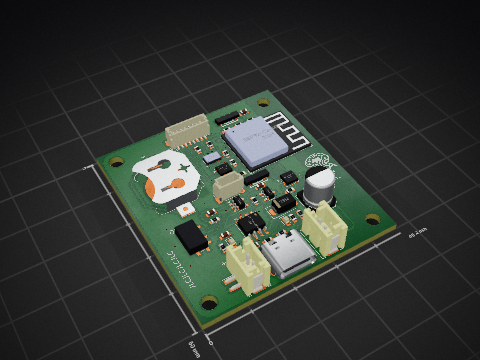


ZachS07/RP2040-IMU-Altimeter-PCB
Custom PCB motion and altitude data logger. RP2040 microcontroller with onboard IMU, barometric sensor, and flash storage. It's suitable for model rockets, drones, and other applications.


sequoia-hope/ultraroute
PCB autorouting experiments around copperroute: route jobs, leaderboards, board morphing

OpenJBOD/rp2040
This repository contains the hardware design files OpenJBOD RP2040 Baseboard.
It measures 84 × 36 mm and has 2 copper layers, 1.6 mm thick.
28 parts, built around the RP2040, LSM6DS3 and SS14. The full list of its parts is on this page, with links to each part's symbol and footprint where PCBKit's library has them.
From the Scrubs22/Vibrometer-II repository on GitHub, at the commit this page was made from: the board is PCB_SCHEM/PCB_SCHEM_MAIN(V-II)/PCB_SCHEM_MAIN(V-II).kicad_pcb and its schematic PCB_SCHEM/PCB_SCHEM_MAIN(V-II)/PCB_SCHEM_MAIN(V-II).kicad_sch. PCBKit opens the board in the browser, with nothing to install.
Its repository publishes it under the CERN-OHL-W-2.0 licence: you may reuse it on that licence's terms (keep the author's notice, and for a copyleft licence share your changes alike).