2 layers34.6 × 38.4 mm

 ZachS07/RP2040-IMU-Altimeter-PCB1
Custom PCB motion and altitude data logger. RP2040 microcontroller with onboard IMU, barometric sensor, and flash storage. It's suitable for model rockets, drones, and other applications.
Rocket Project is an open-source printed circuit board by ZachS07, from the ZachS07/RP2040-IMU-Altimeter-PCB repository on GitHub. It is a 4-layer board of 115.5 × 79.5 mm with 33 parts on 61 nets, routed with 752 tracks and 102 vias.
It is built around the RP2040, BMP280 and W25Q16JVSSIQ, with the AP2112K-3.3 and LSM6DS3 among its other parts. Its parts include 13 capacitors, 7 resistors, 5 ICs, 3 connectors and 2 diodes. It belongs with the sensors and measurement and robots and motor control boards and the RP2040 boards of this library.


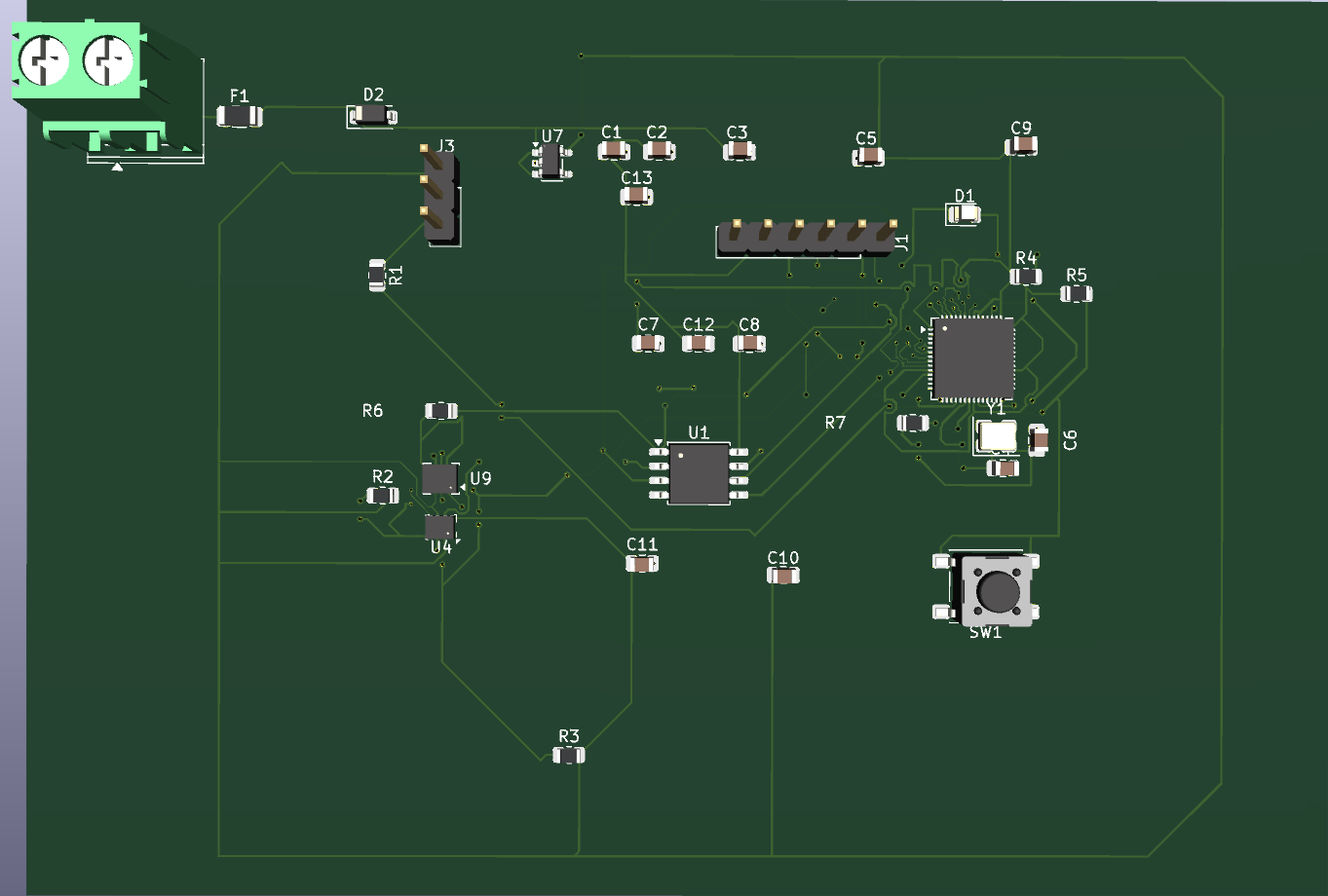
Custom PCB motion and altitude data logger. RP2040 microcontroller with onboard IMU, barometric sensor, and flash storage. It's suitable for model rockets, drones, and other applications.
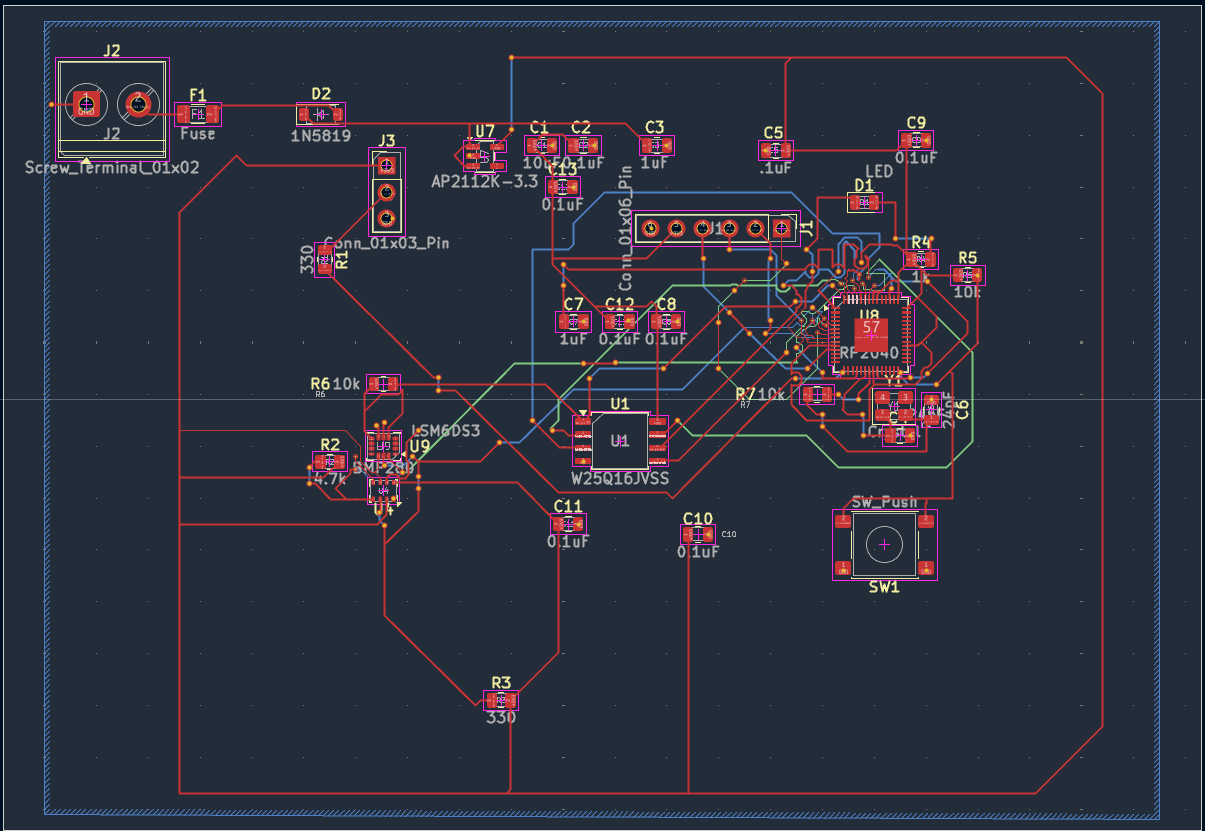
My inspiration for this was wanting to learn how to use KiCad to design a PCB, and seeing something similar in the Rocket Club at UConn. At this club, I was oddly fascinated by how these little components generated such important data for navigation.
Because this was among my first KiCad projects, it was very challenging, but that allowed me to learn a ton about the program.
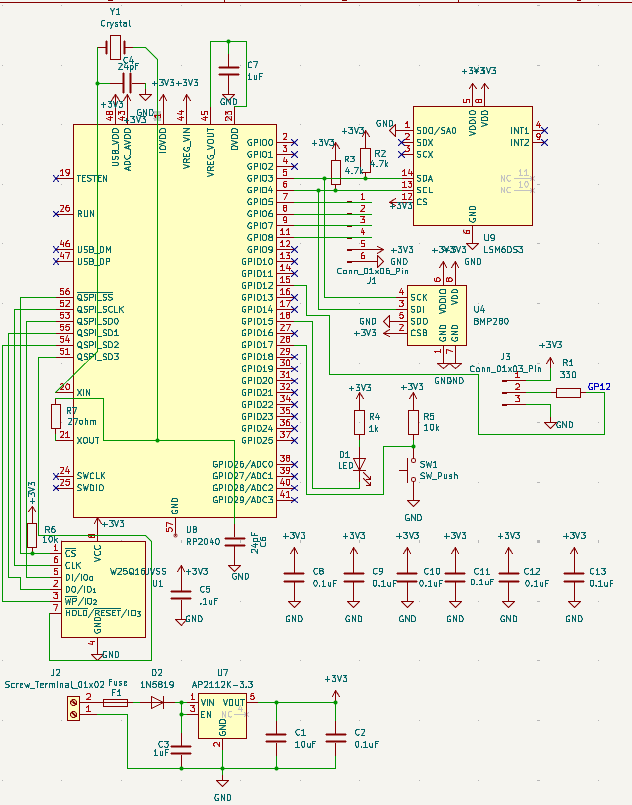
I also used LTSpice to simulate the power input side of the board. It confirmed the protection diode would block reverse polarity while only dropping about 0.3V during normal use.
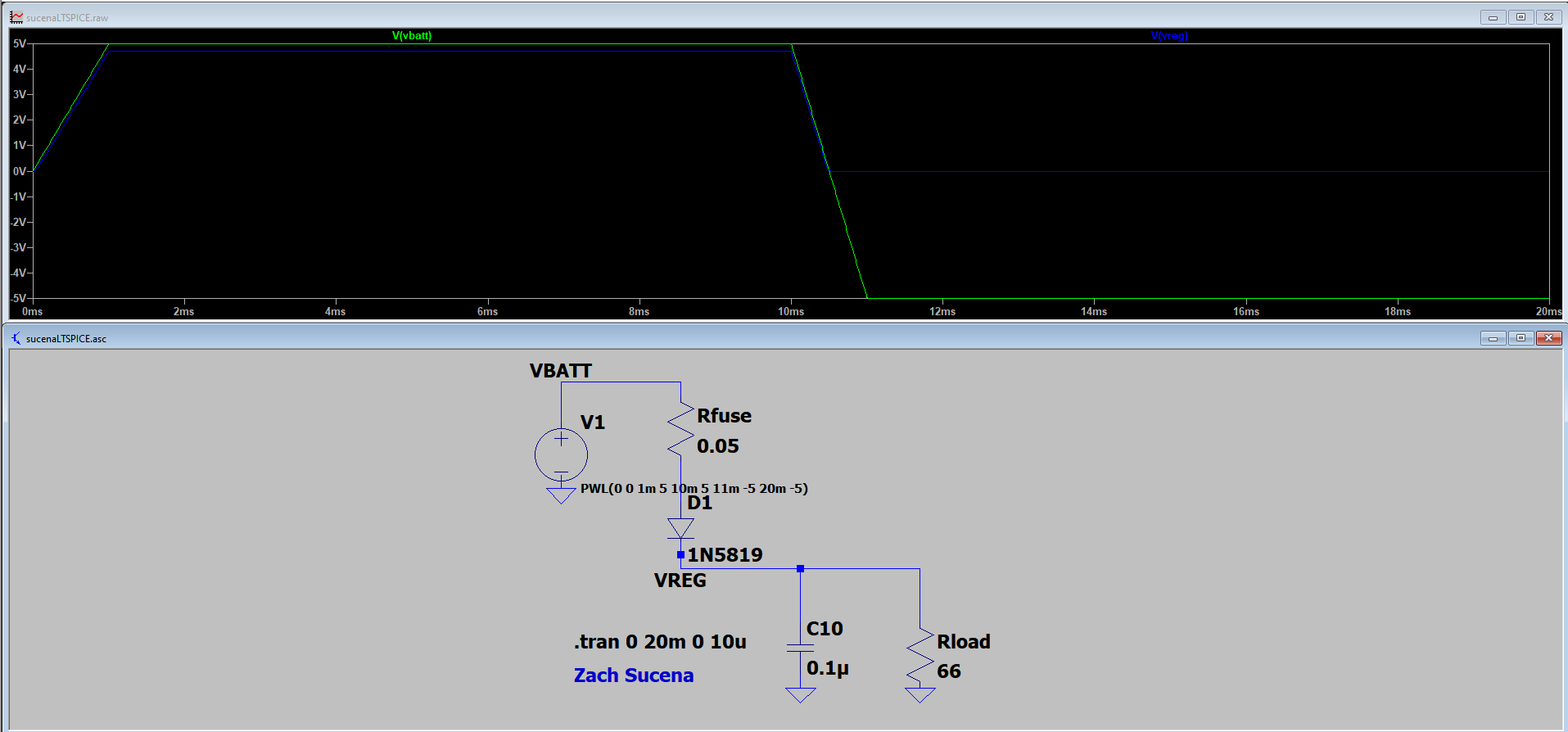
| Qty | Value | Footprint | References |
|---|---|---|---|
| 7 | 0.1uF | Capacitor_SMD:C_0805_2012Metric | C2, C8, C9, C10, C11, C12, C13 |
| 3 | 10k | Resistor_SMD:R_0805_2012Metric | R5, R6, R7 |
| 2 | 1uF | Capacitor_SMD:C_0805_2012Metric | C3, C7 |
| 2 | 24pF | Capacitor_SMD:C_0805_2012Metric | C4, C6 |
| 2 | 330 | Resistor_SMD:R_0805_2012Metric | R1, R3 |
| 1 | .1uF | Capacitor_SMD:C_0805_2012Metric | C5 |
| 1 | 10uF | Capacitor_SMD:C_0805_2012Metric | C1 |
| 1 | 1N5819 | Diode_SMD:D_SOD-123 | D2 |
| 1 | 1k | Resistor_SMD:R_0805_2012Metric | R4 |
| 1 | 4.7k | Resistor_SMD:R_0805_2012Metric | R2 |
| 1 | AP2112K-3.3 | Package_TO_SOT_SMD:SOT-23-5 | U7 |
| 1 | BMP280 | Package_LGA:Bosch_LGA-8_2x2.5mm_P0.65mm_ClockwisePinNumbering | U4 |
| 1 | Conn_01x03_Pin | Connector_PinHeader_2.54mm:PinHeader_1x03_P2.54mm_Vertical | J3 |
| 1 | Conn_01x06_Pin | Connector_PinHeader_2.54mm:PinHeader_1x06_P2.54mm_Vertical | J1 |
| 1 | Crystal | Crystal:Crystal_SMD_3225-4Pin_3.2x2.5mm | Y1 |
| 1 | Fuse | Fuse:Fuse_1206_3216Metric | F1 |
| 1 | LED | LED_SMD:LED_0805_2012Metric | D1 |
| 1 | LSM6DS3 | Package_LGA:LGA-14_3x2.5mm_P0.5mm_LayoutBorder3x4y | U9 |
| 1 | RP2040 | Package_DFN_QFN:QFN-56-1EP_7x7mm_P0.4mm_EP3.2x3.2mm | U8 |
| 1 | SW_Push | Button_Switch_SMD:SW_SPST_PTS645Sx43SMTR92 | SW1 |
| 1 | Screw_Terminal_01x02 | TerminalBlock_Phoenix:TerminalBlock_Phoenix_PT-1,5-2-5.0-H_1x02_P5.00mm_Horizontal | J2 |
| 1 | W25Q16JVSS | Package_SO:SOIC-8_5.3x5.3mm_P1.27mm | U1 |


nthclrd/picflash
Programmeur PIC open source en Rust : remplace MPLAB IPE/XC8 pour les PIC16, pilote les PICkit 4/5/Basic ou une carte RP2040 maison (KiCad)

C-yue28/Plant-Monitor
ML-powered plant monitor, tracking metrics such as temperature, humidity, soil moisture, etc to inform plant watering behavior.

Cherry-Blossom-Development/GreywireStudio
GreywireStudio - a combined software/hardware product

draarivpatel-ui/helios-cad-forge
Helios-6 is a parametric dual-axis solar tracker gimbal, OpenSCAD + watertight STL mesh generator, Spencer (1971) solar ephemeris calculator, and KiCad 8 RP2040 + INA219 telemetry node.

JesseLevine727/AirNote
A touchless musical instrument built around a fully integrated RP2040, VL53L1X distance sensor and MAX98357A speaker amplifier. One hand selects eleven pentatonic notes over two octaves.
It measures 115.5 × 79.5 mm and has 4 copper layers, 1.6 mm thick.
33 parts, built around the RP2040, BMP280, W25Q16JVSSIQ and AP2112K-3.3. The full list of its parts is on this page, with links to each part's symbol and footprint where PCBKit's library has them.
From the ZachS07/RP2040-IMU-Altimeter-PCB repository on GitHub, at the commit this page was made from: the board is Rocket Project.kicad_pcb and its schematic Rocket Project.kicad_sch. PCBKit opens the board in the browser, with nothing to install.
Its repository states no licence, so its author keeps all rights: ask ZachS07 before reusing the design.