4 layers54.6 × 54.6 mm

 roybaer/parallel_port_headphone_dac4
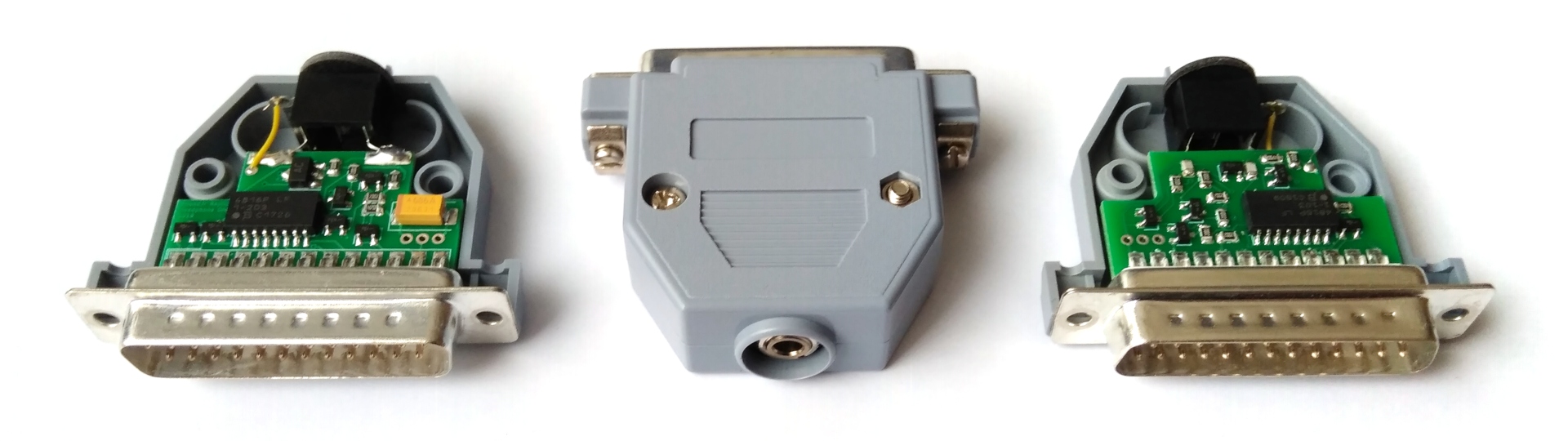
This is a reasonably accurate replica of the early 1990s SoundJr device by SiliconSoft.
Parallel port headphone dac is an open-source printed circuit board by roybaer, from the roybaer/parallel_port_headphone_dac repository on GitHub. It is a 2-layer board of 36.8 × 20.1 mm with 37 parts on 44 nets, routed with 265 tracks and 19 vias.
It is built around the MMST2222A, MMST2907A and BCX51-10. Its parts include 14 resistors, 9 transistors, 4 diodes, 3 capacitors and 2 connectors. It belongs with the audio and music boards of this library.


This is a reasonably accurate replica of the early 1990s SoundJr device by SiliconSoft, a port-powered parallel port DAC that can directly drive 32 ohm headphones.
A comprehensive list of the SoundJr's features can be found on the manufacturer's website. The drivers for the SoundJr can be found in the VOGONS Vintage Driver Library.
The primitive R-2R DAC will continuously convert the 8-bit PCM sample on the parallel port's data lines. A PC program can therefore play PCM data by periodically writing PCM samples to the parallel port's data port.
The device's output volume can be set to one of nominally eight levels via the control port bits of the PC's parallel port. Note that some of these signals are active-low. There is also an implicit energy saving mode that is active whenever no port pin provides power to the device.
| Ctrl 3..0 | Volume level |
|---|---|
| 0000 | undefined (weaker 8) |
| 0001 | undefined (weaker 6) |
| 0010 | undefined (weaker 7) |
| 0011 | undefined (weaker 5) |
| 0100 | 8 |
| 0101 | 6 |
| 0110 | 7 |
| 0111 | 5 |
| 1000 | undefined (weaker 4) |
| 1001 | undefined (weaker 2) |
| 1010 | undefined (weaker 3) |
| 1011 | muted, if data 1..0 = 0 |
| 1100 | 4 |
| 1101 | 2 |
| 1110 | 3 |
| 1111 | 1 |
Since the availability and pricing of components can vary widely over the course of decades, some component substitution can become necessary. The following substitutions have been tested successfully:
| Original component | Acceptable substitute | Type of component |
|---|---|---|
| DAN202K (ROHM Semiconductor) | M1MA152WKT1G (ON Semiconductor) | Double diode |
| 767163203G (CTS Corporation) | 4816P-1-203LF (Bourns Inc.) | Resistor pack |
| 767163103G (CTS Corporation) | 4816P-1-103LF (Bourns Inc.) | Resistor pack |
| MMST2222A (ROHM Semiconductor) | MSD601-RT1G (ON Semiconductor) | NPN transistor |
| MMST2907A (ROHM Semiconductor) | MSA1162GT1G (ON Semiconductor) | PNP transistor |
The value of the two filter capacitors is unknown, but 1nF capacitors appear to work well enough.
| Qty | Value | Footprint | References |
|---|---|---|---|
| 6 | 20k | Resistor_SMD:R_0805_2012Metric | R2, R3, R5, R9, R10, R13 |
| 4 | 10k | Resistor_SMD:R_0805_2012Metric | R6, R11, R12, R14 |
| 4 | DAN202K | Package_TO_SOT_SMD:SC-59 | D1, D2, D3, D4 |
| 4 | MMST2222A | Package_TO_SOT_SMD:SC-59 | Q5, Q7, Q8, Q9 |
| 4 | MMST2907A | Package_TO_SOT_SMD:SC-59 | Q2, Q3, Q4, Q6 |
| 3 | TestPoint | Connector_Wire:SolderWirePad_1x01_Drill0.8mm | TP1, TP2, TP3 |
| 2 | 100 | Resistor_SMD:R_0805_2012Metric | R1, R7 |
| 2 | C | Capacitor_SMD:C_0805_2012Metric | C2, C3 |
| 1 | 161-3402-E | parallel_port_headphone_dac:SoundJr_AudioJack | J2 |
| 1 | 4.7k | Resistor_SMD:R_0805_2012Metric | R4 |
| 1 | 470 | Resistor_SMD:R_0805_2012Metric | R8 |
| 1 | 68µ | Capacitor_Tantalum_SMD:CP_EIA-7343-30_AVX-N | C1 |
| 1 | 8x10k | Package_SO:SOIC-16W_5.3x10.2mm_P1.27mm | RN2 |
| 1 | 8x20k | Package_SO:SOIC-16W_5.3x10.2mm_P1.27mm | RN1 |
| 1 | BCX51-10 | Package_TO_SOT_SMD:SOT-89-3 | Q1 |
| 1 | DB25_Male | Connector_Dsub:DSUB-25_Male_EdgeMount_P2.77mm | J1 |


hoglet67/RGBtoHDMI
Bare-metal Raspberry Pi project that provides pixel-perfect sampling of Retro Computer RGB/YUV video and conversion to HDMI

hackclub/OnBoard
💡 Join 1,000 teenagers and make your first PCB with a $100 grant!

FreeYourStream/freedeck-hardware
all the stuff you need to build your own FreeDeck

stuartpittaway/diyBMS
Do it yourself battery management system for Lithium ion battery packs/cells
It measures 36.8 × 20.1 mm and has 2 copper layers, 1.6 mm thick.
37 parts, built around the MMST2222A, MMST2907A and BCX51-10. The full list of its parts is on this page, with links to each part's symbol and footprint where PCBKit's library has them.
From the roybaer/parallel_port_headphone_dac repository on GitHub, at the commit this page was made from: the board is parallel_port_headphone_dac/parallel_port_headphone_dac.kicad_pcb. PCBKit opens the board in the browser, with nothing to install.
Its repository states no licence, so its author keeps all rights: ask roybaer before reusing the design.