
4 layers50 × 40 mm

 rfleuryleveso/analysair
Open-source air quality monitoring board based on ESP32-C3-MINI-1-N4X and Sensirion SEN66. USB-C powered, designed in KiCad.
Analysair is an open-source printed circuit board by rfleuryleveso, from the rfleuryleveso/analysair repository on GitHub. It is a 2-layer board of 29.5 × 48 mm with 42 parts on 56 nets, routed with 211 tracks and 31 vias.
It is built around the ESP32-C3-MINI-1-N4X and SMAJ5.0A. Its parts include 11 resistors, 9 capacitors, 2 ICs, 2 diodes and 2 connectors. It belongs with the sensors and measurement boards and the ESP32 and RISC-V boards of this library.
An indoor air quality monitor built around the Sensirion SEN66 and an ESP32-C3. USB-C powered, no display, no buttons you need during normal use. it sits on a shelf and reports over Wi-Fi.
I built this because the consumer air quality monitors I looked at either had no way to get raw data out of them, or wanted me to send it through someone else's cloud first. The SEN66 gives nine parameters from a single I²C device, so most of the work here is a clean 3.3 V rail and a decent USB front end.
The SEN66 does all of the sensing. One driver, one I²C address (0x6B), nine outputs:
| Parameter | Range | Notes |
|---|---|---|
| PM1 / PM2.5 / PM4 / PM10 | 0–1000 µg/m³ | MEMS particulate sensor (SPS6x) |
| Temperature | −10 to 50 °C | Compensated for module self-heating |
| Relative humidity | 0–100 % | |
| VOC index | 1–500 | Sensirion's index, not a ppb figure |
| NOx index | 1–500 | |
| CO₂ | 400–5000 ppm | NDIR |
New readings are available every second in measurement mode. The sensor has its own STAR engine for temperature compensation, which needs retuning if you change the enclosure. see Sensirion's app note on that if you build a different case than the one here.
ESP32-C3-MINI-1-N4X, USB-C, 3.3 V linear regulation, and a JST GH pigtail to the sensor.
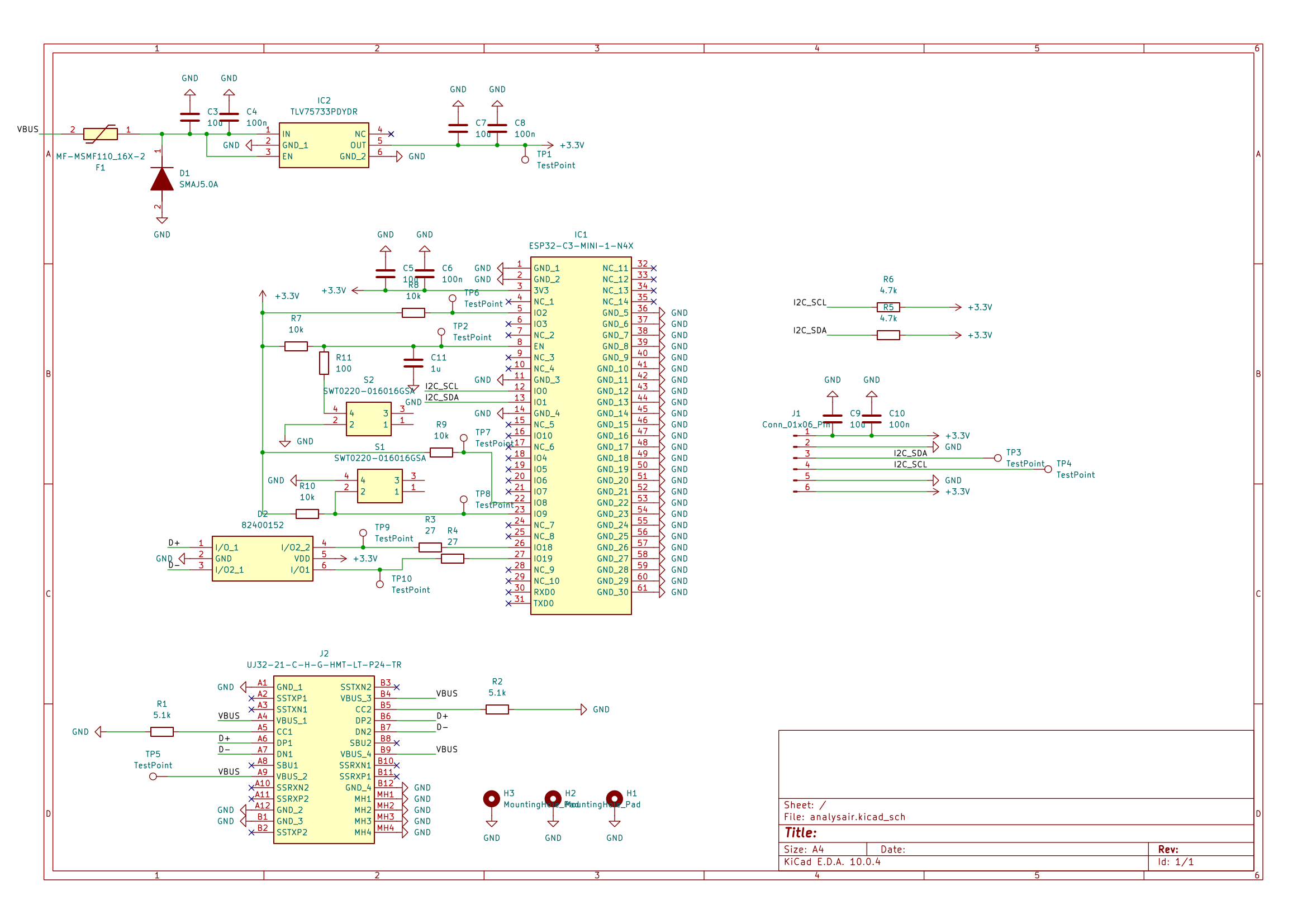
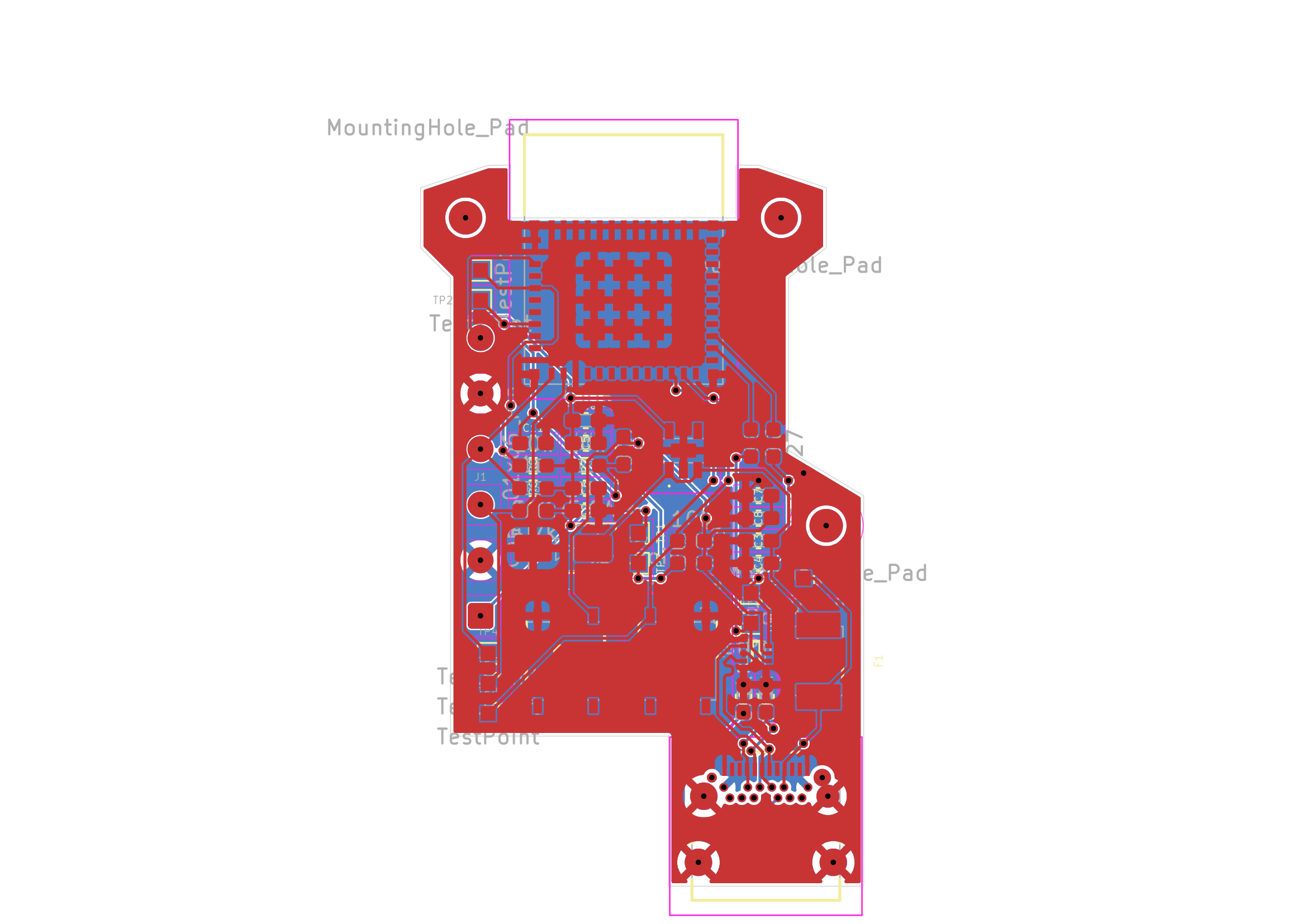
Around thirty lines, all 0603 passives and hand-solderable packages except the module and the USB connector. Mouser part numbers live in the symbol fields.
Waiting on JLPCB order
Hardware under CERN-OHL-S v2. Firmware under MIT. See LICENSE-hardware and LICENSE-firmware.
| Qty | Value | Footprint | References |
|---|---|---|---|
| 10 | TestPoint | TestPoint:TestPoint_Pad_1.0x1.0mm | TP1, TP2, TP3, TP4, TP5, TP6, TP7, TP8, TP9, TP10 |
| 4 | 100n | Capacitor_SMD:C_0603_1608Metric_Pad1.08x0.95mm_HandSolder | C4, C6, C8, C10 |
| 4 | 10k | Resistor_SMD:R_0603_1608Metric_Pad0.98x0.95mm_HandSolder | R7, R8, R9, R10 |
| 4 | 10u | Capacitor_SMD:C_0603_1608Metric_Pad1.08x0.95mm_HandSolder | C3, C5, C7, C9 |
| 3 | MountingHole_Pad | MountingHole:MountingHole_2.2mm_M2 | H1, H2, H3 |
| 2 | 27 | Resistor_SMD:R_0603_1608Metric_Pad0.98x0.95mm_HandSolder | R3, R4 |
| 2 | 4.7k | Resistor_SMD:R_0603_1608Metric_Pad0.98x0.95mm_HandSolder | R5, R6 |
| 2 | 5.1k | Resistor_SMD:R_0603_1608Metric_Pad0.98x0.95mm_HandSolder | R1, R2 |
| 2 | SWT0220-016016GSA | SWT0220-016016GSA:SWT0220016016GSA | S1, S2 |
| 1 | 100 | Resistor_SMD:R_0603_1608Metric_Pad0.98x0.95mm_HandSolder | R11 |
| 1 | 1u | Capacitor_SMD:C_0603_1608Metric_Pad1.08x0.95mm_HandSolder | C11 |
| 1 | 82400152 | 82400152:SOTFL50P160X55-6N | D2 |
| 1 | Conn_01x06_Pin | Connector_Wire:SolderWire-0.127sqmm_1x06_P3.7mm_D0.48mm_OD1mm | J1 |
| 1 | ESP32-C3-MINI-1-N4X | ESP32-C3-MINI-1-N4X:ESP32C3MINI1N4X | IC1 |
| 1 | MF-MSMF110_16X-2 | MF-MSMF110_16X-2:MFMSMF11016X2 | F1 |
| 1 | SMAJ5.0A | Diode_SMD:D_SMA | D1 |
| 1 | TLV75733PDYDR | TLV75733PDYDR:TLV75733PDYDR | IC2 |
| 1 | UJ32-21-C-H-G-HMT-LT-P24-TR | UJ32-21-C-H-G-HMT-LT-P24-TR:UJ3221CHGHMTLTP24TR | J2 |


wisdom-km/color-eink-work-badge
Color e-ink work badge (彩色墨水屏工牌). P36 3.6-inch six-color 400x600 portrait badge.

hicancan/carbentra-smart-switch
CARBENTRA three-channel smart switch: hardware, firmware and local engineering checks


brickbots/PiFinder
A plate solving telescope finder based around a Raspberry PI and RPI HQ Camera

tombueng/LuxDMX
Open-source Art-Net / sACN (E1.31) → DMX512 gateway for ESP32 / ESP32-S3 / Ethernet. Live web UI shows all 512 channels in real time, flags console conflicts, and drives galvanically-isolated DMX.

It measures 29.5 × 48 mm and has 2 copper layers, 1.6 mm thick.
42 parts, built around the ESP32-C3-MINI-1-N4X and SMAJ5.0A. The full list of its parts is on this page, with links to each part's symbol and footprint where PCBKit's library has them.
From the rfleuryleveso/analysair repository on GitHub, at the commit this page was made from: the board is analysair.kicad_pcb and its schematic analysair.kicad_sch. PCBKit opens the board in the browser, with nothing to install.
Its repository states no licence, so its author keeps all rights: ask rfleuryleveso before reusing the design.