

2 layers56.5 × 47.2 mm

 prydin/param-eq3
Parametric Equalizer
Param eq is an open-source printed circuit board by prydin, from the prydin/param-eq repository on GitHub. It is a 2-layer board of 88.5 × 74.5 mm with 45 parts on 73 nets, routed with 213 tracks and 1 via.
It is built around the TEENSY 4.1 and SB140. Its parts include 23 resistors, 13 connectors, 2 capacitors, 2 diodes and 1 IC. It belongs with the NXP (LPC, Kinetis, i.MX RT) boards of this library.
This project started as a focused experiment: build a practical, hardware-controlled parametric equalizer. Along the way it grew into something broader: a general-purpose DSP platform for real-time audio processing, instrumentation, and UI experiments.
What began as "just three EQ bands" now includes filter control, combined response visualization, VU metering, spectrum visualization, and a register-based control/data protocol between two MCUs.
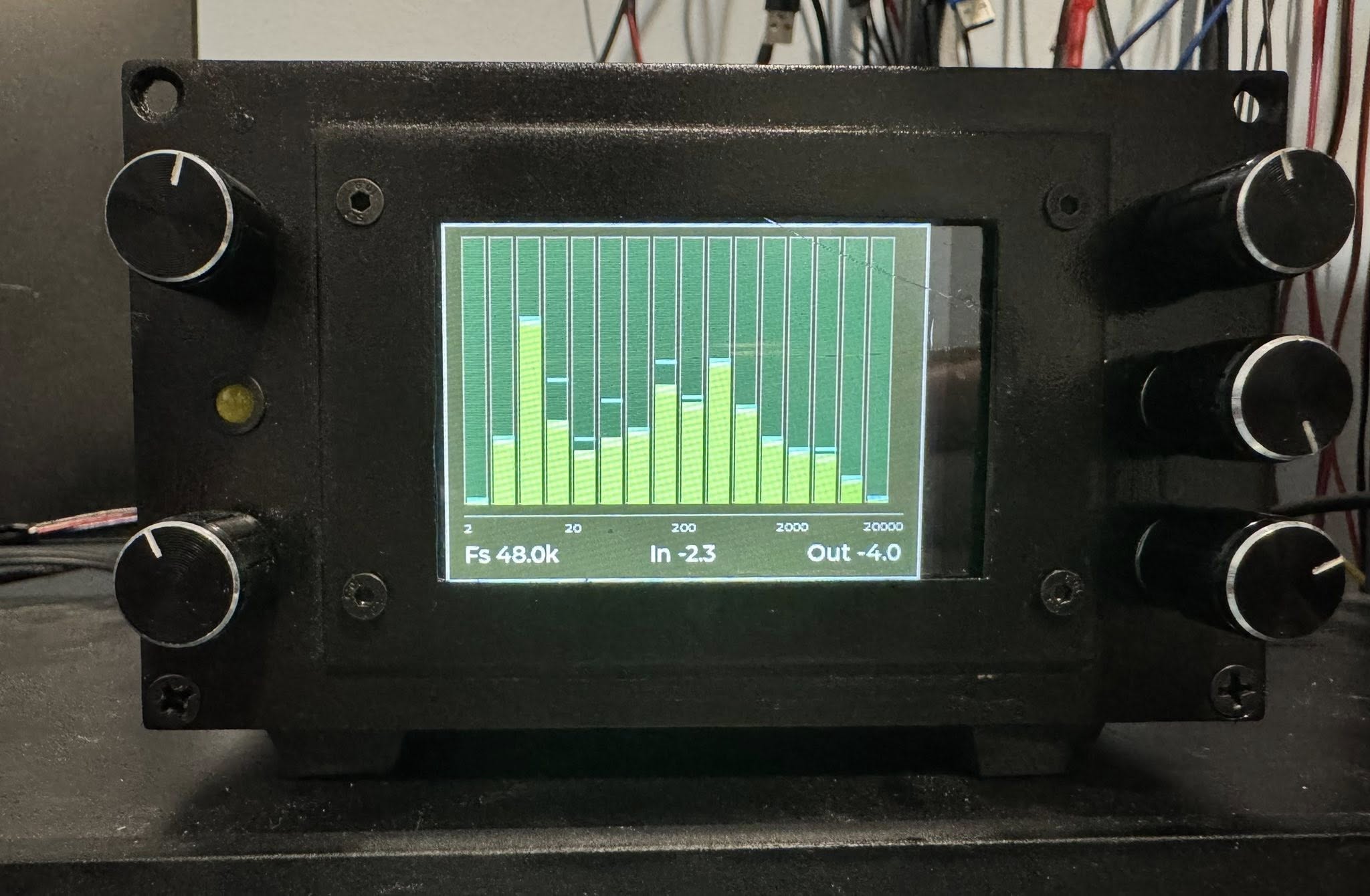

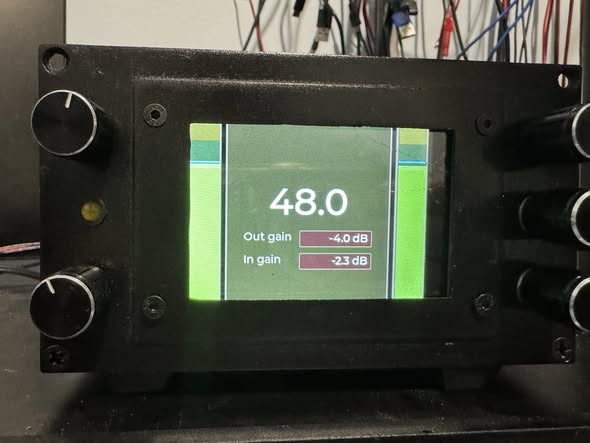
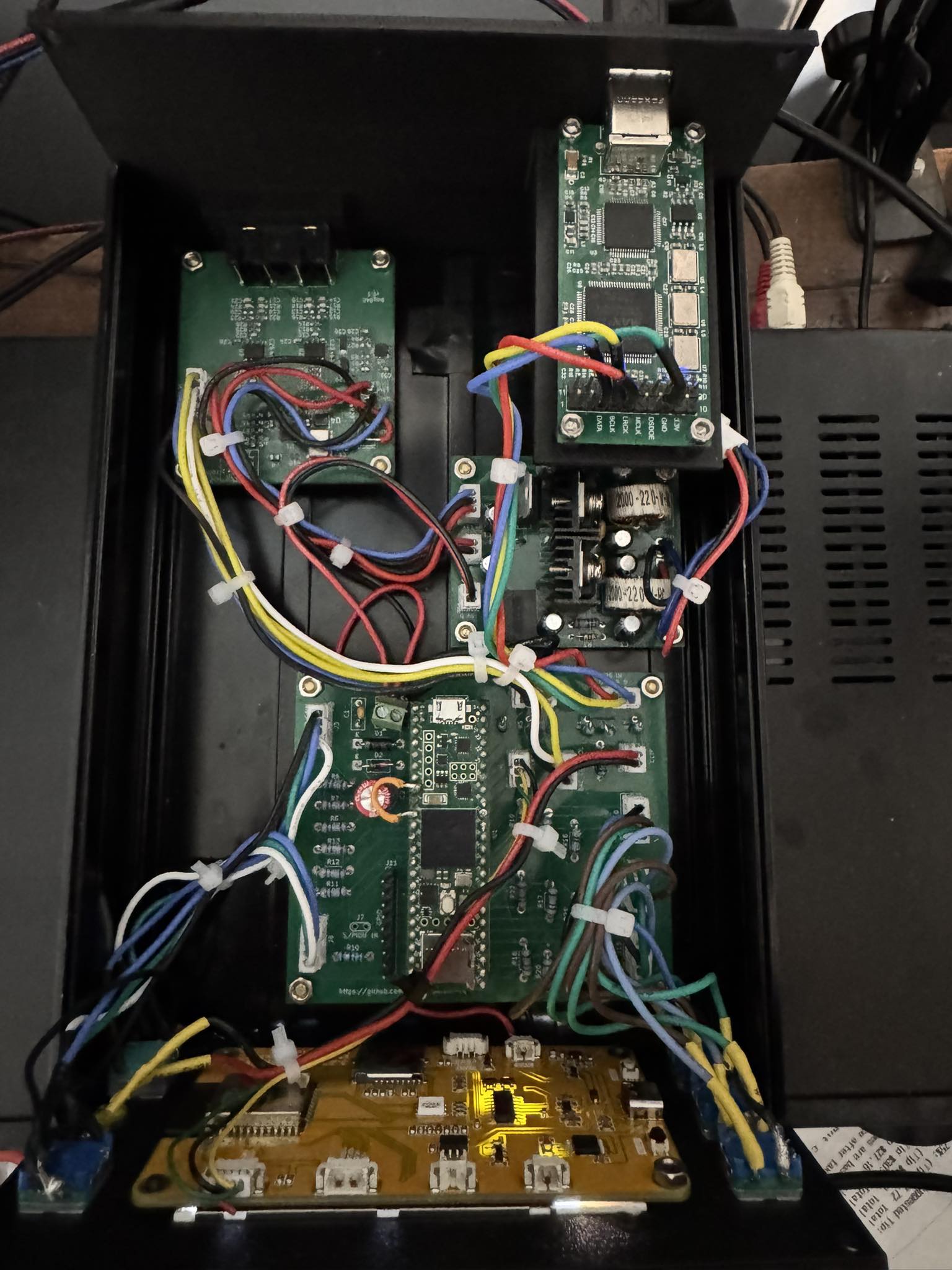
The original goal was simple:
That third point changed everything. Once the DSP core and UI link were stable, it became obvious that the architecture could do far more than EQ alone. The codebase now behaves more like a modular DSP workbench than a single-purpose effect.
The system uses two processors, each doing the job it is best at.
Why Teensy 4.1:
The UI runs on a CYD (Cheap Yellow Display), which is an ESP32-based board with an integrated TFT.
Communication between DSP and UI uses compact register messages over I2C.
The UI currently provides three main modes, each optimized for a different use case.
Purpose: precise tuning and analysis.
Purpose: quick operating view.
Purpose: visualize real-time spectral behavior.
When operating in Simple or Spectrum mode, parameter changes can trigger a framed popup showing key filter settings (band, type, frequency, gain, and Q). The popup auto-hides after inactivity, and can be gated by user-input state so remote/background updates do not constantly interrupt the view.
Long term, the plan is to fold this work into a DAC/DSP/preamplifier build. This repository is the proving ground for that hardware/software stack.
Big thanks to the diyAudio.com community.
Many design choices, implementation refinements, and troubleshooting ideas were inspired by the knowledge shared by diyAudio members. The project benefited directly from their practical guidance, experience, and generosity in public discussion threads.
| Qty | Value | Footprint | References |
|---|---|---|---|
| 15 | 4.7k | Custom:R_Axial_DIN0204_L3.6mm_D1.6mm_P7.62mm_Horizontal_HandSolder | R6, R7, R8, R11, R12, R13, R15, R16, R17, R18, R19, R20, R21, R22, R23 |
| 6 | 100 | Resistor_THT:R_Axial_DIN0204_L3.6mm_D1.6mm_P2.54mm_Vertical | R1, R2, R3, R4, R5, R9 |
| 4 | MountingHole | MountingHole:MountingHole_3.2mm_M3 | H1, H2, H3, H4 |
| 2 | I2S_IN | Connector_JST:JST_PH_B4B-PH-K_1x04_P2.00mm_Vertical | J2, J4 |
| 1 | 100n | Custom:C_Rect_L7.2mm_W3.0mm_P5.00mm_FKS2_FKP2_MKS2_MKP2_HandSolder | C1 |
| 1 | 100u | Capacitor_THT:CP_Radial_D8.0mm_P5.00mm | C2 |
| 1 | 180 | Custom:R_Axial_DIN0204_L3.6mm_D1.6mm_P7.62mm_Horizontal_HandSolder | R14 |
| 1 | 1N5233 | Diode_THT:D_DO-41_SOD81_P10.16mm_Horizontal | D2 |
| 1 | 75 | Custom:R_Axial_DIN0204_L3.6mm_D1.6mm_P7.62mm_Horizontal_HandSolder | R10 |
| 1 | CLIP_LED | Connector_JST:JST_PH_B2B-PH-K_1x02_P2.00mm_Vertical | J9 |
| 1 | DAC_CONTROL | Connector_JST:JST_PH_B3B-PH-K_1x03_P2.00mm_Vertical | J6 |
| 1 | DISPLAY | Connector_JST:JST_PH_B3B-PH-K_1x03_P2.00mm_Vertical | J5 |
| 1 | FC | Connector_JST:JST_PH_B4B-PH-K_1x04_P2.00mm_Vertical | J13 |
| 1 | GAIN | Connector_JST:JST_PH_B4B-PH-K_1x04_P2.00mm_Vertical | J12 |
| 1 | GPIO | Connector_PinHeader_2.54mm:PinHeader_1x09_P2.54mm_Vertical | J11 |
| 1 | MGAIN | Connector_JST:JST_PH_B4B-PH-K_1x04_P2.00mm_Vertical | J3 |
| 1 | POWER | TerminalBlock_4Ucon:TerminalBlock_4Ucon_1x02_P3.50mm_Horizontal | J1 |
| 1 | Q | Connector_JST:JST_PH_B4B-PH-K_1x04_P2.00mm_Vertical | J10 |
| 1 | S/PDIF | TestPoint:TestPoint_2Pads_Pitch2.54mm_Drill0.8mm | J7 |
| 1 | SB140 | Diode_THT:D_DO-41_SOD81_P10.16mm_Horizontal | D1 |
| 1 | SPARE | Connector_JST:JST_PH_B4B-PH-K_1x04_P2.00mm_Vertical | J8 |
| 1 | Teensy4.1 | Custom:Teensy41 | U1 |
It measures 88.5 × 74.5 mm and has 2 copper layers, 1.6 mm thick.
45 parts, built around the TEENSY 4.1 and SB140. The full list of its parts is on this page, with links to each part's symbol and footprint where PCBKit's library has them.
From the prydin/param-eq repository on GitHub, at the commit this page was made from: the board is kicad/param-eq/param-eq.kicad_pcb and its schematic kicad/dac/dac.kicad_sch. PCBKit opens the board in the browser, with nothing to install.
Its repository states no licence, so its author keeps all rights: ask prydin before reusing the design.


jkuituni/Raven68k
A repository for all the hardware and software development related files for a 68000 based single board computer

etherkit/PartyLine80
A cheap and cheerful 80 meter QRP CW radio made from all discrete components


el-puerro/eater-deluxe
6502-based homebrew computer based on eater.net/6502

Kevin-CE21/PCB-Hotplate01
This project is a custom designed PCB hotplate for reflow soldering, built around an Arduino Nano. The board reads real time temperature through an analog LMT85 sensor and displays live readings on an I2C OLED screen…