2 layers156.5 × 67.5 mm
NixieScanDisplay
profdc9/NixieClock
A Nixie clock that uses IN-14 tubes and very generic components that can be easily sourced.
106 parts10
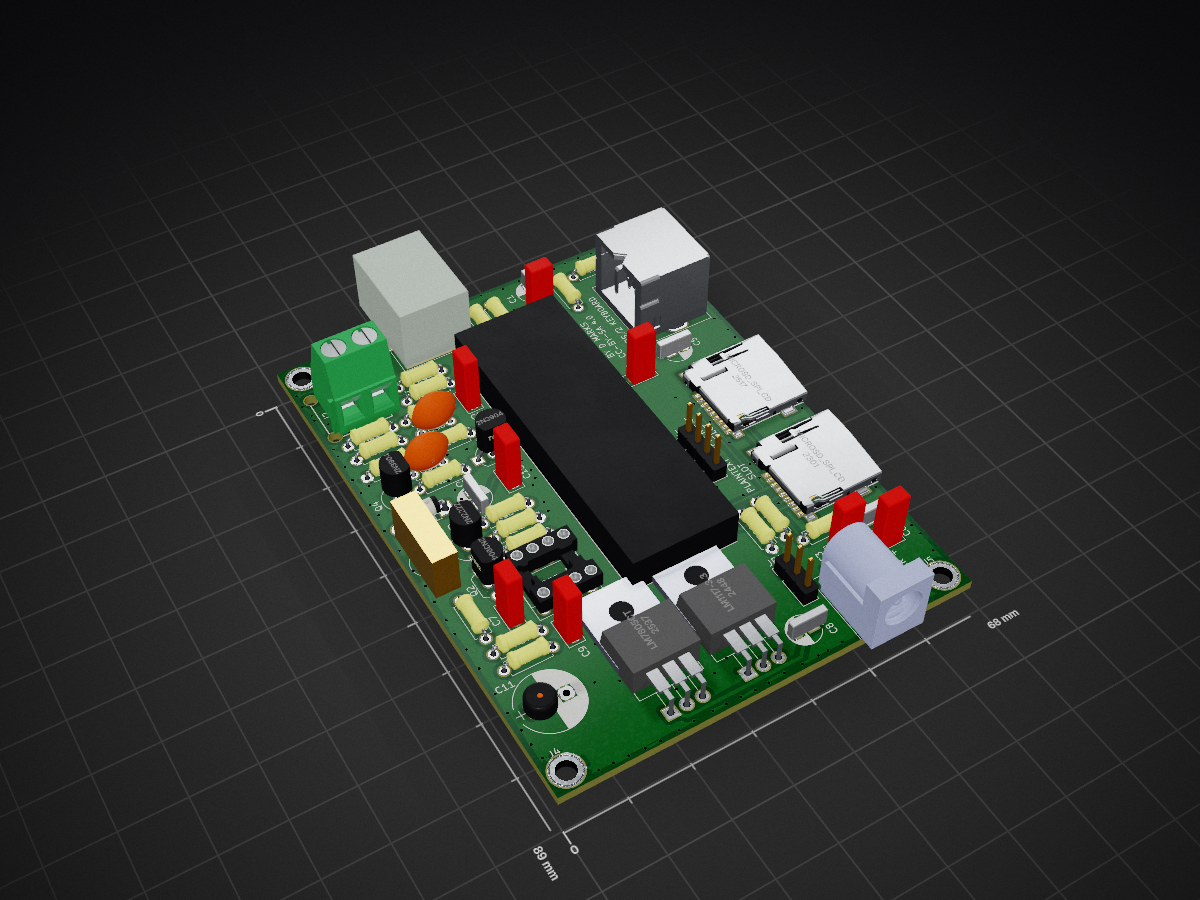
 profdc9/ParanoiaBox17
A standalone elliptic curve/AES file encryption and decryption device
ParanoiaBox is an open-source printed circuit board by profdc9, from the profdc9/ParanoiaBox repository on GitHub. It is a 2-layer board of 68 × 89 mm with 60 parts on 62 nets, routed with 830 tracks and 189 vias.
It is built around the LM1117-3.3, LM7805CT and NE555, with the UF4007 among its other parts. Its parts include 22 resistors, 16 capacitors, 9 connectors, 5 ICs and 4 transistors.


The ParanoiaBox by Daniel L. Marks
The ParanoiaBox is a standalone open hardware/software encryption device based on the STM32F103CBT6 processor. On this device, messages may be composed, encrypted, decrypted, and viewed. The device is an experiment in encryption minimalism, presenting a minimal attack surface by using a small microcontroller rather than a full personal computer with a complex operating system, while providing the functionality needed to transact encrypted messages between humans through insecure networks. The device is connected to a NTSC television and a PS/2 keyboard for user input and control. There are two micro SD card slots, one for ciphertext and the other for plaintext used to transact files. There is a hardware random number generator based on avalanche noise generated in two transistors. A picture of the complete PCB of the device can be seen below:
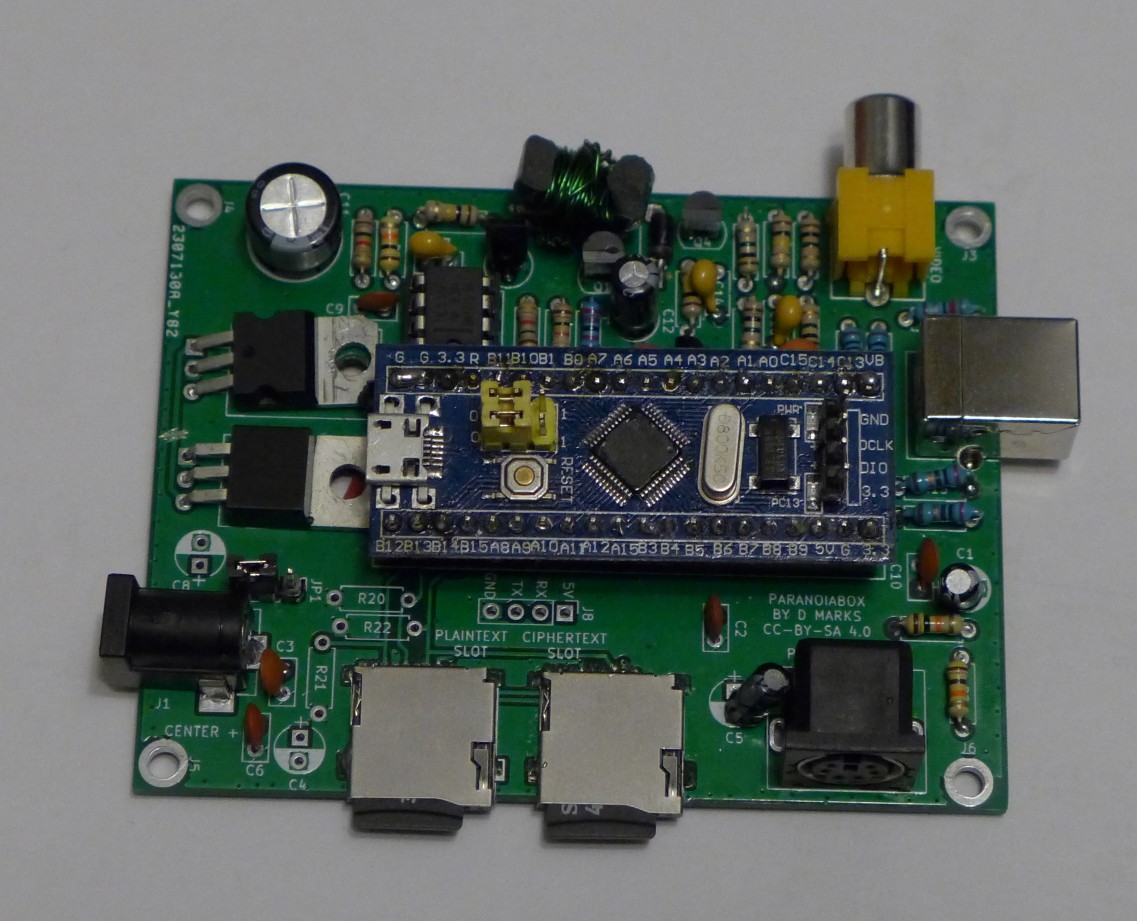
At the top of the board is a RCA composite video connector. At the right is a USB B connector that can be used to program the microcontroller. At the lower right is a female PS/2 keyboard connector. At the bottom are two SD card slots. Finally, at the left is a barrel jack for 7 to 12 volt DC input power. Except for the micro SD card slots, the PCB is all through assembly so it can be assembled more easily using simple tools.
The hardware is licensed under the Creative Commons CC-BY-SA 4.0 license. The software written by D. L. Marks is licensed under the zlib license. All other libraries are licensed under the licenses as described in the corresponding source files. This hardware and software is provided under these licenses to be used at your own risk.
THE HARDWARE AND SOFTWARE IS PROVIDED "AS IS", WITHOUT WARRANTY OF ANY KIND, EXPRESS OR IMPLIED, INCLUDING BUT NOT LIMITED TO THE WARRANTIES OF MERCHANTABILITY, FITNESS FOR A PARTICULAR PURPOSE AND NONINFRINGEMENT. IN NO EVENT SHALL THE AUTHORS OR COPYRIGHT HOLDERS BE LIABLE FOR ANY CLAIM, DAMAGES OR OTHER LIABILITY, WHETHER IN AN ACTION OF CONTRACT, TORT OR OTHERWISE, ARISING FROM, OUT OF OR IN CONNECTION WITH THE HARDWARE AND SOFTWARE OR THE USE OR OTHER DEALINGS IN THE HARDWARE AND SOFTWARE.
The project uses Advanced Encryption Standard AES256-GCM Galois Counter Mode as an authenticated symmetric encryption. The keys are derived from shared secrets based on then Elliptic Curve Diffie-Hellmann (ECDH) 25519. The keys are encrypted using a passphrase and AES256-GCM and stored in the flash memory of the microcontroller. The encrypted data and public key certificates are base64 encoded so that they can be transmitted through e-mail as text files. The library used is the Arduino Cryptography Library by Rhys Weatherley:
https://rweather.github.io/arduinolibs/crypto.html
The project uses the stm32duino libraries located here:
https://github.com/rogerclarkmelbourne/Arduino_STM32
All other Arduino libraries are provided in the libraries directory in this project, including those that provide the FAT fs, NTSC video output, PS/2 keyboard input, and cryptography. To enter a message into the microcontroller, there is a full-screen text editor:
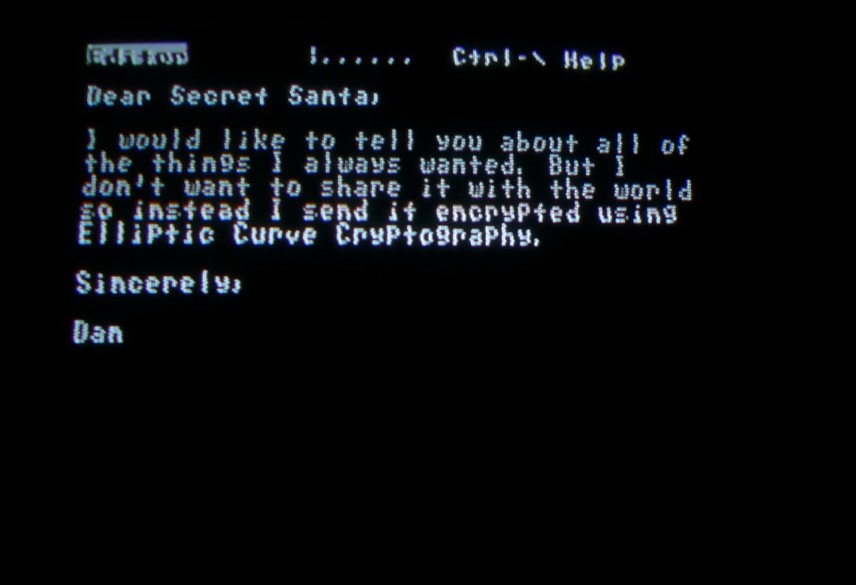
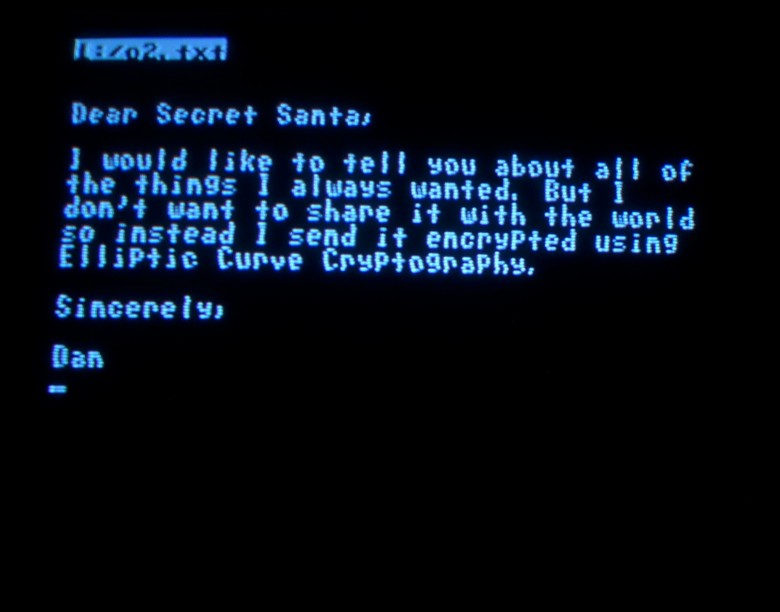
There is a the built-in full-screen editor used to compose short messages. Files may be selected from the SD cards for editing, encryption, or decryption:
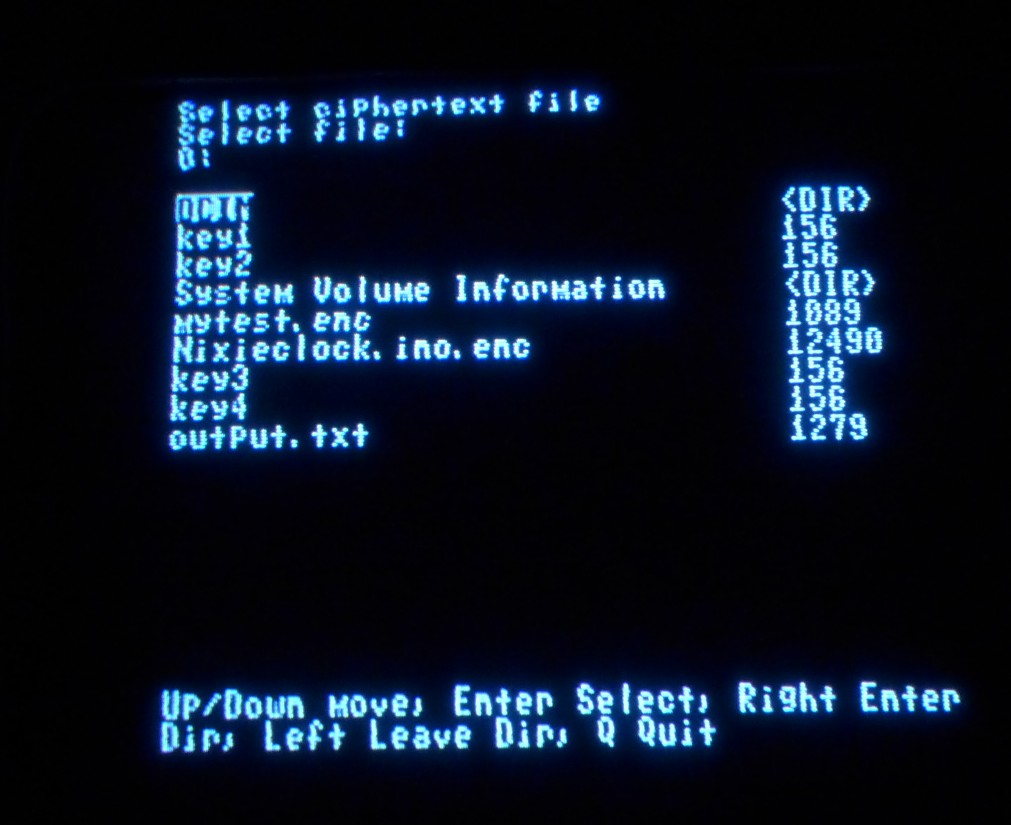
This is the key manager screen from which the AES 256 symmetric, ECDH25519 private or public keys are selected:
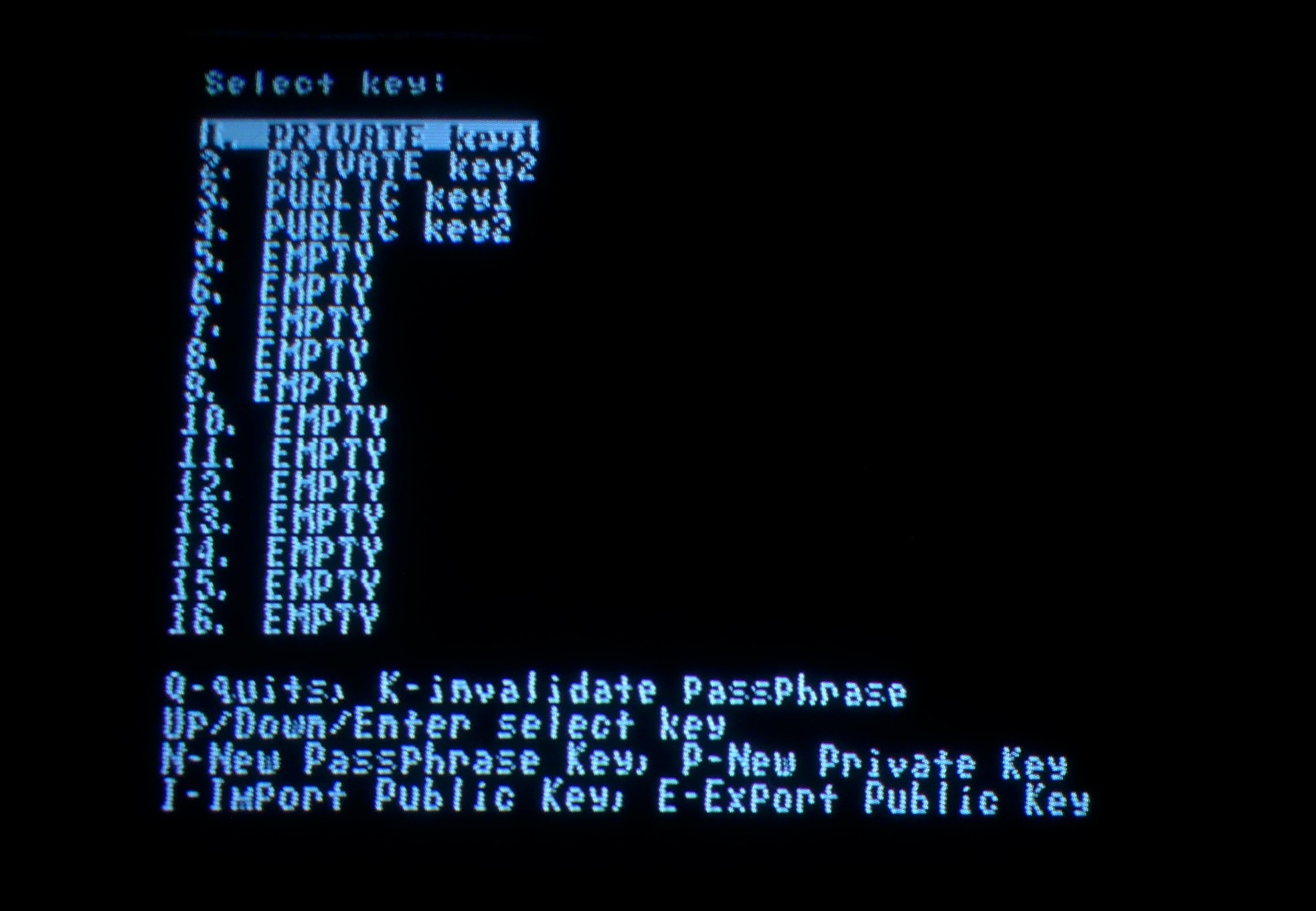
To encrypt/decrypt using AES, a AES key is selected. To encrypt/decrypt using ECDH25519, a private and public key pair are selected. Then one selects a file to encrypt or decrypt. Separate SD cards must be used for encryption and decryption to ensure that both are not available together to be compared. One can export a public key certificate from a private key. After selection, the main screen shows the selected keys:
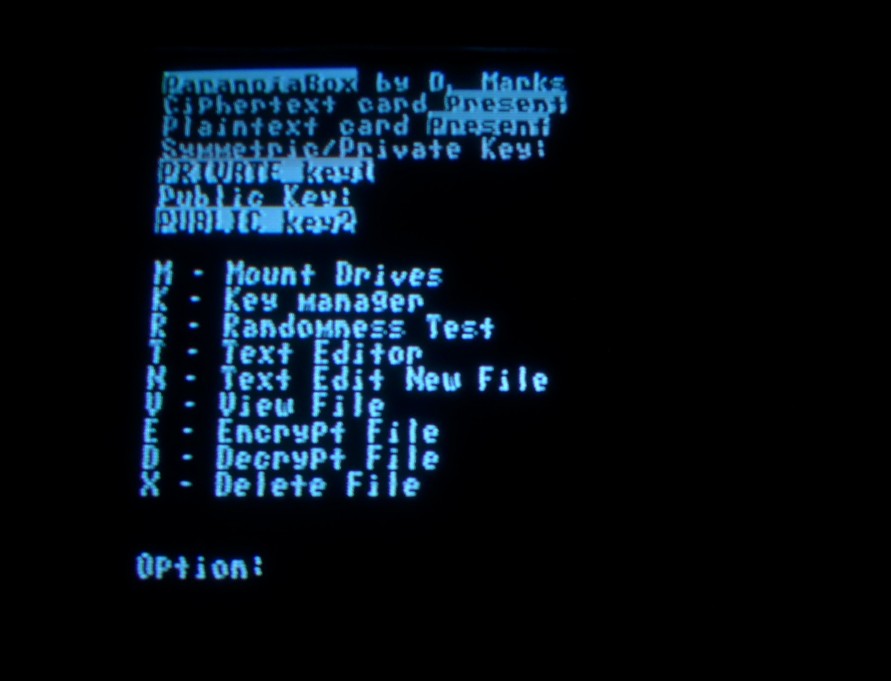
The message is then encrypted by selecting the file from the card in the plaintext slot using the (E)ncrypt option. Then the encrypted file is placed on the card in the ciphertext slot. You can view this file which is text encoded to be easily transmitted over email:
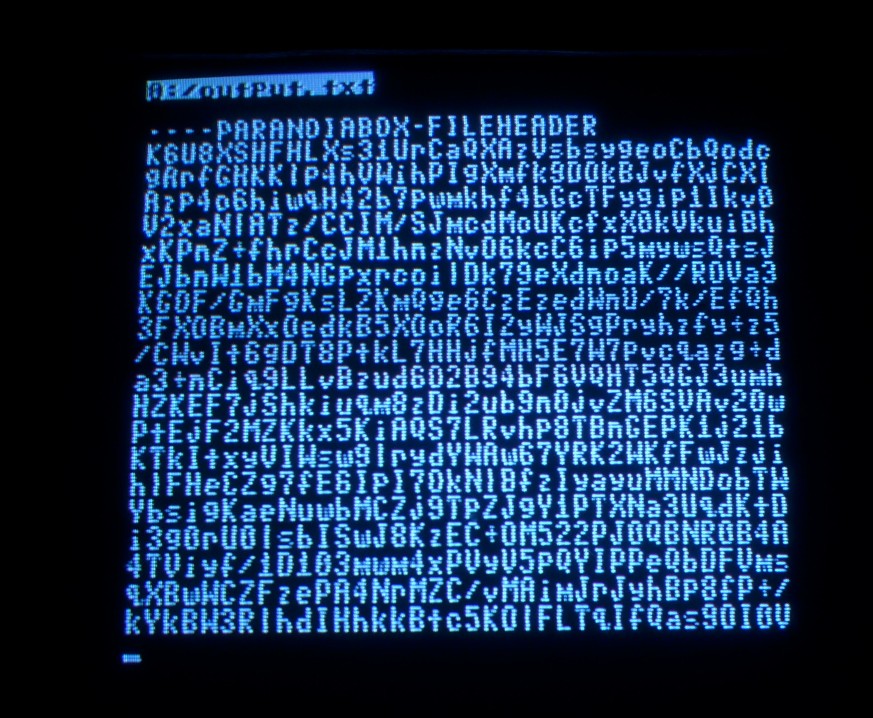
Once it has been received, it can be decrypted and viewed, and it looks like the original:
| Qty | Value | Footprint | References |
|---|---|---|---|
| 7 | 100 nF | Capacitors_THT:C_Disc_D5.0mm_W2.5mm_P2.50mm | C2, C3, C6, C9, C10, C13, C15 |
| 5 | 10 uF | Capacitors_THT:CP_Radial_D5.0mm_P2.50mm | C1, C4, C5, C8, C12 |
| 4 | 1M | Resistors_THT:R_Axial_DIN0207_L6.3mm_D2.5mm_P7.62mm_Horizontal | R10, R11, R17, R18 |
| 4 | Conn_01x01 | Connectors:1pin | J3, J4, J5, J6 |
| 3 | 100k | Resistors_THT:R_Axial_DIN0207_L6.3mm_D2.5mm_P7.62mm_Horizontal | R8, R12, R19 |
| 3 | 1k | Resistors_THT:R_Axial_DIN0207_L6.3mm_D2.5mm_P7.62mm_Horizontal | R4, R5, R14 |
| 3 | 220R | Resistors_THT:R_Axial_DIN0207_L6.3mm_D2.5mm_P7.62mm_Horizontal | R20, R21, R22 |
| 3 | 2N3904 | TO_SOT_Packages_THT:TO-92_Inline_Wide | Q2, Q3, Q4 |
| 2 | 1 uF | Capacitors_THT:C_Disc_D5.0mm_W2.5mm_P5.00mm | C14, C18 |
| 2 | 22R | Resistors_THT:R_Axial_DIN0207_L6.3mm_D2.5mm_P7.62mm_Horizontal | R15, R16 |
| 2 | 4k7 | Resistors_THT:R_Axial_DIN0207_L6.3mm_D2.5mm_P7.62mm_Horizontal | R1, R2 |
| 2 | MicroSD_SPI_CD | ParanoiaBox:GCT-MEM2055-00-190-01-A | U1, U2 |
| 1 | 100 pF | Capacitors_THT:C_Disc_D5.0mm_W2.5mm_P2.50mm | C7 |
| 1 | 100 uF | Capacitors_THT:CP_Radial_D10.0mm_P5.00mm | C11 |
| 1 | 100 uH | Inductors_THT:L_Toroid_Horizontal_D5.1mm_P9.00mm_Diameter6-5mm_Amidon-T20 | L1 |
| 1 | 10k | Resistors_THT:R_Axial_DIN0207_L6.3mm_D2.5mm_P7.62mm_Horizontal | R3 |
| 1 | 22k | Resistors_THT:R_Axial_DIN0207_L6.3mm_D2.5mm_P7.62mm_Horizontal | R13 |
| 1 | 240R | Resistors_THT:R_Axial_DIN0207_L6.3mm_D2.5mm_P7.62mm_Horizontal | R7 |
| 1 | 2N2222 | TO_SOT_Packages_THT:TO-92_Inline_Wide | Q1 |
| 1 | 560R | Resistors_THT:R_Axial_DIN0207_L6.3mm_D2.5mm_P7.62mm_Horizontal | R6 |
| 1 | 82R | Resistors_THT:R_Axial_DIN0207_L6.3mm_D2.5mm_P7.62mm_Horizontal | R9 |
| 1 | BLUEPILL | ParanoiaBox:BLUEPILL | UB1 |
| 1 | Barrel_Jack | Connectors:BARREL_JACK | J1 |
| 1 | Conn_01x04 | Pin_Headers:Pin_Header_Straight_1x04_Pitch2.54mm | J8 |
| 1 | Jumper_NC_Dual | Pin_Headers:Pin_Header_Straight_1x03_Pitch2.54mm | JP1 |
| 1 | LM1117-3.3 | TO_SOT_Packages_THT:TO-220-3_Horizontal | U5 |
| 1 | LM7805CT | TO_SOT_Packages_THT:TO-220-3_Horizontal | U4 |
| 1 | Mini-DIN_6pins_ver4 | ParanoiaBox:Connector_Mini-DIN_Female_6Pin_2rows | P1 |
| 1 | NE555 | Housings_DIP:DIP-8_W7.62mm_Socket | U3 |
| 1 | RCAJack | ParanoiaBox:RCAConnectorCommon | J2 |
| 1 | UF4007 | Diodes_THT:D_DO-41_SOD81_P7.62mm_Horizontal | D1 |
| 1 | USB_B | Connectors:USB_B | J7 |
profdc9/NixieClock
A Nixie clock that uses IN-14 tubes and very generic components that can be easily sourced.

telagod/moskill
MosKill - Smart Mosquito Swatter with BLE, Kill Counting & Statistics | ESP32-C3 + KiCad PCB + UniApp


baranovskiykonstantin/aquarium
Control the lighting and the heating of the aquarium.

JeyRunner/actonator
3D printable robot actuator with belt-driven gearbox and custom FOC driver board.

AmericanRework/Pico-2x-BLDC
One RP2040 Pico drives two brushless motors! SimpleFOC + Halls + 2304 drivers + TO-220 mosfets or IGBTs. Plugs directly into 450x automower motors.

cpipero/solarinverter
Kicad Project to build a programmable Solar Inverter

It measures 68 × 89 mm and has 2 copper layers, 1.6 mm thick.
60 parts, built around the LM1117-3.3, LM7805CT, NE555 and UF4007. The full list of its parts is on this page, with links to each part's symbol and footprint where PCBKit's library has them.
From the profdc9/ParanoiaBox repository on GitHub, at the commit this page was made from: the board is board/ParanoiaBox.kicad_pcb. PCBKit opens the board in the browser, with nothing to install.
Its repository states no licence, so its author keeps all rights: ask profdc9 before reusing the design.