2 layers61 × 58 mm
Glassify
poganyg/Glassify
Colour-based glass recycling sorting. University project for real-time embedded programming.
16 parts1GPL-3.0

 poganyg/Glassify1
Colour-based glass recycling sorting. University project for real-time embedded programming.
LED circuit withPlanes is an open-source printed circuit board by poganyg, from the poganyg/Glassify repository on GitHub, published under the GPL-3.0 licence. It is a 2-layer board of 39.5 × 43 mm with 18 parts on 3 nets, routed with 18 tracks and 3 vias.
Its parts include 8 diodes and 1 resistor.

We are bringing you a colour-based glass recycling sorter which can separate, in real-time, green, amber and clear bottles! This is a university project for the subject real-time embedded programming. Watch our short introduction to why and how we are building this project:
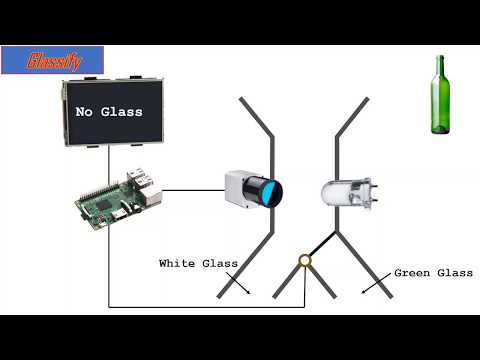
Glass is 100% recyclable and by doing so we can substantially reduce raw materials needed, the waste produced as well as water and air pollution.1 However, contamination is a major factor in the effectiveness of recycling.2 This can be due to non-glass materials disposed alongside with the bottles, such as bottle caps, but also by mixing differently coloured glasses. Colours are achieved by adding impurities, such as sulfur, copper or iron to the glasses. Their purpose is to protect the contents from environmental effects. Even one colour misplaced in the wrong bin can deteriorate the quality of the recycled glass. 3 This project aims to achieve a more effective glass recycling to preserve our natural resources and protect our environment.
We are presenting here a device which can be installed to recycling points to assisst with the user-side recycling process. Once installed, a single input can be used for the glass recycling bin and the internal sorting would ensure that colour contamination doesn't occur. The device uses a Raspberry Pi microcontroller and is built using 3D printing which means that the overall production cost can be kept under £100.
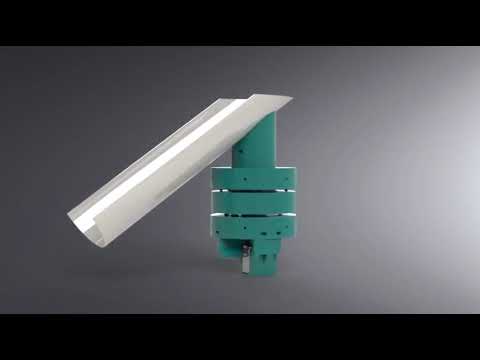
To see updates follow us on Facebook, YouTube and Instagram.
If you would like to recreate this project, head over to our Wiki page where you will find a detailed building guide including a list of all the components you will need for building it. In terms of software requirements, you will need to install:
Do make sure to only have these installed once on your Raspberry Pi.
To build our software run the following code in your terminal:
git clone https://github.com/poganyg/Glassify.git
cd Glassify
mkdir build
cd build
cmake ..
make
The project is under the GNU General Public License v3.0.
| Qty | Value | Footprint | References |
|---|---|---|---|
| 8 | 3.2V | LED_SMD:LED_PLCC-2 | LED1, LED2, LED3, LED4, LW-TTSD_SMD_LED5, LW-TTSD_SMD_LED6, LW-TTSD_SMD_LED7, LW-TTSD_SMD_LED8 |
| 8 | MountingHole | MountingHole:MountingHole_2.5mm_Pad | H1, H2, H3, H4, H5, H6, H7, H8 |
| 1 | 16 | Resistor_THT:R_Axial_DIN0207_L6.3mm_D2.5mm_P10.16mm_Horizontal | R1 |
| 1 | 2mm pitch | Connector_Molex:Molex_KK-254_AE-6410-02A_1x02_P2.54mm_Vertical |
poganyg/Glassify
Colour-based glass recycling sorting. University project for real-time embedded programming.


VoronDesign/Voron-Hardware
Cool Hardware designed by the Voron Design group


hackclub/OnBoard
💡 Join 1,000 teenagers and make your first PCB with a $100 grant!

VoronDesign/Voron-Tap
Tap is a nozzle-based z-probe for the V2 and Trident printer designs. The entire toolhead moves to trigger an optical switch. Tap offers many advantages:

Luos-io/luos_engine
Open-source and real-time orchestrator for cyber-physical-systems, to easily design, test and deploy embedded applications and digital twins.


Twotoz/C5VRX
Ultra-minimal, zero-CPU 5.8 GHz analog FPV video receiver using ESP32-C5 Wi-Fi 6 PHY MODEM_DIAG, BitScrambler WBFM demodulation & resistor DAC CVBS
It measures 39.5 × 43 mm and has 2 copper layers, 1.6 mm thick.
18 parts. The full list of its parts is on this page, with links to each part's symbol and footprint where PCBKit's library has them.
From the poganyg/Glassify repository on GitHub, at the commit this page was made from: the board is hardware/PCB/LED_circuit/LED_circuit_withPlanes.kicad_pcb. PCBKit opens the board in the browser, with nothing to install.
Its repository publishes it under the GPL-3.0 licence: you may reuse it on that licence's terms (keep the author's notice, and for a copyleft licence share your changes alike).