

4 layers174 × 104 mm

 pirtoo/turning-feather
Turning controller based on an Adafruit Feather Huzzah32 or Feather ESP32 V2
Turning feather is an open-source printed circuit board by pirtoo, from the pirtoo/turning-feather repository on GitHub, published under the BSD-3-Clause licence. It is a 2-layer board of 64.8 × 72.4 mm with 24 parts on 48 nets, routed with 255 tracks and 7 vias.
It is built around the MIC4427ZM. Its parts include 5 resistors, 5 diodes, 5 connectors, 4 ICs and 3 capacitors. It belongs with the microcontroller boards boards of this library.
More flexible than an Auto Duel controller (and indelfa seem to have vanished), programs defined in JSON in a text file on a micro SD card. Can have a backup config file flashed to SPI accessed via LittleFS.
Current maximums of approx 55 programs and up to 12 stages per program (limited by memory in the controller) but will increase with development and it will be easier to swap between sets of programs.
Configs can be checked for JSON validity here or on any JSON website with a checker.
Touch screen to select program/stage.
RF remote control via RF Solutions ZPT module, compatable with their 4 button Fobber or longer range Trap remote.
Remote buttons give:
You can set a program and walk down range without needing to return to the unit to run, stop or change stages. The buzzer chirps briefly by default when changing stage from the RF remote so if you are unsure which stage you are in you can go to the first or last stage (when it cannot go further so will not chirp) to establish what stage is set.
ZPT module can be programmed to respond to several different remotes. See the ZPT datasheet for programming instructions. I keep the learning button internal to the unit so it can't be accidentally activated.
Display is a Featherwing 2.4" TFT or Featherwing 2.4" TFT V2.
Optional WiFi control, with no configuration and with WiFi enabled the controller will create a WiFi network called TurningFeather. Connecting to that network with no password and connecting to http://192.168.4.1/ will get you to the control page. http://192.168.4.1/wifisetup.html will allow you to change setup of network names and joining an existing WiFi network. The MAC address for the controller is displayed on the setup page and also over serial console while booting for setting ststic
IP addresses on your router or IP can be set on the device (not recommended). Pages like wifisetup.html can be protected by an admin password (default username is admin) but this is all sent over unencrypted HTTP so is not high security, just to keep prying fingers out.
Control/power connector is RJ45; takes ground, +12V power and two signal lines for face and away activation at 12V. As used here. The control and power connections are exposed to another optional board connector if you do not want to use a PCB mounted RJ45.
Software build and flash managed by PlatformIO for different versions of ESP32 and display boards.
Custom PCB made for the main IO board manufactured by PCBWay. See schematic.
Graphics are currently fairly simple but functional.
Two physical buttons for face/away and start/stop. Program selection via the touchscreen. Start/stop, face/away and stage +/- via RF remote.
If USE_ZPT_SERIAL is enabled the controller detects when it receives a packet from a remote that is not paired with the comntroller and displays a ? character in the top right hand corner of the display. Similarly if the battery in the transmitter is low then it will display a ! character. These characters clear the next time the controller receives a packet from a paired receiver that does not have a low battery.
With an ESP32 V2 there is a Neopixel LED on the board, if enabled by default this will light up white during initial setup and Red/Green/Blue for beep/face/away during stages. It points backwards but if using the case with a mostly clear front it should be visible to see what part of a stage the unit is in and if it has finished from further away. This can be enabled/disabled with the ESP_V2_NEOPIXEL macro and the overall brightness set with ESP_V2_NEOPIXEL_BRIGHTNESS
Spare 5v output for light flash or other features.
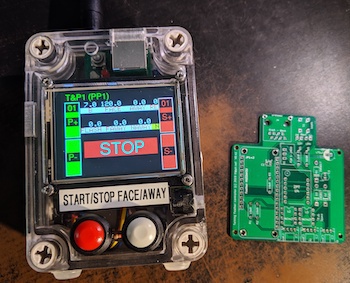
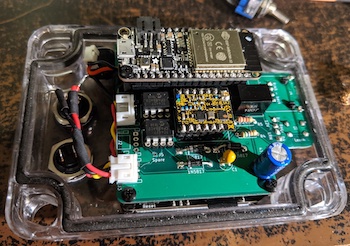
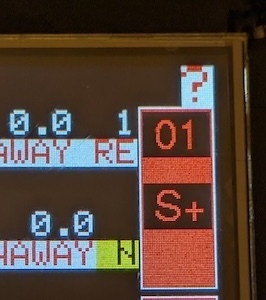
Turning Feather is still very much in alpha and under development however it has been in use at one club for over 6 years.
Config GUI to change system settings.
Signal strength meter for the RFSolutions system.
Add a stage name/comment to describe what each stage is for.
The Feather HUZZAH32 microcontroller includes wifi, this will be used for setup, programming and control.
Ability to change which config file is in use.
Updates planned here to provide parts lists, links, etc, to allow others to build their own units.
Provide a full definition of the config file and what all the options do.
Add the ability to use cheaper 433MHz radio transmitters (there are some nice 4/6 button units available) as an option but getting reliable detection of events with debouncing is hard to do well, unlike with the RF Solutions units.
Support for the V2 versions of Adafruit Feather/Featherwing products used.
Other TODOs in the code are noted in the main ino file.
No plans to sell pre-made units in any volume but I may have one spare to sell that has not been installed in a case.
Feature request also invited.
| Qty | Value | Footprint | References |
|---|---|---|---|
| 3 | 10kR | Resistor_THT:R_Axial_DIN0207_L6.3mm_D2.5mm_P7.62mm_Horizontal | R1, R2, R3 |
| 3 | 1N5817 | Diode_THT:D_DO-41_SOD81_P10.16mm_Horizontal | D1, D2, D3 |
| 2 | MIC4427 | Package_DIP:DIP-8_W7.62mm | U2, U3 |
| 1 | 0.1uF | Capacitor_THT:C_Disc_D3.0mm_W2.0mm_P2.50mm | C2 |
| 1 | 12V | LED_THT:LED_D3.0mm_Clear | D5 |
| 1 | 2.2KR | Resistor_THT:R_Axial_DIN0207_L6.3mm_D2.5mm_P7.62mm_Horizontal | R5 |
| 1 | 22uF | Capacitor_THT:CP_Radial_Tantal_D4.5mm_P2.50mm | C1 |
| 1 | 470uF | Capacitor_THT:CP_Radial_D6.3mm_P2.50mm | C3 |
| 1 | 560R | Resistor_THT:R_Axial_DIN0207_L6.3mm_D2.5mm_P7.62mm_Horizontal | R4 |
| 1 | Buttons/beep | Connector_JST:JST_PH_S3B-PH-K_1x03_P2.00mm_Horizontal | J3 |
| 1 | Feather HUZZAH32 | turning-feather:ADAFRUIT_FEATHER | JP1+2 |
| 1 | LRN | LED_THT:LED_D3.0mm_Clear | D4 |
| 1 | Learn | Button_Switch_THT:SW_PUSH_6mm_H5mm | S1 |
| 1 | Out to RJ45 | Connector_JST:JST_PH_S4B-PH-K_1x04_P2.00mm_Horizontal | J2 |
| 1 | Out to power switch | Connector_JST:JST_PH_S4B-PH-K_1x04_P2.00mm_Horizontal | J1 |
| 1 | RJ45_Shielded | turning-feather:RJ45_Horizontal_Shielded | J4 |
| 1 | Spare | Connector_PinHeader_1.00mm:PinHeader_1x01_P1.00mm_Vertical | J5 |
| 1 | TSR 1-2450 | turning-feather:Converter_DCDC_TRACO_TSR-1_THT | U1 |
| 1 | ZPT | turning-feather:ZPT8RD | U4 |
It measures 64.8 × 72.4 mm and has 2 copper layers, 1.6 mm thick.
24 parts, built around the MIC4427ZM. The full list of its parts is on this page, with links to each part's symbol and footprint where PCBKit's library has them.
From the pirtoo/turning-feather repository on GitHub, at the commit this page was made from: the board is PCBs/kicad/turning-feather/turning-feather.kicad_pcb. PCBKit opens the board in the browser, with nothing to install.
Its repository publishes it under the BSD-3-Clause licence: you may reuse it on that licence's terms (keep the author's notice, and for a copyleft licence share your changes alike).

rusefi/hw_microRusEfi
microRusEfi board for rusEfi ECU


ararobo/GN10RemoteEmergencyStop
PowerCutoffBoard and RemoteSwitchBoard created by Gento Aiba.