4 layers33.2 × 33.2 mm
Pendant
picafe/pendant
A pendant built from two PCBs: a 8×8 bicolor LED matrix module (red, orange, green) and controller board with battery charging, USB-C power, 5 V boost, and motion sensing.
46 parts

 picafe/pendant
A pendant built from two PCBs: a 8×8 bicolor LED matrix module (red, orange, green) and controller board with battery charging, USB-C power, 5 V boost, and motion sensing.
Matrix is an open-source printed circuit board by picafe, from the picafe/pendant repository on GitHub. It is a 4-layer board of 33.2 × 33.2 mm with 12 parts on 32 nets, routed with 147 tracks and 15 vias.
It is built around the HT16K33A-28SSOP and 1N4148WS. Its parts include 3 resistors, 2 diodes, 2 connectors, 1 capacitor and 1 IC. It belongs with the lEDs and displays boards of this library.


A pendant built from two PCBs: a 8×8 bicolor LED matrix module (red, orange, green) and controller board with battery charging, USB-C power, 5 V boost, and motion sensing.
I had already been working on a 32×8 bicolor matrix module and wanted to try the Pendant YSWS before the deadline. An example on the pendant website inspired me to make a bicolor version with an orange fire-style pattern. Fitting the full matrix and controller on one 2/4 layer board was not the most possible, so my design splits into a display PCB and a pendant controller, which are connected with 2.54mm pitch pin headers (likely just male machine pin headers soldered on both sides, since they have a larger spacing to accomodate for the inductor). There is also an accelerometer to have potential particle motion simulation.
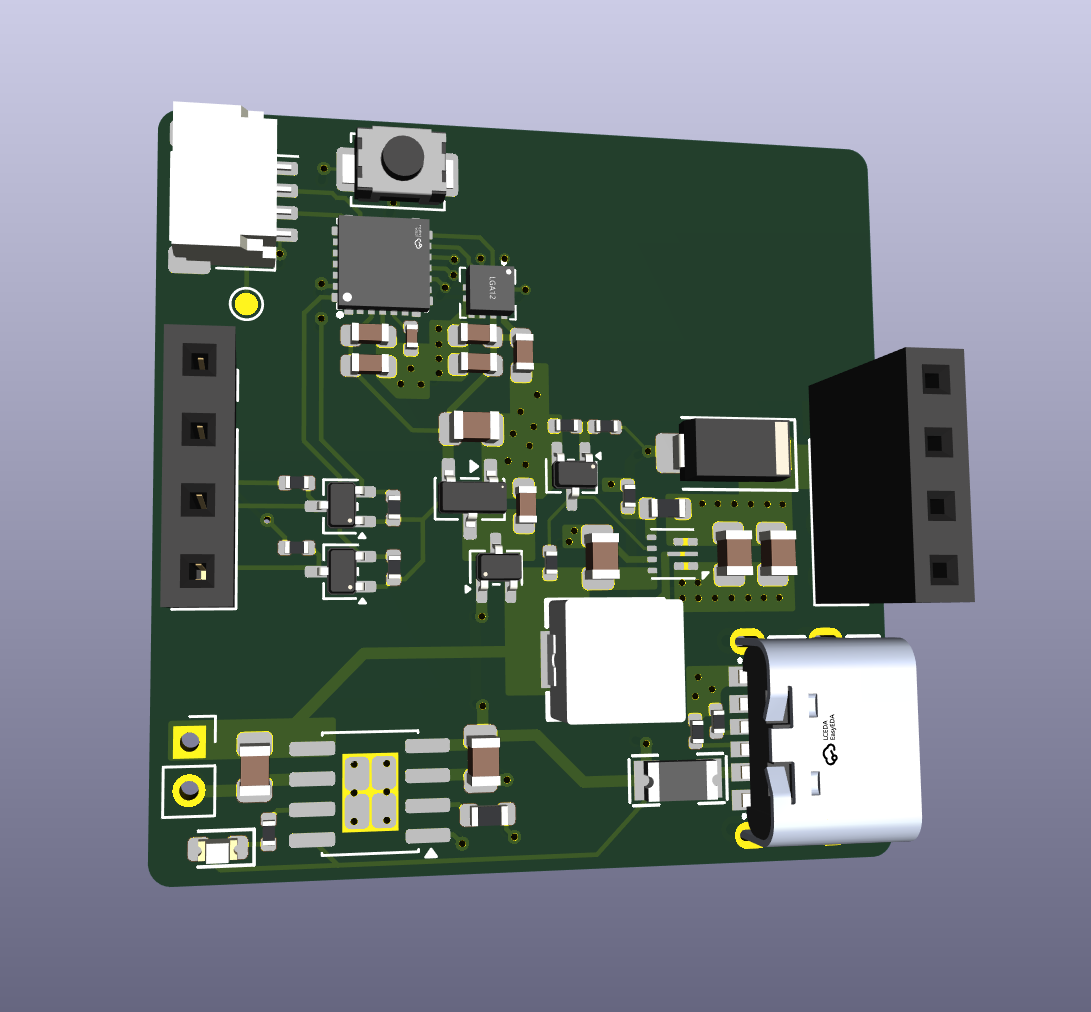
Controller
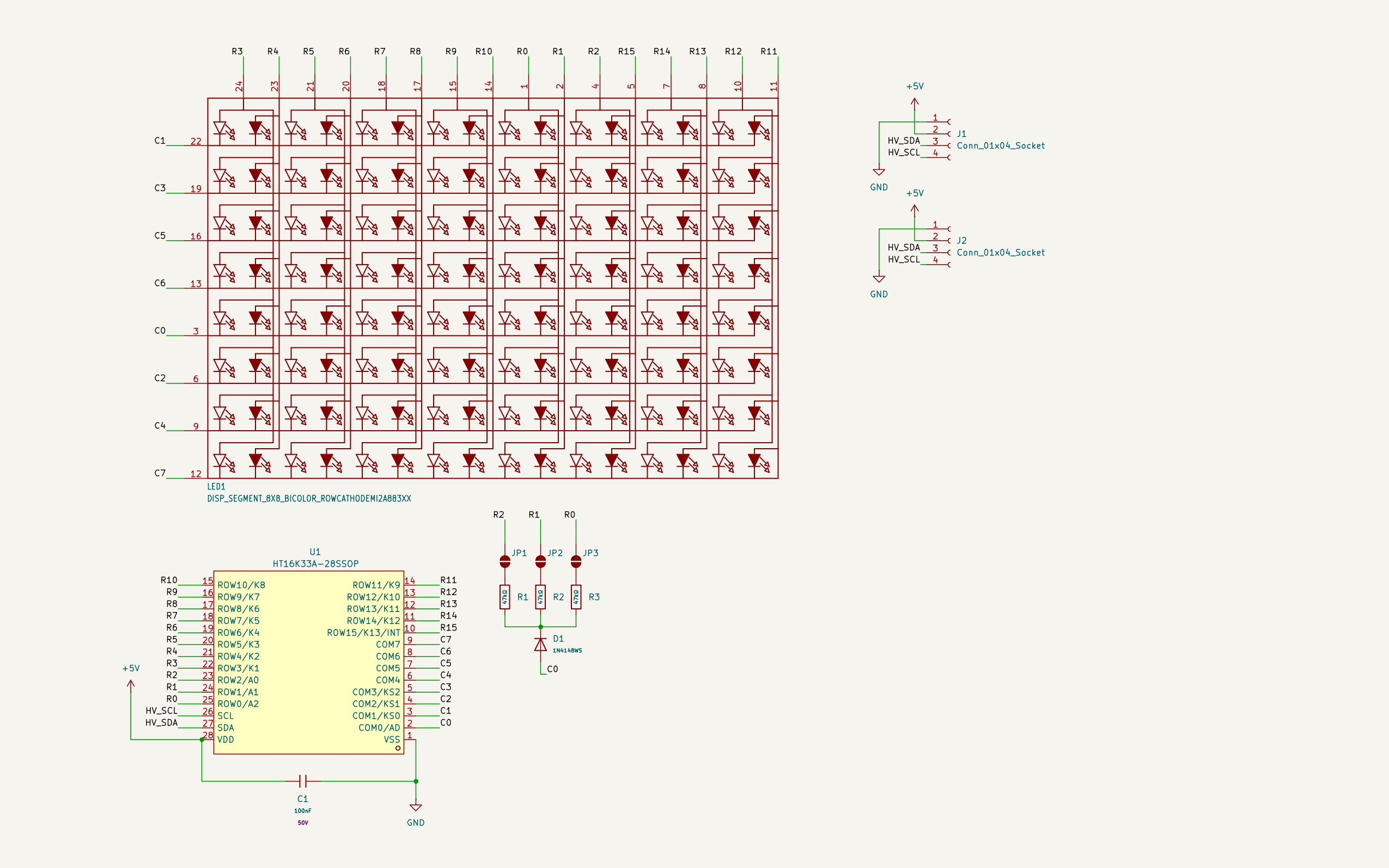
Matrix
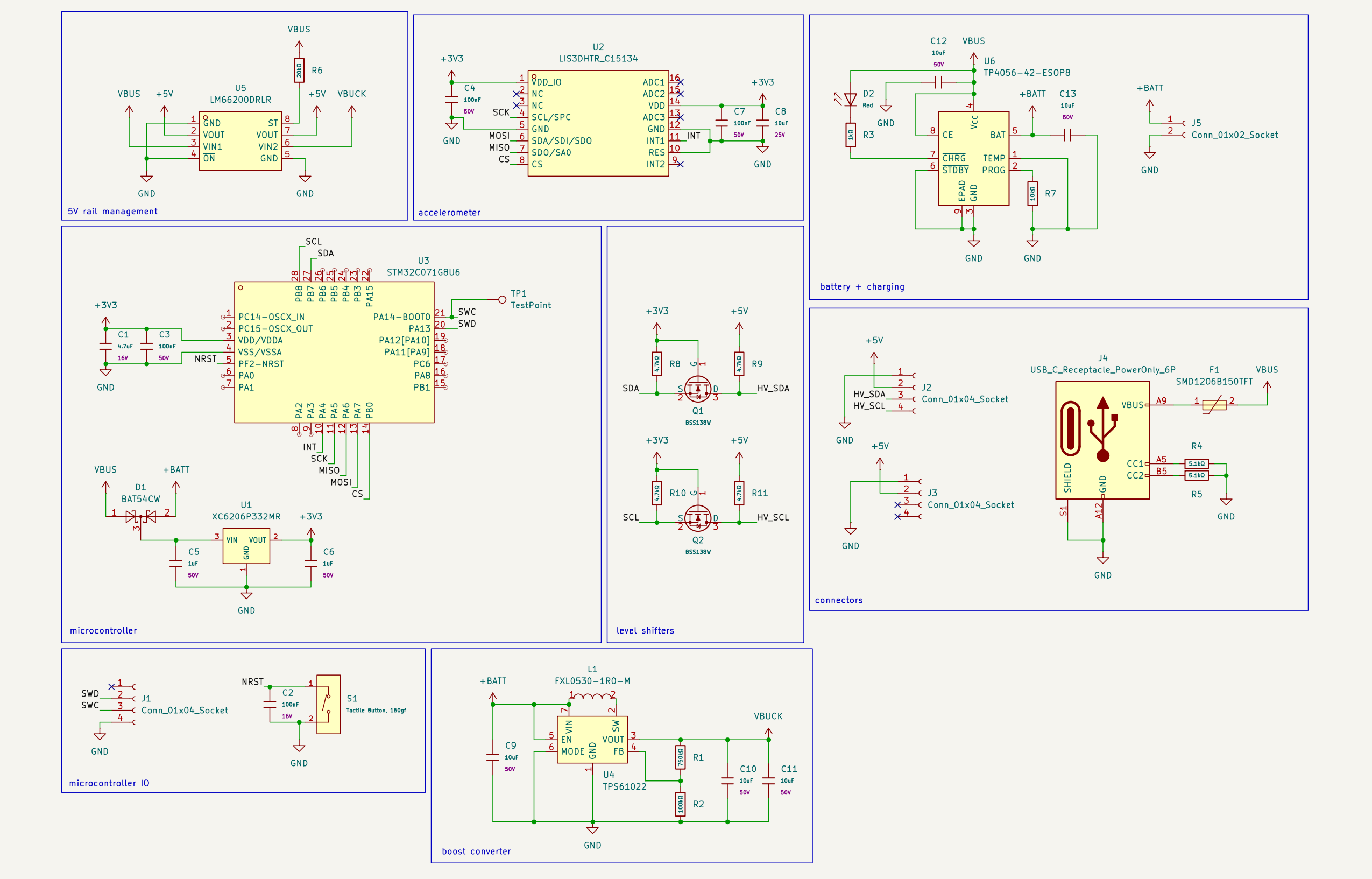
Controller board

Matrix module
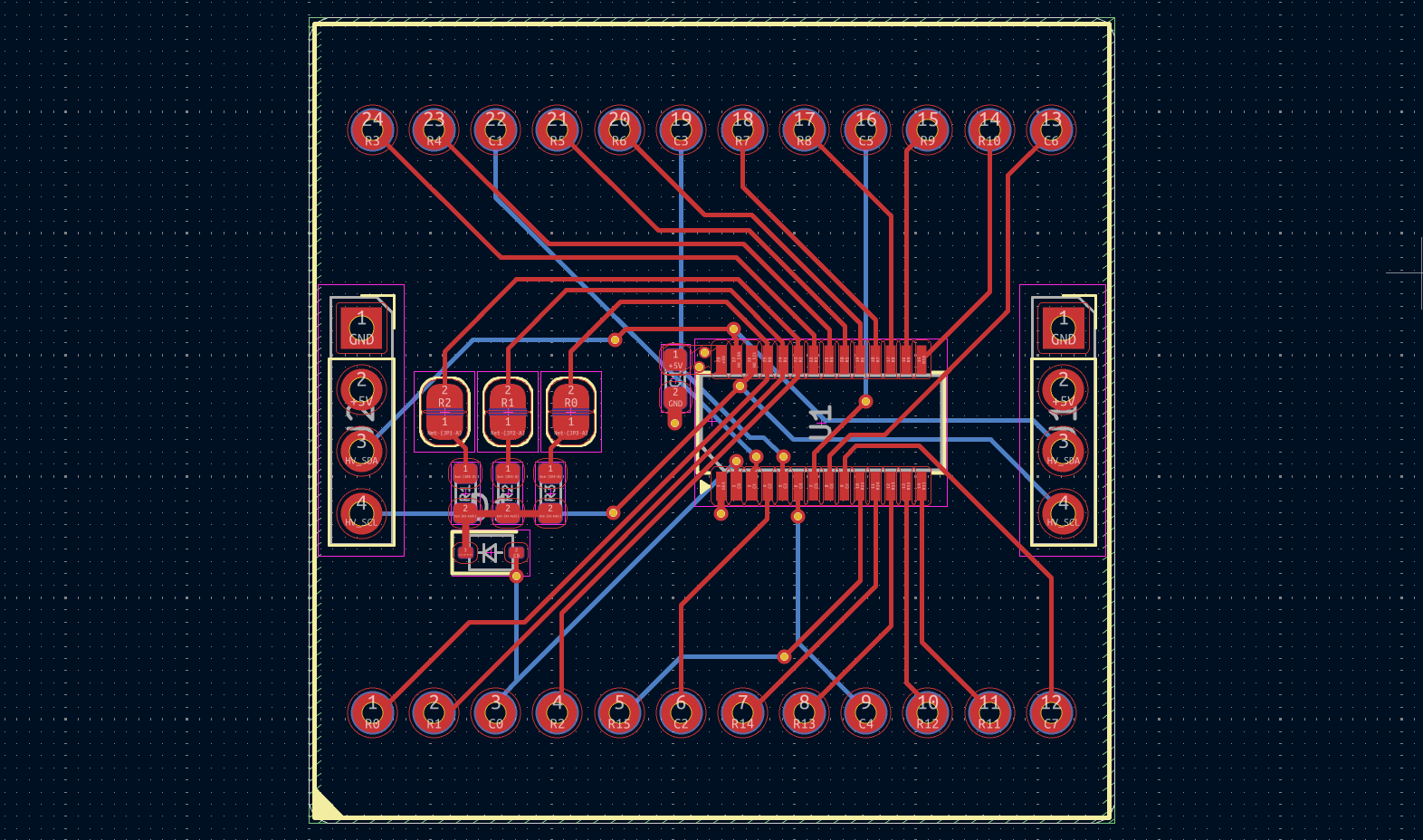
All signals between the two boards are carried on PCB-mounted 2.54 mm pin headers. No off-board wiring is required beyond a LiPo cell on the controller.
Prices are per-unit LCSC values; standard connector values are estimated.
| Ref | Qty | Value | LCSC | Unit | Extended |
|---|---|---|---|---|---|
| U3 | 1 | STM32C071G8U6 | C44521811 | $1.67 | $1.67 |
| U4 | 1 | TPS61022 | C915088 | $1.32 | $1.32 |
| U5 | 1 | LIS2DW12TR | C189624 | $1.25 | $1.25 |
| U1 | 1 | XC6206P332MR | C5446 | $0.102 | $0.10 |
| U6 | 1 | TP4056-42-ESOP8 | C16581 | $0.19 | $0.19 |
| L1 | 1 | FXL0530-1R0-M | C475517 | $0.17 | $0.17 |
| Q1, Q2, Q3 | 3 | BSS138W | C28646265 | $0.025 | $0.08 |
| D1 | 1 | BAT54CW | C22392482 | $0.035 | $0.04 |
| D2 | 1 | Red LED | C2286 | $0.009 | $0.01 |
| D3 | 1 | SS34 | C8678 | $0.030 | $0.03 |
| F1 | 1 | SMD1206B150TFT | C269120 | $0.03 | $0.03 |
| S1 | 1 | Tactile button | C720477 | $0.053 | $0.05 |
| J4 | 1 | USB-C receptacle | C18357552 | $0.08 | $0.08 |
| J1 | 1 | JST-SH 4-pin | - | $0.08 (est.) | $0.08 |
| J2, J3 | 2 | 4-pin pin socket | - | $0.05 (est.) | $0.10 |
| J5 | 1 | 2-pin pin socket | - | $0.03 (est.) | $0.03 |
| C9–C13 | 5 | 10 µF | C440198 | $0.069 | $0.35 |
| C1 | 1 | 4.7 µF | C19666 | $0.014 | $0.01 |
| C8 | 1 | 10 µF | C96446 | $0.021 | $0.02 |
| C3, C4, C7 | 3 | 100 nF | C14663 | $0.006 | $0.02 |
| C5 | 1 | 1 µF | C15849 | $0.008 | $0.01 |
| C6 | 1 | 1 µF | C28323 | $0.012 | $0.01 |
| C2 | 1 | 100 nF | C1525 | $0.004 | $0.00 |
| R10–R11, R8–R9 | 4 | 4.7 kΩ | C25900 | $0.004 | $0.02 |
| R4, R5 | 2 | 5.1 kΩ | C25905 | $0.004 | $0.01 |
| R2, R6 | 2 | 100 kΩ | C25741 | $0.004 | $0.01 |
| R1 | 1 | 750 kΩ | C23240 | $0.004 | $0.00 |
| R3 | 1 | 1 kΩ | C11702 | $0.004 | $0.00 |
| R7 | 1 | 10 kΩ | C25804 | $0.004 | $0.00 |
| R12 | 1 | 10 kΩ | C25744 | $0.004 | $0.00 |
| R13 | 1 | 120 Ω | C25079 | $0.004 | $0.00 |
Controller subtotal: $5.71
| Ref | Qty | Value | LCSC | Unit | Extended |
|---|---|---|---|---|---|
| U1 | 1 | HT16K33A-28SSOP | C5444738 | $0.50 | $0.50 |
| LED1 | 1 | 8×8 bicolor LED matrix | - | $1.50 (est.) | $1.50 |
| R1–R3 | 3 | 47 kΩ | C25819 | $0.004 | $0.01 |
| C1 | 1 | 100 nF | C14663 | $0.006 | $0.01 |
| D1 | 1 | 1N4148WS | C2128 | $0.012 | $0.01 |
| J1, J2 | 2 | 4-pin pin socket | - | $0.05 (est.) | $0.10 |
Matrix subtotal: $2.13
| Board | Subtotal |
|---|---|
| Controller | $5.71 |
| Matrix | $2.13 |
| Grand total (1× each board) | $7.84 |
Does not include PCB fabrication, shipping, LiPo battery, or assembly fees.
| Qty | Value | Footprint | References |
|---|---|---|---|
| 3 | 47kΩ | PCM_JLCPCB:R_0603 | R1, R2, R3 |
| 3 | SolderJumper_2_Open | Jumper:SolderJumper-2_P1.3mm_Open_RoundedPad1.0x1.5mm | JP1, JP2, JP3 |
| 2 | Conn_01x04_Socket | Connector_PinSocket_2.54mm:PinSocket_1x04_P2.54mm_Vertical | J1, J2 |
| 1 | 100nF | PCM_JLCPCB:C_0603 | C1 |
| 1 | 1N4148WS | PCM_JLCPCB:D_SOD-323 | D1 |
| 1 | DISP_SEGMENT_8X8_BICOLOR_ROWCATHODEMI2A883XX | custom:SEGMENT_BICOL_BL-M12A883XX | LED1 |
| 1 | HT16K33A-28SSOP | Package_SO:SSOP-28_3.9x9.9mm_P0.635mm | U1 |
It measures 33.2 × 33.2 mm and has 4 copper layers, 1.6 mm thick.
12 parts, built around the HT16K33A-28SSOP and 1N4148WS. The full list of its parts is on this page, with links to each part's symbol and footprint where PCBKit's library has them.
From the picafe/pendant repository on GitHub, at the commit this page was made from: the board is matrix/matrix.kicad_pcb and its schematic controller/pendant.kicad_sch. PCBKit opens the board in the browser, with nothing to install.
Its repository states no licence, so its author keeps all rights: ask picafe before reusing the design.
picafe/pendant
A pendant built from two PCBs: a 8×8 bicolor LED matrix module (red, orange, green) and controller board with battery charging, USB-C power, 5 V boost, and motion sensing.

picafe/bicolor-matrix
A 32x8 bicolor LED matrix module based on the Holtek HT16K33A LED driver.

picafe/bicolor-matrix-v2
A 32x8 bicolor LED matrix module composed of 4 8x8 matrices based on the Holtek HT16K33A I2C LED driver. V1 paired it with a stacked adapter (RP2040 Zero + DS3231 module); V2 redesigns the matrix routing and puts an…


shorepine/tulipcc
The Tulip Creative Computer and AMYboard - portable Python synthesizers

antmicro/jetson-nano-baseboard
Antmicro's open hardware baseboard for the NVIDIA Jetson Nano, TX2 NX and Xavier NX

Twisted-Fields/rp2040-motor-controller
A dual channel brushless motor controller based on the RP2040 microcontroller, designed in Kicad.

TeXitoi/keyseebee
KeySeeBee is a split ergo keyboard. It is only 2 PCB (so the name) with (almost) only SMD components on it. It's only a keyboard, no LED, no display, nothing more than keys and USB.
