
4 layers234 × 84 mm
Main panel
google/mozc-devices
Circuit diagrams and firmware source code for Gboard DIY keyboards
234 parts3kApache-2.0

 PendulumPower/PolarisPad1
A Macropad designed for space combat in games such as Star Citizen.
PolarisPad is an open-source printed circuit board by PendulumPower, from the PendulumPower/PolarisPad repository on GitHub, published under the MIT licence. It is a 2-layer board of 81 × 61 mm with 23 parts on 28 nets, routed with 252 tracks and 25 vias.
It is built around the SK6812MINI-E. Its parts include 12 diodes, 9 switches and 2 ICs. It belongs with the keyboards and input boards of this library.
A Macropad designed for space combat in games such as Star Citizen.
Finished Device
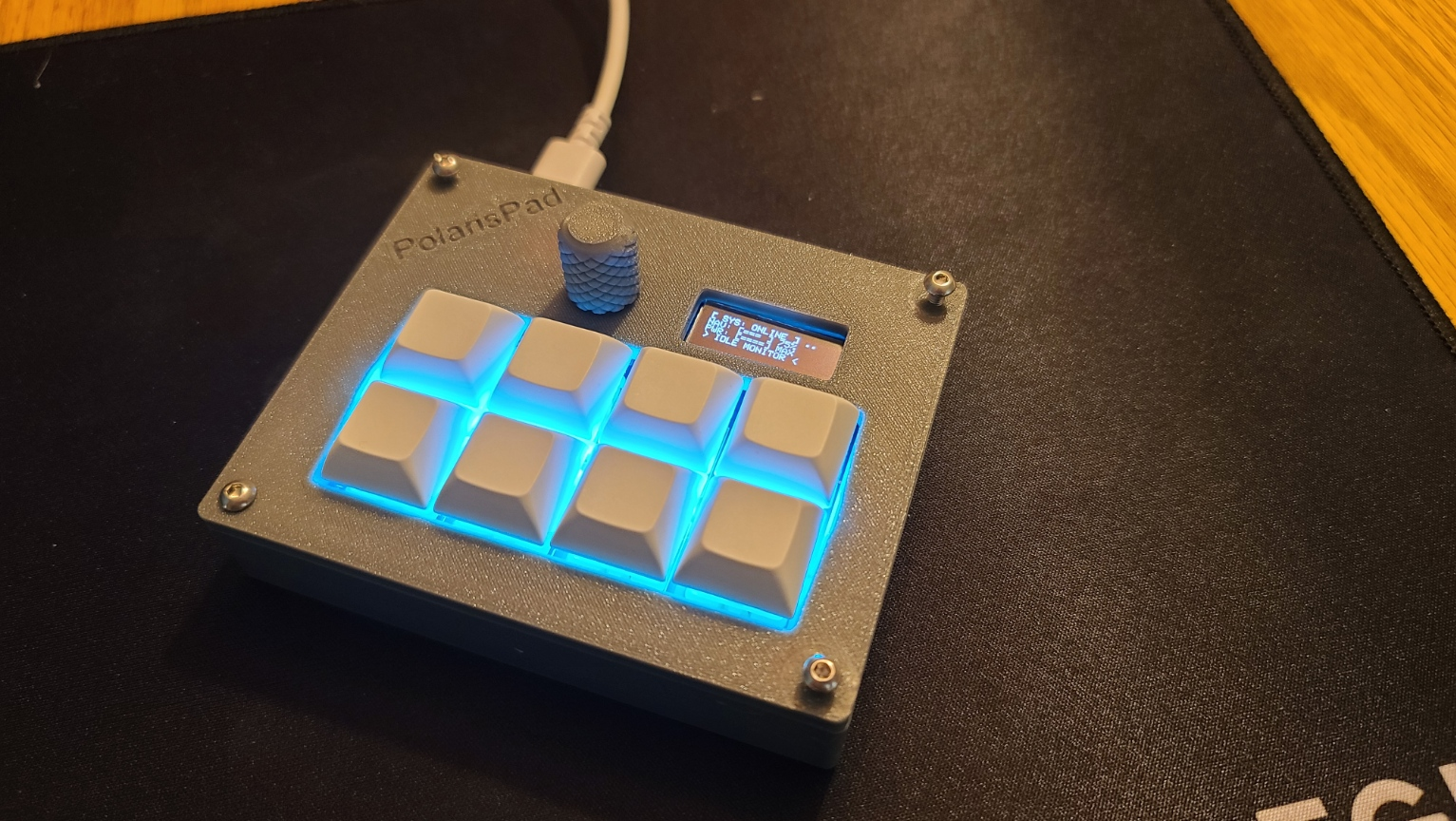 Case:
Full Design:
PCB:
Schematic:
How to program:
BOM:
-8 MX-Style switches
-1 unsoldered Seeed XIAO RP2040
-8 through-hole 1N4148 Diodes
-4 SK6812 MINI-E LEDs
-1 EC11 Rotary encoders
-1 0.91 inch OLED display
| Qty | Value | Footprint | References |
|---|---|---|---|
| 8 | 1N4148 | Diode_THT:D_DO-35_SOD27_P7.62mm_Horizontal | D3, D4, D5, D6, D7, D8, D9, D10 |
| 8 | SW_Push | Button_Switch_Keyboard:SW_Cherry_MX_1.00u_PCB | SW1, SW2, SW3, SW4, SW5, SW6, SW7, SW8 |
| 4 | SK6812MINI-E | footprints:SK6812MINI-E_fixed | D1, D2, D11, D12 |
| 1 | ER_OLEDM0.91_1x-I2C | Connector:FanPinHeader_1x04_P2.54mm_Vertical | U2 |
| 1 | MOUDLE-SEEEDUINO-XIAO | footprints:XIAO-Generic-Hybrid-14P-2.54-21X17.8MM | U1 |
| 1 | RotaryEncoder_Switch | Rotary_Encoder:RotaryEncoder_Alps_EC11E-Switch_Vertical_H20mm | SW9 |
google/mozc-devices
Circuit diagrams and firmware source code for Gboard DIY keyboards

Bastardkb/Dilemma
The Dilemma is a vertical stagger low-profile keyboard with mods.

Pwnsat/FlatSat
Flatsat v1.0 is a hardware based platform for aerospace cybersecurity research

adamws/kicad-kbplacer
KiCad plugin for automatic keyboard's key placement and routing

imchipwood/dumbpad
Simple 4x4 numpad with rotary encoder. Powered by QMK via ATmega32u4 Pro Micro

makerforgetech/modular-biped
An open source framework for creating a bipedal modular companion robot.


It measures 81 × 61 mm and has 2 copper layers, 1.6 mm thick.
23 parts, built around the SK6812MINI-E. The full list of its parts is on this page, with links to each part's symbol and footprint where PCBKit's library has them.
From the PendulumPower/PolarisPad repository on GitHub, at the commit this page was made from: the board is PCB/PolarisPad.kicad_pcb and its schematic PCB/PolarisPad.kicad_sch. PCBKit opens the board in the browser, with nothing to install.
Its repository publishes it under the MIT licence: you may reuse it on that licence's terms (keep the author's notice, and for a copyleft licence share your changes alike).