2 layers48 × 32 mm
FlatSat
Pwnsat/FlatSat
Flatsat v1.0 is a hardware based platform for aerospace cybersecurity research
37 parts575GPL-2.0

 Pwnsat/FlatSat575
Flatsat v1.0 is a hardware based platform for aerospace cybersecurity research
FlatSat is an open-source printed circuit board by Pwnsat, from the Pwnsat/FlatSat repository on GitHub, published under the GPL-2.0 licence. It is a 4-layer board of 48 × 32 mm with 106 parts on 91 nets, routed with 929 tracks and 153 vias.
It is built around the RP2040, SX1262IMLTRT and 0900FM15D0039E, with the LIS2DH, TLV75733PDBVR-MS and SK6812MINI-E among its other parts. Its parts include 38 capacitors, 13 resistors, 11 ICs, 6 inductors and 5 connectors. It belongs with the RP2040 boards of this library.


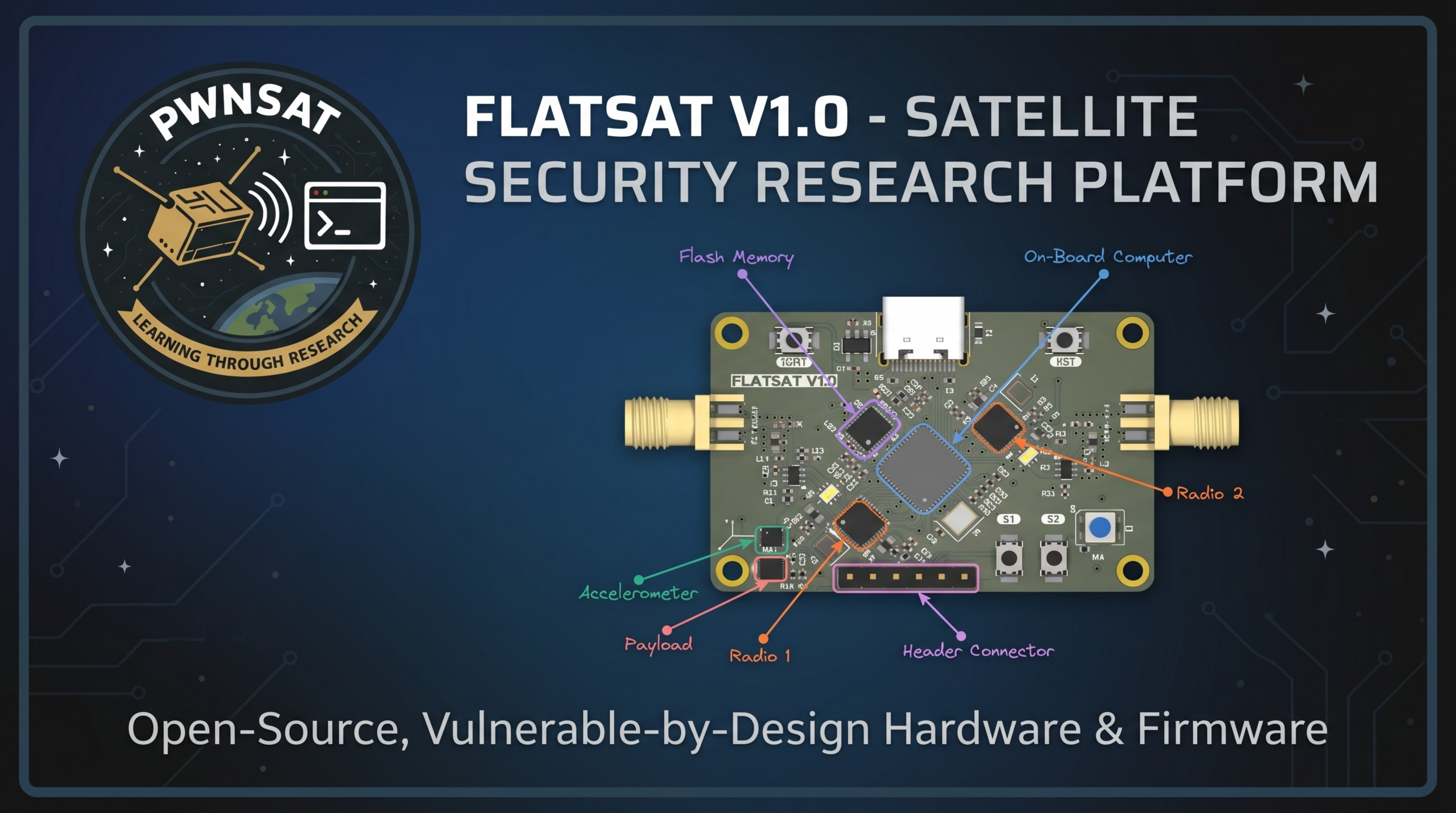
The world’s first open-source and hardware platform vulnerable-by-design, engineered specifically to learn space hacking adn aerospace cybersecurity.
FlatSat is a hardware-based training platform designed to be vulnerable on purpose. It is built for hackers, engineers, and space enthusiasts who want to dive deep into space-grade systems, learn cybersecurity concepts, and prototype their own payloads in a safe, controlled environment.
The project simulates critical real-world satellite subsystems, orbital telemetry, and authentic aerospace communication protocols, serving as a bridge between hardware hacking and aerospace security research.
FlatSat's physical architecture layout is fully accessible and designed for open hardware auditing:
RF Compliance Note: FlatSat operates exclusively within standard license-free ISM bands (typically 433 MHz or 915 MHz depending on your region). This ensures a legal, safe educational ecosystem that does not interfere with production space systems or critical ground infrastructure.
Firmware/: The vulnerable-by-design firmware source, a pre-built .uf2 ready to flash (Firmware/build/), and platformio.ini to build it yourself. See Firmware/README.md for the full diff against the public baseline.Attacks/: Eight attack scripts (00–07) exploiting the vulnerabilities above, each in an RF variant (HackRF/RTL-SDR) and a USB variant. See Attacks/README.md for what's here, and the wiki (below) for the full step-by-step walkthrough of each one.All deep technical documentation, source analysis, and setup guides have been centralized. If you want to start compiling, debugging, or exploiting the platform, please visit the FlatSat Wiki:
This project is an open-source initiative maintained by PWNSAT and Electronic Cats. Contributions are highly welcome.
This project was created for educational purposes, to teach and learn aerospace cybersecurity. Neither PWNSAT nor Electronic Cats are responsible for how the knowledge, code, or tools hosted in this repository are used. Use only against hardware, firmware, or signal sources you own or are explicitly authorized to test.
Electronic Cats invests time and resources providing this open source design, please support Electronic Cats and open-source hardware by purchasing products from Electronic Cats!
Designed by PWNSAT and Electronic Cats.
Hardware released under an CERN Open Hardware Licence v1.2. See the LICENSE_HARDWARE file for more information. Firmware and attack scripts are released under GPL-2.0-or-later — see LICENSE_FIRMWARE and Attacks/LICENSE.
PWNSAT and Electronic Cats are a registered trademark, please do not use if you sell these PCBs.
A special thanks to Alex Lynd. His support made it possible to kick off the first version of the project, and his contribution remains a fundamental part of PWNSAT. His work will always be embedded in what this project has become.
| Qty | Value | Footprint | References |
|---|---|---|---|
| 19 | 0.1uF | Capacitor_SMD:C_0402_1005Metric | C1, C13, C14, C18, C19, C24, C25, C27, C28, C32, C33, C34, C35, C36, C37, C38 +3 |
| 4 | 100R | Resistor_SMD:R_0402_1005Metric | R3, R4, R6, R7 |
| 4 | 1nF | Capacitor_SMD:C_0402_1005Metric | C10, C12, C21, C23 |
| 4 | 3.3pF | Capacitor_SMD:C_0402_1005Metric | C3, C4, C16, C17 |
| 4 | SW | FlatSat:TS1088R02026 | BOOT1, Button1, Button2, RESET1 |
| 3 | 1uF | Capacitor_SMD:C_0402_1005Metric | C6, C26, C31 |
| 2 | 0900FM15D0039 | FlatSat:0900FM15D0039E | U2, U6 |
| 2 | 100pF | Capacitor_SMD:C_0402_1005Metric | C2, C15 |
| 2 | 15uH | Inductor_SMD:L_0603_1608Metric | L3, L6 |
| 2 | 27 | Resistor_SMD:R_0402_1005Metric | R8, R10 |
| 2 | 27pF | Capacitor_SMD:C_0402_1005Metric | C29, C30 |
| 2 | 32Mhz | Crystal:Crystal_SMD_2520-4Pin_2.5x2.0mm | Y1, Y2 |
| 2 | 4.7k | Resistor_SMD:R_0402_1005Metric | R9, R15 |
| 2 | 470nF | Capacitor_SMD:C_0402_1005Metric | C11, C22 |
| 2 | 47nH | Inductor_SMD:L_0603_1608Metric | L2, L5 |
| 2 | 47pF | Capacitor_SMD:C_0402_1005Metric | C9, C20 |
| 2 | 5k1 | Resistor_SMD:R_0402_1005Metric | R1, R2 |
| 2 | 9.1nH | Inductor_SMD:L_0603_1608Metric | L1, L4 |
| 2 | Antenna | FlatSat:SMA_EDGE | J1, J2 |
| 2 | G*** | kibuzzard-696512BA | kibuzzard-696512BA, kibuzzard-696512BA |
| 2 | Jumper | Jumper:SolderJumper-3_P1.3mm_Bridged12_RoundedPad1.0x1.5mm_NumberLabels | JP1, JP2 |
| 2 | PE42421 | Package_TO_SOT_SMD:SOT-363_SC-70-6 | U3, U7 |
| 2 | SX1262IMLTRT | Package_DFN_QFN:QFN-24-1EP_4x4mm_P0.5mm_EP2.65x2.65mm | U4, U8 |
| 1 | |||
| 1 | 0.75A | Fuse:Fuse_0603_1608Metric_Pad1.05x0.95mm_HandSolder | F1 |
| 1 | 10k | Resistor_SMD:R_0402_1005Metric | R5 |
| 1 | 12MHz | Crystal:Crystal_SMD_3225-4Pin_3.2x2.5mm | Y3 |
| 1 | 1k | Resistor_SMD:R_0402_1005Metric | R13 |
| 1 | 470 | Resistor_SMD:R_0402_1005Metric | R14 |
| 1 | BME280 /BMP280 | Package_LGA:Bosch_LGA-8_2.5x2.5mm_P0.65mm_ClockwisePinNumbering | U11 |
| 1 | G*** | kibuzzard-69652909 | kibuzzard-69652909 |
| 1 | G*** | kibuzzard-6965130C | kibuzzard-6965130C |
| 1 | G*** | kibuzzard-69651319 | kibuzzard-69651319 |
| 1 | G*** | kibuzzard-69651236 | kibuzzard-69651236 |
| 1 | G*** | kibuzzard-69651254 | kibuzzard-69651254 |
| 1 | G*** | kibuzzard-6965136B | kibuzzard-6965136B |
| 1 | G*** | kibuzzard-69651304 | kibuzzard-69651304 |
| 1 | G*** | kibuzzard-69651380 | kibuzzard-69651380 |
| 1 | G*** | kibuzzard-696512FB | kibuzzard-696512FB |
| 1 | G*** | kibuzzard-69653048 | kibuzzard-69653048 |
| 1 | G*** | kibuzzard-69651375 | kibuzzard-69651375 |
| 1 | G*** | kibuzzard-69651321 | kibuzzard-69651321 |
| 1 | G*** | kibuzzard-69652959 | kibuzzard-69652959 |
| 1 | G*** | kibuzzard-69652922 | kibuzzard-69652922 |
| 1 | LIS2DH | Package_LGA:LGA-14_2x2mm_P0.35mm_LayoutBorder3x4y | U10 |
| 1 | LOGO | Aesthetics:electronic_cats_logo_8x6 | G*** |
| 1 | RP2040 | Package_DFN_QFN:QFN-56-1EP_7x7mm_P0.4mm_EP3.2x3.2mm | U9 |
| 1 | SK6812MINI | Library:SK6812MINI-HS | D2 |
| 1 | SWD | Connector_PinHeader_2.54mm:PinHeader_1x04_P2.54mm_Vertical | J4 |
| 1 | TLV75733PDBVR | Package_TO_SOT_SMD:SOT-23-5 | U1 |
| 1 | USB_C_Plug_USB2.0 | FlatSat:C393939 | P1 |
| 1 | W25Q16JV | Package_SON:Winbond_USON-8-2EP_3x4mm_P0.8mm_EP0.2x0.8mm | U5 |
| 1 | periphs | Connector_PinHeader_2.54mm:PinHeader_1x06_P2.54mm_Vertical | J3 |
The 102 most common of 106 parts.
Pwnsat/FlatSat
Flatsat v1.0 is a hardware based platform for aerospace cybersecurity research

GodOfStrategy/Personal-LoRa-Puck
A small compact module made to transmit and receive messages using sub gigahertzs frequencies of radio waves, for use in things such as automation, transmission, reception etc.

joshitha-c/lora-pluck
A custom-designed LoRa development board built in KiCad, combining the powerful Raspberry Pi RP2040 microcontroller with the Semtech SX1262 LoRa transceiver.


Pwnsat/PWNCUBE
PWNCUBE v1.0 is a Cubesat hardware based platform for aerospace cybersecurity research


hlord2000/Sidewalk_Devkit
KiCad hardware design for a compact Nordic Semiconductor devkit built around an nRF54L15 target, nPM1300 power management, and an SX1262 sub-GHz radio front end.
It measures 48 × 32 mm and has 4 copper layers, 1.6 mm thick.
106 parts, built around the RP2040, SX1262IMLTRT, 0900FM15D0039E and LIS2DH. The full list of its parts is on this page, with links to each part's symbol and footprint where PCBKit's library has them.
From the Pwnsat/FlatSat repository on GitHub, at the commit this page was made from: the board is Hardware/flat-sat/FlatSat.kicad_pcb and its schematic Hardware/Legacy/FlatSat.kicad_sch. PCBKit opens the board in the browser, with nothing to install.
Its repository publishes it under the GPL-2.0 licence: you may reuse it on that licence's terms (keep the author's notice, and for a copyleft licence share your changes alike).