2 layers91.5 × 100 mm
Trailmap
katetriestocode/trailmap
this is the working version! (disclaimer: no antenna as it has not delivered yet, so manual gps coords insertion for now!)
57 parts2
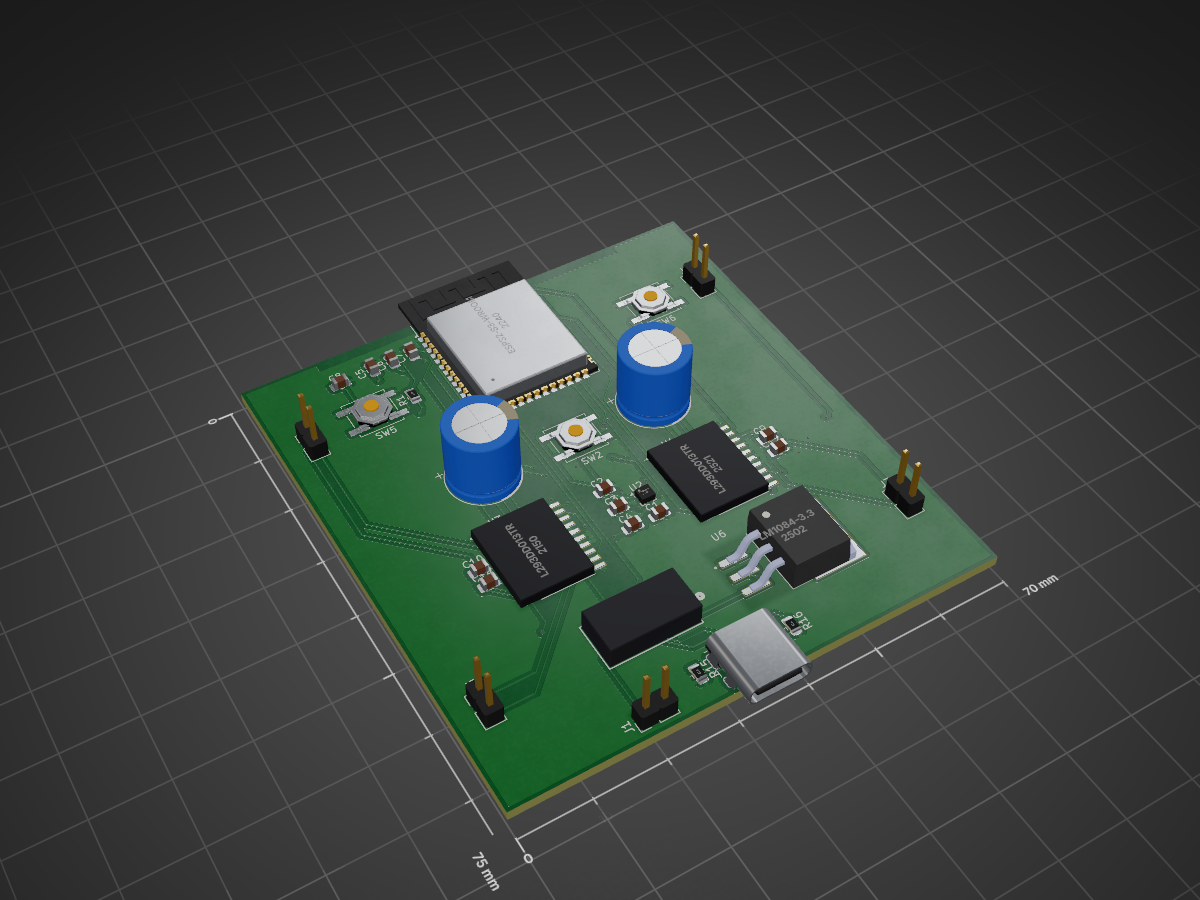
 Padimo/robotbrain
A PCB for a 4 motor robot (can be used for less than 4 motors!) Designed primarily with Science Olympiad in mind.
Robotbrain is an open-source printed circuit board by Padimo, from the Padimo/robotbrain repository on GitHub. It is a 2-layer board of 70 × 75 mm with 32 parts on 64 nets, routed with 347 tracks and 59 vias.
It is built around the ESP32-S3-WROOM-1-N8 and LIS2MDL. Its parts include 14 capacitors, 6 connectors, 5 ICs, 4 switches and 3 resistors. It belongs with the robots and motor control boards and the ESP32 boards of this library.


An ESP32-based robot board that integrates two L293DD ICs to control four DC motor outputs. Also has an integrated magnetometer (LIS3MDL) for direction control.
Last year for Science Olympiad's Robot Tour event, I designed an omnidirectional robot with tons of features, and importantly, many of them were based on QFN packages and a very weak LDO. This time I'm doing better. 5A LDO. No QFN (except the magnetometer). Proper power regulation. This will be the better robot.
The previous version also contained a LSM6DSOX IC which has been scrapped since the SciOly robot can't effectively use linear and rotational acceleration data (too much drift). However magnetic field helps with absolute positioning. The previous version used a 1A LDO which was too little for three motors. This uses a 5A LDO which is plenty for 4 motors. The motor drivers have been upgraded to large L293DD packages to account for the higher current load. The power switching system has been significantly simplified, using a physical switch to alternate between battery power and USB power. There is no integrated battery charging since the robot is designed to use 8xAA (12V) instead of a 3.7V LiPo. Has an extra button to calibrate and start the robot because it may be easier than resetting. can be used to toggle on/off instead of robot running every time code uploads.
The current revision of the board lacks I2C pull up resistors, and so the sensors don't work. If you plan on making this project, please add those pull ups!


| Qty | Value | Footprint | References |
|---|---|---|---|
| 6 | 0.1uF | Capacitor_SMD:C_0805_2012Metric | C2, C4, C9, C10, C12, C14 |
| 5 | Conn_01x02_Pin | Connector_PinHeader_2.54mm:PinHeader_1x02_P2.54mm_Vertical | J1, J2, J5, J6, J7 |
| 3 | 5.1k | Resistor_SMD:R_0805_2012Metric | R1, R15, R16 |
| 3 | SW_Push | Button_Switch_SMD:SW_Push_1P1T_NO_CK_KSC6xxJ | SW2, SW5, SW6 |
| 2 | 10uF | Capacitor_SMD:C_0805_2012Metric | C5, C6 |
| 2 | 1uF | Capacitor_SMD:C_0805_2012Metric | C7, C8 |
| 2 | 220uF | Capacitor_THT:CP_Radial_D10.0mm_P5.00mm | C11, C13 |
| 2 | L293DD013TR | footprints:SOIC127P1032X265-20N | U3, U4 |
| 1 | 10nF | Capacitor_SMD:C_0805_2012Metric | C3 |
| 1 | 220nF | Capacitor_SMD:C_0805_2012Metric | C1 |
| 1 | ESP32-S3-WROOM-1 | RF_Module:ESP32-S3-WROOM-1 | U1 |
| 1 | LIS2MDL | Package_LGA:LGA-12_2x2mm_P0.5mm | U2 |
| 1 | LM1084-3.3 | footprints:TO254P1524X483-4N | U6 |
| 1 | SW_SPDT | Button_Switch_THT:SS-12D10G5_XKB | SW1 |
| 1 | USB_C_Receptacle_USB2.0_16P | Connector_USB:USB_C_Receptacle_GCT_USB4085 | J3 |
It measures 70 × 75 mm and has 2 copper layers, 1.6 mm thick.
32 parts, built around the ESP32-S3-WROOM-1-N8 and LIS2MDL. The full list of its parts is on this page, with links to each part's symbol and footprint where PCBKit's library has them.
From the Padimo/robotbrain repository on GitHub, at the commit this page was made from: the board is pcb/robotbrain.kicad_pcb and its schematic pcb/robotbrain.kicad_sch. PCBKit opens the board in the browser, with nothing to install.
Its repository states no licence, so its author keeps all rights: ask Padimo before reusing the design.
katetriestocode/trailmap
this is the working version! (disclaimer: no antenna as it has not delivered yet, so manual gps coords insertion for now!)


theta-machines/DEV-G2-NANO
The G2 Nano is powered by a record-breaking 1 GHz Arm Cortex-M7 processor, combining the performance of an application processor with real-time determinism.

anticitizn/p4eregrine
All-in-one ESP32 P4-based drone ESC, flight controller, and video processor

timohueser/OpenBikeComputer
Open source Bikecomputer with a focus on exploration and adventure.
