

2 layers120 × 100 mm
Root
GonzaCerv/noah-hardware
This repo contains all the hardware description for the Noah project. Here lies 3D models, electronics PCB and Firmware software of the robot.
127 parts28MIT
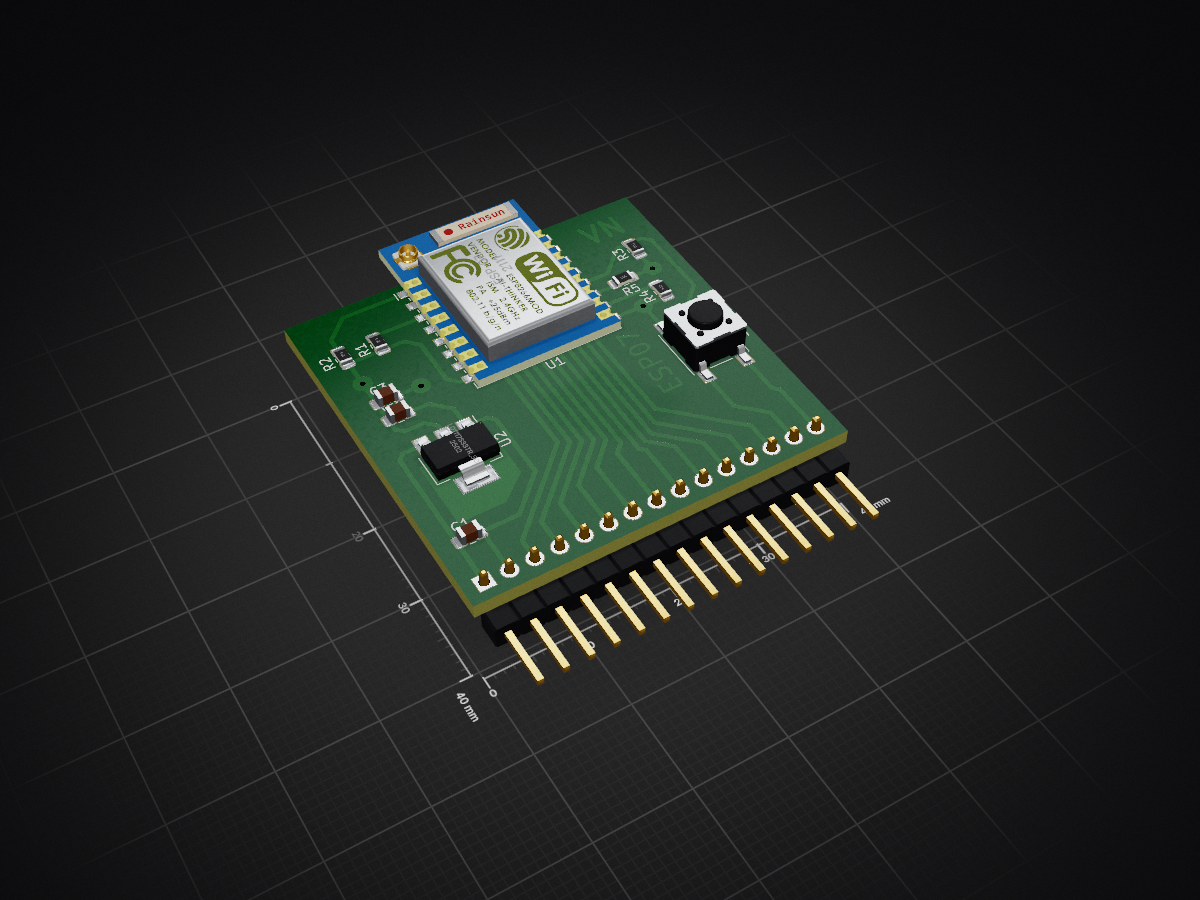
 pacmancoder/esp07-breakout1
ESP07 module breakout board with 3.3v LDO
Esp07-breakout is an open-source printed circuit board by pacmancoder, from the pacmancoder/esp07-breakout repository on GitHub, published under the CC-BY-SA-4.0 licence. It is a 2-layer board of 40 × 40 mm with 12 parts on 17 nets, routed with 133 tracks and 4 vias.
It is built around the ESP-07. Its parts include 5 resistors, 3 capacitors, 2 ICs, 1 connector and 1 switch. It belongs with the interfaces and adapters boards and the ESP8266 boards of this library.
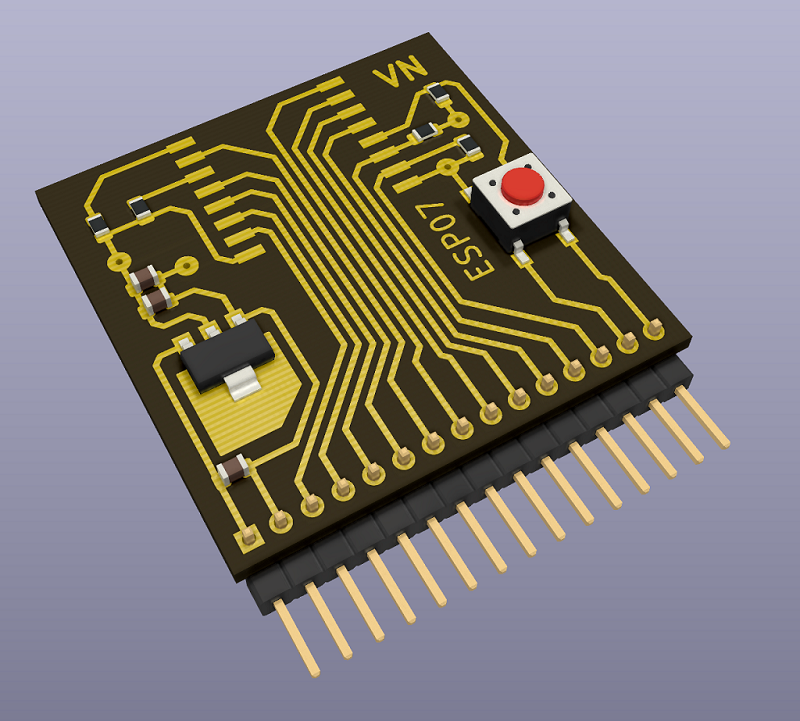
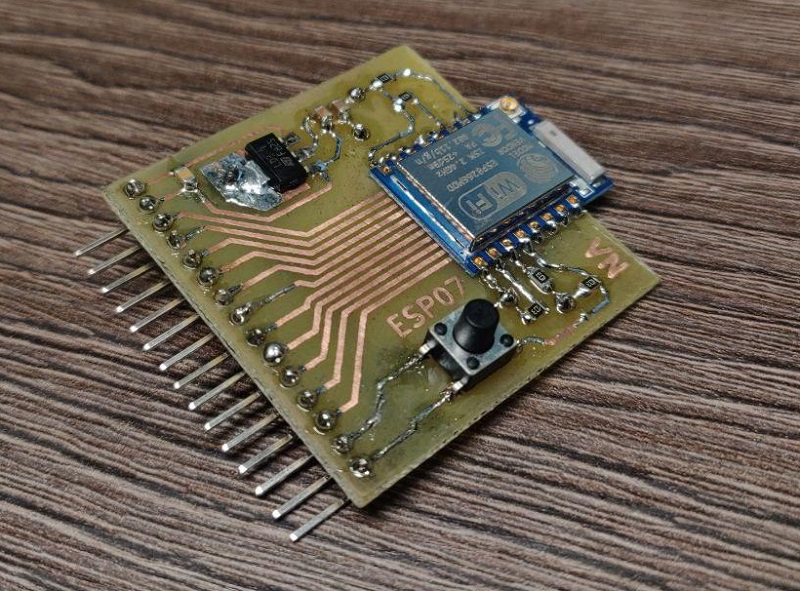
Crude ESP-07 module breakout board intended for toner transfer method DIY PCB production.
Use Mirrored_Front_Layer.svg file for printing with 100% scale; No additional mirroring required. Also 2 additional almost parallel jumper wires should be placed on the backside of the PCB.
| Render | Photo |
|---|---|
 |  |
| Qty | Value | Footprint | References |
|---|---|---|---|
| 5 | 10K | Resistor_SMD:R_0805_2012Metric_Pad1.15x1.40mm_HandSolder | R1, R2, R3, R4, R5 |
| 2 | 10uF | Capacitor_SMD:C_0805_2012Metric_Pad1.15x1.40mm_HandSolder | C2, C3 |
| 1 | 100nF | Capacitor_SMD:C_0805_2012Metric_Pad1.15x1.40mm_HandSolder | C1 |
| 1 | ESP-07 | RF_Module:ESP-07 | U1 |
| 1 | FLASH | Button_Switch_SMD:SW_SPST_PTS645 | SW1 |
| 1 | LD1117S33TR_SOT223 | Package_TO_SOT_SMD:SOT-223-3_TabPin2 | U2 |
| 1 | Module port | Connector_PinHeader_2.54mm:PinHeader_1x15_P2.54mm_Horizontal | J1 |
It measures 40 × 40 mm and has 2 copper layers, 1.6 mm thick.
12 parts, built around the ESP-07. The full list of its parts is on this page, with links to each part's symbol and footprint where PCBKit's library has them.
From the pacmancoder/esp07-breakout repository on GitHub, at the commit this page was made from: the board is esp07-breakout.kicad_pcb. PCBKit opens the board in the browser, with nothing to install.
Its repository publishes it under the CC-BY-SA-4.0 licence: you may reuse it on that licence's terms (keep the author's notice, and for a copyleft licence share your changes alike).
GonzaCerv/noah-hardware
This repo contains all the hardware description for the Noah project. Here lies 3D models, electronics PCB and Firmware software of the robot.


ezcGman/tiny-power-meter
A very tiny 3-phase power meter to measure your homes power consumption and report to Home Assistant!

martin2250/SinglePhaseEnergyMonitor
an adapter to plug between a device and an outlet, to monitor electricity usage and provide data to influxdb


AirMQ/AirMQ-sensor
Root repository for AirMQ hardware project