2 layers43.9 × 27.7 mm

 openMLA/elegoo-mars-4-dlp-controller32
Raspberry pi hat for the elegoo mars 4 dlp UV projector. Implements SPI data transfer for the DLPC1438.
Elegoo dlp controller is an open-source printed circuit board by openMLA, from the openMLA/elegoo-mars-4-dlp-controller repository on GitHub. It is a 2-layer board of 65 × 30 mm with 19 parts on 34 nets, routed with 141 tracks and 14 vias.
Its parts include 9 connectors, 1 capacitor, 1 IC and 1 diode.
To control the DMD with a raspberry pi, we need a very simple board that allows us to plug in the original Anhua board's connectors (Molex Pico-clasp). Check out the schematic 🗺 for the quickest overview of all functionality.
To make our life a little easier, you can add an (optional) dc-dc converter that also converts the 12V to 5V and uses that to power the raspberry pi. This means you do not need to apply separate 5V power to the raspberry pi, and that the 12V needed for the Anhua board provided by the Elegoo Mars 4's power supply is enough to power everything.
Finally, the board breaks out some extra pins for adding your own extra custom bits. SPI and I2C connections, as well as some spare GPIO pins. This may be useful if you want to have exposure occur based on some sensor readout, or maybe tie UV exposure to a simple button for batch production where you don't want to send commands over SSH.
[!IMPORTANT]
Not every connection has been verified to work. I suspect they are all fine since its not a very complex board or high frequency signals. At least the minimum set of pins required for data/exposure seem to work fine.
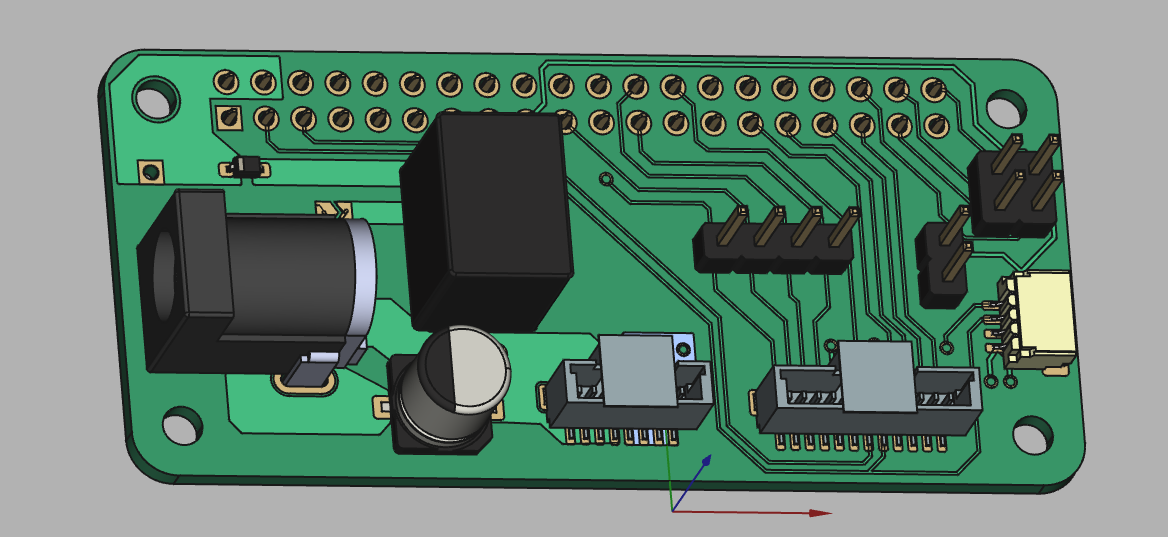
The costs below are indicative, as shipping cost and price changes may have occurred since writing this document. Check with KiCAD's schematic to see if it all up to date. All listed values are including taxes (21%).
| Description | Supplier | Supplier Part Number | Amount | Total Cost | Comment |
|---|---|---|---|---|---|
| PCB manufacturing | Aisler | 3 | 14 | MOC 3pcs | |
| Raspberry Pi Zero 2 | Mouser | 358-SC0510 | 1 | 17 | |
| Micro SD Card (32GB) | Kiwi Electronics | TS32GUSDU1 | 1 | 10 | Whatever kind you want would work |
| Raspberry pi header | Kiwi Electronics | KW-2639 | 1 | 2 | or any basic, cheaper header |
| Raspberry pi header female | Kiwi Electronics | KW-1650 | 1 | 1.5 | |
| JST SH 4-pin | Mouser | 474-PRT-14417 | 1 | 0.67 | Optional, allows i2c through stemmaQT/QWIIC |
| Molex PicoClasp 12 pin | Mouser | 538-501331-1207 | 1 | 1.19 | |
| Molex PicoClasp 8 pin | Mouser | 538-501331-0807 | 1 | 0.92 | |
| Cui DC-DC converter | Mouser | 490-P78E05-1000 | 1 | 3.45 | |
| Barreljack | Mouser | 490-PJ-002B | 1 | 0.79 | |
| Schottky Diode | Mouser | 771-PMEG1020EJ-T/R | 1 | 0.29 | |
| 100uF capacitor | Mouser | 667-EEE-FN1E101UP | 1 | 0.57 | |
| Total | 52.38 |
| Qty | Value | Footprint | References |
|---|---|---|---|
| 4 | MountingHole_2.7mm_M2.5 | MountingHole:MountingHole_2.7mm_M2.5 | MH1, MH2, MH3, MH4 |
| 1 | 100uF | Capacitor_SMD:CP_Elec_6.3x7.7 | C1 |
| 1 | Barrel_Jack | Connector_BarrelJack:BarrelJack_GCT_DCJ200-10-A_Horizontal | J4 |
| 1 | CUI P78E05-1000 | Converter_DCDC:Converter_DCDC_RECOM_R-78E-0.5_THT | U2 |
| 1 | Conn_01x01_Pin | Connector_PinHeader_2.54mm:PinHeader_1x01_P2.54mm_Vertical | J9 |
| 1 | Conn_01x02_Pin | Connector_PinHeader_2.54mm:PinHeader_1x02_P2.54mm_Vertical | J7 |
| 1 | Conn_01x04_Pin | Connector_PinHeader_2.54mm:PinHeader_2x02_P2.54mm_Vertical | J6 |
| 1 | Conn_01x04_Pin | Connector_JST:JST_SH_SM04B-SRSS-TB_1x04-1MP_P1.00mm_Horizontal | J8 |
| 1 | Conn_01x04_Pin | Connector_PinHeader_2.54mm:PinHeader_1x04_P2.54mm_Vertical | J5 |
| 1 | Conn_01x08_Pin | Connector_Molex:Molex_Pico-Clasp_501331-0807_1x08-1MP_P1.00mm_Vertical | J3 |
| 1 | Conn_01x12_Pin | Connector_Molex:Molex_Pico-Clasp_501331-1207_1x12-1MP_P1.00mm_Vertical | J2 |
| 1 | D_Schottky | Diode_SMD:D_SOD-323_HandSoldering | D1 |
| 1 | GPIO | Connector_PinSocket_2.54mm:PinSocket_2x20_P2.54mm_Vertical | J1 |
| 1 | LOGO | board-assets:openmla-logo | G*** |
| 1 | SolderJumper_2_Bridged | Jumper:SolderJumper-2_P1.3mm_Open_TrianglePad1.0x1.5mm | JP2 |
| 1 | TestPoint | TestPoint:TestPoint_Pad_D1.5mm | TP1 |
It measures 65 × 30 mm and has 2 copper layers, 1.6 mm thick.
19 parts. The full list of its parts is on this page, with links to each part's symbol and footprint where PCBKit's library has them.
From the openMLA/elegoo-mars-4-dlp-controller repository on GitHub, at the commit this page was made from: the board is PCB/elegoo-dlp-controller.kicad_pcb and its schematic PCB/elegoo-dlp-controller.kicad_sch. PCBKit opens the board in the browser, with nothing to install.
Its repository states no licence, so its author keeps all rights: ask openMLA before reusing the design.

hackclub/OnBoard
💡 Join 1,000 teenagers and make your first PCB with a $100 grant!

polpo/picogus
Emulation of ISA sound cards and CD-ROM on Raspberry Pi Pico (GUS, SB/Adlib, MPU-401, Tandy, CMS, Panasonic CD-ROM) with USB mouse/joystick support


nkitanov/iaq_board
IAQ Board is a DIY (Do-It-Yourself) device for measuring internal air quality


Ardumower/ardumower
Develop an open source robotic lawn mower (HW+SW reference platform)

zmaker/arduino_cookbook
gli sketch del nuovo progetto Arduino Cookbook e dei video di YouTube