4 layers79 × 81 mm
BIRDS X PCB
AlbertaSat/BIRDS-X_PCB
Repository for the PCB design for the BIRDS-X project
162 parts1CERN-OHL-P-2.0

 OpnTec/open-spectrometer-hardware1.5k
Open source VIS spectrometer
Tcd1304-4v is an open-source printed circuit board by OpnTec, from the OpnTec/open-spectrometer-hardware repository on GitHub. It is a 2-layer board of 43.9 × 27.7 mm with 19 parts on 15 nets, routed with 92 tracks and 6 vias.
It is built around the TCD1304DG(8Z,K), 74HC04D and LT1761-BYP, with the 2SA1015 among its other parts. Its parts include 5 capacitors, 5 resistors, 3 ICs, 1 transistor and 1 connector.


This repository provides hardware schematics and list of materials for the open spectrometer project to enable practitioners, students and citizen scientists to collect data with their spectrometer and have a good and fun learning experience. The open spectrometer project consists of a web cam, simple lasercut parts, battery casing and a suitable LED lightning component. The spectrometer connects to a computer via USB, where the user can run the scripts provided in this repository to run experiments and take measurements. Enjoy!
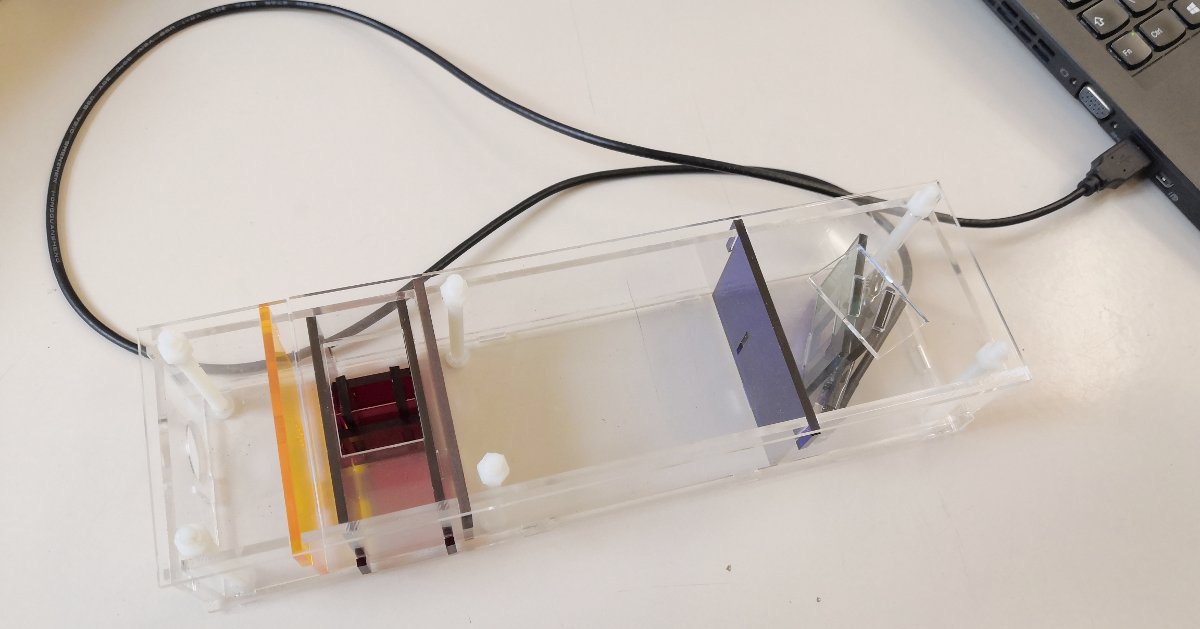 A transparent version of the spectrometer for explanation purposes.
By definition science should be open and reproducible. So, the outcome of an experiment can be verified by anyone. Unfortunately today this is not always the case. In order to be able to verify experiments all components used should be openly accessible. This includes the software and hardware of scientific instruments. Our spectrometer project follows this path. By giving access to all layers of the device used in a scientific experiment users can develop a deep understanding how scientific measurements are taken and practitioners are able to critically understand the limitations of the particular instrument.
The spectrometer consists of a set of materials designed to be available and affordable anywhere in the world. The design's focus is to promote education about spectrometry and analytical chemistry, with the goal of empowering, stimulating and encouraging individuals to learn about their environment applying scientific methodologies. Furthermore, the goal of the tool is to enable practitioners to study open design, scientific programming, physics and to reflect about reproducibility in scientific practices.
The spectrometer community is still small. There are overlaps with the Pocket Science Lab team. To stay connected with different community members we continue to use the PSLab Gitter channel for the beginning. We will set up a dedicated channel once the project is more established. Please join us here:
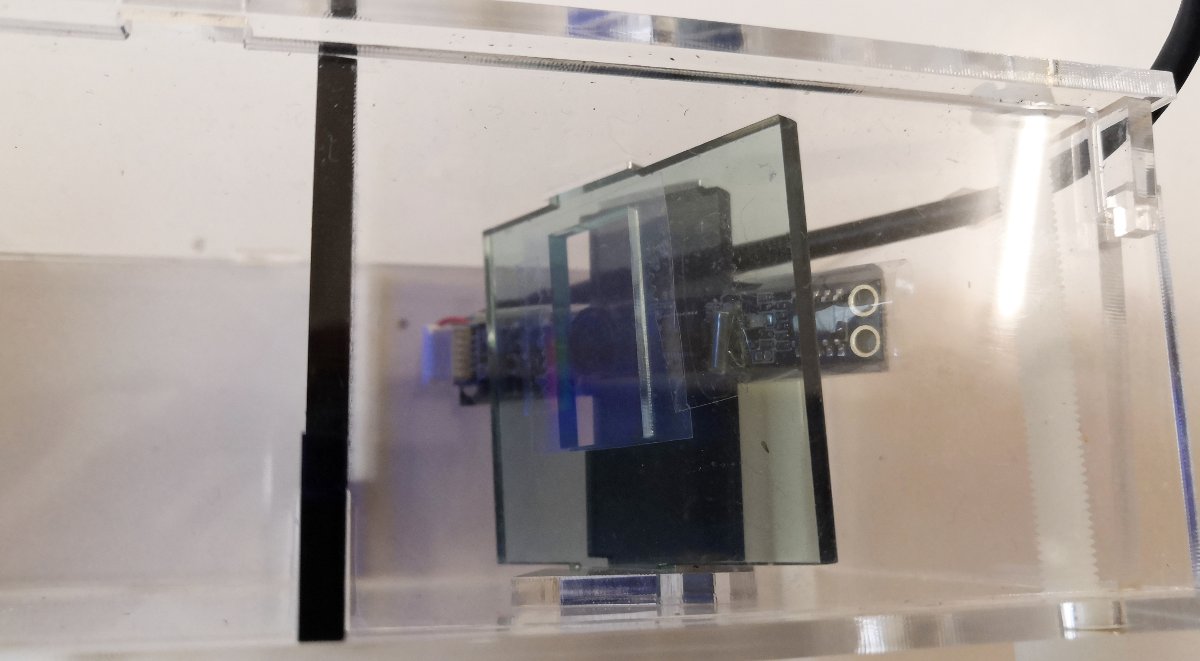 The camera component of the spectrometer in transparent casing.
Roadmap:
To get the data from the spetrometer device practitioners can use the spectrometer Python scripts available in the project.
Alessandro Volpato is the creator of the project. The work was done by merging concepts of the Public Lab Spectrometer, the GaudiLabs spectrometer and creating new design features to simplify the assembly of a lasercut spetrometer.
The repository is licenced under CERN Open Hardware Licence v1.2
| Qty | Value | Footprint | References |
|---|---|---|---|
| 2 | 0.1uF | Capacitors_SMD:C_0805 | C3, C4 |
| 2 | 150R | Capacitors_SMD:C_0805 | R4, R5 |
| 1 | 10nF | Capacitors_SMD:C_0805 | C1 |
| 1 | 10uF | Capacitors_SMD:C_1206 | C2 |
| 1 | 12k | Capacitors_SMD:C_0805 | R1 |
| 1 | 1uF | Capacitors_SMD:C_0805 | C5 |
| 1 | 27k | Capacitors_SMD:C_0805 | R2 |
| 1 | 2SA1015 | TO_SOT_Packages_SMD:SOT-23_Handsoldering | Q1 |
| 1 | 2k2 | Capacitors_SMD:C_0805 | R3 |
| 1 | 74HC04 | Housings_SOIC:SOIC-14_3.9x8.7mm_Pitch1.27mm | U2 |
| 1 | CONN_01X06 | Pin_Headers:Pin_Header_Straight_1x06 | P1 |
| 1 | LT1761-BYP | linear-ccd-module:SOT-23-5-handsoldering | U1 |
| 1 | TCD1304DG | Housings_DIP:DIP-22_W10.16mm | U3 |
The 15 most common of 19 parts.
It measures 43.9 × 27.7 mm and has 2 copper layers, 1.6 mm thick.
19 parts, built around the TCD1304DG(8Z,K), 74HC04D, LT1761-BYP and 2SA1015. The full list of its parts is on this page, with links to each part's symbol and footprint where PCBKit's library has them.
From the OpnTec/open-spectrometer-hardware repository on GitHub, at the commit this page was made from: the board is pcb/tcd1304-4Vn/tcd1304-4Vn2/tcd1304-4v.kicad_pcb. PCBKit opens the board in the browser, with nothing to install.
Its repository states no licence, so its author keeps all rights: ask OpnTec before reusing the design.
AlbertaSat/BIRDS-X_PCB
Repository for the PCB design for the BIRDS-X project

drmcnelson/S11639-01-Linear-CCD-PCB-and-Code
PCB and Code (Teensy 4) for the Hamamatsu S11639-01 Linear CCD with 16 bit ADC and SPI interface


Sepios/connection_board
The KiCad files (schemes, layouts, gerbers) for the Sepios connection board.

Sepios/servo_controller-shield
KiCad files (schemes, layouts, gerbers) for the Sepios servo controller shield, interconnecting the servo controller to the fin case cable.

CameraNexus/sitina1
Open-source 35mm full-frame (36mm x 24mm) CCD mirror-less interchangable lens camera (MILC). The original goal of this project was to create a digital camera back to convert SLR cameras to DSLR cameras, but has since…
