2 layers192.4 × 50 mm

 oliverhanka/esp32_cloud_pcb
ESP32 low power sensor node
Esp32 cloud is an open-source printed circuit board by oliverhanka, from the oliverhanka/esp32_cloud_pcb repository on GitHub. It is a 2-layer board of 50 × 30.9 mm with 23 parts on 58 nets, routed with 418 tracks and 48 vias.
It is built around the ESP32-PICO-D4 and XC6220B331MR. Its parts include 7 capacitors, 6 connectors, 3 ICs, 2 resistors and 1 diode. It belongs with the home automation and IoT and sensors and measurement boards and the ESP32 and RISC-V boards of this library.


This is a simplistic ESP32 based sensor node with a focus on very low power consumption while beeing idle. This means, external components are keept to a minimum and the selected LDO has a very low power consumption. The board can be supplied with 3.3V directly or by using the on-board LDO (max. 6V input) to generate the required 3.3V. NOTE: The LDO_EN solder jumper must be closed in order to use the LDO.
These values have not been verified by measurements and do not take the passive components into account.
Power consumption while beeing in hibernation:
| Active component | Current | Power |
|---|---|---|
| ESP32 (in hibernation) | 5𝜇A @ 3.3V | 16.5𝜇W |
| LDO | 8𝜇A @ 5V | 40𝜇W |
| Total | 11.3𝜇A @ 5V | 56.5𝜇W |
While beeing active and transmitting via Wifi (BLE off):
| Active component | Current | Power |
|---|---|---|
| ESP32 (240MHz, Wifi tx) | 240mA @ 3.3V | 792mW |
| LDO | 8𝜇A @ 5V | 40𝜇W |
| Total | 158.4mA @ 5V | 792mW |
| Connector | Purpose |
|---|---|
| J1 | I2C, power via GPIO14 |
| J2 | power connector, JST-PH |
| J3 | power connector, USB-C |
| J4 | programming interface, compatible with ESP-Prog |
| J5 | various GPIOs or ADC and SPI, VCC, GND |
| J6 | GPIO (e.g., for WS2812, power via GPIO2) |
| Solder jumper | Purpose |
|---|---|
| LED_EN | Enable blue LED D1 controlled by GPIO12) |
| LDO_EN | Enable LDO (e.g., for power via USB-C) |
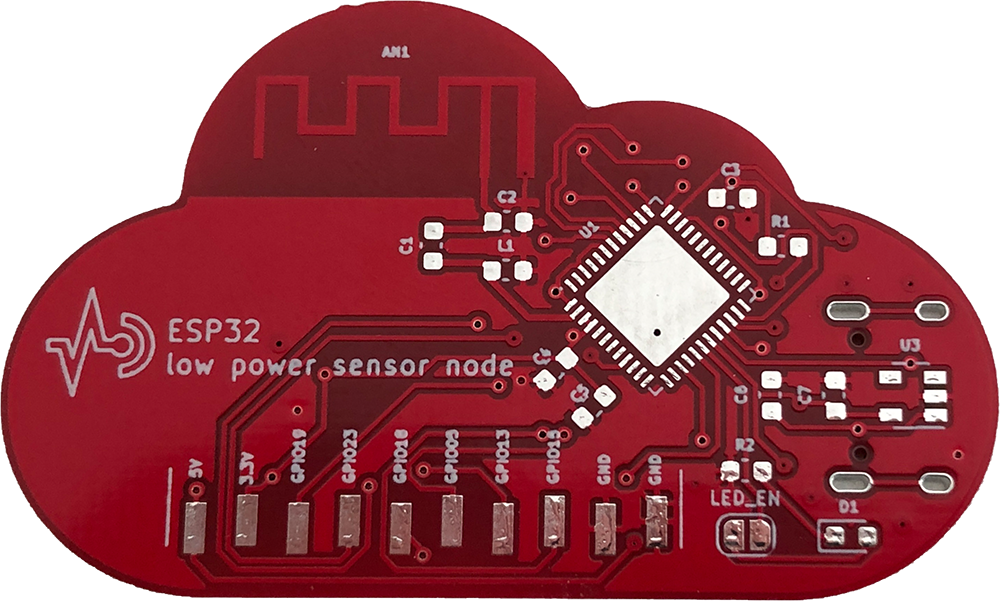 | 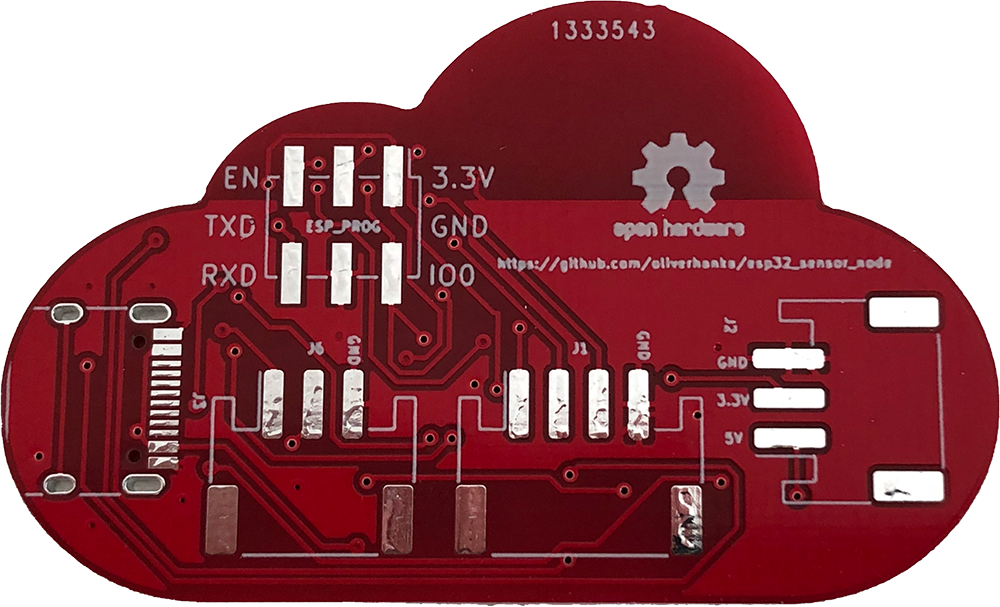 |
|---|---|
| frontside rev 1.0 | backside rev 1.0 |
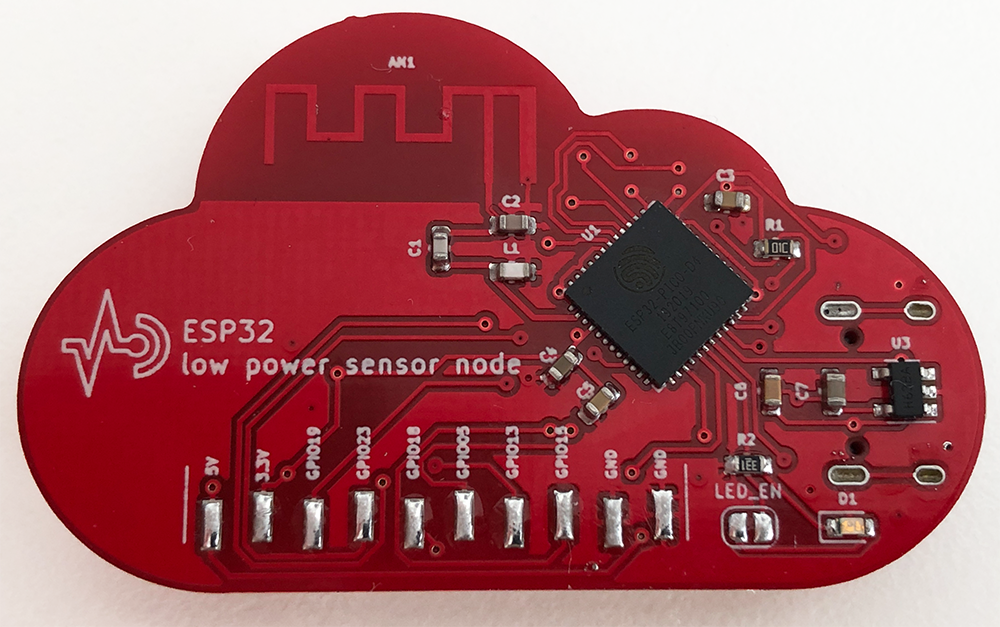 | 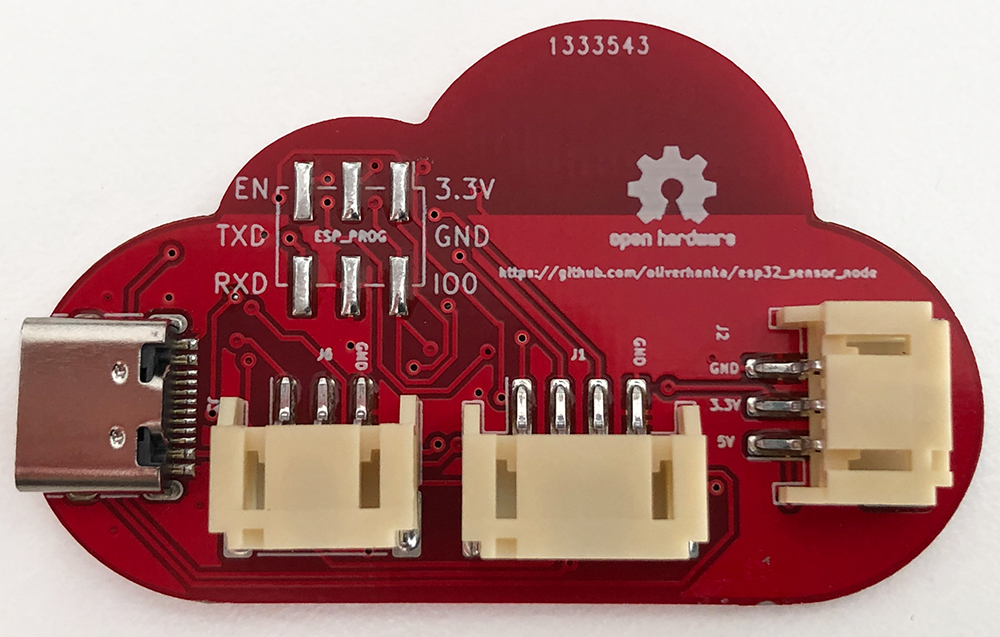 |
|---|---|
| assembled front rev 1.0 | assembled back rev 1.0 |
| Designator | Manufacturer Part Number | Qty |
|---|---|---|
| J6, J2 | S3B-PH-SM4-TB(LF)(SN) | 2 |
| J1 | S4B-PH-SM4-TB(LF)(SN) | 1 |
| J3 | TYPE-C-31-M-12 | 1 |
| R1 | 10kΩ (0603) | 1 |
| R2 | 330Ω (0603) | 1 |
| D1 | LED (0603) | 1 |
| L1 | 1.6nH (0603) | 1 |
| C7 | 22uF (0603) | 1 |
| C6 | 0.1uf (0603) | 1 |
| C5, C3 | 0.1uF/25V (0603) | 2 |
| C4 | 10uF/6.3V (0603) | 1 |
| C2 | 2.7pF (0603) | 1 |
| C1 | 4.7pF (0603) | 1 |
| U1 | ESP32-PICO-D4 | 1 |
| U3 | XC6220B331MR-G | 1 |
rev 1.2
rev 1.1
rev 1.0
| Qty | Value | Footprint | References |
|---|---|---|---|
| 2 | 0.1uF/25V | Capacitor_SMD:C_0603_1608Metric | C3, C5 |
| 2 | Conn_01x03_Male | Connector_JST:JST_PH_S3B-PH-SM4-TB_1x03-1MP_P2.00mm_Horizontal | J2, J6 |
| 2 | Jumper_NO_Small | Jumper:SolderJumper-2_P1.3mm_Open_RoundedPad1.0x1.5mm | JP1, JP2 |
| 1 | 0.1uF | Capacitor_SMD:C_0603_1608Metric | C6 |
| 1 | 1.6nH | Inductor_SMD:L_0603_1608Metric | L1 |
| 1 | 10k | Resistor_SMD:R_0603_1608Metric | R1 |
| 1 | 10uF/6.3V | Capacitor_SMD:C_0603_1608Metric | C4 |
| 1 | 2.7pF | Capacitor_SMD:C_0603_1608Metric | C2 |
| 1 | 22uF | Capacitor_SMD:C_0603_1608Metric | C7 |
| 1 | 330 | Resistor_SMD:R_0603_1608Metric | R2 |
| 1 | 4.7pF | Capacitor_SMD:C_0603_1608Metric | C1 |
| 1 | AN91445 | RF_Antenna:Texas_SWRA117D_2.4GHz_Left | U2 |
| 1 | Conn_01x04_Male | Connector_JST:JST_PH_S4B-PH-SM4-TB_1x04-1MP_P2.00mm_Horizontal | J1 |
| 1 | Conn_01x06_Male | Connector_PinHeader_2.54mm:PinHeader_2x03_P2.54mm_Vertical_SMD | J4 |
| 1 | Conn_01x10_Male | Connector_PinHeader_2.54mm:PinHeader_1x10_P2.54mm_Vertical_SMD_Pin1Left | J5 |
| 1 | ESP32-PICO-D4 | Package_DFN_QFN:QFN-48-1EP_7x7mm_P0.5mm_EP5.3x5.3mm | U1 |
| 1 | LED | LED_SMD:LED_0603_1608Metric | D1 |
| 1 | USB_C_Receptacle_USB2.0 | Connector_USB:USB_C_Receptacle_HRO_TYPE-C-31-M-12 | J3 |
| 1 | XC6220B331MR | Package_TO_SOT_SMD:SOT-23-5 | U3 |
The 22 most common of 23 parts.

TobleMiner/ESP32-Devkit-Type-C
Breadboard friendly, USB Type C enabled, ESP32 Devkit compatible, JLCPCB assembly ready ESP32 devboard


Pixelvation/Pixelvation
This GitHub repository is the current home of Pixelvation and will be updated whenever there's some significant new development.

heyspacebuck/double-oh
A WiFi-enabled power supply in a AA battery form factor, designed for sex toys


It measures 50 × 30.9 mm and has 2 copper layers, 1.6 mm thick.
23 parts, built around the ESP32-PICO-D4 and XC6220B331MR. The full list of its parts is on this page, with links to each part's symbol and footprint where PCBKit's library has them.
From the oliverhanka/esp32_cloud_pcb repository on GitHub, at the commit this page was made from: the board is pcb/esp32_cloud.kicad_pcb. PCBKit opens the board in the browser, with nothing to install.
Its repository states no licence, so its author keeps all rights: ask oliverhanka before reusing the design.