2 layers80 × 54 mm
Bis zone
tsmiltonAgents/pl60c-dmx-wakeup
A small ESP32-S3 board that drives the wired DMX512 input of a Neewer PL60C panel light so the light can be ramped up slowly in the morning (sunrise alarm). Rev A, 2026-09-02.
39 parts

 olexsu/inos-rev-a-robotics-controller
INOS Rev A — CAN-based robotic arm controller designed as a real-time motion-control node for NVIDIA Jetson robotics systems.
Teensy 4.1 + Jetson Nano powered from board is an open-source printed circuit board by olexsu, from the olexsu/inos-rev-a-robotics-controller repository on GitHub, published under the MIT licence. It is a 4-layer board of 163 × 117 mm with 157 parts on 111 nets, routed with 813 tracks and 1,865 vias.
It is built around the MAX3485ESA+T, TCAN1042HGVDRQ1 and TEENSY 4.1, with the TPS56A37RPAR, SN74LVC1G08DBVRE4 and TLV75533PDBV among its other parts. Its parts include 59 resistors, 40 capacitors, 24 connectors, 11 diodes and 6 ICs. It belongs with the computers and single-board computers and robots and motor control boards and the NXP (LPC, Kinetis, i.MX RT) boards of this library.


INOS Rev A is a custom robotics controller developed as a dedicated real-time motion-control node for NVIDIA Jetson-based robotic systems.
The platform follows a distributed control architecture where the NVIDIA Jetson performs high-level functions such as computer vision, AI processing, motion planning, and operator interaction, while the INOS controller executes deterministic real-time functions including motion control, homing, safety monitoring, sensor processing, and hardware management.
The first implementation of the INOS platform is a six-axis robotic arm prototype utilizing stepper motors, external motor drivers, and inductive proximity sensors for joint homing and position reference.
INOS is built around a simple principle:
High-level intelligence belongs on the Jetson. Real-time control belongs on dedicated embedded hardware.
This separation allows the robotics platform to maintain deterministic motion control while leveraging the computational capabilities of NVIDIA Jetson hardware for future AI and machine vision applications.
Controller / Vision System
            │
            ▼
     NVIDIA Jetson
   (High-Level Control)
            │
         CAN Bus
            │
            ▼
        INOS Rev A
 (Real-Time Controller)
            │
        STEP / DIR
            │
            ▼
 External Driver Board
            │
            ▼
     Stepper Motors
            │
            ▼
Inductive Homing SensorsOne of the core functions of INOS Rev A is establishing known joint positions after power-up.
Because stepper motors do not inherently know their absolute position when the system starts, each robotic axis uses an inductive proximity sensor as a mechanical reference point.
During initialization:
This homing architecture allows repeatable positioning and forms the foundation for future inverse kinematics, trajectory planning, and autonomous operation.
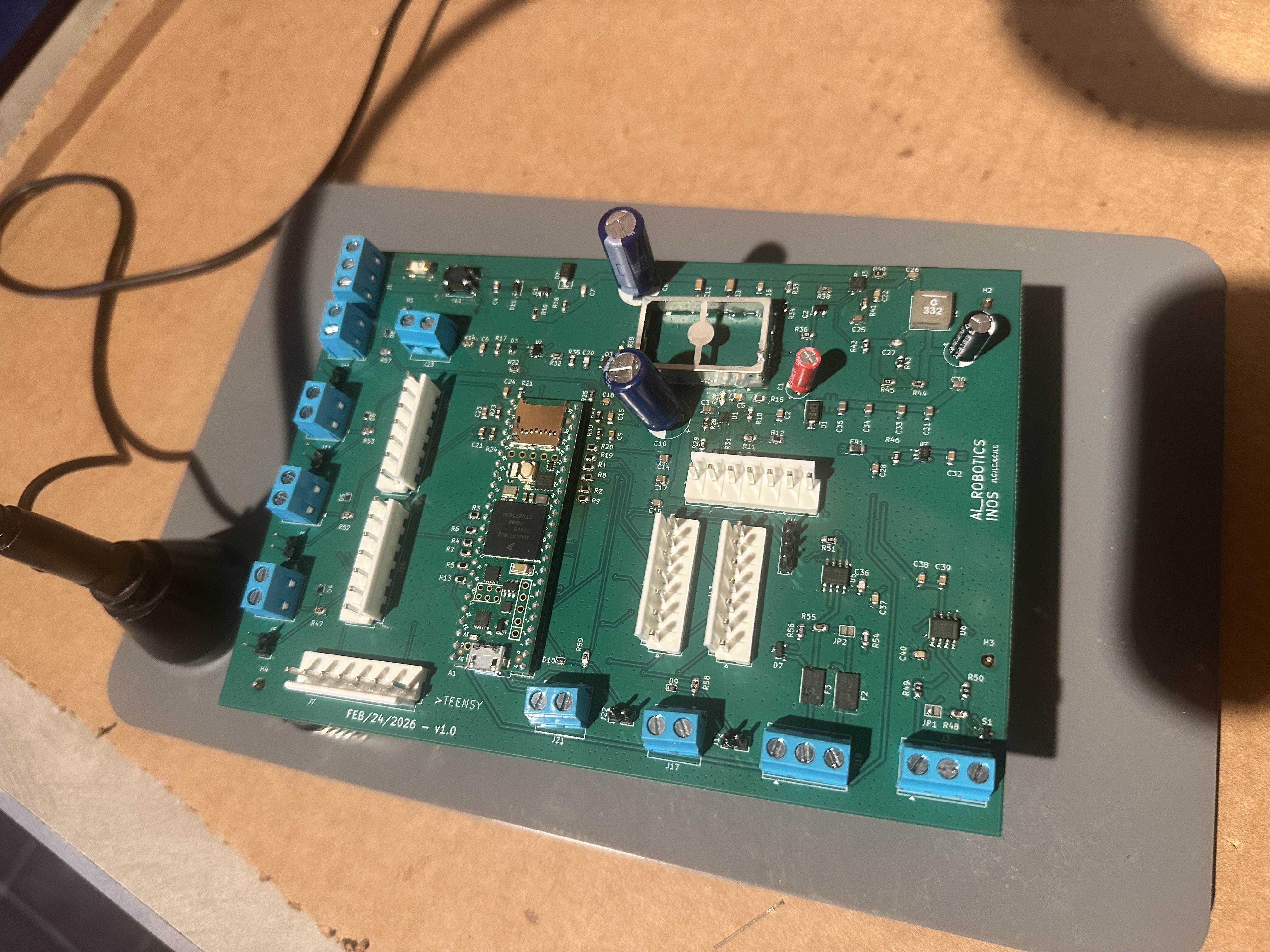
Features:
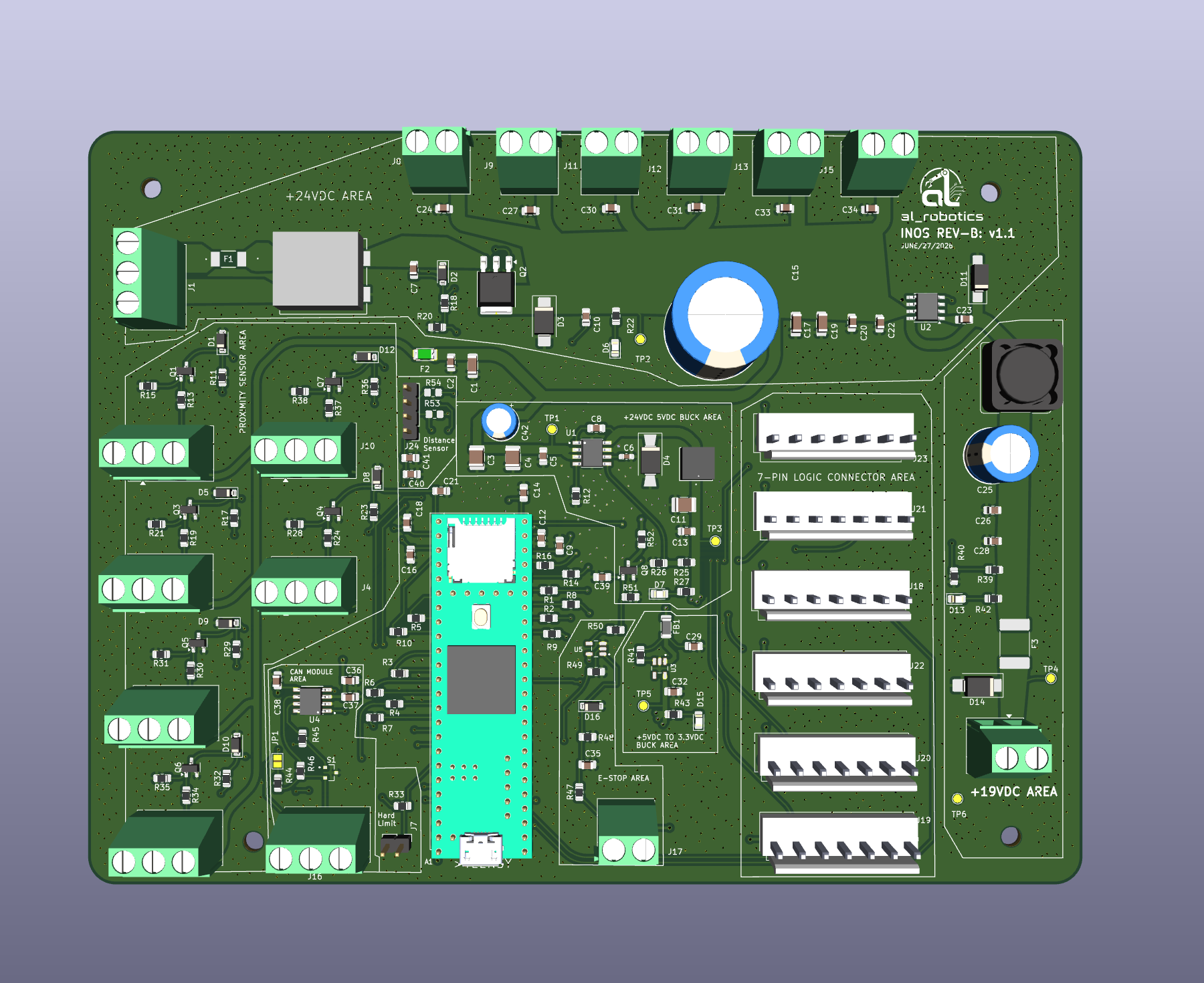
Designed using KiCad and manufactured through JLCPCB.


The INOS Rev A platform has successfully demonstrated:
The long-term objective of the INOS platform is to create a scalable robotics architecture capable of supporting:
INOS Rev A is an experimental development platform and active engineering project. The hardware and software are continuously evolving as new features, capabilities, and lessons learned are incorporated into future revisions.
| Qty | Value | Footprint | References |
|---|---|---|---|
| 15 | 100 | Resistor_SMD:R_0805_2012Metric_Pad1.20x1.40mm_HandSolder | R1, R2, R3, R4, R5, R6, R7, R8, R9, R13, R15, R16, R19, R20, R37 |
| 7 | 10K | Resistor_SMD:R_0805_2012Metric_Pad1.20x1.40mm_HandSolder | R21, R23, R24, R25, R27, R30, R31 |
| 7 | 10nF | Capacitor_SMD:C_0805_2012Metric_Pad1.18x1.45mm_HandSolder | C5, C9, C15, C18, C21, C23, C24 |
| 7 | 1K | Resistor_SMD:R_0805_2012Metric_Pad1.20x1.40mm_HandSolder | R14, R47, R52, R53, R57, R58, R59 |
| 7 | 22uF | Capacitor_SMD:C_0805_2012Metric_Pad1.18x1.45mm_HandSolder | C14, C17, C30, C31, C33, C34, C35 |
| 7 | Limit Switch | TerminalBlock_Phoenix:TerminalBlock_Phoenix_MKDS-1,5-2-5.08_1x02_P5.08mm_Horizontal | J4, J8, J10, J14, J17, J21, J23 |
| 6 | Conn_01x07 | Connector_JST:JST_VH_B7P-VH-B_1x07_P3.96mm_Vertical | J6, J7, J12, J13, J16, J20 |
| 6 | ESD5Z3.3 | Diode_SMD:D_SOD-523 | D4, D5, D6, D8, D9, D10 |
| 6 | Hard limit switch | Connector_PinHeader_2.54mm:PinHeader_1x02_P2.54mm_Vertical | J5, J9, J11, J15, J19, J22 |
| 5 | 0.1uF | Capacitor_SMD:C_0805_2012Metric_Pad1.18x1.45mm_HandSolder | C2, C16, C19, C26, C37 |
| 4 | 0 | Resistor_SMD:R_0805_2012Metric_Pad1.20x1.40mm_HandSolder | R40, R43, R49, R50 |
| 4 | 100K | Resistor_SMD:R_0805_2012Metric_Pad1.20x1.40mm_HandSolder | R17, R35, R46, R51 |
| 4 | 100nF | Capacitor_SMD:C_0805_2012Metric_Pad1.18x1.45mm_HandSolder | C6, C7, C38, C40 |
| 4 | MountingHole | MountingHole:MountingHole_2.5mm | H1, H2, H3, H4 |
| 3 | 100k | Resistor_SMD:R_0805_2012Metric_Pad1.20x1.40mm_HandSolder | R18, R36, R41 |
| 3 | TB006-508-03BE | TerminalBlock_Phoenix:TerminalBlock_Phoenix_MKDS-1,5-3-5.08_1x03_P5.08mm_Horizontal | J1, J3, J18 |
| 2 | 1 µF | Capacitor_SMD:C_0805_2012Metric_Pad1.18x1.45mm_HandSolder | C28, C32 |
| 2 | 100pF | Capacitor_SMD:C_0805_2012Metric_Pad1.18x1.45mm_HandSolder | C20, C36 |
| 2 | 10uF | Capacitor_SMD:C_1206_3216Metric_Pad1.33x1.80mm_HandSolder | C11, C13 |
| 2 | 120 | Resistor_SMD:R_0805_2012Metric_Pad1.20x1.40mm_HandSolder | R48, R55 |
| 2 | 2N7002 | Package_TO_SOT_SMD:SOT-23-3 | Q2, Q3 |
| 2 | 470uF | Capacitor_THT:CP_Radial_D10.0mm_P5.00mm | C8, C10 |
| 2 | 47K | Resistor_SMD:R_0805_2012Metric_Pad1.20x1.40mm_HandSolder | R22, R28 |
| 2 | 680 | Resistor_SMD:R_0805_2012Metric_Pad1.20x1.40mm_HandSolder | R54, R56 |
| 2 | Jumper_2_Open | Jumper:SolderJumper-2_P1.3mm_Open_Pad1.0x1.5mm | JP1, JP2 |
| 2 | TBU-CA-065-200-WH | Fuse:Fuse_Bourns_TBU-CA | F2, F3 |
| 1 | 10k | Resistor_SMD:R_0805_2012Metric_Pad1.20x1.40mm_HandSolder | R42 |
| 1 | 10nF | Resistor_SMD:R_0805_2012Metric_Pad1.20x1.40mm_HandSolder | C4 |
| 1 | 137K | Resistor_SMD:R_0805_2012Metric_Pad1.20x1.40mm_HandSolder | R12 |
| 1 | 15.8K | Resistor_SMD:R_0805_2012Metric_Pad1.20x1.40mm_HandSolder | R29 |
| 1 | 150pF | Capacitor_SMD:C_0805_2012Metric_Pad1.18x1.45mm_HandSolder | C27 |
| 1 | 169k | Resistor_SMD:R_0805_2012Metric_Pad1.20x1.40mm_HandSolder | R33 |
| 1 | 1uF | Capacitor_SMD:C_0805_2012Metric_Pad1.18x1.45mm_HandSolder | C39 |
| 1 | 2.2uF | Capacitor_SMD:C_0805_2012Metric_Pad1.18x1.45mm_HandSolder | C25 |
| 1 | 220uF | Capacitor_THT:CP_Radial_D6.3mm_P2.50mm | C29 |
| 1 | 22uF | Capacitor_THT:CP_Radial_D5.0mm_P2.00mm | C1 |
| 1 | 33.2K | Resistor_SMD:R_0805_2012Metric_Pad1.20x1.40mm_HandSolder | R11 |
| 1 | 330 | Resistor_SMD:R_0805_2012Metric_Pad1.20x1.40mm_HandSolder | R32 |
| 1 | 36.1k | Resistor_SMD:R_0603_1608Metric_Pad0.98x0.95mm_HandSolder | R34 |
| 1 | 4.7K | Resistor_SMD:R_0805_2012Metric_Pad1.20x1.40mm_HandSolder | R39 |
| 1 | 4.7nF | Capacitor_SMD:C_0805_2012Metric_Pad1.18x1.45mm_HandSolder | C12 |
| 1 | 470K | Resistor_SMD:R_0805_2012Metric_Pad1.20x1.40mm_HandSolder | R10 |
| 1 | 47nF | Capacitor_SMD:C_0805_2012Metric_Pad1.18x1.45mm_HandSolder | C22 |
| 1 | 49.9 | Resistor_SMD:R_0805_2012Metric_Pad1.20x1.40mm_HandSolder | R44 |
| 1 | 5.6nF | Capacitor_SMD:C_0805_2012Metric_Pad1.18x1.45mm_HandSolder | C3 |
| 1 | 52.3k | Resistor_SMD:R_0805_2012Metric_Pad1.20x1.40mm_HandSolder | R38 |
| 1 | 549 | Resistor_SMD:R_0805_2012Metric_Pad1.20x1.40mm_HandSolder | R26 |
| 1 | 73.2k | Resistor_SMD:R_0805_2012Metric_Pad1.20x1.40mm_HandSolder | R45 |
| 1 | ACM7060-701-2PL-TL01 | Inductor_SMD:L_CommonModeChoke_TDK_ACM7060 | L1 |
| 1 | BLM31PG121SH1L | Inductor_SMD:L_1206_3216Metric | FB1 |
| 1 | BMI-S-209-F | RF_Shielding:Laird_Technologies_BMI-S-209-F_29.36x18.50mm | J2 |
| 1 | BZT52C15-7-F | Diode_SMD:D_SOD-123 | D11 |
| 1 | CDSOT23-SM712 | Package_TO_SOT_SMD:SOT-23 | D7 |
| 1 | Conn_01x04 | Connector_PinHeader_2.54mm:PinHeader_1x04_P2.54mm_Vertical | J24 |
| 1 | DMP4065S-7 | Package_TO_SOT_SMD:SOT-23 | Q1 |
| 1 | ESD5Z3V3 | Diode_SMD:D_SOD-523 | D3 |
| 1 | Fuse | Fuse:Fuse_Littelfuse-NANO2-451_453 | F1 |
| 1 | MAX3485ESA+T | Package_SO:SOIC-8_3.9x4.9mm_P1.27mm | U5 |
| 1 | PESD2CANFD36UU-Q | Teensy 4.1:DIO_PESD2CAN_215 | S1 |
| 1 | SMAJ24A | Diode_SMD:D_SMA | D2 |
| 1 | SMAJ6.0A | Diode_SMD:D_SMA | D1 |
| 1 | SN74LVC1G08DBVRE4 | Teensy 4.1:SOT95P280X145-5N | U2 |
| 1 | TCAN1042HGVDRQ1 | Teensy 4.1:TCAN1042HGVDRQ1 | U6 |
| 1 | TEENSY_4.1 | Teensy 4.1:TEENSY_LONG_EXT | A1 |
| 1 | TLV75533PDBV | Teensy 4.1:TLV75533PDBV | U7 |
| 1 | TPS259474LRPWR | Teensy 4.1:IC_TPS25974ARPWR | U1 |
| 1 | TPS56A37RPAR | Teensy 4.1:RPA0010A-MFG | U3 |
| 1 | XAL7030-332MEC | Inductor_SMD:L_Coilcraft_XAL7030-332 | L2 |
tsmiltonAgents/pl60c-dmx-wakeup
A small ESP32-S3 board that drives the wired DMX512 input of a Neewer PL60C panel light so the light can be ramped up slowly in the morning (sunrise alarm). Rev A, 2026-09-02.


imendizabal/LibreVerter
Open Source Power Converter - Hardware Components


Mines-Rocketry-Club/flight-computers
Fully open source high power rocketry flight computers.

BayLibre/Labrack
A standard 1U rack front panel metal sheet and PCB providing power, connectivity and more.
It measures 163 × 117 mm and has 4 copper layers, 1.6 mm thick.
157 parts, built around the MAX3485ESA+T, TCAN1042HGVDRQ1, TEENSY 4.1 and TPS56A37RPAR. The full list of its parts is on this page, with links to each part's symbol and footprint where PCBKit's library has them.
From the olexsu/inos-rev-a-robotics-controller repository on GitHub, at the commit this page was made from: the board is hardware/inos rev-a/Teensy 4.1 + Jetson Nano powered from board.kicad_pcb and its schematic hardware/inos rev-a/Teensy 4.1 + Jetson Nano powered from board.kicad_sch. PCBKit opens the board in the browser, with nothing to install.
Its repository publishes it under the MIT licence: you may reuse it on that licence's terms (keep the author's notice, and for a copyleft licence share your changes alike).