4 layers70 × 116 mm

 niksaw/SenseView-IoT
Modular IoT environmental monitoring platform based on ESP32-C6 with custom hardware, MQTT, InfluxDB and Grafana.
ESP32C6 IoT Sensor Node rev6 ThrougHole is an open-source printed circuit board by niksaw, from the niksaw/SenseView-IoT repository on GitHub, published under the MIT licence. It is a 2-layer board of 40.1 × 96.7 mm with 37 parts on 45 nets, routed with 281 tracks and 33 vias.
It is built around the ESP32-C6-DEVKITC-1-N8, TPS63036YFGR and TP4057. Its parts include 12 resistors, 8 capacitors, 6 ICs, 3 diodes and 3 connectors. It belongs with the home automation and IoT and sensors and measurement boards and the ESP32 and RISC-V boards of this library.


An end-to-end IoT platform engineered from concept to deployment, integrating custom hardware, embedded firmware, and a scalable edge-to-cloud data pipeline.
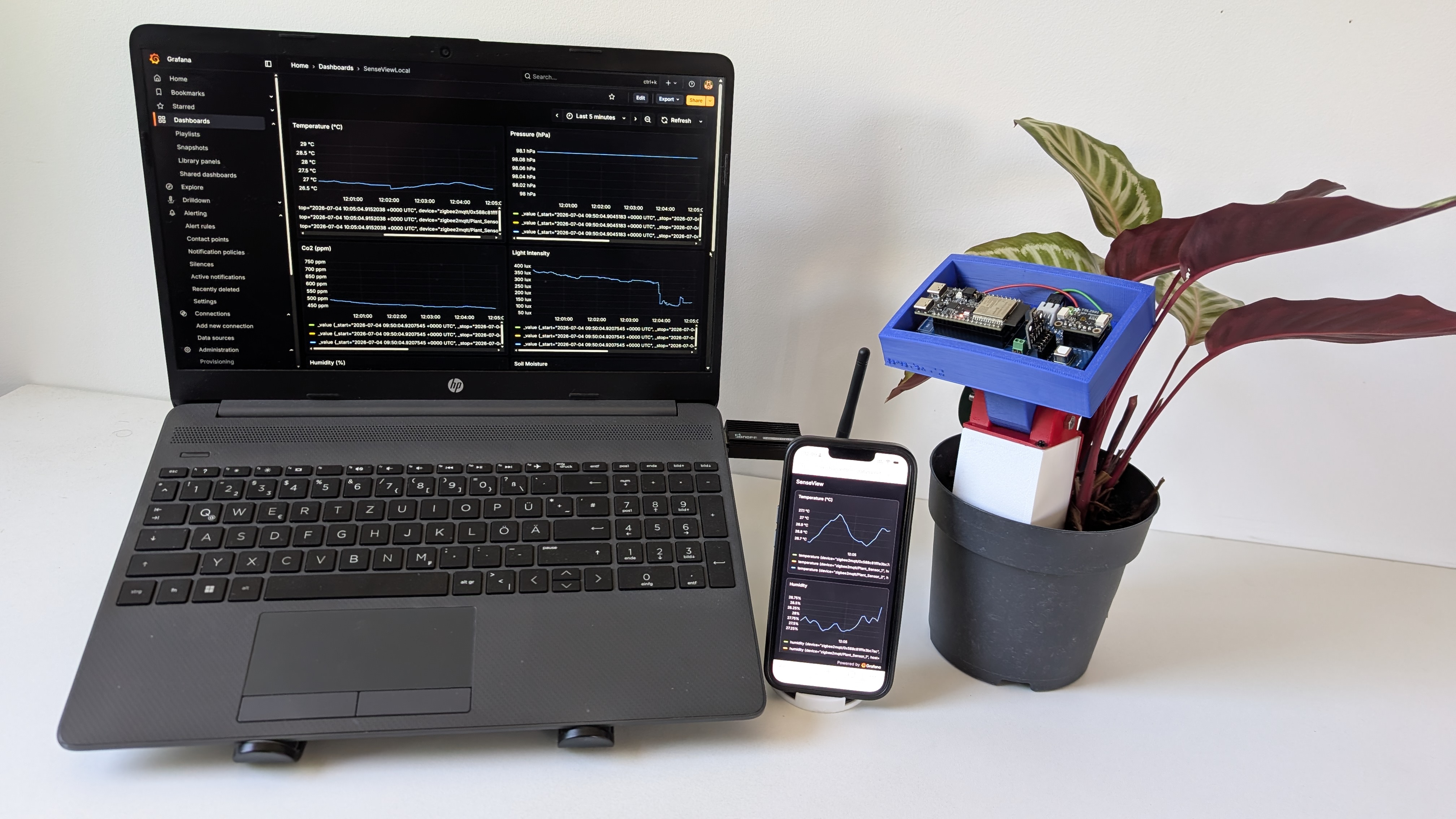




SenseView is a battery-powered IoT environmental monitoring platform developed to demonstrate the complete lifecycle of an embedded IoT system—from hardware design and firmware development to data acquisition, visualization, and cloud integration.
Originally developed as part of a Master's thesis in Electrical and Microsystems Engineering, the project was driven by research objectives emphasizing measurement quality, reliability, modularity, and low-power operation rather than minimizing hardware cost. Consequently, hardware and sensor selection were based on engineering requirements rather than cost optimization.
The platform combines a custom-designed ESP32-C6 sensor node, modular embedded firmware, and a complete MQTT-based backend capable of simultaneously storing data in both local and cloud time-series databases. Although the current implementation uses Zigbee communication, the architecture was intentionally designed to support future migration to Wi-Fi or Thread/Matter with minimal changes.
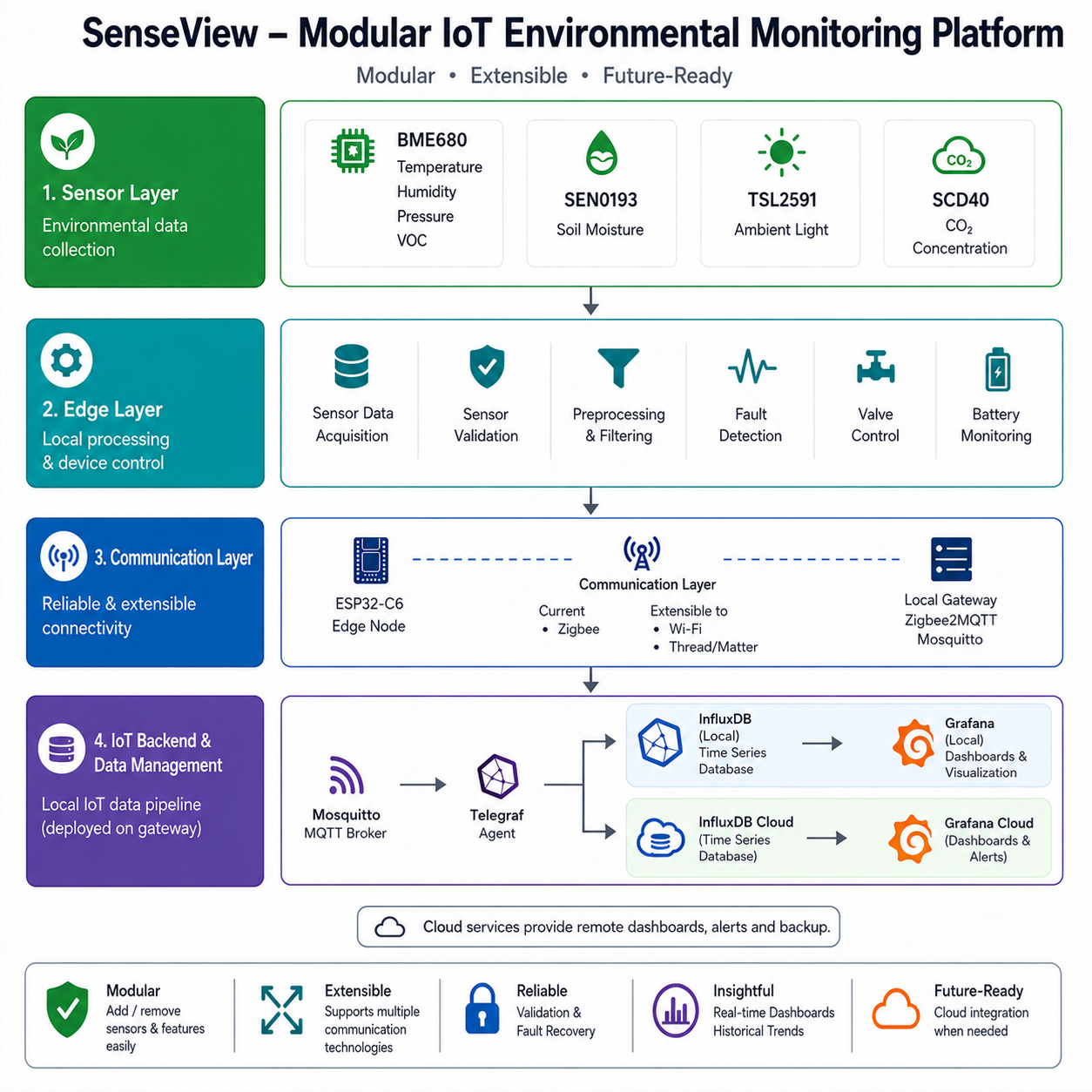
| Category | Technology |
|---|---|
| Microcontroller | ESP32-C6 |
| Sensors | SCD40, BME680, TSL2591, SEN0193 |
| Communication | Zigbee (Extensible to Wi-Fi & Thread/Matter) |
| Firmware | Arduino Framework (C++) |
| MQTT Broker | Mosquitto |
| Data Collection | Telegraf |
| Database | InfluxDB + InfluxDB Cloud |
| Dashboard | Grafana + Grafana Cloud |
| PCB Design | KiCad |
| Mechanical Design | SolidWorks |
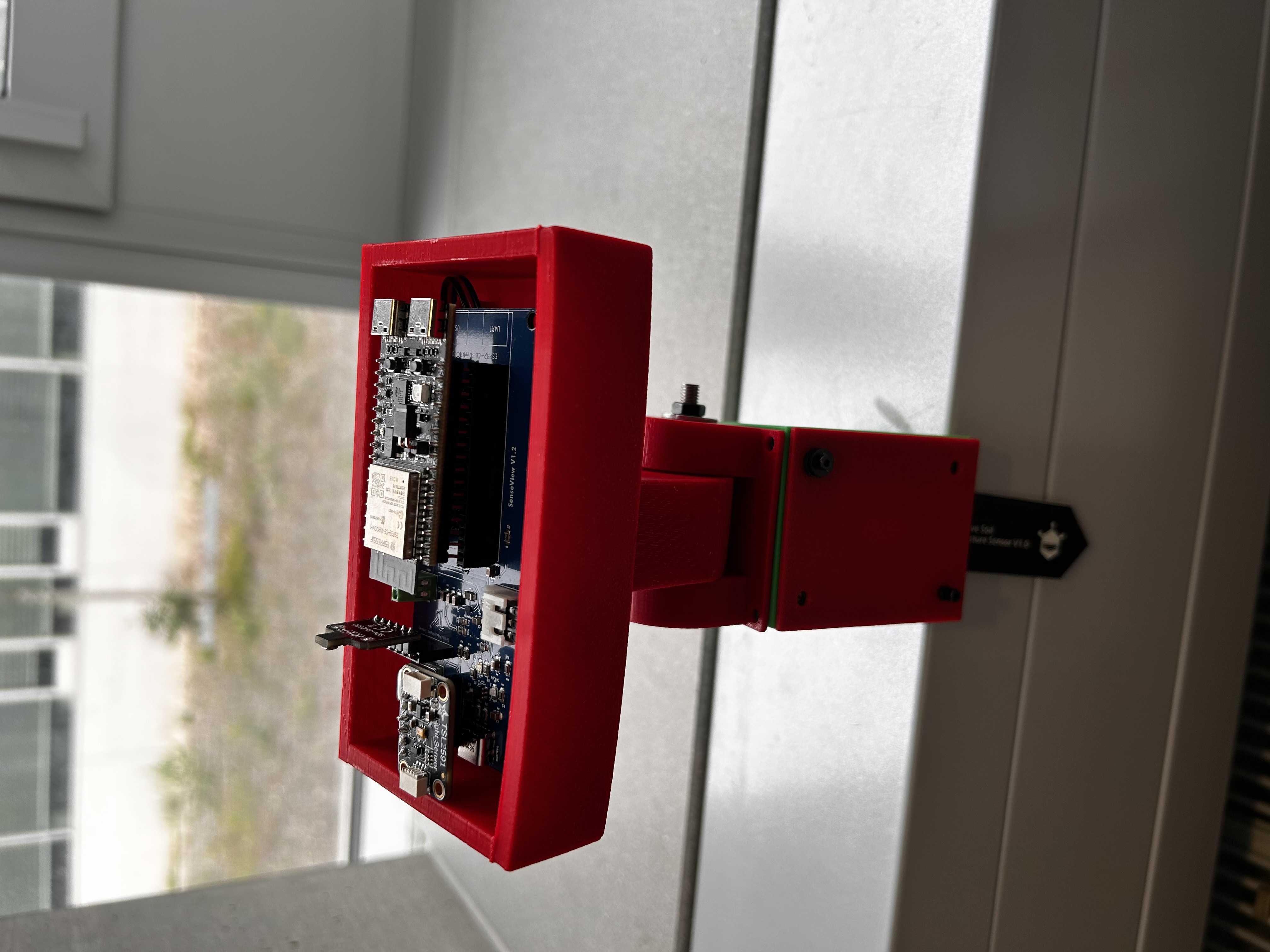
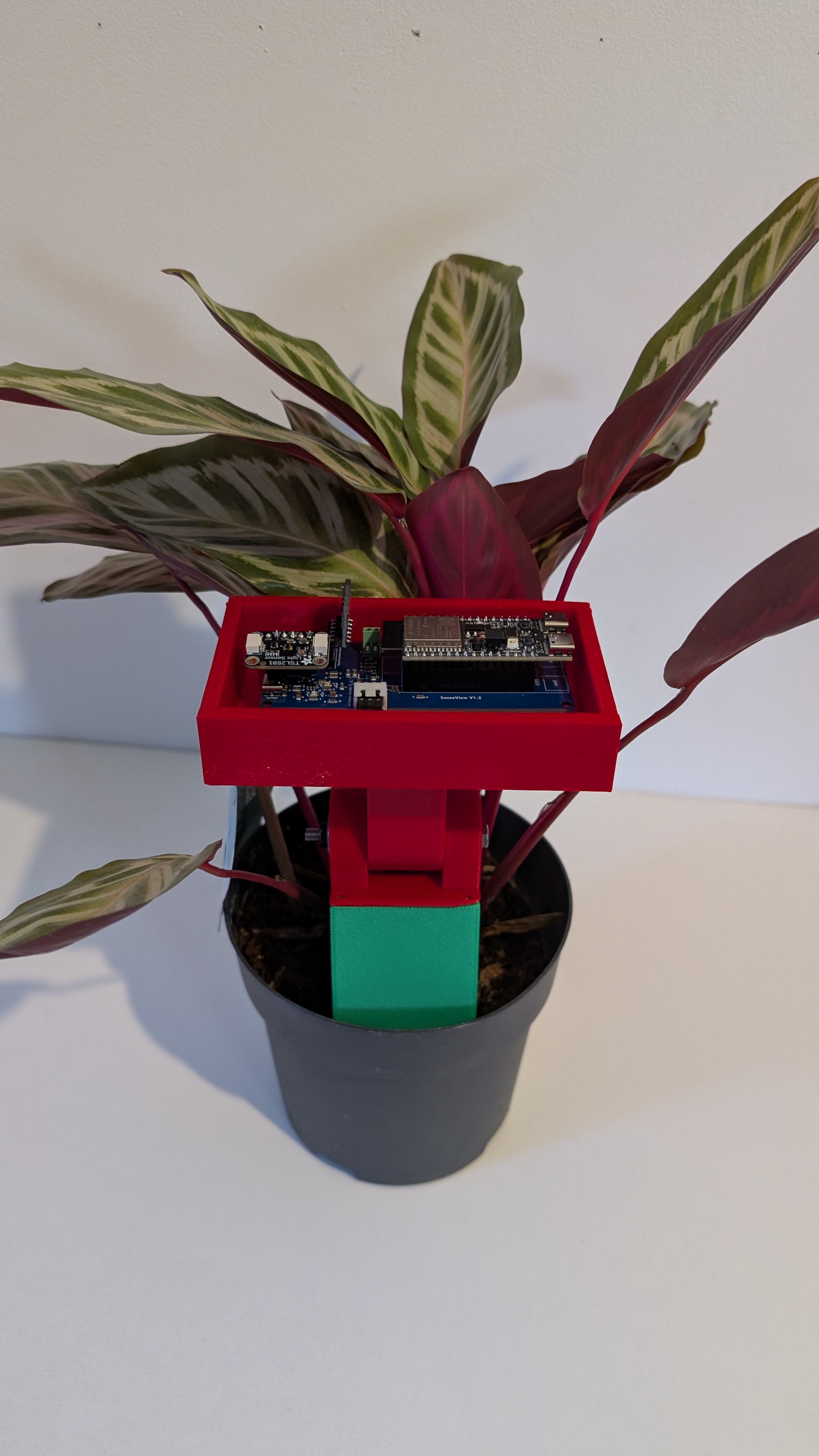
Battery-powered prototype assembled inside the custom enclosure prior to deployment.
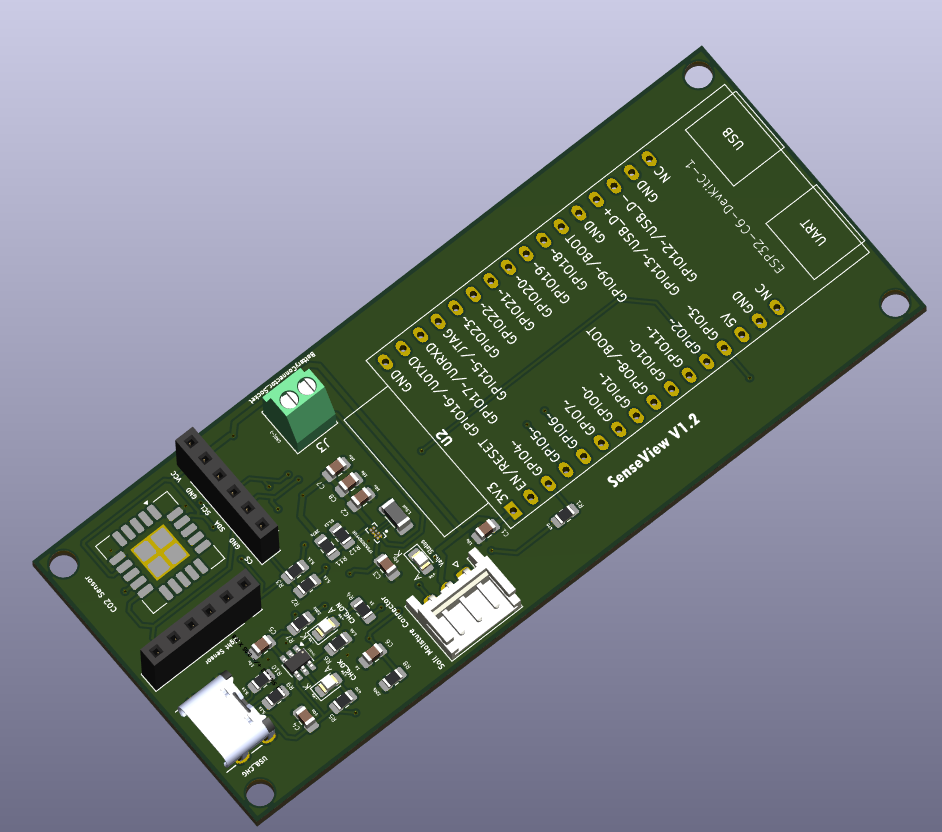
PCB integrating the ESP32-C6, environmental sensors, battery management, and expansion headers.
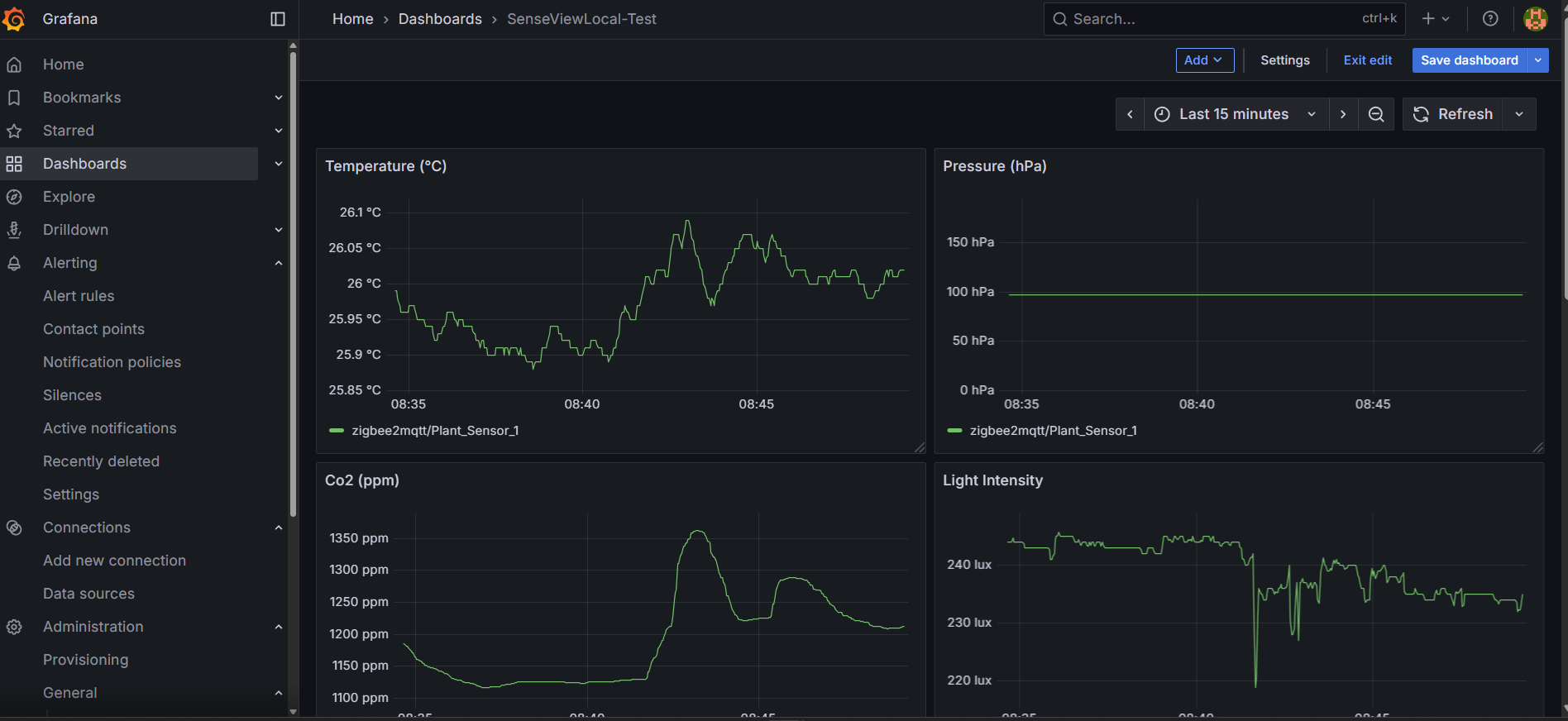
Real-time visualization of environmental data collected from the deployed sensor node
Prototype deployed for indoor environmental monitoring
| Sensor | Purpose |
|---|---|
| Sensirion SCD40 | CO₂ Concentration |
| Bosch BME680 | Temperature, Humidity, Pressure, VOC |
| Adafruit TSL2591 | Ambient Light |
| DFRobot SEN0193 | Soil Moisture |
firmware/
    ESP32-C6 firmware

hardware/
    bom/
    gerbers/
    kicad/

enclosure/
    SolidWorks enclosure

images/
    architecture/
    dashboard/
    hardware/
showcase/| Decision | Reason |
|---|---|
| ESP32-C6 | Supports Zigbee, Wi-Fi and native Thread, enabling a modular communication architecture. |
| Zigbee | Low-power communication suitable for battery-operated IoT devices and readily available laboratory infrastructure. |
| BME680 | Higher measurement capability including VOC sensing compared to BME280. |
| Custom PCB | Improved robustness, compactness and deployment reliability compared to breadboard prototypes. |
| Telegraf | Flexible preprocessing and simultaneous transmission to both local and cloud InfluxDB instances. |
Some of the most significant engineering challenges encountered during this project included:
This project was developed as part of a Master's thesis in Electrical and Microsystems Engineering at OTH Regensburg.
Rather than focusing on building a single-purpose plant monitoring device, the objective was to engineer a reusable IoT platform capable of supporting environmental sensing applications while remaining modular, scalable and suitable for future communication technologies.
I would like to thank my thesis supervisor and OTH Regensburg for providing the opportunity and research environment for this project.
This project is licensed under the MIT License.
| Qty | Value | Footprint | References |
|---|---|---|---|
| 7 | 10u | Capacitor_SMD:C_0805_2012Metric_Pad1.18x1.45mm_HandSolder | C1, C2, C3, C4, C5, C7, C8 |
| 4 | , , , | ||
| 4 | 5.1k | Resistor_SMD:R_0805_2012Metric_Pad1.20x1.40mm_HandSolder | R2, R3, R9, R10 |
| 2 | 220k | Resistor_SMD:R_0805_2012Metric_Pad1.20x1.40mm_HandSolder | R7, R8 |
| 2 | 470 | Resistor_SMD:R_0805_2012Metric_Pad1.20x1.40mm_HandSolder | R1, R5 |
| 1 | 1.5uH | Inductor_SMD:L_1206_3216Metric | L1 |
| 1 | 1.6k | Resistor_SMD:R_0805_2012Metric_Pad1.20x1.40mm_HandSolder | R6 |
| 1 | 1k | Resistor_SMD:R_0805_2012Metric_Pad1.20x1.40mm_HandSolder | R4 |
| 1 | 1u | Capacitor_SMD:C_0805_2012Metric_Pad1.18x1.45mm_HandSolder | C6 |
| 1 | 287k | Resistor_SMD:R_0805_2012Metric_Pad1.20x1.40mm_HandSolder | R11 |
| 1 | 51.1k | Resistor_SMD:R_0805_2012Metric_Pad1.20x1.40mm_HandSolder | R12 |
| 1 | BatteryConnector_Socket | TerminalBlock_Phoenix:TerminalBlock_Phoenix_MPT-0,5-2-2.54_1x02_P2.54mm_Horizontal | J3 |
| 1 | CHG_OK | LED_SMD:LED_0805_2012Metric_Pad1.15x1.40mm_HandSolder | D1 |
| 1 | CHG_ON | LED_SMD:LED_0805_2012Metric_Pad1.15x1.40mm_HandSolder | D3 |
| 1 | CO2 Sensor | Sensor:Sensirion_SCD4x-1EP_10.1x10.1mm_P1.25mm_EP4.8x4.8mm | U3 |
| 1 | ESP32-C6-DevKitC-1 | Espressif:ESP32-C6-DevKitC-1 | U2 |
| 1 | Light Sensor | Connector_PinSocket_2.54mm:PinSocket_1x06_P2.54mm_Vertical | U4 |
| 1 | Soil Moisture Connector | Connector_JST:JST_EH_S3B-EH_1x03_P2.50mm_Horizontal | J1 |
| 1 | TP4057 | Package_TO_SOT_SMD:TSOT-23-6 | U5 |
| 1 | TPS63036YFGR | TPS63036YFGR:BGA8N40P4X2_181X107X62N | U6 |
| 1 | Temp/Press/Humd Sensor | Connector_PinSocket_2.54mm:PinSocket_1x06_P2.54mm_Vertical | U1 |
| 1 | USB_CHG | 217175-0001 USB Type C:MOLEX_2171750001 | J2 |
| 1 | Valve Status | LED_SMD:LED_0805_2012Metric_Pad1.15x1.40mm_HandSolder | D2 |


cvonk/OPNpool
Integrates the functionality of a Pentair pool controller into the smart home using ESP32 SoC.

embedded-purdue/IntelliThings
From IoT to AIoT: ESP32-C6 sensor nodes, Home Assistant and an LLM agent that acts through MCP

Angelpele/F1-Steering-Wheel
F1 Functional Steering Wheel based on the ESP32

kongr45gpen/led-controller-pcb
A PCB to control LEDs (up to 5 channels) using PWM, based on an Espressif ESP32-C6 development board.

leehambley/leels
Lee LS (Lead Screw). Forked and simplified from kachurovskiy/nanoels, rewritten in Rust and simplified for a true ELS implementation not a quasi-CNC controller

Poent/RC-Snowblower
Working on designing the impeller and auger portion of the snowblower. Switched from using a worm gear assembly to a custom ring and pinion setup using a spiral bevel gear.
It measures 40.1 × 96.7 mm and has 2 copper layers, 1.6 mm thick.
37 parts, built around the ESP32-C6-DEVKITC-1-N8, TPS63036YFGR and TP4057. The full list of its parts is on this page, with links to each part's symbol and footprint where PCBKit's library has them.
From the niksaw/SenseView-IoT repository on GitHub, at the commit this page was made from: the board is hardware/kicad/ESP32C6_IoT_Sensor_Node_rev6_ThrougHole.kicad_pcb and its schematic hardware/kicad/ESP32C6_IoT_Sensor_Node_rev6_ThrougHole.kicad_sch. PCBKit opens the board in the browser, with nothing to install.
Its repository publishes it under the MIT licence: you may reuse it on that licence's terms (keep the author's notice, and for a copyleft licence share your changes alike).