
2 layers13 × 39 mm
Connector
nepyope/Project-Homunculus
Project Homunculus is open-source, low-cost hardware for capturing human hand and arm motions. It has two parts.
7 parts51
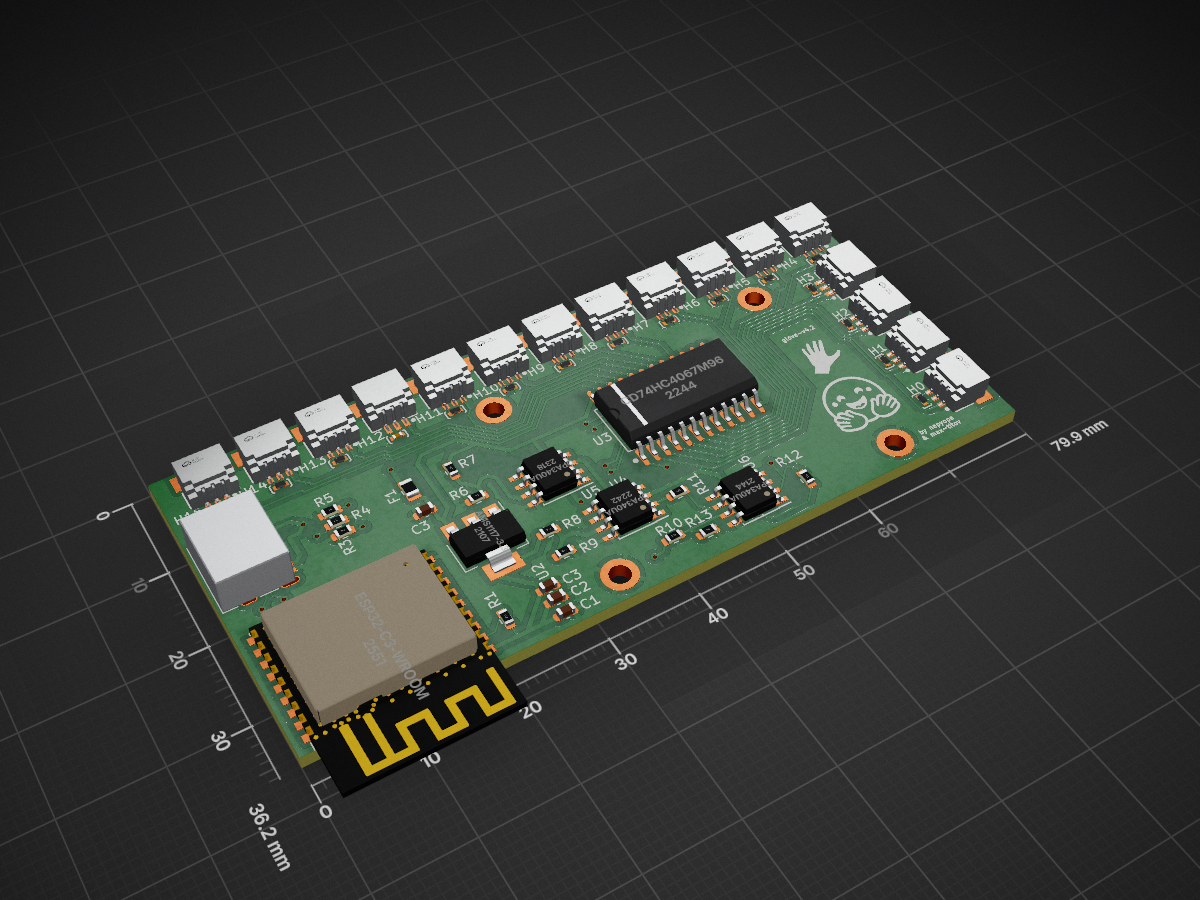
 nepyope/Project-Homunculus51
Project Homunculus is open-source, low-cost hardware for capturing human hand and arm motions. It has two parts.
Desk display is an open-source printed circuit board by nepyope, from the nepyope/Project-Homunculus repository on GitHub. It is a 2-layer board of 79.9 × 36.2 mm with 63 parts on 44 nets, routed with 479 tracks and 40 vias.
It is built around the ESP32-C3-WROOM-02-H4, OPA340UA and AMS1117-3.3, with the CD74HC4067M96 among its other parts. Its parts include 20 capacitors, 12 resistors, 6 ICs, 1 connector and 1 fuse. It belongs with the lEDs and displays boards and the ESP32 and RISC-V boards of this library.


Project Homunculus is open-source, low-cost hardware for capturing human hand and arm motions. It has two parts. The first is a Hall-effect VR glove that tracks finger joints with magnetic sensors instead of cameras or external tracking stations. The second is a 7-DOF exoskeleton arm for whole-body teleoperation. Together they let you drive dexterous hands and humanoids directly from your own body, so you can collect demonstration data for robot learning without motion-capture rigs or expensive commercial gloves.
The glove is built from off-the-shelf parts (SS49E Hall sensors, an ESP32-C3, a 16-channel multiplexer) and costs under $20 in materials. Everything is included so you can build, modify, and extend it yourself: firmware, a 3D-printable enclosure, the PCB design, and a Unity visualizer.
| Qty | Value | Footprint | References |
|---|---|---|---|
| 16 | C-0402-0.1uF-16V | 0_easyeda2kicad:C0402 | C0, C1, C1, C1, C1, C1, C1, C1, C1, C1, C1, C1, C1, C2, C3, C9 |
| 16 | JST-SM03B | 0_easyeda2kicad:CONN-SMD_SM03B-SRSS-TB-LF-SN-P | H0, H1, H2, H3, H4, H5, H6, H7, H8, H9, H10, H11, H12, H13, H14, H15 |
| 5 | 10K | Resistor_SMD:R_0603_1608Metric | R8, R10, R10, R11, R12 |
| 4 | 10µF | Capacitor_SMD:C_0603_1608Metric | C1, C2, C3, C3 |
| 4 | 5.11K | Resistor_SMD:R_0603_1608Metric | R1, R4, R5, R6 |
| 3 | OPA340UA | Housings_SOIC:SOIC-8_3.9x4.9mm_Pitch1.27mm | U4, U5, U6 |
| 1 | 1K | Resistor_SMD:R_0603_1608Metric | R7 |
| 1 | 1M | Resistor_SMD:R_0603_1608Metric | R3 |
| 1 | 2.4K | Resistor_SMD:R_0603_1608Metric | R9 |
| 1 | AMS1117-3.3 | Package_TO_SOT_SMD:SOT-223-3_TabPin2 | U2 |
| 1 | CD74HC4067M96 | 0_easyeda2kicad:SOIC-24_L15.4-W7.5-P1.27-LS10.3-BL | U3 |
| 1 | ESP32-C3-WROOM-02 | Espressif:ESP32-C3-WROOM-02 | U1 |
| 1 | Fuse_0805_2012Metric | Fuse:Fuse_0805_2012Metric | F1 |
| 1 | LOGO | pcb:glovegraphics | G*** |
| 1 | LOGO | pcb:hf | G*** |
| 1 | LOGO | pcb:glve | G*** |
| 1 | USB_C_Receptacle_USB2.0 | Connector_USB:USB_C_Receptacle_Palconn_UTC16-G | J1 |
The 59 most common of 63 parts.
nepyope/Project-Homunculus
Project Homunculus is open-source, low-cost hardware for capturing human hand and arm motions. It has two parts.

JQIamo/Eurocard_DDS
DDS Controller designed for the DDS board with ad9910 at JQI

mmazzanti/PMT-counter
A PCB board for counting pulses up to 1.5GHz from a PMT (or similar)


qrotx/qrotx-singleband-hw
Schematics and PCB design

vatral/nodemcu_camera_trigger
Trigger for Pentax cameras based on sound, light and LIDAR

zademahi238/mission-mimosa
To answer this, we compare task-completion success rates with and without tactile sensing across different robot-learning policies.

dataehora/beatconfused
A small web studio of fast, elegant, install-free music tools. Every tool is plain HTML, CSS and vanilla JavaScript with the Web Audio API — no build step, no dependencies, no accounts, works offline after first load.
It measures 79.9 × 36.2 mm and has 2 copper layers, 1.6 mm thick.
63 parts, built around the ESP32-C3-WROOM-02-H4, OPA340UA, AMS1117-3.3 and CD74HC4067M96. The full list of its parts is on this page, with links to each part's symbol and footprint where PCBKit's library has them.
From the nepyope/Project-Homunculus repository on GitHub, at the commit this page was made from: the board is glove/homunculus_pcb/kicad/pcb/desk_display.kicad_pcb and its schematic glove/homunculus_pcb/kicad/pcb/connector/._connector.kicad_sch. PCBKit opens the board in the browser, with nothing to install.
Its repository states no licence, so its author keeps all rights: ask nepyope before reusing the design.