4 layers100 × 100 mm

 NEOgHacking/Balancing_cam1
Balancing cam is an open-source printed circuit board by NEOgHacking, from the NEOgHacking/Balancing_cam repository on GitHub. It is a 4-layer board of 50 × 50 mm with 145 parts on 127 nets, routed with 739 tracks and 212 vias.
It is built around the ESP32-S3-MINI-1-N8, TPS62933DRL and TMC2209-LA, with the LSM6DS3, USBLC6-2P6 and BLM18KG121TN1D among its other parts. Its parts include 46 capacitors, 25 resistors, 14 inductors, 9 diodes and 9 connectors. It belongs with the ESP32 boards of this library.


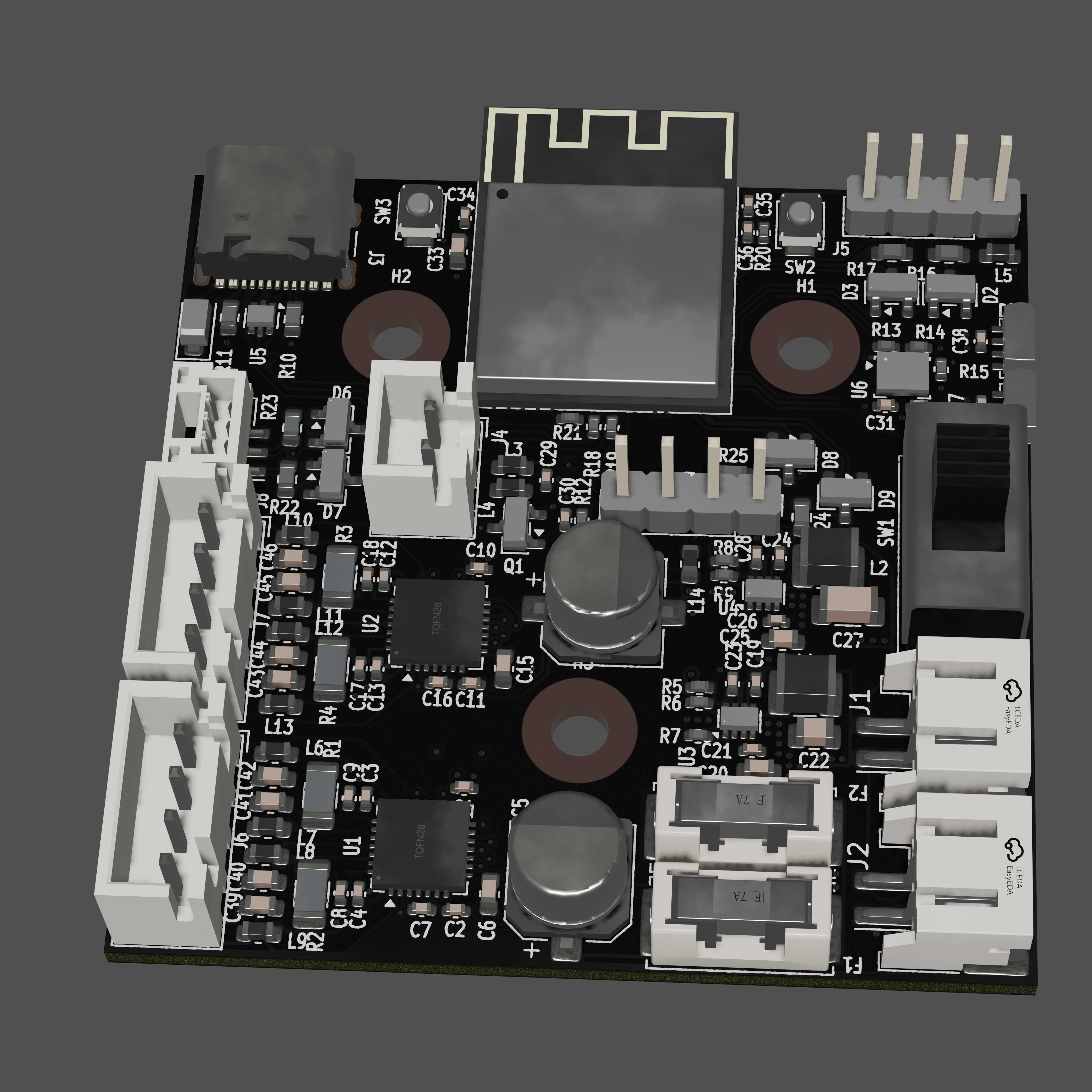
This is a side project to improve on the with a new smaller esd protected pcb to prevent failures on the board, also to make the board smaller and make room for a second battery pack.
| Qty | Value | Footprint | References |
|---|---|---|---|
| 24 | 100n | Capacitor_SMD:C_0402_1005Metric | C1, C2, C3, C10, C11, C12, C13, C17, C18, C19, C21, C24, C26, C29, C30, C31 +8 |
| 22 | TestPoint | TestPoint:TestPoint_Pad_D1.5mm | TP1, TP2, TP3, TP10, TP11, TP12, TP13, TP14, TP15, TP16, TP17, TP18, TP19, TP21, TP22, TP23 +6 |
| 12 | BLM18KG121TN1D | Inductor_SMD:L_0603_1608Metric | L3, L4, L5, L6, L7, L8, L9, L10, L11, L12, L13, L14 |
| 8 | 1n | Capacitor_SMD:C_0603_1608Metric | C39, C40, C41, C42, C43, C44, C45, C46 |
| 6 | 100R | Resistor_SMD:R_0603_1608Metric | R16, R17, R22, R23, R24, R25 |
| 6 | BAV99W | Package_TO_SOT_SMD:SOT-23 | D2, D3, D6, D7, D8, D9 |
| 5 | 10k | Resistor_SMD:R_0402_1005Metric | R6, R9, R13, R14, R20 |
| 4 | 100m | Resistor_SMD:R_1206_3216Metric | R1, R2, R3, R4 |
| 4 | SolderJumper_2_Open | Jumper:SolderJumper-2_P1.3mm_Open_RoundedPad1.0x1.5mm | JP1, JP2, JP3, JP4 |
| 3 | 0R | Resistor_SMD:R_0402_1005Metric | R15, R18, R19 |
| 3 | MountingHole_Pad | MountingHole:MountingHole_3.2mm_M3_Pad | H1, H2, H3 |
| 2 | 100μ | Capacitor_SMD:CP_Elec_6.3x5.4 | C5, C14 |
| 2 | 10u | Capacitor_SMD:C_0603_1608Metric | C20, C25 |
| 2 | 1k | Resistor_SMD:R_0402_1005Metric | R12, R21 |
| 2 | 22n | Capacitor_SMD:C_0402_1005Metric | C7, C16 |
| 2 | 2u2 | Inductor_SMD:L_1210_3225Metric | L1, L2 |
| 2 | 2u2 | Capacitor_SMD:C_0603_1608Metric | C6, C15 |
| 2 | 33n | Capacitor_SMD:C_0402_1005Metric | C23, C28 |
| 2 | 5.1k | Resistor_SMD:R_0603_1608Metric | R10, R11 |
| 2 | B3U-1000P | Button_Switch_SMD:SW_SPST_B3U-1000P | SW2, SW3 |
| 2 | Conn_01x04 | Connector_JST:JST_XH_B4B-XH-A_1x04_P2.50mm_Vertical | J6, J7 |
| 2 | Conn_01x04 | Connector_PinHeader_2.54mm:PinHeader_1x04_P2.54mm_Vertical | J5, J9 |
| 2 | Fuse | Fuse:Fuseholder_Littelfuse_Nano2_154x | F1, F2 |
| 2 | JST_PH | footprints:JST_PH_S2B-PH-SM4-TB_1x02-1MP_P2.00mm_Horizontal | J1, J2 |
| 2 | TMC2209-LA | Package_DFN_QFN:VQFN-28-1EP_5x5mm_P0.5mm_EP3.7x3.7mm_ThermalVias | U1, U2 |
| 2 | TPS62933 | Package_TO_SOT_SMD:SOT-583-8 | U3, U4 |
| 2 | WS2812B-4020 | footprints:WS2812B-4020 | D4, D5 |
| 1 | 100u | Capacitor_SMD:C_1206_3216Metric | C27 |
| 1 | 14k7 | Resistor_SMD:R_0402_1005Metric | R7 |
| 1 | 1u | Capacitor_SMD:C_0402_1005Metric | C36 |
| 1 | 22u | Capacitor_SMD:C_0603_1608Metric | C33 |
| 1 | 30k9 | Resistor_SMD:R_0402_1005Metric | R8 |
| 1 | 47u | Capacitor_SMD:C_0805_2012Metric | C22 |
| 1 | 52k3 | Resistor_SMD:R_0402_1005Metric | R5 |
| 1 | BC817 | Package_TO_SOT_SMD:SOT-23 | Q1 |
| 1 | Conn_01x03 | Connector_JST:JST_GH_BM03B-GHS-TBT_1x03-1MP_P1.25mm_Vertical | J8 |
| 1 | DSK24L | Diode_SMD:D_SOD-123F | D1 |
| 1 | ESP32-S3-MINI-1 | RF_Module:ESP32-S2-MINI-1 | U7 |
| 1 | JST_XH | Connector_JST:JST_XH_B2B-XH-A_1x02_P2.50mm_Vertical | J4 |
| 1 | LSM6DS3 | Package_LGA:LGA-14_3x2.5mm_P0.5mm_LayoutBorder3x4y | U6 |
| 1 | SW_SPDT | footprints:SS12D10G5 | SW1 |
| 1 | USBLC6-2P6 | Package_TO_SOT_SMD:SOT-666 | U5 |
| 1 | USB_C_Receptacle_USB2.0_16P | Connector_USB:USB_C_Receptacle_GCT_USB4105-xx-A_16P_TopMnt_Horizontal | J3 |


NEOgHacking/SCORPION-MAX-V1
4x Power Mosfets for controlling heated beds, heaters, ext.

NEOgHacking/DMXion_4Port_Node
A 4 port dmx node with rdm funtionallity. Connects via ARTNET or sACN


It measures 50 × 50 mm and has 4 copper layers, 1.57 mm thick.
145 parts, built around the ESP32-S3-MINI-1-N8, TPS62933DRL, TMC2209-LA and LSM6DS3. The full list of its parts is on this page, with links to each part's symbol and footprint where PCBKit's library has them.
From the NEOgHacking/Balancing_cam repository on GitHub, at the commit this page was made from: the board is PCB/Balancing_cam/Balancing_cam.kicad_pcb and its schematic PCB/Balancing_cam/Balancing_cam.kicad_sch. PCBKit opens the board in the browser, with nothing to install.
Its repository states no licence, so its author keeps all rights: ask NEOgHacking before reusing the design.