2 layers99.8 × 65 mm
HandheldAerosolSensor
mrWheel/handheldAerosolSensor
This project describes a battery-powered, low-power air quality monitor
35 parts

 mrWheel/softPowerLatch
A simple and efficient soft power latch circuit that allows a device to be switched on and off using a single push button, with ultra-low standby current.
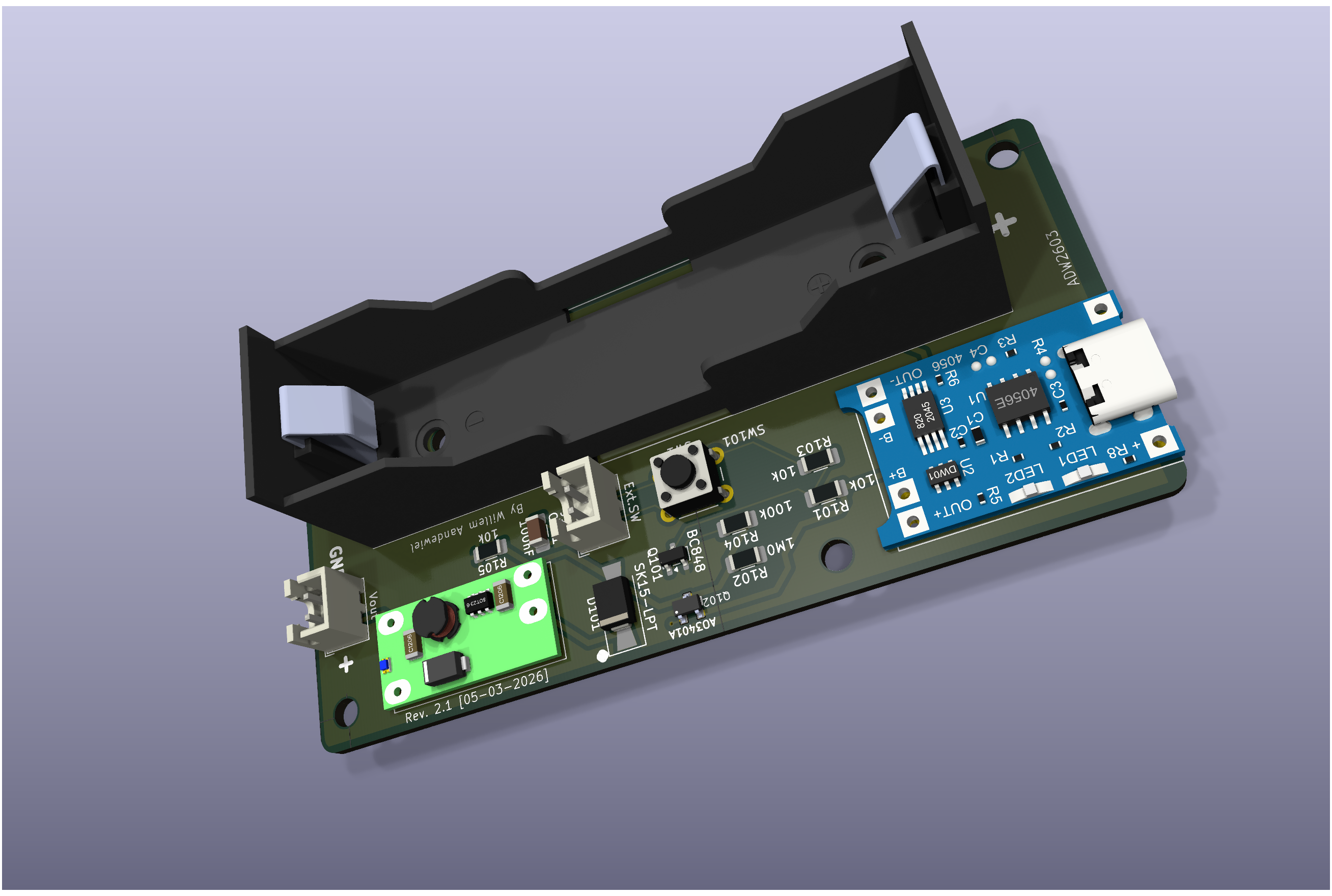
SoftPowerLatch is an open-source printed circuit board by mrWheel, from the mrWheel/softPowerLatch repository on GitHub, published under the MIT licence. It is a 2-layer board of 96 × 44 mm with 19 parts on 13 nets, routed with 64 tracks and 2 vias.
It is built around the AO3401A, BC848 and BH-18650-PC. Its parts include 5 resistors, 2 ICs, 2 transistors, 2 connectors and 1 capacitor.


This hardware is developed incrementally. That means I have no clear idea how it works (though it mostly does).
If you have questions about this software, it will probably take you just as long to figure things out as it would take me. So I’d prefer that you investigate it yourself.
Having said that Don’t Even Think About Using It
Seriously. Don’t.
Building this design may injure or kill you during construction, burn your house down while in use, and then—just to be thorough—explode afterward.
This is not a joke. This project involves lethal voltages. If you are not a qualified electronics engineer, close this repository, step away from the soldering iron, and make yourself a cup of tea.
If you decide to ignore all of the above and build it anyway, you do so entirely at your own risk. You are fully responsible for taking proper safety precautions. I take zero responsibility for anything that happens—electrically, mechanically, chemically, spiritually, or otherwise.
Also, full disclosure: I am not a qualified electrical engineer. I provide no guarantees, no warranties, and absolutely no assurance that this design is correct, safe, or suitable for any purpose whatsoever.
A simple and efficient soft power latch circuit that allows a device to be switched on and off using a single push button, with ultra-low standby current.
This project is based on the design described by Willem Aandewiel.
•	Single push-button ON/OFF control
•	Ultra-low standby current (µA range)
•	Suitable for battery-powered devices
•	Works with Li-Ion (e.g. 18650) + boost converter
•	Minimal component count
• Reliable latch behaviorThis circuit provides a latching power switch using discrete components. A short button press toggles the power state:
•	First press → Power ON
•	Second press → Power OFF
Unlike a mechanical switch, this solution allows:
•	electronic control
•	low standby consumption
• integration with microcontroller systems• The battery is connected but the circuit is inactive
• The MOSFET is OFF
• No current flows to the load
• Capacitor is uncharged• The capacitor pulls the MOSFET gate low
• The MOSFET turns ON
• Output voltage rises to V+• The transistor turns ON
• It keeps the MOSFET gate low
• The circuit stays ON after releasing the button• The capacitor is now charged
• Pressing the button breaks the latch
• The transistor turns OFF
• The MOSFET gate is pulled high
• Power is disconnectedThis creates a reliable toggle behavior with a single button. 
•	A small load resistor improves stability
•	A Schottky diode is recommended when:
 •	driving motors
• using boost converters (prevents backfeed issues) • Schematic (KiCad)
• PCB design
• Gerber files for manufacturingAll symbols, footprint and 3D files are stored in and referenced by localLibs
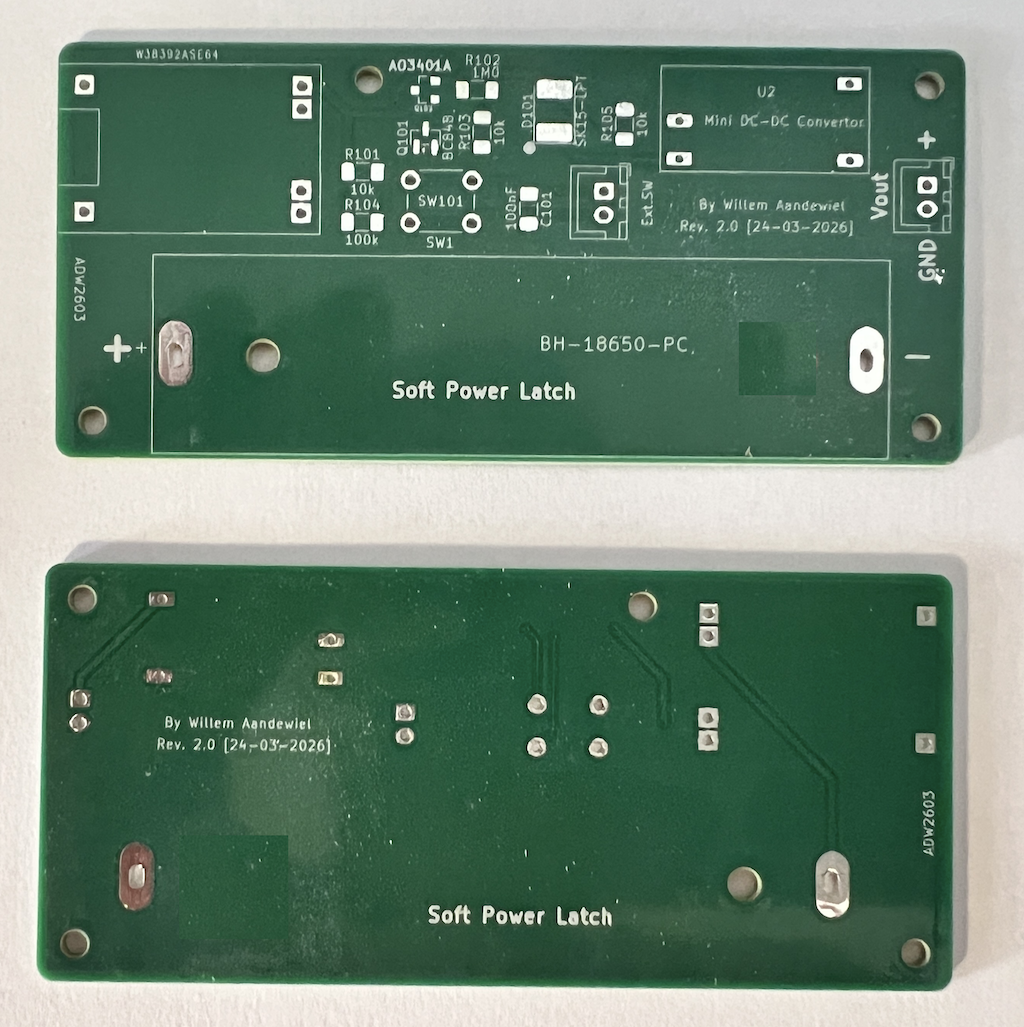
•	Battery: Li-Ion (18650)
•	Charging module: standard TP4056
• Step-up converter: 5V output• Battery-powered microcontroller projects
• Portable IoT devices
• DIY gadgets with a single-button interface
• Retro or embedded systems• No mechanical power switch required
• Very low standby consumption
• Simple and inexpensive
• Easy to integrate into existing designs• Not intended for high-current switching without proper MOSFET selection
• Requires careful component selection for stabilityDesign and concept by Willem Aandewiel
Original article: https://willem.aandewiel.nl/index.php/2026/04/07/soft-power-latch-2/
MIT License
| Qty | Value | Footprint | References |
|---|---|---|---|
| 4 | MountingHole | localLib:MountingHole_3.2mm_M3 | H1, H2, H3, H4 |
| 3 | 10k | localLib:R_1206_3216Metric_Pad1.30x1.75mm_HandSolder | R101, R103, R105 |
| 1 | 100k | localLib:R_1206_3216Metric_Pad1.30x1.75mm_HandSolder | R104 |
| 1 | 100nF | localLib:C_1206_3216Metric_Pad1.33x1.80mm_HandSolder | C101 |
| 1 | 1M0 | localLib:R_1206_3216Metric_Pad1.30x1.75mm_HandSolder | R102 |
| 1 | AO3401A | localLib:AO3401 | Q102 |
| 1 | BC848 | localLib:SOT-23 | Q101 |
| 1 | BH-18650-PC | localLib:BAT_BH-18650-PC | BT1 |
| 1 | Ext.SW | localLib:JST_XH_B2B-XH-A_1x02_P2.50mm_Vertical | J101 |
| 1 | Mini DC-DC Convertor | localLib:Mini_DC-DC_Boost_Convertor | U2 |
| 1 | SK15-LPT | localLib:D_SMA-SMB_Universal_Handsoldering | D101 |
| 1 | SW1 | localLib:SW_PUSH_6mm_H5mm | SW101 |
| 1 | TP4056module | localLib:TP4056_USB-Charger_Board | U1 |
| 1 | Vout | localLib:JST_XH_B2B-XH-A_1x02_P2.50mm_Vertical | J102 |
It measures 96 × 44 mm and has 2 copper layers, 1.6 mm thick.
19 parts, built around the AO3401A, BC848 and BH-18650-PC. The full list of its parts is on this page, with links to each part's symbol and footprint where PCBKit's library has them.
From the mrWheel/softPowerLatch repository on GitHub, at the commit this page was made from: the board is softPowerLatch.kicad_pcb and its schematic softPowerLatch.kicad_sch. PCBKit opens the board in the browser, with nothing to install.
Its repository publishes it under the MIT licence: you may reuse it on that licence's terms (keep the author's notice, and for a copyleft licence share your changes alike).
mrWheel/handheldAerosolSensor
This project describes a battery-powered, low-power air quality monitor


332753-art/Water_Quality_Monitoring
portable Water Quality Monitoring System for Live Fish Transport

edantoni96/NomobotSK
NomobotSK is a educational robot for kids to learn programming and robotics.

Mark-RT/BrainRing_Wireless
Разработка для игры BrainRing - беспроводная версия. Участников до 5. Для устройства ведущего есть прошивка master, а для всех участников одна прошивка slave.

Michael-Lloyd/macropad
A simple macropad powered by an 18650, with bluetooth capabilities.

