2 layers80.8 × 60.5 mm
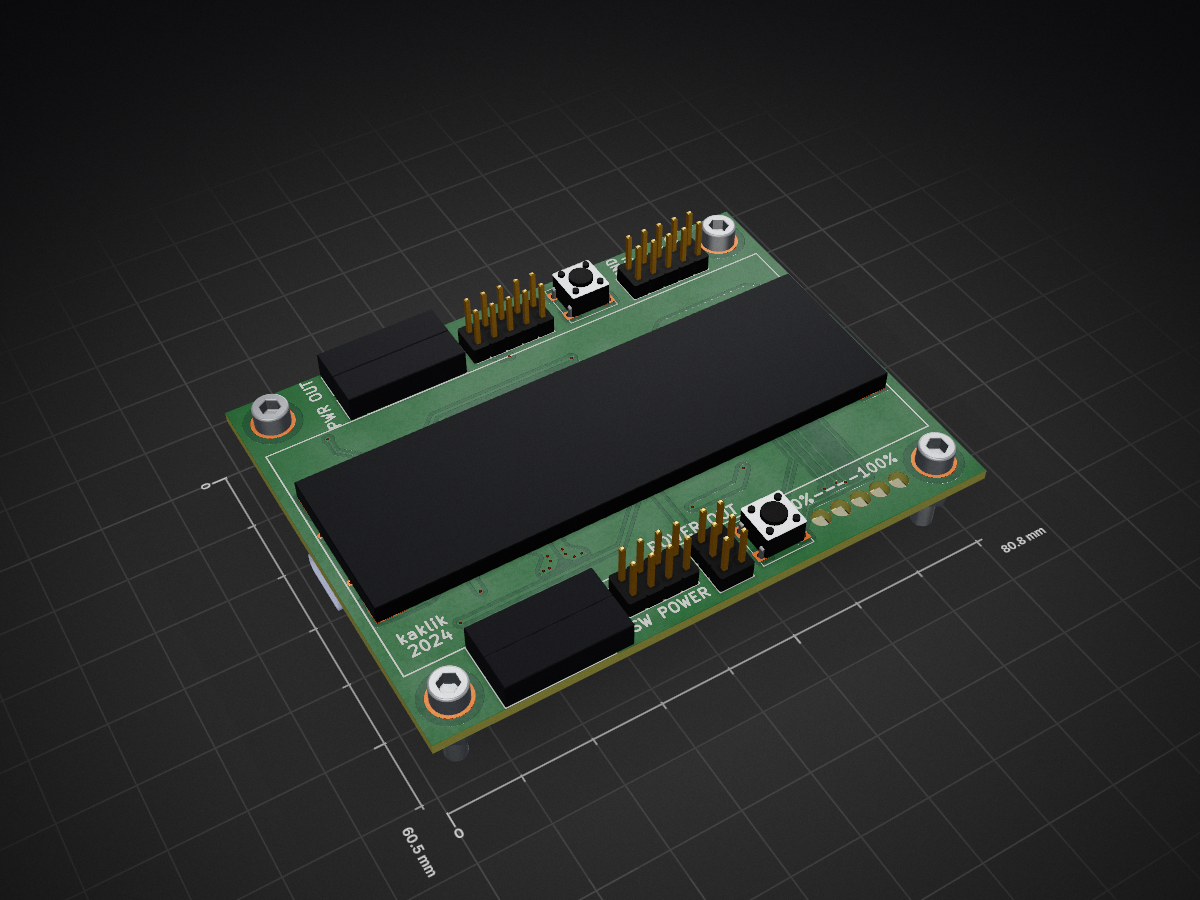
 mlab-modules/LION2CELL021
Dual-cell Li-Ion Battery management system with I2C interface and USB-C charging.
LION2CELL02 is an open-source printed circuit board by mlab-modules, from the mlab-modules/LION2CELL02 repository on GitHub, published under the GPL-3.0 licence. It is a 2-layer board of 80.8 × 60.5 mm with 104 parts on 70 nets, routed with 745 tracks and 91 vias.
It is built around the NCP21XV103J03RA, DMTH3002LPS and 1N4148WS, with the USB4105-GF-A among its other parts. Its parts include 30 capacitors, 29 resistors, 12 connectors, 8 diodes and 4 transistors. It belongs with the power boards of this library.


The LION2CELL02 module is designed to manage the charging and protection of the 2-cell Li-Ion battery stack. It incorporates advanced safe and efficient battery management features, utilizing the BQ40Z50-R2 fuel gauge and BQ25792 battery charger ICs.
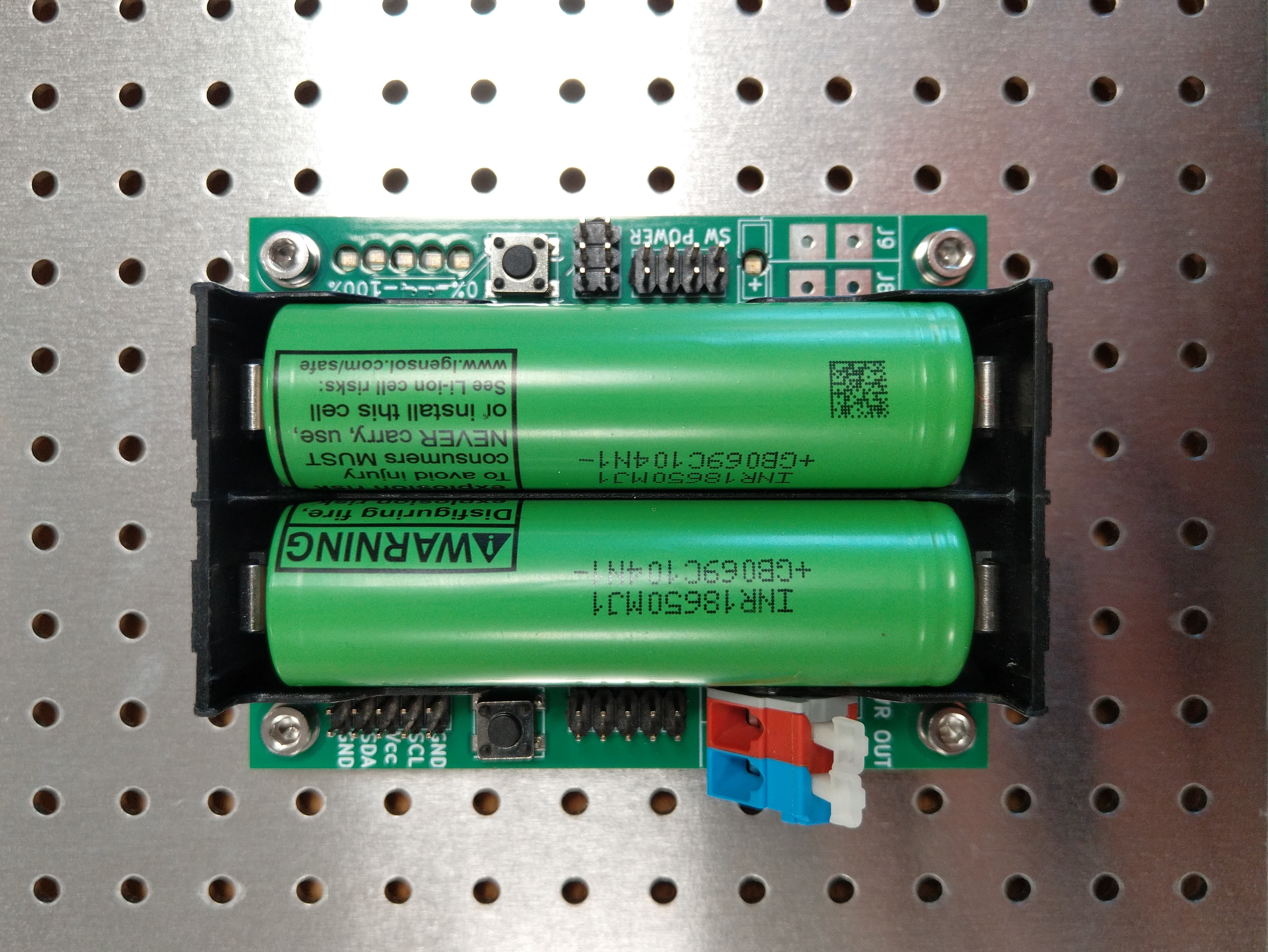
The LION2CELL02 module include USB-C connector for quick charge connection. This allows for easy integration with USB-C power sources.
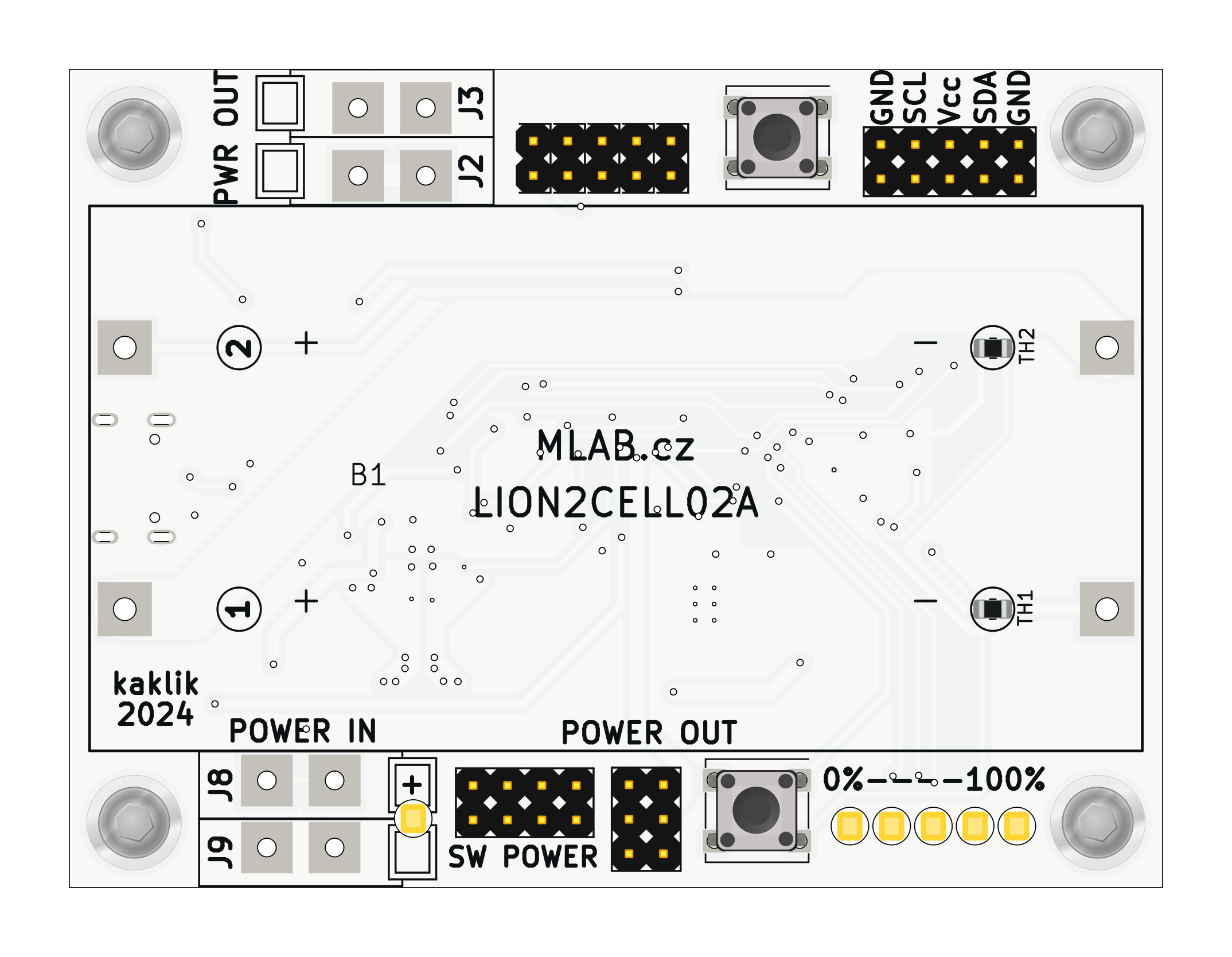
The module supports BC 1.2 for charging. For the full USB Power Delivery (PD) support, an external USB PD controller is required. The MLAB USBPDSINK01 module can be used to enable PD functionality.
For further information, refer to the datasheets:
| Qty | Value | Footprint | References |
|---|---|---|---|
| 12 | 10u | Capacitor_SMD:C_0805_2012Metric | C3, C4, C6, C7, C8, C11, C19, C25, C26, C27, C30, C31 |
| 7 | 100nF | Capacitor_SMD:C_0805_2012Metric | C1, C2, C17, C18, C21, C23, C29 |
| 6 | 100 | Resistor_SMD:R_0805_2012Metric | R8, R20, R32, R33, R34, R36 |
| 6 | LED | Mlab_D:LED_1206 | D1, D3, D4, D5, D7, D8 |
| 5 | 10k | Resistor_SMD:R_0805_2012Metric | R11, R13, R14, R15, R24 |
| 5 | 5k1 | Resistor_SMD:R_0805_2012Metric | R1, R2, R19, R27, R28 |
| 4 | CONN1_1 | Mlab_CON:WAGO256 | J2, J3, J8, J9 |
| 4 | Fiducial | Fiducial:Fiducial_1mm_Mask2mm | FID1, FID2, FID3, FID4 |
| 4 | M3 | Mlab_Mechanical:MountingHole_3mm | H1, H2, H3, H4 |
| 4 | NCP21XV103J03RA | Resistor_SMD:R_0805_2012Metric | TH1, TH2, TH3, TH4 |
| 3 | 10M | Resistor_SMD:R_0805_2012Metric | R18, R22, R23 |
| 3 | DMTH3002LPS | Mlab_T:D_POWERDI5060-8_6.0x5.1mm_P1.27mm | Q1, Q3, Q5 |
| 3 | HEADER_2x01_PARALLEL | Mlab_Pin_Headers:Straight_2x01 | J6, J7, J10 |
| 2 | 100nF | Capacitor_SMD:C_0603_1608Metric | C5, C24 |
| 2 | 10uF | Capacitor_SMD:C_0805_2012Metric | C13, C36 |
| 2 | 1uF | Capacitor_SMD:C_0805_2012Metric | C12, C35 |
| 2 | 2.2uH | Inductor_SMD:L_Vishay_IHLP-2020 | L1, L2 |
| 2 | 47nF | Capacitor_SMD:C_0805_2012Metric | C9, C10 |
| 2 | SW_Push | Mlab_SW:SW_PUSH_SMALL | SW1, SW2 |
| 1 | 100k | Resistor_SMD:R_0805_2012Metric | R4 |
| 1 | 127k | Resistor_SMD:R_0805_2012Metric | R3 |
| 1 | 15k | Resistor_SMD:R_0805_2012Metric | R12 |
| 1 | 18650 | Mlab_Batery:BAT_BK-18650-PC4_no_screws | B1 |
| 1 | 1N4148WS | Diode_SMD:D_0805_2012Metric | D6 |
| 1 | 2.2uF | Capacitor_SMD:C_0805_2012Metric | C16 |
| 1 | 22nF | Capacitor_SMD:C_0805_2012Metric | C38 |
| 1 | 2k2 | Resistor_SMD:R_0805_2012Metric | R7 |
| 1 | 2mR | Resistor_SMD:R_2512_6332Metric | R35 |
| 1 | 30.31k | Resistor_SMD:R_0805_2012Metric | R6 |
| 1 | 300R | Resistor_SMD:R_1206_3216Metric | R17 |
| 1 | 44k2 | Resistor_SMD:R_0805_2012Metric | R10 |
| 1 | 4u7 | Capacitor_SMD:C_0805_2012Metric | C20 |
| 1 | 5.24k | Resistor_SMD:R_0805_2012Metric | R5 |
| 1 | 8k2 | Resistor_SMD:R_0805_2012Metric | R9 |
| 1 | AP2305AGN-HF-3 | Package_TO_SOT_SMD:SOT-23 | Q2 |
| 1 | BQ25792RQMR1 | Mlab_IO:Texas_RQM0029A_VQFN-HR-28_4x4mm_P0.5mm | U1 |
| 1 | BQ40z50-R2 | Mlab_IO:Texas_RSM0032A_VQFN-32-4.1x4.1-EP-1.4 | U3 |
| 1 | HEADER_1x02 | Mlab_Pin_Headers:Straight_2x01 | J11 |
| 1 | HEADER_2x03_PARALLEL | Mlab_Pin_Headers:Straight_2x03 | J5 |
| 1 | HEADER_2x05_PARALLEL | Mlab_Pin_Headers:Straight_2x05 | J12 |
| 1 | JUMP_4X2 | Mlab_Pin_Headers:Straight_2x04 | J4 |
| 1 | Jumper_2_Open | Mlab_Pin_Headers:Straight_2x01 | JP1 |
| 1 | LMR14050 | Package_SO:SOIC-8-1EP_3.9x4.9mm_P1.27mm_EP2.41x3.3mm_ThermalVias | U2 |
| 1 | PDS760-13 | Diode_SMD:D_PowerDI-5 | D2 |
| 1 | USBC_USB4105-GF-A | Mlab_CON:USBC GCT_USB4105-GF-A | J1 |
It measures 80.8 × 60.5 mm and has 2 copper layers, 1.6 mm thick.
104 parts, built around the NCP21XV103J03RA, DMTH3002LPS, 1N4148WS and USB4105-GF-A. The full list of its parts is on this page, with links to each part's symbol and footprint where PCBKit's library has them.
From the mlab-modules/LION2CELL02 repository on GitHub, at the commit this page was made from: the board is hw/sch_pcb/LION2CELL02.kicad_pcb and its schematic hw/sch_pcb/LION2CELL02.kicad_sch. PCBKit opens the board in the browser, with nothing to install.
Its repository publishes it under the GPL-3.0 licence: you may reuse it on that licence's terms (keep the author's notice, and for a copyleft licence share your changes alike).

mlab-modules/DATALOGGER02
Arduino based data logger with LoRa IoT interface.


antmicro/kria-k26-devboard
Open source AMD Xilinx Kria UltraScale+ SoM baseboard

Arkos-Engineering/HT-15_hardware
We can split this out into separate repos later, right now its very convenient to have everything here.

fdiwth/tvc-drone
This repository contains the documentation, hardware designs, and source code for a Thrust Vector Control (TVC) drone.

wszeto9/ESP32-S3-HUB75-Driver
This board serves as the Matrix Display driver for MIT's 2.007 gameboards in Spring 2024 and Spring 2025. The board can take 4 button inputs, Stemma-QT I2C sensors, and breaks out 8 GPIO pins for future use.

atechofficials/protokeeb
Open Source 16-Key Mechanical Keyboard with rotary encoder and ARGB backlight. Powered by Raspberry Pi Pico. Supports QMK, KMK and ZMK Keyboard Firmware.