2 layers88.9 × 38.1 mm

 mirobotech/CHRP400
CHRP4 (Common Hardware Robotics Project 4, rev. 0) KiCad schematic and PCB design files.
CHRP400 is an open-source printed circuit board by mirobotech, from the mirobotech/CHRP400 repository on GitHub, published under the MIT licence. It is a 2-layer board of 88.9 × 76.2 mm with 78 parts on 51 nets, routed with 456 tracks and 11 vias.
It is built around the SN754410NE, TSOP38238 and LTR-4206E, with the OED-EL-1L2 among its other parts. Its parts include 26 resistors, 9 capacitors, 8 diodes, 5 switches and 4 ICs. It belongs with the PIC boards of this library.


CHRP4 (Common Hardware Robotics Project 4, rev. 0) KiCad schematic and PCB design files.
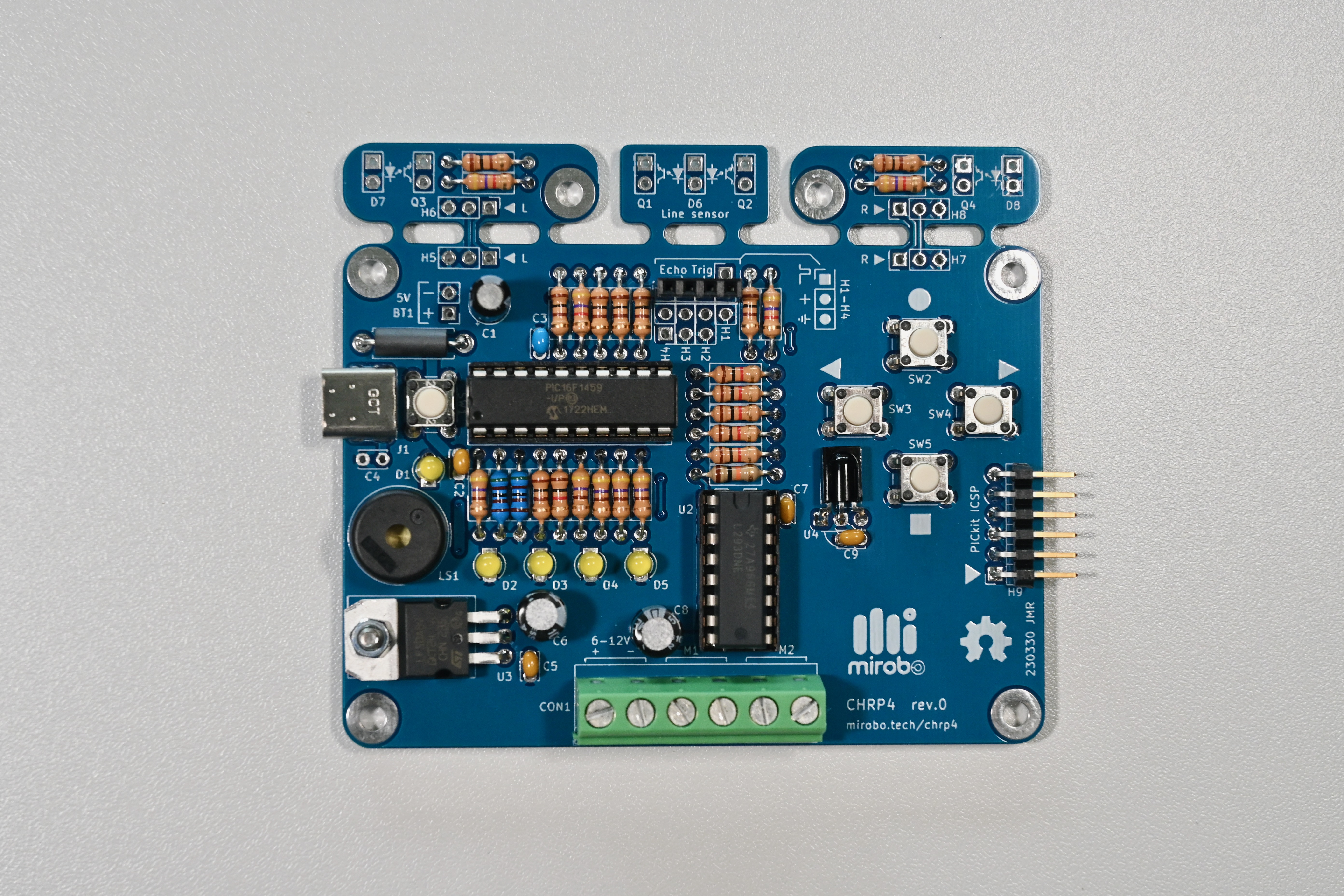
CHRP4 is a simple, versatile, and inexpensive microcontroller development system designed to help anyone make simple line-following, obstacle-sensing, or Sumo robots! CHRP4 is a robot-focused derivative of UBMP4, and was designed for learning or teaching PICmicro programming for robotic applications using either Microchip’s MPLAB X IDE or the cloud-based MPLAB Xpress IDE.
CHRP4 uses the USB µC bootloader, which allows CHRP4 to appear as a mass storage drive for ease of programming. Simply drag and drop a compiled .hex file onto the PIC16F1459 drive that shows up in your computer's device manager, and your program will start to run as soon as the file is transferred. The bootloader makes it possible to program CHRP4 using almost any kind of device, even enabling schools with 1:1 Chromebook programs to teach real C language microcontroller programming with Github integration.
The CHRP4 circuit board has a variety of simple I/O devices built-in so beginners can learn to code and make an assortment of different projects using just the parts on CHRP4 – no breadboarding, shields, or other modules are required. The on-board components allow CHRP4 to be built in a variety of configurations including: a minimal parts, education-focused trainer for specifically for teaching or learning microcontroller programming, a simple line-following robot, and, with the addition of an ultrasonic distance sensor module, an obstacle-sensing or Sumo robot.
Find out more at mirobo.tech/chrp4 , and see the CHRP4 description on Hackaday.
CHRP4 is open hardware and uses open source software – we want educators to have full access to the circuit, lesson materials, and code. The following permissions and conditions apply to CHRP4:
CHRP4 boards, and kits are available at mirobo.tech.
Bare CHRP4 printed circuit boards are also available from OSHPARK.
| Qty | Value | Footprint | References |
|---|---|---|---|
| 8 | 100 | Resistor_THT:R_Axial_DIN0207_L6.3mm_D2.5mm_P10.16mm_Horizontal | R1, R11, R12, R13, R14, R15, R18, R20 |
| 8 | Conn_01x03_Male | Connector_PinHeader_2.54mm:PinHeader_1x03_P2.54mm_Vertical | H1, H2, H3, H4, H5, H6, H7, H8 |
| 6 | 1k0 | Resistor_THT:R_Axial_DIN0207_L6.3mm_D2.5mm_P10.16mm_Horizontal | R3, R4, R5, R6, R22, R24 |
| 6 | MountingHole | MountingHole:MountingHole_3.2mm_M3_Pad | MH1, MH2, MH3, MH4, MH5, MH6 |
| 5 | 470 | Resistor_THT:R_Axial_DIN0207_L6.3mm_D2.5mm_P10.16mm_Horizontal | R2, R7, R8, R9, R10 |
| 4 | 100nF | Capacitor_THT:C_Disc_D3.4mm_W2.1mm_P2.50mm | C2, C5, C7, C9 |
| 4 | 4k7 | Resistor_THT:R_Axial_DIN0207_L6.3mm_D2.5mm_P10.16mm_Horizontal | R16, R17, R19, R21 |
| 4 | LED | CHRP400-Library:LED_D3.0mm | D2, D3, D4, D5 |
| 4 | LTR-4206E | CHRP400-Library:LED_D3.0mm_IRBlack | Q1, Q2, Q3, Q4 |
| 4 | SW_Push | Button_Switch_THT:SW_PUSH_6mm | SW2, SW3, SW4, SW5 |
| 3 | OED-EL-1L2 | CHRP400-Library:LED_D5.0mm_Clear | D6, D7, D8 |
| 2 | 10uF | Capacitor_THT:CP_Radial_D5.0mm_P2.50mm | C6, C8 |
| 2 | 5k1 | Resistor_THT:R_Axial_DIN0207_L6.3mm_D2.5mm_P10.16mm_Horizontal | R25, R26 |
| 1 | 100Z Ferrite | Resistor_THT:R_Axial_DIN0411_L9.9mm_D3.6mm_P12.70mm_Horizontal | FB1 |
| 1 | 10k | Resistor_THT:R_Axial_DIN0207_L6.3mm_D2.5mm_P10.16mm_Horizontal | R23 |
| 1 | 10nF(opt.) | Capacitor_THT:C_Disc_D3.4mm_W2.1mm_P2.50mm | C4 |
| 1 | 1uF | Capacitor_THT:CP_Radial_D5.0mm_P2.50mm | C1 |
| 1 | 470nF | Capacitor_THT:C_Disc_D3.4mm_W2.1mm_P2.50mm | C3 |
| 1 | Battery | Connector_PinHeader_2.54mm:PinHeader_1x02_P2.54mm_Vertical | BT1 |
| 1 | Conn_01x06 | TerminalBlock_Phoenix:TerminalBlock_Phoenix_MKDS-1,5-6-5.08_1x06_P5.08mm_Horizontal | CON1 |
| 1 | ICSP | CHRP400-Library:PinHeader_1x06_P2.54mm_Horizontal | H9 |
| 1 | LF50_TO220 | Package_TO_SOT_THT:TO-220-3_Horizontal_TabDown | U3 |
| 1 | Logo_Open_Hardware_Small | Symbol:OSHW-Symbol_6.7x6mm_SilkScreen | G2 |
| 1 | PIC16F1459-IP | Package_DIP:DIP-20_W7.62mm_Socket | U1 |
| 1 | PROG | Button_Switch_THT:SW_PUSH_6mm | SW1 |
| 1 | Piezo Beeper | Buzzer_Beeper:Buzzer_TDK_PS1240P02BT_D12.2mm_H6.5mm | LS1 |
| 1 | RUN | CHRP400-Library:LED_D3.0mm | D1 |
| 1 | SN754410NE | Package_DIP:DIP-16_W7.62mm | U2 |
| 1 | TSOP38238 | OptoDevice:Vishay_MINICAST-3Pin | U4 |
| 1 | USB2 TYPE-C | Connector_USB:USB_C_Receptacle_GCT_USB4085 | J1 |
| 1 | mirobotech_logo | CHRP400-Library:mirobo_logo_10 | G1 |
It measures 88.9 × 76.2 mm and has 2 copper layers, 1.6 mm thick.
78 parts, built around the SN754410NE, TSOP38238, LTR-4206E and OED-EL-1L2. The full list of its parts is on this page, with links to each part's symbol and footprint where PCBKit's library has them.
From the mirobotech/CHRP400 repository on GitHub, at the commit this page was made from: the board is CHRP400.kicad_pcb and its schematic CHRP400.kicad_sch. PCBKit opens the board in the browser, with nothing to install.
Its repository publishes it under the MIT licence: you may reuse it on that licence's terms (keep the author's notice, and for a copyleft licence share your changes alike).


ismaillgunes/IR_Programmer
A standalone, button-operated firmware programmer for STM32L0 microcontrollers, built on an STM32L073VBT. It stores a firmware image in its own flash and writes it to a target MCU over one of two links:

ductomn/Swarm-robot
Bachelor Thesis - Design and implementation of a cooperative robotic platform with simple communication

hnz1102/sdcdmux-emmc
SD CARD and eMMC Device Multiplexer with Infrared Remote Controller

mithat/Volume-AlpsRK16814MG
Alps RK16814MG motorized potentiometer with H-bridge motor drive.


PatriceG/ArduiBodet
Horloge mère pour Horloge de type Bodet pilotée par Arduino