Skip to the content
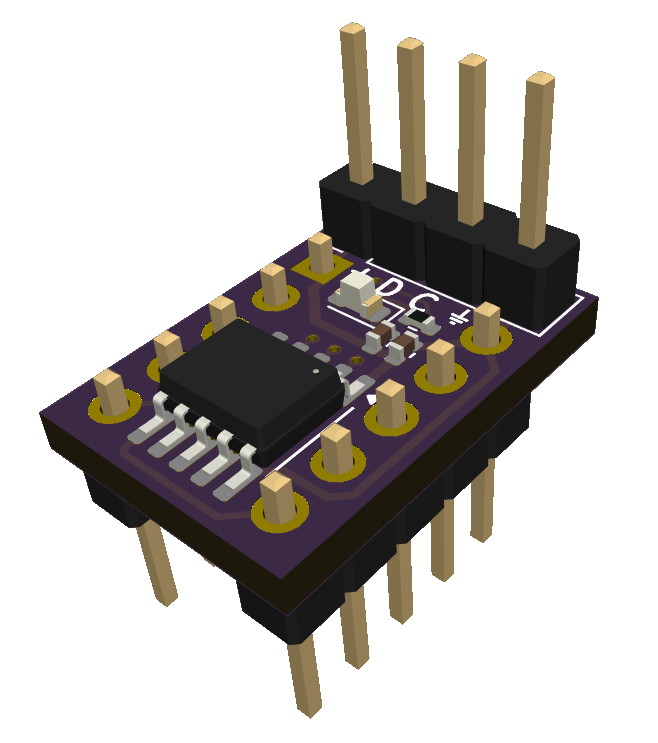
2 layers11.2 × 16.3 mmPY32F002 ESSOP10 minimal board, the printed circuit board in 3D

PY32F002 ESSOP10 minimal board

michpro/PY32F002_ESSOP10_minimal_board1

Puya PY32F002A ARM M0+ minimal development board (ESSOP10 package)

Size
11.2 × 16.3 mm
Copper layers
2
Thickness
1.6 mm
Parts
9
Nets
12
Pads
36
Tracks, vias
86, 7
Routed
Yes
KiCad
KiCad 9.0 (file 20241229)
Created
4 Apr 2025
Updated
7 Aug 2025

Overview

PY32F002 ESSOP10 minimal board is an open-source printed circuit board by michpro, from the michpro/PY32F002_ESSOP10_minimal_board repository on GitHub, published under the CERN-OHL-P-2.0 licence. It is a 2-layer board of 11.2 × 16.3 mm with 9 parts on 12 nets, routed with 86 tracks and 7 vias.

It is built around the PY32F002AA15M6TU. Its parts include 3 connectors, 2 capacitors, 1 resistor, 1 IC and 1 diode. It belongs with the microcontroller boards boards of this library.

Main components

1

README

README.md

PY32F002A ESSOP10 Minimal Board


Overview

This project is a minimal development board designed for the PY32F002A microcontroller in the ESSOP10 package. It serves as a simple and compact platform for prototyping and testing applications using this low-power ARM Cortex-M0+ microcontroller. The board includes essential components to power the microcontroller, provide access to its pins, and offer basic functionality for development purposes.

Features

  • PY32F002A Microcontroller: Low-power ARM Cortex-M0+ in ESSOP10 package.
    • Operating voltage: 1.7V to 5.5V
    • Driver current: 8mA
    • 32-bit ARM® Cortex® - M0+ CPU
    • Internal 8/24 MHz RC Oscillator (HSI)
    • Internal 32.768 KHz RC oscillator (LSI)
    • 20 Kbytes of flash memory
    • 3 Kbytes SRAM
    • 1 x 12-bit ADC (Input voltage conversion range: 0 ~ VCC)
    • Two comparators (One has full mapping to external µC pins)
    • Timers:
      • A 16bit advanced control timer (TIM1)
      • 1 general purpose 16-bit timers (TIM16)
      • A low-power timer (LPTIM), supports wake-up from stop mode
      • An Independent Watchdog Timer (IWDT)
      • A SysTick timer
    • Communication Interfaces:
      • A Serial Peripheral Interface (SPI)
      • 1 Universal Synchronous/Asynchronous Transceivers (USARTs) with automatic baudrate detection
      • A I²C interface , supports standard mode (100kHz), Fast mode (400 kHz), supports 7-bit addressing mode
    • Hardware CRC-32 module
    • Unique UID
    • Working temperature: -40 to 85℃
  • SWD Header: For easy programming/debugging.
  • Decoupling Capacitors: Ensure stable power supply to the microcontroller.
  • Indicator LED: Connected to a microcontroller pin via a resistor for status or testing with solder jumper - configurable option to enable/disable the LED circuit.
  • Compact Design: Two-layer PCB optimized for minimal footprint.

Software

Arduino boards: https://github.com/py32duino/Arduino-PY32 with recommended patch for Windows: https://github.com/michpro/PY32Duino_windows_patch


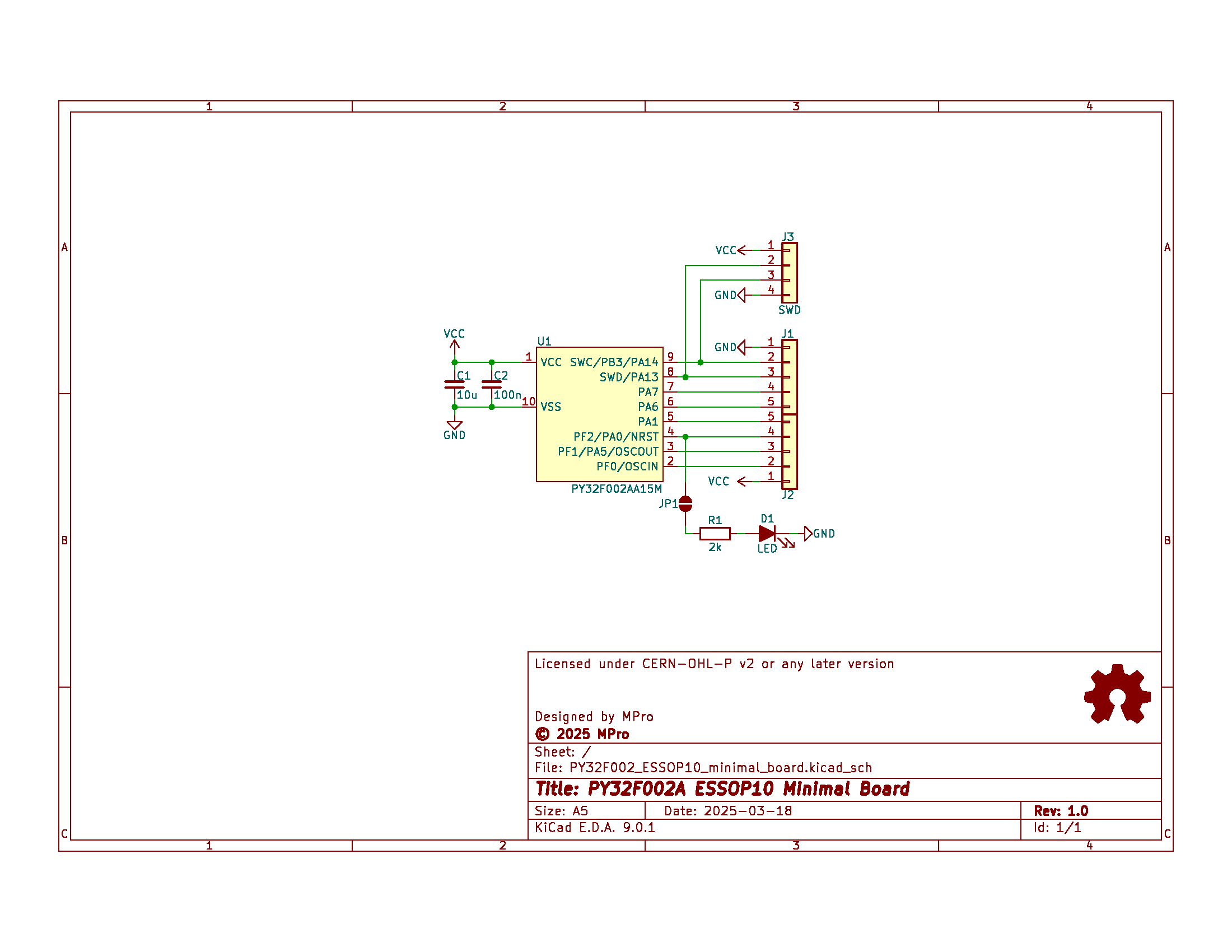
Schematic diagram

wiring diagram

Module visualisation

(click on the image to see the 3D model)

I²C to 1-Wire Click

Assembly

Interactive BOM and placement

Production files

Production files can be found here.


Reporting bugs

Create an issue on GitHub


License

Copyright © 2025 Michal Protasowicki

This project is released under CERN Open Hardware Licence Version 2 - Permissive.

License: CERN-OHL-P-2.0


Support

If You find my projects interesting and You wanted to support my work, You can give me a cup of coffee or a keg of beer :)

PayPal Direct     ko-fi     Coinbase

Parts

9
QtyValueFootprintReferences
11-5footprints:PinHeader_1x05_P2.54mm_VerticalJ2
1100nfootprints:C_0402_1005MetricC2
110ufootprints:C_0402_1005MetricC1
12kfootprints:R_0402_1005MetricR1
16-10footprints:PinHeader_1x05_P2.54mm_VerticalJ1
1LEDfootprints:SolderJumper-2_P1.3mm_Open_RoundedPad1.0x1.5mmJP1
1LEDfootprints:LED_0603_1608MetricD1
1PY32F002AA15Mfootprints:SSOP-10-1EP_3.9x4.9mm_P1mm_EP2.1x3.3mmU1
1SWDfootprints:PinHeader_1x04_P2.54mm_VerticalJ3

Similar boards

  • 2 layers84 × 37.7 mmSidebar, the printed circuit board in 3D

    Sidebar

    Professor-plum/SaintCon-RE-Topper

    A reverse engineering themed SaintCon 2024 badge topper

    9 parts3MIT
  • 2 layers16.7 × 14.4 mmSolderingChallenge, the printed circuit board in 3D

    SolderingChallenge

    ElectronicCats/SolderingChallenge

    The classic Soldering challenge

    28 parts2MIT
  • 2 layers50 × 50 mmBADGE MALWARE SPACE-2025, the printed circuit board in 3D

    BADGE MALWARE SPACE-2025

    ElectronicCats/BADGE-MALWARE-SPACE-2025

    Prerequisites: You must have the Arm GNU Toolchain ( ) installed on your system.

    23 parts
  • 4 layers100 × 50 mmController, the printed circuit board in 3D

    Controller

    usbalbin/hw-half-bridge

    226 parts
  • 2 layers19.3 × 31.8 mmPUYA Prototype, the printed circuit board in 3D

    PUYA Prototype

    ElectronicCats/puya-projects

    PUYA Projects

    26 parts9
  • 2 layers39 × 26 mmConnector, the printed circuit board in 3D

    Connector

    Professor-plum/SAINTCON-BADGE-2026

    Electronic badge for SAINTCON2026

    8 parts5MIT
  • 2 layers45.6 × 50 mmAddon Websec, the printed circuit board in 3D

    Addon Websec

    ElectronicCats/Badge_Tropicon-2026

    Badge Oficial Tropicon 2026

    22 parts1

Questions

How big is the PY32F002 ESSOP10 minimal board PCB?

It measures 11.2 × 16.3 mm and has 2 copper layers, 1.6 mm thick.

What parts does the PY32F002 ESSOP10 minimal board use?

9 parts, built around the PY32F002AA15M6TU. The full list of its parts is on this page, with links to each part's symbol and footprint where PCBKit's library has them.

Where can I download the PY32F002 ESSOP10 minimal board KiCad files?

From the michpro/PY32F002_ESSOP10_minimal_board repository on GitHub, at the commit this page was made from: the board is PY32F002_ESSOP10_minimal_board.kicad_pcb and its schematic PY32F002_ESSOP10_minimal_board.kicad_sch. PCBKit opens the board in the browser, with nothing to install.

Can I use the PY32F002 ESSOP10 minimal board design in my own project?

Its repository publishes it under the CERN-OHL-P-2.0 licence: you may reuse it on that licence's terms (keep the author's notice, and for a copyleft licence share your changes alike).