Skip to the content
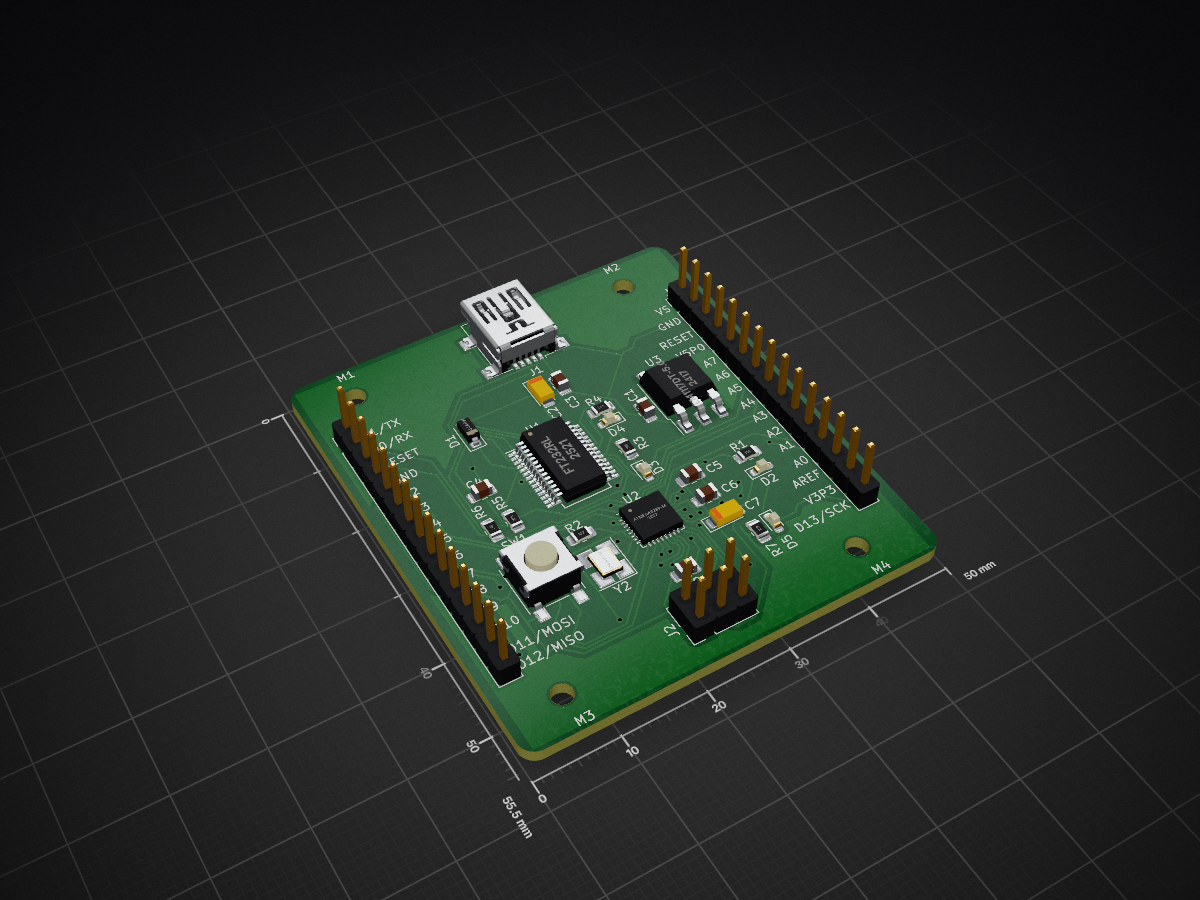
2 layers50 × 55.5 mmArduino Nano, the printed circuit board in 3D

PCB designed to recreate a Arduino Nano starting from Arduino Nano official schematic

Size
50 × 55.5 mm
Copper layers
2
Thickness
1.6 mm
Parts
33
Nets
54
Pads
177
Tracks, vias
556, 32
Pours
2
Routed
Yes
KiCad
KiCad 7 (file 20221018)
Created
5 Jul 2024
Updated
5 Jul 2024

Parts

33
QtyValueFootprintReferences
71KohmResistor_SMD:R_0805_2012Metric_Pad1.20x1.40mm_HandSolderR1, R2, R3, R4, R5, R6, R7
4MountingHole_2.5mmMountingHole:MountingHole_2.5mmM1, M2, M3, M4
3100nFCapacitor_SMD:C_0805_2012Metric_Pad1.18x1.45mm_HandSolderC3, C4, C8
31uFCapacitor_SMD:C_0805_2012Metric_Pad1.18x1.45mm_HandSolderC1, C5, C6
24.7uF_16VCapacitor_Tantalum_SMD:CP_EIA-3216-10_Kemet-I_Pad1.58x1.35mm_HandSolderC2, C7
2Green LEDLED_SMD:LED_0603_1608Metric_Pad1.05x0.95mm_HandSolderD2, D4
11N4448WDiode_SMD:D_SOD-123D1
1ATmega328P-MPackage_DFN_QFN:QFN-32-1EP_5x5mm_P0.5mm_EP3.1x3.1mmU2
1Conn_01x15_PinConnector_PinHeader_2.54mm:PinHeader_1x15_P2.54mm_VerticalJ4
1Conn_01x15_SocketConnector_PinHeader_2.54mm:PinHeader_1x15_P2.54mm_VerticalJ3
1Conn_PIC_ICSP_ICDConnector_PinHeader_2.54mm:PinHeader_2x03_P2.54mm_VerticalJ2
1FT232RLPackage_SO:SSOP-28_5.3x10.2mm_P0.65mmU1
1LM1117DT-5.0Package_TO_SOT_SMD:TO-252-3_TabPin2U3
1Red LEDLED_SMD:LED_0603_1608Metric_Pad1.05x0.95mm_HandSolderD3
1ResonatorCrystal:Crystal_SMD_3225-4Pin_3.2x2.5mm_HandSolderingY2
1SW_PushButton_Switch_SMD:SW_Push_1P1T_NO_6x6mm_H9.5mmSW1
1USB_B_MicroConnector_USB:USB_Mini-B_Lumberg_2486_01_HorizontalJ1
1Yellow LEDLED_SMD:LED_0603_1608Metric_Pad1.05x0.95mm_HandSolderD5

Similar boards

  • 2 layers45 × 62.5 mmDevelopment board project with STM components and Micro USB, the printed circuit board in 3D

    Development board project with STM components and Micro USB

    joshishreyas320/STM32-Style-Development-Board-with-Micro-USB

    Arduino-compatible development board PCB designed in KiCad. Features ATmega328P-M MCU, Micro USB interface, LM1117DT-5V onboard regulator, SMD resonator, dual 15-pin expansion headers, power LED, and reset switch.

    34 parts
  • 2 layers47 × 47 mmLoadcell PCB, the printed circuit board in 3D

    Loadcell PCB

    Jackiempty/DAQ_PCB

    NCKU ISP loadcell unit project

    57 parts2
  • 4 layers43.9 × 18.8 mmNano, the printed circuit board in 3D

    Nano

    heyitsmeyo/arduinonano-pcb-

    a custom arduino nano pcb desigb

    34 parts
  • 2 layers442 × 421.7 mmTR-808 clone, the printed circuit board in 3D

    TR-808 clone

    mkomakonkon/Vocaluino

    MIDI device for playing drum, vocal, PSG, etc.

    1,268 parts5
  • 2 layers40.1 × 40.1 mmSOLARMINI01B, the printed circuit board in 3D

    SOLARMINI01B

    mlab-modules/SOLARMINI01

    Small low-power MPPT module for photovoltaic cells.

    28 parts2GPL-3.0
  • 2 layers40.1 × 60.5 mmRFIQINT02B, the printed circuit board in 3D

    RFIQINT02B

    mlab-modules/RFIQINT02

    UTP cable RF signal I/Q interface for QFHMIX module with RJ45 connectors

    46 partsGPL-3.0
  • 2 layers114.3 × 67.3 mmBackdash, the printed circuit board in 3D

    Backdash

    PhoenixRacing/Electrical1920

    Firmware, software, and component design of sensing and computer systems for the 2019-2020 season

    75 parts
  • 2 layers78 × 36 mmPump Driver, the printed circuit board in 3D

    Pump Driver

    pranavb104/TMC2130-Stall-guardPCB

    A breakout PCB equipped with an atmega328p(Arduino) and TMC2130 driver board.

    30 parts

Questions

How big is the Arduino Nano PCB?

It measures 50 × 55.5 mm and has 2 copper layers, 1.6 mm thick.

What parts does the Arduino Nano use?

33 parts, built around the ATMEGA328P-MU, FT232RL, LM1117DT-5.0 and 4.7UF 16V. The full list of its parts is on this page, with links to each part's symbol and footprint where PCBKit's library has them.

Where can I download the Arduino Nano KiCad files?

From the michelegiorgio/Arduino_Nano repository on GitHub, at the commit this page was made from: the board is ArduinoNano.kicad_pcb and its schematic ArduinoNano.kicad_sch. PCBKit opens the board in the browser, with nothing to install.

Can I use the Arduino Nano design in my own project?

Its repository publishes it under the CC0-1.0 licence: you may reuse it on that licence's terms (keep the author's notice, and for a copyleft licence share your changes alike).