8 layers424.5 × 336.3 mm

 michelangelo/SBuCa
SBuCa, the Smart Business Card: hardware designs
SBuCa is an open-source printed circuit board by michelangelo, from the michelangelo/SBuCa repository on GitHub, published under the MIT licence. It is a 2-layer board of 85 × 53 mm with 43 parts on 56 nets, routed with 482 tracks and 40 vias.
It is built around the ATMEGA328P-MMH, 2N7002KW and SS2040FL. Its parts include 18 capacitors, 5 resistors, 4 connectors, 2 diodes and 2 transistors. It belongs with the AVR (ATmega, ATtiny) boards of this library.


SBuCa stands for Smart Business card and it's a card-sized, e-ink based, embedded platform.
Its high-level goal is to provide a reference platform for e-ink based display applications and there's nothing better than a business card for that!
Other than that, these are the main goals:
Everything in SBuCa is open source, starting with its hardware design: schematics and layout are provided along with the whole KiCad project, including eventual custom footprints.
As already pointed out, one of the non-functional goals of SBuCa, since its inception, was to come up with something vertical, meaning that everything had to be done from scratch, even its OS/firmware.
This goal has been achieved by Cumae, the proto-OS SBuCa is currently running.
Cumae, like everything else here, is totally open source and can be found on its own repository.
Well, it's a business card and it looks like this:
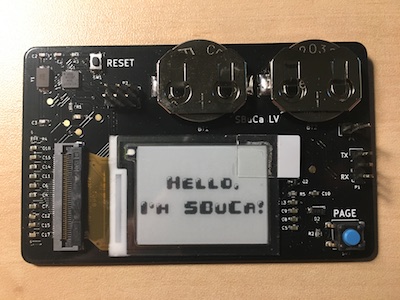
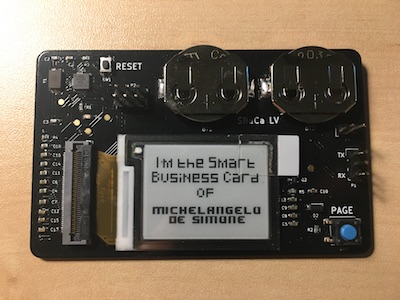
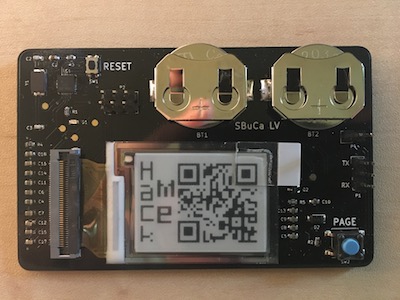
WIP
This repository starts tracking from the LV (Line Verification) revision; previous revisions (B0, B1 aka "the wingboard") are not available just yet on this repository. If you really need them just shoot the author an email.
The original author is Michelangelo De Simone, a system software engineer that is always open to thinker and hack around with the ultimate goal of learning stuff, breaking things: it's the family business. ;-)
| Qty | Value | Footprint | References |
|---|---|---|---|
| 9 | 2.2uF/25V | Capacitors_SMD:C_0603 | C4, C5, C6, C7, C8, C9, C11, C13, C14 |
| 4 | 2.2uF/16V | Capacitors_SMD:C_0603 | C12, C15, C16, C17 |
| 2 | 22pF | Capacitors_SMD:C_0603 | C2, C3 |
| 2 | 2N7002KW | TO_SOT_Packages_SMD:SOT-323 | Q1, Q2 |
| 2 | Battery | SBuCa_Footprints:SBuCa_CR2032_Holder | BT1, BT2 |
| 1 | 0 | Resistors_SMD:R_0603 | R4 |
| 1 | 100nF | Capacitors_SMD:C_0603 | C1 |
| 1 | 10K | Resistors_SMD:R_0603 | R3 |
| 1 | 12MHz | Crystals:Crystal_SMD_5032_2Pads | Y1 |
| 1 | 178 | Resistors_SMD:R_0603 | R1 |
| 1 | 1uF/10V/X7R | Capacitors_SMD:C_0603 | C10 |
| 1 | 2.2uF/10V | Capacitors_SMD:C_0603 | C18 |
| 1 | 2K | Resistors_SMD:R_0603 | R5 |
| 1 | 4.7K | Resistors_SMD:R_0603 | R2 |
| 1 | ATMEGA328P-MM | Housings_DFN_QFN:QFN-28-1EP_4x4mm_Pitch0.4mm | IC1 |
| 1 | EPD_CONN | SBuCa_Footprints:SBuCa_FH28_40_05mmpitch | P3 |
| 1 | EXTPW_CONN | Pin_Headers:Pin_Header_Straight_1x02_Pitch2.54mm | P4 |
| 1 | ISP | Pin_Headers:Pin_Header_Straight_2x03 | P2 |
| 1 | LED_IC_STATUS | LEDs:LED_0603 | D1 |
| 1 | SS2040FL | Diodes_SMD:SOD-123 | D2 |
| 1 | SW_PAGE_INT | Buttons_Switches_SMD:SW_SPST_B3S-1000 | SW2 |
| 1 | SW_RESET | Buttons_Switches_SMD:SW_SPST_KMR2 | SW1 |
| 1 | TP_BUSY | Measurement_Points:Measurement_Point_Round-SMD-Pad_Small | W1 |
| 1 | TP_DCHARGE | Measurement_Points:Measurement_Point_Round-SMD-Pad_Small | W3 |
| 1 | TP_EPD_VCC | Measurement_Points:Measurement_Point_Round-SMD-Pad_Small | W5 |
| 1 | TP_RSTN | Measurement_Points:Measurement_Point_Round-SMD-Pad_Small | W4 |
| 1 | TP_SS | Measurement_Points:Measurement_Point_Round-SMD-Pad_Small | W2 |
| 1 | TTL_CONN | Pin_Headers:Pin_Header_Straight_1x03 | P1 |
The 42 most common of 43 parts.
It measures 85 × 53 mm and has 2 copper layers, 1.6 mm thick.
43 parts, built around the ATMEGA328P-MMH, 2N7002KW and SS2040FL. The full list of its parts is on this page, with links to each part's symbol and footprint where PCBKit's library has them.
From the michelangelo/SBuCa repository on GitHub, at the commit this page was made from: the board is SBuCa/SBuCa.kicad_pcb. PCBKit opens the board in the browser, with nothing to install.
Its repository publishes it under the MIT licence: you may reuse it on that licence's terms (keep the author's notice, and for a copyleft licence share your changes alike).

open-batt/openbms-hardware
OpenBMS - Open Source Battery Management System Hardware


HyFiVeUser/HyFiVe
For this use case we developed a very flexible autonomous measuring system, which can be deployed on fishing gear to collect data in an affordable and scalable way.


Alzymologist/Kampela
Hardware signer and key storage for Substrate ecosystem

