
2 layers60 × 146.5 mm

 mgit-at/raspiECC34
ATECC608A for Raspberry PI
RaspiECCv1 is an open-source printed circuit board by mgit-at, from the mgit-at/raspiECC repository on GitHub. It is a 2-layer board of 17 × 8.9 mm with 7 parts on 4 nets, routed with 66 tracks and 14 vias.
It is built around the ATECC608A-SSHDA-T. Its parts include 2 resistors, 1 capacitor, 1 IC and 1 connector.
A small RaspberryPI compatible PCB for the ATECC608A Security Chip.
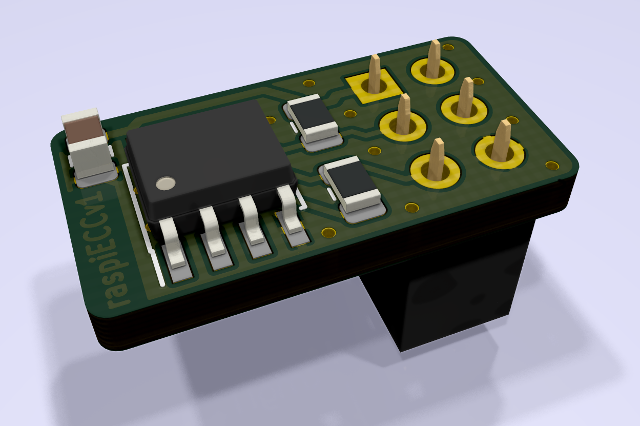
First you have to enable the I²C interface on the RaspberryPI. On Raspbian you can do this following these steps:
dtparam=i2c_arm=on inside the file /boot/config.txti2c-dev module using raspi-config or by adding the line i2c-dev to /etc/modulesIf you want to access the I²C interface using a non-root user you also need to add this user to the group i2c by running the command adduser <username> i2c.
On Raspbian you can use python to test whether the chip works:
# apt install build-essential python python-pip cmake libudev-dev libusb-1.0-0-dev libffi-dev libssl-dev git
# git clone https://github.com/MicrochipTech/cryptoauthtools.git
# cd cryptoauthtools/python/examples
# pip install -r requirements.txt
# python info.py -i i2craspiECC is licensed under CERN OHL v.1.2 or later. See LICENSE for details.
Copyright CERN 2013.
This documentation describes Open Hardware and is licensed under the CERN OHL v. 1.2.
You may redistribute and modify this documentation under the terms of the CERN OHL v.1.2. (http://ohwr.org/cernohl). This documentation is distributed WITHOUT ANY EXPRESS OR IMPLIED WARRANTY, INCLUDING OF MERCHANTABILITY, SATISFACTORY QUALITY AND FITNESS FOR A PARTICULAR PURPOSE. Please see the CERN OHL v.1.2 for applicable conditions
| Qty | Value | Footprint | References |
|---|---|---|---|
| 2 | 2k2 | Resistor_SMD:R_0805_2012Metric | R1, R2 |
| 1 | 100nF | Capacitor_SMD:C_0805_2012Metric | C1 |
| 1 | ATECC608A-SSHDA | Package_SO:SOIC-8_3.9x4.9mm_P1.27mm | U1 |
| 1 | LOGO | raspiECC:mgit-logo | G*** |
| 1 | Raspi | Connector_PinSocket_2.54mm:PinSocket_2x03_P2.54mm_Vertical | J1 |
The 6 most common of 7 parts.

ffich/Arduino_UNO_Experimental_Shield
Experimental shield for Arduino UNO form factor boards.


LEAT-EDGE/ambient-pcb-dkaiot
The design also provides empty footprints for several other sensors which are not populated in the Ambient variant: - Light sensor (LITEON LTR-303ALS-01) - MEMS microphone (Knowles SPH0645LM4H) - Indoor air quality…

mildlyfunctionalgays/bigbutton
PCB and firmware for a keyboard with one, huge, button

Naveens-Lab/mspm0g3507-evm
EVM-style dev board — TI MSPM0G3507 + ATECC608A secure element | KiCad 9.0 | REV A
It measures 17 × 8.9 mm and has 2 copper layers, 1.6 mm thick.
7 parts, built around the ATECC608A-SSHDA-T. The full list of its parts is on this page, with links to each part's symbol and footprint where PCBKit's library has them.
From the mgit-at/raspiECC repository on GitHub, at the commit this page was made from: the board is hardware/raspiECCv1/raspiECCv1.kicad_pcb. PCBKit opens the board in the browser, with nothing to install.
Its repository states no licence, so its author keeps all rights: ask mgit-at before reusing the design.