2 layers178 × 711 mm
 MelonMars/TuringPCB
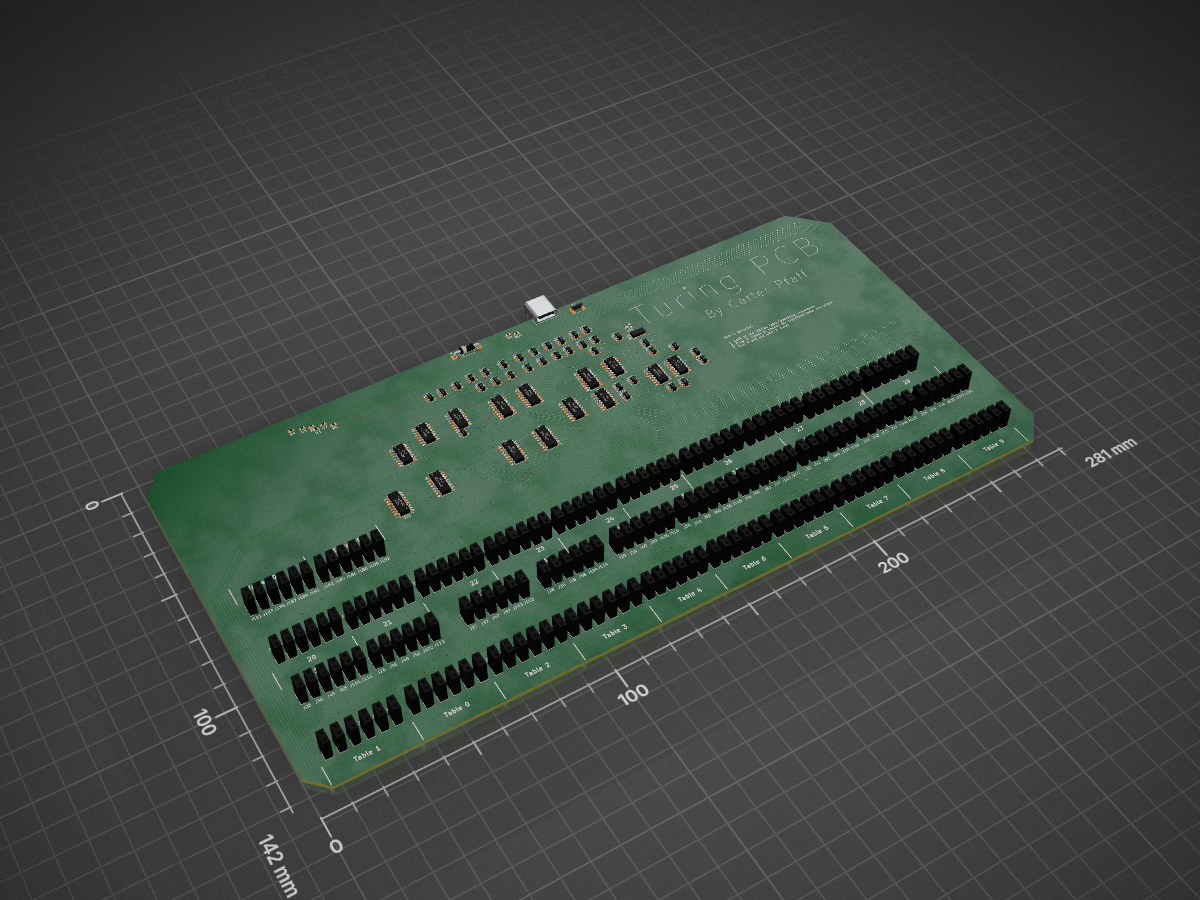
A Turing Machine that does not use any premade microchips, but rather is built exclusively on simple components.
Turing Machine is an open-source printed circuit board by MelonMars, from the MelonMars/TuringPCB repository on GitHub. It is a 4-layer board of 281 × 142 mm with 255 parts on 212 nets, routed with 2,266 tracks and 447 vias.
It is built around the 74AHC1G00GW, 74AHC1G04SE and 74AHC1G32GW, with the 74HC74D, 74HC138 and 74HC151D among its other parts. Its parts include 193 connectors, 49 ICs, 10 resistors, 1 diode and 1 switch.


This is a PCB for a Turing Machine that is made primarily using "simple" components, without using complex microchips or programmable stuff (as that would be cheating). It is designed to be programmed through the transition table being bridged by diodes (e.g. LEDs) in order to represent what is being done and how the machine should progress. It has both an automatic clock and the ability to step through it, to enable debugging programs or just run through them. It has 4 state bits and 8 tape bits. It ended up being much more complex than I thought at first, and took way longer than expected, but it was really enjoyable. It has 6 layers & 2 flood fills for both GND and VCC.
I made this project primarily for the fun of it. I've always found challenges with confounding variables fun and interesting, and believe that this is just sort of the next step in that regard, with Turing Machine's being fun proofs of concept and this being a very restricted form of it.
Bill of materials:
1x PCB (JLCPCB) -- $62.70
| Qty | Value | Footprint | References |
|---|---|---|---|
| 192 | Conn_01x02_Socket | Connector_PinSocket_2.54mm:PinSocket_1x02_P2.54mm_Vertical | J1, J10, J11, J100, J101, J102, J103, J104, J105, J106, J107, J108, J109, J110, J111, J112 +176 |
| 18 | 74AHC1G00 | Package_TO_SOT_SMD:SOT-23-5 | U14, U15, U17, U20, U22, U23, U26, U27, U30, U31, U34, U35, U38, U39, U42, U43 +2 |
| 8 | 10k | Resistor_SMD:R_0603_1608Metric | R1, R2, R3, R4, R5, R6, R7, R8 |
| 8 | 74AHC1G04 | Package_TO_SOT_SMD:SOT-23-5 | U19, U21, U25, U29, U33, U37, U41, U45 |
| 8 | 74AHC1G32 | Package_TO_SOT_SMD:SOT-23-5 | U18, U24, U28, U32, U36, U40, U44, U48 |
| 7 | 74HC74 | Package_SO:SOIC-14_3.9x8.7mm_P1.27mm | U1, U2, U3, U7, U12, U13, U16 |
| 5 | 74HC138 | Package_SO:SOIC-16_3.9x9.9mm_P1.27mm | U5, U8, U9, U10, U11 |
| 2 | 5.1k | Resistor_SMD:R_0603_1608Metric | R9, R10 |
| 1 | 1N5817 | Diode_THT:D_DO-41_SOD81_P10.16mm_Horizontal | D1 |
| 1 | 74HC151 | Package_SO:SOIC-16_3.9x9.9mm_P1.27mm | U6 |
| 1 | 74HC157 | Package_SO:SOIC-16_3.9x9.9mm_P1.27mm | U49 |
| 1 | 74HCT193 | Package_SO:SOIC-16_3.9x9.9mm_P1.27mm | U4 |
| 1 | Polyfuse | Fuse:Fuse_1812_4532Metric | F1 |
| 1 | SW_Push_SPDT | Button_Switch_SMD:Nidec_Copal_CAS-120A | SW1 |
| 1 | USB_C_Receptacle_USB2.0_14P | Connector_USB:USB_C_Receptacle_GCT_USB4085 | J193 |
It measures 281 × 142 mm and has 4 copper layers, 1.6 mm thick.
255 parts, built around the 74AHC1G00GW, 74AHC1G04SE, 74AHC1G32GW and 74HC74D. The full list of its parts is on this page, with links to each part's symbol and footprint where PCBKit's library has them.
From the MelonMars/TuringPCB repository on GitHub, at the commit this page was made from: the board is Turing Machine.kicad_pcb and its schematic Turing Machine.kicad_sch. PCBKit opens the board in the browser, with nothing to install.
Its repository states no licence, so its author keeps all rights: ask MelonMars before reusing the design.


AJain9199/AOS16
Table of Contents About The Project Pictures Technical Details Directory Structure To-Do Acknowledgments


charlespax/macroprocessor
A project to create a microprocessor optimized for human visual verification

artemisamsx/artemisa
Schematics, PCB designs and HDL simulations to build a 8-bits MSX computer
