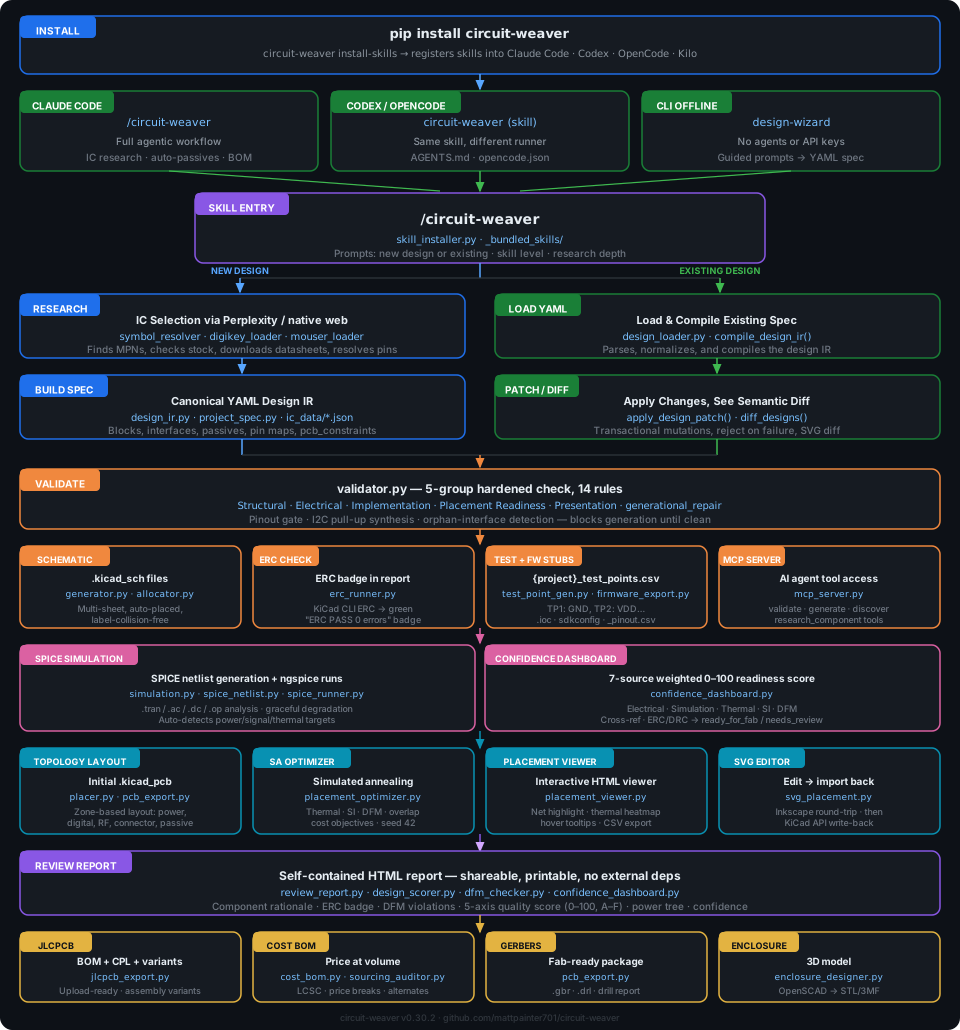
Programmatic KiCad schematic generation, strict validation, and manufacturing export designed for AI-assisted hardware workflows — Claude Code, Codex, and offline CLI.
Battery IoT Sensor placement is an open-source printed circuit board by mattpainter701, from the mattpainter701/circuit-weaver repository on GitHub, published under the MIT licence. It is a 2-layer board of 63 × 70 mm with 5 parts on 17 nets.
It is built around the ESP32-WROOM-32E, MAX17048G+T10 and MCP73831T-2ACI/OT-HXY. Its parts include 4 ICs and 1 connector. It belongs with the power and home automation and IoT boards and the ESP32 boards of this library.
Programmatic KiCad schematic generation, strict validation, and manufacturing export
designed for AI-assisted hardware workflows — Claude Code, Codex, and offline CLI.
How It Works
Circuit Weaver supports describe the design → validate → generate KiCad artifacts, with additional native placement, routing and review workflows. Start from an agent skill or the CLI and inspect the resulting evidence and blockers before proceeding.
Validated scope
Circuit Weaver is an alpha tool for engineering prototypes. The 0.37.0 workflow corpus covers all 13 shipped samples and three connected mixed-signal boards with 149, 155 and 145 physical parts. Each passes 16 stages, including native routing, DRC, assembled model previews and a real MCP session. These are finite regression fixtures; passing them does not establish arbitrary-circuit electrical correctness or fabrication readiness.
Claude Code, Codex and OpenCode can use the packaged agent skills and CLI. The optional MCP server exposes five focused tools rather than the entire CLI lifecycle. Installer and MCP tests do not constitute a fresh end-to-end test inside every agent client; see agent platform support.
RF research and circuit-generation assistance are available, but controlled-impedance routing, matching networks, antenna performance and RF stability require separate engineering verification. Native DRC and a rendered board are not evidence of RF performance. Review the automation validation guide for prerequisites, evidence and prototype delivery gates.
Capability Contract
This table is generated from the checked-in capability registry. Regenerate it with python scripts/gen_capability_docs.py; do not edit it by hand.
Verification is conservative: a capability only claims the evidence level its public path actually verifies. not applicable means an operational capability makes no design-artifact verification claim; it is not a lower verification level.
CLI capability
Maturity
Public surfaces
Verification contract
Evidence
Since
validate
beta
CLI: validate; Python: circuit_weaver.dispatcher:validate_design; HTTP: POST /validate; POST /mvp/validate; MCP: validate_design; Skill: circuit-weaver
static-parse → static-parse
command-contract, static-parse
0.32.1
apply-patch
beta
CLI: apply-patch; Python: circuit_weaver.dispatcher:apply_design_patch; HTTP: POST /mvp/apply-patch
static-parse → static-parse
command-contract, static-parse
0.32.1
generate
experimental
CLI: generate; Python: circuit_weaver.dispatcher:generate_artifacts; HTTP: POST /generate; POST /mvp/generate; MCP: generate_artifacts; Skill: circuit-weaver
static-parse → static-parse
command-contract, static-parse, kicad-load, erc
0.32.1
review-report
experimental
CLI: review-report; Skill: circuit-weaver
static-parse → static-parse
command-contract, static-parse
0.32.1
diff
beta
CLI: diff; Python: circuit_weaver.dispatcher:diff_designs; HTTP: POST /mvp/diff
static-parse → static-parse
command-contract, static-parse
0.32.1
ingest-pcb-feedback
beta
CLI: ingest-pcb-feedback; Python: circuit_weaver.dispatcher:ingest_pcb_feedback; HTTP: POST /mvp/pcb-feedback
Step 2 — Register the skill(one-time, for Claude Code / Codex / OpenCode)
bash
circuit-weaver install-skills            # install for all supported agent platforms
circuit-weaver install-skills --dry-run  # preview without touching disk
circuit-weaver install-skills --force --backup   # resolve conflicts, back up every replaced file
Upgrade safety: each installed skill has a provenance manifest containing hashes for every
managed file. A pristine older release upgrades automatically. A file changed or deleted by the
user is preserved and reported as a conflict, and the command exits non-zero. Pass --force
only after reviewing conflicts; add --backup to preserve every replaced file.
Step 3 — Launch
text
# Claude Code:
/circuit-weaver

# Codex:
$circuit-weaver

# OpenCode: ask it to use circuit-weaver (loaded through its skill tool).

# Or run offline without any agent:
circuit-weaver design-wizard
The skill walks through IC selection, spec validation, schematic generation, and the electrical-PCB handoff.
For a repeatable real-tool demonstration, run python scripts/validate_app_workflow.py --output ./workflow-evidence.
The automation validation guide describes native ERC/DRC evidence, optional MCP checks,
and the prototype/manufacturing boundary.
Research Traceability
Agentic research runs are expected to persist their output into output/research/.
That directory is the source of truth for why an IC was chosen, which citations
backed it, and which backend produced the result.
For Codex / Claude / OpenCode workflows, Step 2 IC research should stay in the
current agent session. If a premium-research command would delegate to a
subagent or fails with a model/tool conflict, use the platform's native web
tools instead and persist the backend that actually ran.
bash
# Check which backend and depth are active before research starts
circuit-weaver doctor
# Optional: force backend/depth selection for agent workflowsexport CIRCUIT_WEAVER_RESEARCH_BACKEND=standard # or sonar-pro / autoexport CIRCUIT_WEAVER_RESEARCH_DEPTH=fast # or normal# PowerShell: $env:CIRCUIT_WEAVER_RESEARCH_BACKEND="standard"# PowerShell: $env:CIRCUIT_WEAVER_RESEARCH_DEPTH="fast"# Persist a completed research result
circuit-weaver save-research --project-dir ./output --file research.json
Each saved run produces {slug}.json, {slug}.md, and summary.md, and the
matching design.log entry records the canonical JSON path for later audit.
Branch Maintenance
Use scripts/cleanup_branches.py to audit stale local branches before pruning them.
The command is dry-run by default and only targets merged, unprotected branches,
so dated work can be reviewed without risking useful code. When run with
--delete, deleted branch tips are archived under refs/archive/branches/<name>
unless --no-archive is explicitly supplied.
bash
python scripts/cleanup_branches.py                 # audit only
python scripts/cleanup_branches.py --delete        # prune merged stale branches and keep archives
python scripts/cleanup_branches.py --force-unmerged # include unmerged branches only when intentionally forced
What You Get
A successful default generate run produces a complete artifact bundle
(--no-placement-review deliberately omits the four placement-review files):
Artifact
File
Description
KiCad schematic hierarchy
{project}.kicad_sch plus functional sub-sheets
Real, loadable hierarchy; explicit block section values remain separate professional sheets and support passives follow their owner
Markdown design report
{project}_report.md
Validation results, component summary, and design notes
Normalized source of truth and generated design IR
Validation evidence
validation_report.json, placement_readiness.json
Machine-readable release/readiness checks
Artifact inventory
artifact_manifest.json
Portable relative paths, verification state, kinds, and sizes for every generated artifact
Test point map
{project}_test_points.csv
Auto-detected power, clock, bus, and differential-pair nets
Firmware stubs (when applicable)
{project}_pinout.csv, .ioc, sdkconfig.defaults
MCU pin map and STM32/ESP32 co-design files
Resume or Analyze an Existing Design
Circuit Weaver keeps restartable state in <project>/.circuit-weaver/project.json.
Import is non-destructive: source KiCad, PCB, Gerber, drill, and ZIP files are
inventoried and hashed rather than regenerated.
bash
# Import a KiCad project, a single KiCad file, a Gerber directory, or a ZIP
circuit-weaver import-design ./existing_board --analyze

# Inspect durable state or get a deterministic restart plan
circuit-weaver status ./existing_board
circuit-weaver resume ./existing_board

# Re-run every applicable bundled analyzer; unchanged results are cached
circuit-weaver analyze-design ./existing_board
Use --project-dir <dir> when state should live somewhere other than the
source directory. Use --force only to intentionally replace a changed import
source set, ZIP staging tree, or cached analysis. Netlist-only imports are
inventoried, but analysis is reported as unsupported because a netlist alone
does not contain schematic or physical-layout evidence.
Bounded no-connect repair
The first experimental imported-design repair is deliberately narrow: it can
add one explicit KiCad no-connect marker only when a
circuit-weaver-repair-metadata/v1 envelope binds the exact source hash,
analyzer component/pin identity, a v2 finding, and its validated evidence
manifest. Build that envelope with
circuit_weaver.repair_service.build_no_connect_metadata; the matching trusted
finding producer is no_connect_finding_from_intent. Both require current,
verified user evidence whose exact pin:REF.NUMBER claim says the pin is
intentionally unused. Raw analyzer JSON or an unbound boolean is rejected.
The service then independently proves the component UUID/library ID, pin
coordinate, and absence of a net, wire, label, junction, bus entry,
hierarchical sheet pin, power symbol, or coincident component pin. The plan is
reviewable JSON; the apply step will not infer approval from that file.
bash
circuit-weaver repair suggest board.kicad_sch repair-metadata.json \
  --ref U1 --pin 4 \
  --finding-id FND-0123456789ab \
  --evidence-id EV-VALIDATION-0123456789ab \
  --output no-connect-plan.json

# Review the plan and copy its plan_sha256 through the approval channel.
circuit-weaver repair apply no-connect-plan.json repair-metadata.json \
  --approved-plan-hash <approved-plan-sha256> \
  --reviewer <reviewer> \
  --finding-id FND-0123456789ab \
  --evidence-id EV-VALIDATION-0123456789ab

circuit-weaver repair verify board.kicad_sch no-connect-plan.json
The public capability guarantee is static parsing. Run KiCad ERC after review;
unsupported topology, geometry, part replacement, and pin-remapping repairs
fail closed instead of being improvised. Apply holds cross-process source and
audit locks, keeps an exact hard-linked preimage through publication, and uses
prepared/committed append-only audit events so an interrupted successful
publication can be recovered on retry. Lock hardlinks and reparse aliases are
rejected before mutation; the default audit sidecar cannot escape through a
directory junction. On Windows, atomic replacement preserves and verifies the
target owner, group, and DACL access semantics. Applications that write
schematics without honoring Circuit Weaver's lock remain outside the
cooperative locking contract; snapshot, identity, and post-image checks still
detect ordinary write races and preserve observed user bytes rather than
rolling over them.
PCB Placement Workflow
Circuit Weaver generates a review-only placement proposal, then KiCad creates
the electrical PCB. The SVG/HTML/JSON proposal is never a PCB, CPL, or other
fabrication artifact.
1 — Generate initial placement
generate returns the path to artifact_manifest.json. Resolve that manifest's portable root_schematic and artifact paths relative to the manifest directory instead of guessing filenames. Check verification_status before claiming KiCad verification. Placement review is enabled by default:
placement_result.json must contain the exact assembly_manifest.json
reference inventory. It remains fabrication_ready: false by design. Review
its overlap, boundary, support-part, geometry, sourcing, and constraint
blockers. placement_review_context.json records constraints, targeted
research prompts, and official component/reference-layout links available to
the agent; manufacturer documentation remains authoritative.
The optimizer minimizes: overlap, boundary violations, thermal clustering, and DFM zone penalties via simulated annealing. Returns a placement JSON with x/y/rotation/layer per component.
3 — Review in the interactive viewer
Open the generated output/placement_editor.html, or generate a standalone
viewer for a different optimizer configuration:
Thermal heatmap overlay (blue → red gradient by power dissipation)
CSV export button for placement data
4 — Create the electrical PCB in KiCad
Open artifact_manifest.json, then open its root_schematic, assign and verify footprints, and run Update PCB from Schematic. Save that electrically annotated board under a separate name. Only this board has the pads and nets required by routing, DFM, and Gerber export.
Apply reviewed SVG coordinates only to that real electrical PCB. The default
import is strict: every PCB reference must appear exactly once in the SVG, and
unexpected or missing references block the write.
After forward annotation, add a rectangular Edge.Cuts outline and lock connectors
that must remain fixed. Place the actual library footprints, route, import the
tracks, and check the final PCB:
The preview draws actual board layers and footprint body geometry. Use --side back
for a mirrored underside or --render-3d for a native assembly-model PNG on KiCad 9+
with the declared model files installed. The workflow demo
includes named preview controls and full-size views.
KiCad's native Python is discovered separately from your application Python.
Freerouting and a compatible Java runtime are required for routing. The input
board must have real pads and nets; padless previews are rejected. Placement
currently requires an unrouted rectangular board without zones. It preserves
locked footprints and board sides, uses real courtyards and rotated pad locations,
and checks physical DRC. Routing publishes the final board only after KiCad DRC
passes, preserving project rules. See setup and limits.
6 — DFM check and panelization
bash
# Check clearances, pad sizes, and DFM rules
circuit-weaver check-dfm electrical_board.kicad_pcb --profile jlcpcb
# Get panel layout suggestions for small boards
circuit-weaver panelize --board-width 50 --board-height 40 --qty 100# Export dual-sided CPL (top + bottom)
circuit-weaver export-dual-cpl design.yaml --pcb electrical_board.kicad_pcb -o ./jlcpcb
# Export a reconciled JLCPCB delivery and inspect its commit manifest
circuit-weaver export-jlcpcb design.yaml --pcb electrical_board.kicad_pcb -o ./jlcpcb
# → bom_jlcpcb.csv, cpl_jlcpcb.csv, README_jlcpcb.txt, delivery_manifest.json
Without --pcb, export-jlcpcb is intentionally BOM-only. A supplied board
must match every assembly reference and footprint before CPL publication.
Treat delivery_manifest.json as the delivery status/commit marker.
Run circuit-weaver --help or circuit-weaver <subcommand> --help for full flag reference.
Python API
python
from circuit_weaver.dispatcher import(
validate_design,
apply_design_patch,
generate_artifacts,
diff_designs,
ingest_pcb_feedback,
)from circuit_weaver.design_import import analyze_design, import_design
from circuit_weaver.project_state import get_project_state_summary, resume_project
# Validate a canonical design spec
report = validate_design(spec)# Apply a transactional patch and re-validate
result = apply_design_patch(spec, patch)# Generate the full bundle; require real KiCad for a release-quality claim
bundle = generate_artifacts(spec, output_dir="out/design", require_kicad=True)# Non-destructively open and analyze KiCad/PCB/Gerber/ZIP sources
opened = import_design("legacy-board.zip", project_dir="work/legacy", analyze=True)
state = get_project_state_summary(opened["project_root"])
restart_plan = resume_project(opened["project_root"])
analysis = analyze_design(opened["project_root"])
Validation groups
validate_design runs five grouped checks and returns a structured ValidationReport:
Group
What it checks
structural
Topology, block connections, hierarchy integrity
electrical
Power rails, ground nets, net continuity
implementation
Part bindings, footprint assignments, pinout verification
placement_readiness
Hard-gated — dangling buses, missing I2C pull-ups, orphan interfaces, floating enables; never bypassable by --no-require-valid
Machine-readable capability maturity and verification contract
/templates
GET
Available subcircuit templates
/generate
POST
YAML spec → ZIP of .kicad_sch + report
/validate
POST
YAML spec → validation JSON
/mvp/apply-patch
POST
Transactional patch + re-validation
/mvp/diff
POST
Semantic diff between two specs
/mvp/pcb-feedback
POST
Merge PCB layout feedback into spec
/mvp/generate
POST
JSON/YAML spec to a ZIP with a portable artifact manifest
What's New in v0.33.0
Circuit Weaver v0.33.0 makes electrical recommendations measurable and traceable instead of relying on silent universal defaults.
Area
Improvement
Evidence-backed passives
Shared versioned equations, explicit datasheet/equation/bounded-fallback precedence, declared E-series policy, and retained CALC-* evidence for critical support networks.
Fail-closed synthesis
Invalid or unsupported regulator, crystal, reset, USB-C, CAN/RS-485, and analog support values are withheld under CW-PSV-* findings before emission.
Typed power accuracy
Rail limits, direction, current envelopes, sequencing, tolerance, and provenance flow through ingest, validation, reports, placement context, and repair.
Identity safety
Exact MPN/package, symbol pin, footprint pad, and two-source reconciliation block physical CPL handoff when identity or pin-to-pad coverage is ambiguous.
Calibrated validation
Severity is separate from detection confidence; actionable findings name the constraint, observation, evidence, and safest next action.
Published scorecard
A 40-fixture benchmark covers 33 emitted/contract rule IDs—14 scored and 19 explicitly unsupported—with supported precision/recall at 1.000/1.000.
v0.32.0
Circuit Weaver v0.32.0 is an integrity and compatibility release for agent workflows and programmatic users.
Area
Improvement
Schematic integrity
Deterministic sheet/reference allocation, collision-safe symbol naming, strict rendered pin maps, final S-expression checks, and safer label/wire movement for dense designs.
Truthful verification
ERC runs against the exact final schematic; results expose kicad_verified and verification_status, while --require-kicad fails closed when verification cannot run.
Durable workflows
Atomic status/resume state plus non-destructive KiCad, PCB, Gerber/drill, and ZIP import with fingerprinted cached analysis.
Professional hierarchy
Explicit block sections remain separate functional sheets, support parts retain ownership, and filenames are collision-safe.
Placement review
Exhaustive assembly reconciliation, blocker-aware JSON/context, official-reference links, and editable SVG/HTML; review artifacts are never fabrication data.
Manufacturing and routing
JLC/CPL export reconciles real PCB references and footprints; Freerouting publishes validated SES sessions and reports incomplete routing as partial.
Agent workflows
Portable kebab-case skills, narrower triggers, provenance-aware upgrades, and aligned Codex, Claude, and OpenCode installation paths.
Programmatic compatibility
Restored legacy imports and deprecated aliases, strict YAML parsing, exhaustive artifact inventory, and real placement SVG data.
Release reliability
Python 3.10-3.14, blocking Windows coverage, exact-wheel tests, live MCP tests, and KiCad 8/9/10 generation and ERC gates before PyPI publication.
v0.31.0
Circuit Weaver v0.31.0 collected the Sprint 53-54 schematic layout quality work and graduated the prior 0.30.x sprint-release series into a minor release.
Sprint
Feature
54
Layout quality zero-crossing gate — all quality-gated sample schematics now target zero wire-through-body crossings, with body-aware stubs, tapped-rail splitting, unrounded keep-outs, and generator-visible layout-quality warnings/reports.
54
Density, sheet splitting, and autorouter hardening — connector-heavy layouts now use a continuous density score, oversized sheets split instead of cramming onto A0, and Freerouting preflight/effort/timeout handling fail closed with clearer remediation.
53
Schematic readability and passive placement — sidecar passives, passive motifs, and local wiring now use occupancy-aware placement and body-aware routing to remove symbol overlaps and sharply reduce wire-body crossings.
52
Part-neutral repair and schema plumbing — normalized pin_roles now flow through ComponentDef, ic_data, EasyEDA imports, generic-builder outputs, and cache round-trips, so SPI/UART repair can operate from shared capabilities instead of exact MPN branches.
52
Generation and placement hardening — readiness gating now lives in generate_from_components, generic bypass policy is centralized, orphan non-power nets are hard-gated in placement-readiness, and PCB placement preview now penalizes long connected pairs instead of staying purely zone-based.
51
Restart and validation flows are more truthful — log-status works for validate-only sessions, persisted validation summaries now reflect the final verdict, Windows text-mode validation falls back to ASCII, and bad data-driven ic resolution now fails closed instead of silently substituting another part.
51
Workflow skills are less brittle under long-running sessions — /circuit-weaver now reports the installed CLI version first, long steps require timeout follow-up checks, and the validate-output recipe now preserves JSON on stdout instead of mixing it with stderr.
50
Generic builder parity gate is closed — the data-driven path now covers the remaining sensor-front-end, shared-bus, battery, display, and passive-diode contracts that were blocking the sample/corpus release gate; the full suite passes 1009 passed, 1 skipped.
50
CLI/package workflows are hardened for PyPI use — read-only spec directories no longer crash file logging, unreadable ~/.config/secrets.env no longer breaks doctor or unknown-part fallback, and the bundled skill payload is resynced byte-identical with skills/.
49
Wizard intake now tiers by experience level — the offline design-wizard asks for experience before requirements, uses compact design-brief intake for advanced/professional users, and no longer forces the same opening question flow on every user.
49
Specialized RF workflows are now framed correctly — Circuit Weaver skills now route radar / RF / microwave requests into a research-first custom engineering flow instead of treating the lack of turnkey coverage as an out-of-scope rejection.
45-47
Schematic paper over-promotion fix — layout_sheet() now starts from the allocator-selected paper size and only promotes if it doesn't fit. Small IoT-sensor-class designs no longer cascade to A2. Tighter title-block clearance keeps content on A3.
45-47
Design log severity mapping — DesignLogHandler maps Python WARNING records to "warning" type instead of "error" in design.log.
45-47
BME688 bundled IC data — sensor pin/footprint metadata shipped in ic_data/misc.json. IoT_AQ_Sensor_v2 resolves without local custom.json.
Label collision avoidance — overlapping labels on dense sheets are detected and shifted along wire-stub direction. Same-name labels skipped.
44
Validate-all regression gate — 14+1 sample YAMLs now validate clean; CI gate enforces zero hard errors.
44
Sourcing auditor alternates — queries LCSC/DigiKey for functionally similar parts when a component has CRITICAL/WARNING risk.
44
MCP server — circuit-weaver-mcp entry point for AI agent tool access via FastMCP.
44
Wire-crossing minimization — placer penalizes crossing-dense placements; bus signal groups detected for future parallel routing.
43
Density-scaled grid spacing — inter-component gaps scale to spread content across available page area, preventing corner-clustering on large sheets.
43
Annotation overlap prevention — per-IC annotations shift down when they would collide, with overflow line drops.
43
Lane routing counter recycling — capped at 6 with modulo wrap, preventing lanes from drifting 194mm from the IC.
v0.27.0
Sprint
Feature
40
Cache-rebuilt components no longer ship as silent 2-pin stubs — SymbolResolver._rebuild_from_cache now marks cache hits without real pin topology as pinout_source="stub", so the existing pinout-source validator gate catches any multi-pin IC (sensor, MCU, H-bridge, gate driver, regulator) that would otherwise emit as a passive. The EasyEDA tier now persists full pin + power + bypass / strap topology via symbol_cache.component_def_to_cache_payload() so round-tripping a part through the cache preserves everything
40
Schematic emission invariant — primitives.assemble_sheet now dedupes structural duplicates before writing (symbol instances, wires, global / hierarchical labels, no-connects, junctions, UUIDs). Catches the placer / topology-dispatcher double-emission class of bug that was causing stacked passives, duplicate wires, and shared-UUID power symbols
40
Placement PCB preview never fabricates footprints or synthetic pads — the generator field now reads placement_preview so reviewers can tell the file apart from fab-ready output; missing footprint bindings emit Placement_Preview:Missing_<ref> placeholders instead of the old SOIC-8 fallback; and no synthetic pads are emitted for any component. KiCad's schematic → PCB forward annotation is the authoritative source of pads
40
generate enforcement is now deterministic across runs — structural + implementation category errors always raise, regardless of require_valid. --no-require-valid now only bypasses soft electrical warnings (dangling dev signals, crystal load-cap tolerance) and the bypass is logged at WARNING level. Two runs on the same spec + cache state always reach the same verdict
40
Report-fidelity diagnostic — report.verify_report_fidelity(report_text, components) flags references to component refs, net names, or annotations that don't exist in the resolved design. Catches the ghost-feature pattern where a report claimed "BME688 I2C + pull-ups" or "LED + current-limit R4" without any backing wires
40
Five-archetype generation regression corpus — tests/test_generation_corpus.py runs generate_artifacts end-to-end on LED driver, IoT sensor, motor controller, USB bridge, and FPGA power carrier samples, enforcing all three Sprint 40 invariants. Breadth-guard test keeps the corpus at ≥ 5 archetypes
39
Step 2 IC research stays in the current agent session across Codex / Claude / OpenCode instead of delegating to a spawned /research / research-analyst path that could trigger model conflicts; workflow docs and skill prompts now describe the real behavior
39
Research-depth latency selector — design-wizard --research-depth {fast,normal} persists into spec metadata; doctor reports the effective depth; Circuit Weaver skill uses a smaller query budget in fast mode
v0.26.1
Sprint
Feature
38
Research workflow is now reproducible end-to-end — design-wizard --research-backend persists the effective backend into spec metadata, save-research records the canonical JSON artifact path in design.log, and the workflow docs now tell agents to treat output/research/ as the source of truth
38
Resolver credential diagnostics now match real runtime behavior — DigiKey checks both DIGIKEY_CLIENT_ID and DIGIKEY_CLIENT_SECRET, Mouser honors MOUSER_SEARCH_API_KEY through the shared credential loader, and circuit-weaver doctor now reports both credential states directly
37
Research persistence + backend selection shipped in the CLI — circuit-weaver save-research, CIRCUIT_WEAVER_RESEARCH_BACKEND, and circuit-weaver doctor backend reporting are now available in the published package
v0.25.0
Sprint
Feature
35
install-skills collision protection — stopped silently overwriting a curated SKILL.md; added --force, --backup, and --dry-run with collision reporting for review
35
All 11 skills bundled in the wheel — the full set, including design-wizard, is kept in sync by scripts/sync_bundled_skills.py with CI and pre-commit drift guards
35
Windows CI leg — windows-latest / Python 3.12 smoke run (non-blocking first sprint) covering CLI commands, doctor, skill installer, and python -m circuit_weaver --version
v0.24.0
Sprint
Feature
34
Data-Driven Template Engine — IC data now lives in JSON files under src/circuit_weaver/ic_data/ (11 categories). New topology_builders.py produces schematic fragments dynamically, replacing hardcoded template classes
34
7 New Subcircuit Templates — RTC (DS3231, PCF8563), EEPROM (24LCxx, 25LCxx), wireless modules (nRF52, ESP32, LoRa), USB-C connectors, SPI bus conditioning, voltage references (REF5025, LM4040), generic connectors — total template count now 37
34
IC Registration CLI — scripts/extract_ic_data.py harvests IC entries from datasheet research; register_ic() API persists to custom.json
33
Platform Compatibility — full Claude Code / Codex / OpenCode support across all skills, updated shim files, skill trigger disambiguation
32
CLI Integration Tests — 24 end-to-end CLI tests; informational output moved to stderr
Confidence Dashboard — circuit-weaver confidence aggregates 7 data sources into a 0-100 readiness score with HTML report; now a mandatory step in the wizard flow
Enhanced Validations — 3 new checks (power budget, thermal limits, signal integrity); cross-reference auditor validates spec-vs-schematic-vs-BOM consistency
28
Circuit Simulation Engine — SPICE netlist generation, ngspice runner with graceful degradation, simulation orchestrator with auto-planning and confidence scoring
27
Project Discovery — circuit-weaver discover auto-detects projects in CWD; all skills now pre-check before asking for paths
26
Logging Overhaul — 13 structured event types in design.log, Python logging bridge, log-event CLI for skill-callable logging, 7 modules instrumented
v0.21.0
Sprint
Feature
25
Component Selection Rationale — HTML review report now includes a per-IC table showing why each part was chosen, key electrical specs, and any reference design cited
25
Auto Test Point Generation — generate_artifacts() emits {project}_test_points.csv and test-point report data while leaving the validated schematic bytes unchanged (annotated_schematic: false); detects power, ground, clock, bus, and differential-pair nets
24
Firmware Co-Design Export — Auto-generates {project}_pinout.csv, STM32 .ioc skeleton, and ESP32 sdkconfig.defaults when MCU blocks are present
23
KiCad CLI ERC Integration — circuit-weaver erc runs KiCad's built-in ERC and surfaces results in the HTML report with a pass/fail badge
22
Pinout Verification Gate — ICs using unverified stub pinouts now fail validation before any schematic is emitted
$circuit-weaver from the current global ~/.agents/skills location
OpenCode
Agent Skills from ~/.agents/skills, or $OPENCODE_CONFIG_DIR/skills when configured
Kilo
Global skills under $KILO_CONFIG_DIR/skills or ~/.kilo/skills
Install for all platforms at once:
bash
# Bash (Mac/Linux/WSL)
./install.sh --platform all

# PowerShell (Windows)
./install.ps1 -Platform all
The wrappers install the checkout and delegate skill copying, upgrades, dry runs, and conflict handling to the same Python installer. They honor CLAUDE_CONFIG_DIR, OPENCODE_CONFIG_DIR, and KILO_CONFIG_DIR; Codex uses ~/.agents/skills. Use --skills-only / -SkillsOnly to avoid reinstalling the package.
Sample Design
PyPI installs include a portable IoT starter. Copy it into a writable project
directory, then run the full workflow:
bash
python -c "from importlib.resources import files; from pathlib import Path; d=Path('iot_sensor_example'); d.mkdir(exist_ok=True); d.joinpath('design.yaml').write_bytes(files('circuit_weaver').joinpath('examples','iot_sensor.yaml').read_bytes())"# Validate
circuit-weaver validate iot_sensor_example/design.yaml
# Generate schematic + report + test points + firmware stubs
circuit-weaver generate iot_sensor_example/design.yaml -o ./output
# Export a BOM-only delivery (no heuristic CPL is invented)
circuit-weaver export-jlcpcb iot_sensor_example/design.yaml -o ./output/jlcpcb
# After creating a real electrical PCB, export a reconciled BOM + CPL
circuit-weaver export-jlcpcb iot_sensor_example/design.yaml \
--pcb ./output/iot_sensor.kicad_pcb -o ./output/jlcpcb
A source checkout also includes the larger reference gallery under samples/.
Contributing
bash
# Install with dev dependencies
pip install -e ".[dev]"# Install pre-commit hooks
pre-commit install
# Lint
python -m ruff check src tests
# Test
python -m pytest tests -q
Pre-commit hooks run ruff, YAML validation, and circuit-weaver validate --strict on changed design specs automatically.
Programmatic KiCad schematic generation, strict validation, and manufacturing export designed for AI-assisted hardware workflows — Claude Code, Codex, and offline CLI.
Programmatic KiCad schematic generation, strict validation, and manufacturing export designed for AI-assisted hardware workflows — Claude Code, Codex, and offline CLI.
Programmatic KiCad schematic generation, strict validation, and manufacturing export designed for AI-assisted hardware workflows — Claude Code, Codex, and offline CLI.
Programmatic KiCad schematic generation, strict validation, and manufacturing export designed for AI-assisted hardware workflows — Claude Code, Codex, and offline CLI.
Programmatic KiCad schematic generation, strict validation, and manufacturing export designed for AI-assisted hardware workflows — Claude Code, Codex, and offline CLI.
Programmatic KiCad schematic generation, strict validation, and manufacturing export designed for AI-assisted hardware workflows — Claude Code, Codex, and offline CLI.
Programmatic KiCad schematic generation, strict validation, and manufacturing export designed for AI-assisted hardware workflows — Claude Code, Codex, and offline CLI.
Programmatic KiCad schematic generation, strict validation, and manufacturing export designed for AI-assisted hardware workflows — Claude Code, Codex, and offline CLI.
Dual-MCU baremetal embedded development board featuring high-speed QSPI storage, hardware USB hub, and flexible power management. Open for PCB trace routing collaboration
Luxera One is a from-scratch attempt to build what the big labs keep teasing: AR glasses that look like actual glasses. Everything — compute, batteries, optics, sensors, audio — seals inside a chunky acetate frame.
Standalone embedded audio system engineered with an STM32G031K8 microcontroller using HAL drivers for peripheral management and a VS1053B codec for real-time decoding and playback.
MTP F26 (UPC) Team C workspace: radio link budget, RFM69 firmware, protocol simulator
94 parts
Questions
How big is the Battery IoT Sensor placement PCB?
It measures 63 × 70 mm and has 2 copper layers, 1.6 mm thick.
What parts does the Battery IoT Sensor placement use?
5 parts, built around the ESP32-WROOM-32E, MAX17048G+T10 and MCP73831T-2ACI/OT-HXY. The full list of its parts is on this page, with links to each part's symbol and footprint where PCBKit's library has them.
Where can I download the Battery IoT Sensor placement KiCad files?
From the mattpainter701/circuit-weaver repository on GitHub, at the commit this page was made from: the board is samples/battery_iot_sensor/Battery_IoT_Sensor_placement.kicad_pcb and its schematic samples/battery_iot_sensor/Battery_IoT_Sensor.kicad_sch. PCBKit opens the board in the browser, with nothing to install.
Can I use the Battery IoT Sensor placement design in my own project?
Its repository publishes it under the MIT licence: you may reuse it on that licence's terms (keep the author's notice, and for a copyleft licence share your changes alike).