4 layers123 × 75 mm
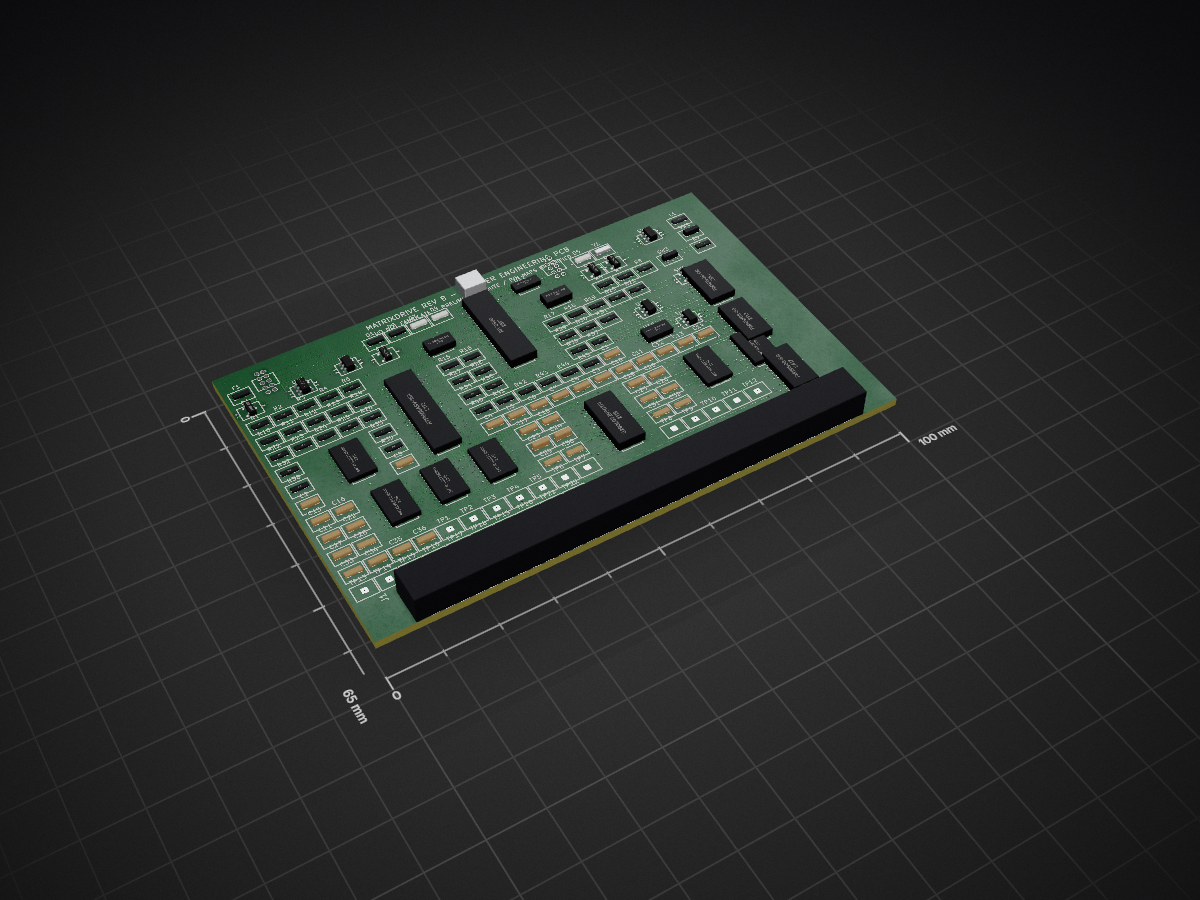
 Matrixite/MatrixDrive
MatrixDrive is a USB-loadable Mega Drive/Genesis cartridge
MatrixDrive RevB is an open-source printed circuit board by Matrixite, from the Matrixite/MatrixDrive repository on GitHub. It is an 8-layer board of 100 × 65 mm with 143 parts on 192 nets, routed with 3,917 tracks and 1,246 vias.
It is built around the ATF1508ASV-15AU100, RP2350B and S29GL032N90TFI040, with the W25Q128JVSIQ, W25Q16JVSSIQ and SN74LVC8T245PWRE4 among its other parts. Its parts include 45 resistors, 36 capacitors, 20 ICs, 5 diodes and 4 transistors. It belongs with the retro computing and games boards and the RP2350 and FPGA and CPLD boards of this library.


MatrixDrive started with a simple idea: make a Mega Drive/Genesis cartridge that you can plug into a computer with USB-C, copy a game onto like a flash drive, and then use in a real console.
Revision B takes that idea quite a bit further. It is also designed to run Master System software on compatible Mega Drive hardware, supply ROM data to a real 32X, work in the upper slot of Sonic & Knuckles, and keep supported save data in battery-free FRAM.
[!IMPORTANT] MatrixDrive is still an engineering prototype. The software and logic have been tested, and the PCB has a preliminary fully connected route, but no physical cartridge has been built or tested in a console. Several package pin assignments still need to be verified and the board has not passed KiCad DRC. Please do not send the current PCB straight to a manufacturer.
| Mode | Files | Maximum size | What happens |
|---|---|---|---|
| Mega Drive / Genesis | .BIN, .MD, .GEN | 4 MiB | The game is presented as linear cartridge ROM |
| 32X with real 32X hardware | .32X | 4 MiB | MatrixDrive supplies the ROM while the real 32X provides the 32X hardware |
| Sonic & Knuckles upper slot | Mega Drive images | 2 MiB recommended | Supports Sonic 2 lock-on and Sonic 3 with its dedicated save area |
| Master System | .SMS | 2 MiB | Uses either the Sega or Codemasters mapper selected by SW4 |
Master System mode should work on standard Mega Drive/Genesis Model 1 and Model 2 consoles. It will not work on an unmodified Genesis 3 or Sega Nomad because their cartridge-port Master System mode pin is disconnected. The JVC X'Eye can run SMS cartridges through an adapter, but its reset circuit prevents SMS games from running from a Genesis flash cartridge such as MatrixDrive. Compatibility with other all-in-one, portable, licensed, or clone systems has not yet been verified. MatrixDrive also does not fit a standalone Master System cartridge slot, and SMS mode cannot run through a 32X or the Sonic & Knuckles upper slot.
When MatrixDrive is connected to a computer, it appears as a FAT16 drive called
MATRIXDRV. The RP2350B checks the game image and programs it into parallel NOR
flash. After USB is disconnected, the CPLD takes over and responds to the
console immediately, without waiting for the microcontroller to boot.
The main hardware is:
MATRIXDRV drive, delete the old game, and copy over one supported
image.[!WARNING] Never connect USB while MatrixDrive is fitted to a console, 32X, or Sonic & Knuckles cartridge. Never move SW2 or SW4 while powered, and never hot-plug any part of the cartridge stack.
SW4 changes purpose depending on the position of SW2:
| SW2 | SW4 low | SW4 high |
|---|---|---|
| MD | Linear ROM, 32X, or Sonic 2 lock-on | Linear ROM with Sonic 3 save FRAM |
| SMS | Sega mapper | Codemasters mapper |
Always change these switches with USB and console power disconnected.
For Sonic 2 & Knuckles, copy a normal Sonic 2 image, set SW2 to MD, and set SW4 low to LINEAR. Power-of-two images up to 2 MiB are mirrored across the upper-cartridge ROM window.
For Sonic 3 & Knuckles, copy a normal Sonic 3 image, set SW2 to MD, and
set SW4 high to S3 SAVE. MatrixDrive then maps the dedicated save FRAM over
odd-byte addresses $200001-$203FFF while leaving the rest of the ROM visible.
Read Sonic & Knuckles lock-on mode for the exact mapping, switch positions, and physical-fit checks.
MatrixDrive is not trying to reproduce a 32X. A real 32X still supplies its processors, boot ROM, registers, video, and audio hardware; MatrixDrive only supplies the cartridge ROM.
Copy a .32X image, set SW2 to MD, leave SW4 low, disconnect USB, and fit
MatrixDrive to an unpowered 32X. The installer checks the SEGA header and
MARS CHECK MODE marker before accepting the image.
Do not use SW4 high for 32X software because that setting deliberately replaces part of the ROM address range with the Sonic 3 save window. More detail is in 32X cartridge mode.
| Profile | Mapper writes | Starting ROM banks | Save window |
|---|---|---|---|
| Sega | $FFFC-$FFFF | 0, 1, 2 | 16 KiB at $8000-$BFFF |
| Codemasters | $0000, $4000, $8000 | 0, 1, 0 | 8 KiB at $A000-$BFFF |
In Codemasters mode, bit 7 of the $4000 write enables FRAM and bits 2:0 choose
one of eight 8 KiB banks. This makes all 64 KiB of SMS save storage available
without hiding the ROM at $8000-$9FFF.
See Master System mode for the full register and banking behaviour.
SEGA at
offset 0x100, and fit within 4 MiB..32X, contain SEGA at 0x100 and MARS CHECK MODE at
0x3C0, be a multiple of four bytes, and fit within 4 MiB.TMR SEGA at 0x1FF0, 0x3FF0, or 0x7FF0..SMD files and copier headers are not supported.No commercial ROM images are included in this repository.
The project is automatically rebuilt and tested on every change. The passing software-only tests currently cover:
These tests show that the intended software and logic paths behave correctly. They cannot prove cartridge fit, signal timing, voltage translation, power isolation, save retention, or operation on real Sega hardware.
The KiCad project contains a complete logical schematic and a preliminary eight-layer PCB route. The routing report currently records all 188 routable nets connected, using six signal layers plus dedicated ground and 3.3 V planes.
Before a board can be considered ready to build, it still needs:
Only the Sonic 3 odd-byte save layout is implemented for Mega Drive software.
Generic Mega Drive or 32X SRAM/EEPROM saves, ROMs larger than 4 MiB,
enhancement hardware, unusual regional or game-specific SMS mappers, light-gun
support, and Sega mapper RAM-at-$C000 mode are outside this revision.
Start with Safety and bring-up before attempting any hardware test.
| Path | What you will find there |
|---|---|
MatrixDrive_Dual_System_Cart_RevB/ | Main Revision B project |
cpld/ | Mapper RTL, reference model, and testbench |
firmware/ | RP2350B USB installer firmware |
hardware/ | KiCad files, BOM, pinout, netlist, and routing report |
docs/ | Architecture, compatibility, and bring-up notes |
tools/ | Project generator, router, and validation scripts |
The full design README contains the component-level details and additional design notes.
You will need Python 3, the Raspberry Pi Pico SDK 2.3.0, an Arm GNU toolchain, CMake/Ninja, and Icarus Verilog.
cd MatrixDrive_Dual_System_Cart_RevB
python3 tools/generate_kicad_project.py
python3 tools/route_kicad_pcb.py
python3 tools/validate_project.py
To build the RP2350B firmware:
export PICO_SDK_PATH=/absolute/path/to/pico-sdk
cmake -S firmware -B ../build/firmware -G Ninja \
  -DPICO_BOARD=matrixdrive \
  -DPICO_PLATFORM=rp2350-arm-s \
  -DCMAKE_BUILD_TYPE=Release
cmake --build ../build/firmware| Qty | Value | Footprint | References |
|---|---|---|---|
| 21 | 100nF | MatrixDrive:0603 | C1, C2, C3, C4, C10, C11, C12, C13, C14, C15, C16, C17, C18, C34, C35, C36 +5 |
| 19 | 10k | MatrixDrive:0603 | R12, R19, R20, R21, R22, R23, R25, R26, R27, R31, R32, R33, R34, R35, R36, R42 +3 |
| 12 | 100k | MatrixDrive:0603 | R6, R7, R8, R14, R29, R30, R37, R38, R39, R40, R41, R44 |
| 6 | SN74LVC8T245PWR | MatrixDrive:TSSOP_24_LOGICAL | U3, U4, U5, U6, U7, U14 |
| 6 | TBD_REF | MatrixDrive:0402 | C28, C29, C30, C31, C32, C33 |
| 4 | 10k DNP | MatrixDrive:0603 | R15, R16, R17, R18 |
| 4 | 1k | MatrixDrive:0603 | R9, R10, R11, R28 |
| 4 | 1uF | MatrixDrive:0603 | C19, C20, C21, C22 |
| 4 | 2N7002 | MatrixDrive:SOT_23 | Q1, Q2, Q3, Q4 |
| 3 | FM18W08-SG | MatrixDrive:SOIC_28_LOGICAL | U17, U18, U20 |
| 2 | 10uF | MatrixDrive:0805 | C23, C24 |
| 2 | 15pF | MatrixDrive:0402 | C25, C26 |
| 2 | 27R | MatrixDrive:0603 | R3, R4 |
| 2 | 5.1k | MatrixDrive:0603 | R1, R2 |
| 2 | PMEG2010AEB | MatrixDrive:SOD_523 | D1, D2 |
| 1 | 0R | MatrixDrive:0603 | R13 |
| 1 | 12MHz_CRYSTAL | MatrixDrive:3225_4P | Y1 |
| 1 | 3.3uH | MatrixDrive:2016 | L1 |
| 1 | 33R | MatrixDrive:0603 | R24 |
| 1 | 3V3 | MatrixDrive:TP_SMD_1MM | TP4 |
| 1 | 4.7uF | MatrixDrive:0603 | C27 |
| 1 | AMBER_LED | MatrixDrive:0603_LED | D4 |
| 1 | AS_3V3 | MatrixDrive:TP_SMD_1MM | TP21 |
| 1 | ATF1508ASV-15AU100 | MatrixDrive:TQFP_100_UNASSIGNED | U13 |
| 1 | BUS_DISABLE | MatrixDrive:TP_SMD_1MM | TP6 |
| 1 | CART_5V | MatrixDrive:TP_SMD_1MM | TP1 |
| 1 | CPLD_JTAG_2x5 | MatrixDrive:HDR_2x5_1_27 | J4 |
| 1 | FRAM_CE_N | MatrixDrive:TP_SMD_1MM | TP13 |
| 1 | FRAM_HI_CE_N | MatrixDrive:TP_SMD_1MM | TP14 |
| 1 | FRAM_OE_N | MatrixDrive:TP_SMD_1MM | TP15 |
| 1 | FRAM_WE_N | MatrixDrive:TP_SMD_1MM | TP16 |
| 1 | GND | MatrixDrive:TP_SMD_1MM | TP5 |
| 1 | GREEN_LED | MatrixDrive:0603_LED | D3 |
| 1 | LWR_3V3 | MatrixDrive:TP_SMD_1MM | TP19 |
| 1 | MD_FRAM_CE_N | MatrixDrive:TP_SMD_1MM | TP17 |
| 1 | MD_HIGH_DISABLE_3V3 | MatrixDrive:TP_SMD_1MM | TP18 |
| 1 | MD_SMS_DPDT | MatrixDrive:SW_DPDT_6P | SW2 |
| 1 | MEGA_DRIVE_EDGE | MatrixDrive:MD_2x32_EDGE | J1 |
| 1 | MF-MSMF020-2 | MatrixDrive:1812 | F1 |
| 1 | PROFILE_SPDT | MatrixDrive:SW_SPDT_3P | SW4 |
| 1 | PROGRAM | MatrixDrive:SW_2P | SW1 |
| 1 | RED_LED | MatrixDrive:0603_LED | D5 |
| 1 | ROM_CE_N | MatrixDrive:TP_SMD_1MM | TP10 |
| 1 | ROM_OE_N | MatrixDrive:TP_SMD_1MM | TP11 |
| 1 | ROM_WE_N | MatrixDrive:TP_SMD_1MM | TP12 |
| 1 | RP2350B | MatrixDrive:UNVERIFIED_LOGICAL_PACKAGE | U1 |
| 1 | S29GL032N90TFI040 | MatrixDrive:TSOP_I_48_UNVERIFIED_PINMAP | U2 |
| 1 | SMS_MODE_3V3 | MatrixDrive:TP_SMD_1MM | TP7 |
| 1 | SMS_MODE_5V | MatrixDrive:TP_SMD_1MM | TP8 |
| 1 | SMS_PAUSE | MatrixDrive:SW_2P | SW3 |
| 1 | SN74LVC1G04DBVR | MatrixDrive:SOT_23_5 | U16 |
| 1 | SN74LVC1G17DBVR | MatrixDrive:SOT_23_5 | U8 |
| 1 | SN74LVC1T45DBVR | MatrixDrive:SOT_23_6 | U19 |
| 1 | SN74LVC2G32DCUR | MatrixDrive:VSSOP_8 | U15 |
| 1 | SWD_UART_2x5 DNP | MatrixDrive:HDR_2x5_1_27 | J3 |
| 1 | SYS_5V | MatrixDrive:TP_SMD_1MM | TP3 |
| 1 | TIME_3V3 | MatrixDrive:TP_SMD_1MM | TP22 |
| 1 | TLV75533PDBVR | MatrixDrive:SOT_23_5 | U11 |
| 1 | TPD2EUSB30DRTR | MatrixDrive:DRT_9_LOGICAL | U12 |
| 1 | USB4105-GF-A | MatrixDrive:USB_C_16P | J2 |
| 1 | USB_MODE_3V3 | MatrixDrive:TP_SMD_1MM | TP9 |
| 1 | USB_VBUS | MatrixDrive:TP_SMD_1MM | TP2 |
| 1 | UWR_3V3 | MatrixDrive:TP_SMD_1MM | TP20 |
| 1 | W25Q128JVSIQ | MatrixDrive:SOIC_8 | U10 |
| 1 | W25Q16JVSSIQ | MatrixDrive:SOIC_8 | U9 |
It measures 100 × 65 mm and has 8 copper layers, 1.6 mm thick.
143 parts, built around the ATF1508ASV-15AU100, RP2350B, S29GL032N90TFI040 and W25Q128JVSIQ. The full list of its parts is on this page, with links to each part's symbol and footprint where PCBKit's library has them.
From the Matrixite/MatrixDrive repository on GitHub, at the commit this page was made from: the board is MatrixDrive_Dual_System_Cart_RevB/hardware/MatrixDrive-RevB.kicad_pcb. PCBKit opens the board in the browser, with nothing to install.
Its repository states no licence, so its author keeps all rights: ask Matrixite before reusing the design.

DeadlySIn777/Controller
Unfinished CNC controller motherboard: native KiCad sources, rules, DSN and global routing review

Fairank/FieldDock
Compact iPhone companion hardware: editable PCB, mechanical CAD and portable firmware. Engineering prototype; original work available for noncommercial use.

EdmundLimBoEn/gps-maidenhead-device
Open-source portable GNSS Maidenhead grid locator with a 16x2 LCD

zgeez/Pixel-Badge
Wearable 32x32 LED badge with Zephyr firmware, BLE control, passive NFC, and a Flutter Android app, built around a custom nRF52840 PCB.

bryfur/tang-av-scaler
PS2-class component video -> deinterlace, SMAA, scale -> 1080p60 HDMI on a Sipeed Tang Console 138K, with its AV board

adham404/Open8-VGA
An 8-bit computer from 74HC logic: microcoded CPU, VGA, PS/2, on-board editor and assembler. Play it in your browser.

arrow53/RoomTempHumidity
A local whole-house temperature and humidity monitor. USB-powered room sensors send measurements over Thread to a Raspberry Pi base unit, which stores history and presents a touchscreen dashboard without requiring a…