2 layers298.8 × 122 mm
Ursaminor pcb
markstory/ursa-minor-keyboard
Design and schematics for the ursaminor keyboard
225 parts23

 markstory/sentry-keyboard3
Replacement PCB for the gifted keyboards
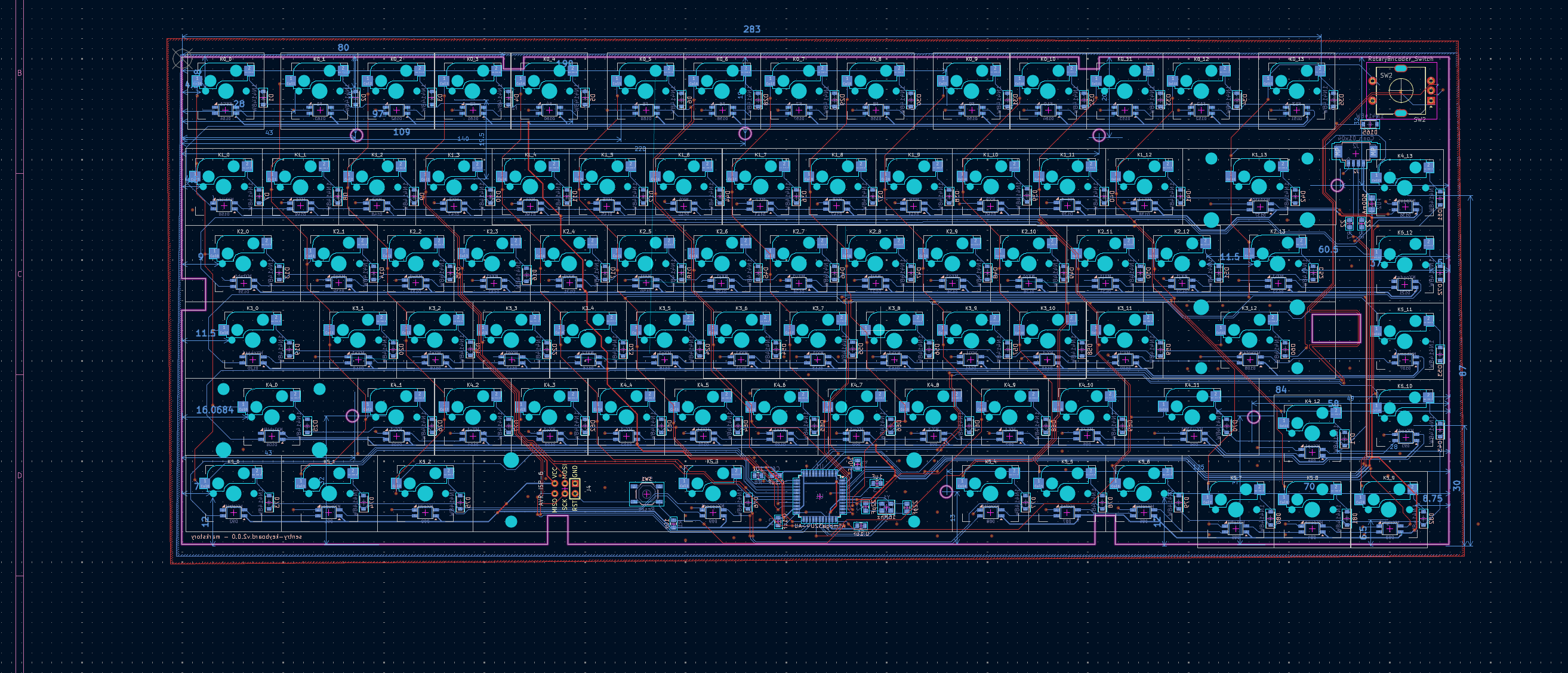
Sentry keyboard v1 is an open-source printed circuit board by markstory, from the markstory/sentry-keyboard repository on GitHub, published under the MIT licence. It is a 2-layer board of 315 × 121 mm with 265 parts on 203 nets, routed with 2,881 tracks and 489 vias.
It is built around the ATMEGA32U4-AU, K210 and K010, with the K08, 1N4148W and SK6812 among its other parts. Its parts include 165 diodes, 13 fuses, 7 capacitors, 4 resistors and 2 connectors. It belongs with the keyboards and input boards and the AVR (ATmega, ATtiny) and RISC-V boards of this library.


A reverse engineered PCB for the keyboard that Sentry gave as holiday gift in 2024.
The firmware directory of this repostiory contains only the files specific
to this keyboards firmware, and does not include all of QMK. To build firmware you
need to have a copy of QMK (lets assume it is at ~/code/qmk):
cp -R firmware/* ~/code/qmk/keyboards/sentry-keyboard
cd ~/code/qmk
qmk compile -kb sentry-keyboard -km default
This will compile a .hex file that you can flash onto your keyboard
qmk flash -kb sentry-keyboardBrand new micro controller chips may have not have the bootloader initialized, and you'll need to erase the chip first:
dfu-programmer atmega32u4 eraseOnce the chip has been erased you can flash the firmware on.
Both the PCB design and firmware are provided under the MIT License
| Qty | Value | Footprint | References |
|---|---|---|---|
| 83 | 1N4148W | Diode_SMD:D_SOD-123 | D1, D2, D10, D11, D12, D13, D14, D15, D16, D17, D18, D19, D20, D21, D22, D165 +67 |
| 82 | SK6812 | Keebio:SK6812-MINI-E | D100, D101, D102, D103, D104, D105, D106, D107, D108, D109, D110, D111, D112, D113, D114, D115 +66 |
| 3 | 0.1uF | Capacitor_SMD:C_0805_2012Metric | C4, C5, C6 |
| 2 | 10k | Resistor_SMD:R_0805_2012Metric | R1, R8 |
| 2 | 22 | Resistor_SMD:R_0805_2012Metric | R6, R7 |
| 2 | 22pF | Capacitor_SMD:C_0805_2012Metric | C1, C2 |
| 1 | 10uF | Capacitor_SMD:C_0805_2012Metric | C7 |
| 1 | 16Mhz | Crystal:Crystal_SMD_3225-4Pin_3.2x2.5mm | Y1 |
| 1 | 1uF | Capacitor_SMD:C_0805_2012Metric | C3 |
| 1 | 750mA | Fuse:Fuse_1206_3216Metric_Pad1.42x1.75mm_HandSolder | FU2 |
| 1 | ATmega32U4-AU | Package_QFP:TQFP-44_10x10mm_P0.8mm | U1 |
| 1 | AVR-ISP-6 | Keebio:Reset_Pretty-Mask | J4 |
| 1 | Conn_01x04 | Connector_Molex:Molex_PicoBlade_53261-0471_1x04-1MP_P1.25mm_Horizontal | J2 |
| 1 | K0_0 | Kaihl hotswap:MX-Hotswap-1U | ESC1 |
| 1 | K0_1 | Kaihl hotswap:MX-Hotswap-1U | F1 |
| 1 | K0_10 | Kaihl hotswap:MX-Hotswap-1U | F10 |
| 1 | K0_11 | Kaihl hotswap:MX-Hotswap-1U | F11 |
| 1 | K0_12 | Kaihl hotswap:MX-Hotswap-1U | F12 |
| 1 | K0_13 | Kaihl hotswap:MX-Hotswap-1U | F13 |
| 1 | K0_2 | Kaihl hotswap:MX-Hotswap-1U | F2 |
| 1 | K0_3 | Kaihl hotswap:MX-Hotswap-1U | F3 |
| 1 | K0_4 | Kaihl hotswap:MX-Hotswap-1U | F4 |
| 1 | K0_5 | Kaihl hotswap:MX-Hotswap-1U | F5 |
| 1 | K0_6 | Kaihl hotswap:MX-Hotswap-1U | F6 |
| 1 | K0_7 | Kaihl hotswap:MX-Hotswap-1U | F7 |
| 1 | K0_8 | Kaihl hotswap:MX-Hotswap-1U | F8 |
| 1 | K0_9 | Kaihl hotswap:MX-Hotswap-1U | F9 |
| 1 | K1_0 | Kaihl hotswap:MX-Hotswap-1U | MXtilde1 |
| 1 | K1_1 | Kaihl hotswap:MX-Hotswap-1U | MX1 |
| 1 | K1_10 | Kaihl hotswap:MX-Hotswap-1U | MX0 |
| 1 | K1_11 | Kaihl hotswap:MX-Hotswap-1U | MX-1 |
| 1 | K1_12 | Kaihl hotswap:MX-Hotswap-1U | MX+1 |
| 1 | K1_13 | Kaihl hotswap:MX-Hotswap-2U | MXbksp1 |
| 1 | K1_2 | Kaihl hotswap:MX-Hotswap-1U | MX2 |
| 1 | K1_3 | Kaihl hotswap:MX-Hotswap-1U | MX3 |
| 1 | K1_4 | Kaihl hotswap:MX-Hotswap-1U | MX4 |
| 1 | K1_5 | Kaihl hotswap:MX-Hotswap-1U | MX5 |
| 1 | K1_6 | Kaihl hotswap:MX-Hotswap-1U | MX6 |
| 1 | K1_7 | Kaihl hotswap:MX-Hotswap-1U | MX7 |
| 1 | K1_8 | Kaihl hotswap:MX-Hotswap-1U | MX8 |
| 1 | K1_9 | Kaihl hotswap:MX-Hotswap-1U | MX9 |
| 1 | K2_0 | Kaihl hotswap:MX-Hotswap-1.5U | MXtab1 |
| 1 | K2_1 | Kaihl hotswap:MX-Hotswap-1U | MXq1 |
| 1 | K2_10 | Kaihl hotswap:MX-Hotswap-1U | MXp1 |
| 1 | K2_11 | Kaihl hotswap:MX-Hotswap-1U | MX[1 |
| 1 | K2_12 | Kaihl hotswap:MX-Hotswap-1U | MX]1 |
| 1 | K2_13 | Kaihl hotswap:MX-Hotswap-1.5U | MX\1 |
| 1 | K2_2 | Kaihl hotswap:MX-Hotswap-1U | MXw1 |
| 1 | K2_3 | Kaihl hotswap:MX-Hotswap-1U | MXe1 |
| 1 | K2_4 | Kaihl hotswap:MX-Hotswap-1U | MXr1 |
| 1 | K2_5 | Kaihl hotswap:MX-Hotswap-1U | MXt1 |
| 1 | K2_6 | Kaihl hotswap:MX-Hotswap-1U | MXy1 |
| 1 | K2_7 | Kaihl hotswap:MX-Hotswap-1U | MXu1 |
| 1 | K2_8 | Kaihl hotswap:MX-Hotswap-1U | MXi1 |
| 1 | K2_9 | Kaihl hotswap:MX-Hotswap-1U | MXo1 |
| 1 | K3_0 | Kaihl hotswap:MX-Hotswap-1.75U | MXcaps1 |
| 1 | K3_1 | Kaihl hotswap:MX-Hotswap-1U | MXa1 |
| 1 | K3_10 | Kaihl hotswap:MX-Hotswap-1U | MX;1 |
| 1 | K3_11 | Kaihl hotswap:MX-Hotswap-1U | MX'1 |
| 1 | K3_12 | Kaihl hotswap:MX-Hotswap-2.25U-ReversedStabilizers | MXenter1 |
| 1 | K3_2 | Kaihl hotswap:MX-Hotswap-1U | MXs1 |
| 1 | K3_3 | Kaihl hotswap:MX-Hotswap-1U | MXd1 |
| 1 | K3_4 | Kaihl hotswap:MX-Hotswap-1U | MXf2 |
| 1 | K3_5 | Kaihl hotswap:MX-Hotswap-1U | MXg1 |
| 1 | K3_6 | Kaihl hotswap:MX-Hotswap-1U | MXh1 |
| 1 | K3_7 | Kaihl hotswap:MX-Hotswap-1U | MXj1 |
| 1 | K3_8 | Kaihl hotswap:MX-Hotswap-1U | MXk1 |
| 1 | K3_9 | Kaihl hotswap:MX-Hotswap-1U | MXl1 |
| 1 | K4_0 | Kaihl hotswap:MX-Hotswap-2.25U | MXlshift1 |
| 1 | K4_1 | Kaihl hotswap:MX-Hotswap-1U | MXz1 |
| 1 | K4_10 | Kaihl hotswap:MX-Hotswap-1U | MX/1 |
| 1 | K4_11 | Kaihl hotswap:MX-Hotswap-1.75U | MXrshift1 |
| 1 | K4_12 | Kaihl hotswap:MX-Hotswap-1U | MXup1 |
| 1 | K4_13 | Kaihl hotswap:MX-Hotswap-1U | MXpgup1 |
| 1 | K4_2 | Kaihl hotswap:MX-Hotswap-1U | MXx1 |
| 1 | K4_3 | Kaihl hotswap:MX-Hotswap-1U | MXc1 |
| 1 | K4_4 | Kaihl hotswap:MX-Hotswap-1U | MXv1 |
| 1 | K4_5 | Kaihl hotswap:MX-Hotswap-1U | MXb1 |
| 1 | K4_6 | Kaihl hotswap:MX-Hotswap-1U | MXn1 |
| 1 | K4_7 | Kaihl hotswap:MX-Hotswap-1U | MXm1 |
The 248 most common of 265 parts.
It measures 315 × 121 mm and has 2 copper layers, 1.6 mm thick.
265 parts, built around the ATMEGA32U4-AU, K210, K010 and K08. The full list of its parts is on this page, with links to each part's symbol and footprint where PCBKit's library has them.
From the markstory/sentry-keyboard repository on GitHub, at the commit this page was made from: the board is kicad/sentry-keyboard-v1.kicad_pcb and its schematic kicad/sentry-keyboard-v1.kicad_sch. PCBKit opens the board in the browser, with nothing to install.
Its repository publishes it under the MIT licence: you may reuse it on that licence's terms (keep the author's notice, and for a copyleft licence share your changes alike).
markstory/ursa-minor-keyboard
Design and schematics for the ursaminor keyboard


BitPeppr/Hojicha44
Open Source Split wireless columnar 44-key keyboard with a focus on sound!


ATmega8/kiterf
Release KiteRF is a SDR system with K210 & FPGA & ESP32 as its core controller, which make SDR more intelligent, portable and cheap.

