
2 layers133.4 × 50.8 mm
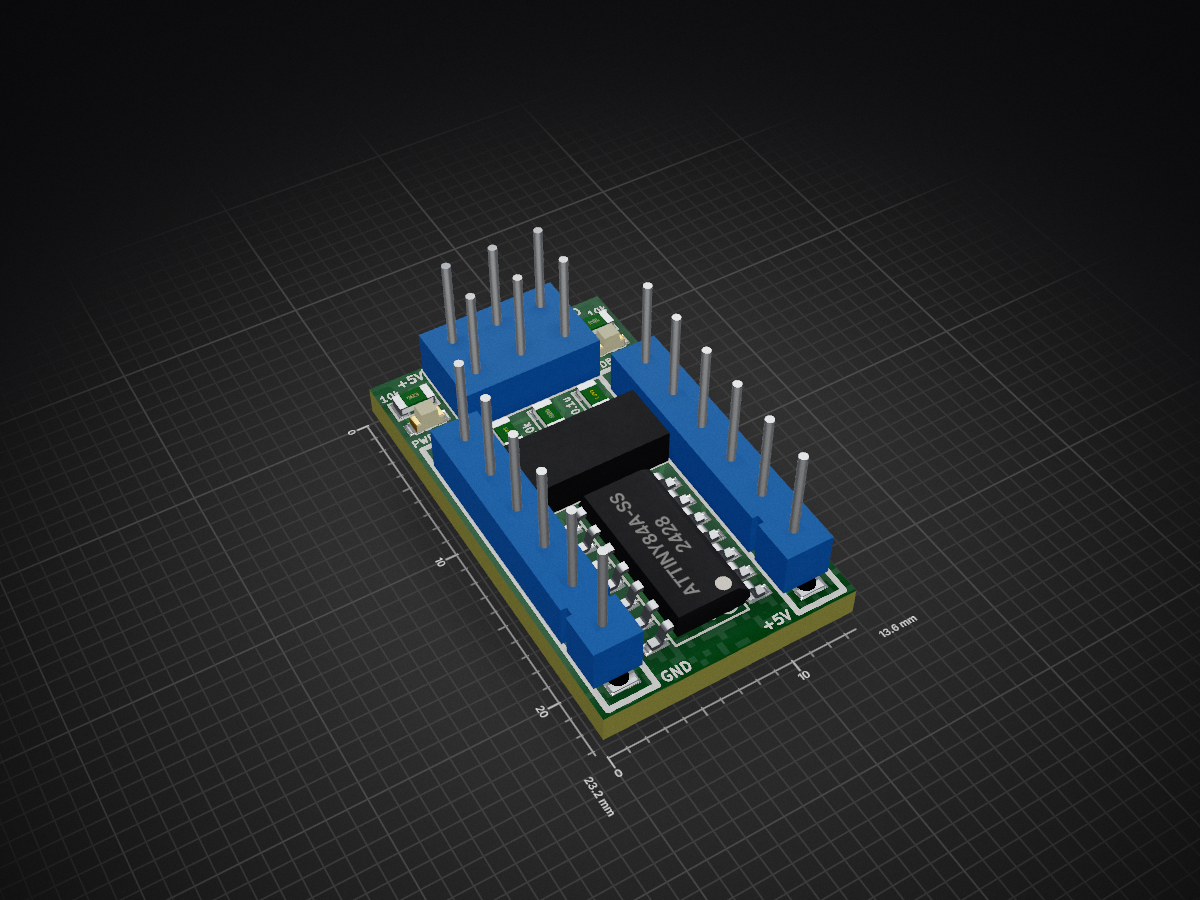
 mage0r/trinkle2
A breakout board for the ATTiny84. Sometimes a Trinket just won't do...
Trinkle is an open-source printed circuit board by mage0r, from the mage0r/trinkle repository on GitHub. It is a 2-layer board of 13.6 × 23.2 mm with 12 parts on 16 nets, routed with 144 tracks and 3 vias.
It is built around the ATTINY84A-SSF. Its parts include 3 resistors, 3 connectors, 2 capacitors, 2 diodes and 1 IC. It belongs with the interfaces and adapters and microcontroller boards boards and the AVR (ATmega, ATtiny) boards of this library.
This project is a simple breakout board for the attiny84.
So, having bulk ordered to save a bit of cash, I have a lot of these attiny 84's. They're a great, cheap little chip and sometimes you just need a few more pins than the 85 has.
This board has such features as: A Power LED, a blink LED attached to D8 and pin spacing to suit a protoboard. It lacks features like anything else.
There are three sections, the circuit design for kicad, a few photos of the finished product and some working examples..
To use this board with the arduino IDE, you're going to need an appropriate boards.txt. I've been using one from https://github.com/damellis/attiny/


This project was designed by John Spencer - john.spencer.9000@gmail.com - https://github.com/mage0r
Made at hackmelbourne.org!
To the HackMelbourne (CCHS, http://hackmelbourne.org) community of Melbourne, Australia.
To all other open-source developers whose countless hours supported every other aspect of this design.
The specific terms of distribution of this project are governed by the license referenced below. Please contact the copyright owner if you wish to modify the board for distribution. Please utilize this design for personal or research projects. Please acknowledge all contributors.
Licensed under the TAPR Open Hardware License (www.tapr.org/OHL). The "license" sub-folder also contains a copy of this license in plain text format.
Copyright John Spencer 2014 john.spencer.9000@gmail.com
| Qty | Value | Footprint | References |
|---|---|---|---|
| 3 | 10k | SM0603 | R1, R2, R3 |
| 2 | CONN_7 | PIN_ARRAY-7X1 | P2, P3 |
| 1 | 0.1u | SM0603 | C1 |
| 1 | 1u | SM0603 | C2 |
| 1 | ATTINY84A-SS | so-14 | IC1 |
| 1 | D8_LED | LED-0603 | D2 |
| 1 | ISCP | pin_array_3x2 | P1 |
| 1 | PWR_LED | LED-0603 | D1 |
| 1 | RESET | 1107G | SW1 |
It measures 13.6 × 23.2 mm and has 2 copper layers, 1.6 mm thick.
12 parts, built around the ATTINY84A-SSF. The full list of its parts is on this page, with links to each part's symbol and footprint where PCBKit's library has them.
From the mage0r/trinkle repository on GitHub, at the commit this page was made from: the board is Circuit/trinkle.kicad_pcb. PCBKit opens the board in the browser, with nothing to install.
Its repository states no licence, so its author keeps all rights: ask mage0r before reusing the design.

mage0r/RSA0N11M9A0J_motorised_slider
This is a H-bridge driver board for the RSA0N11M9A0J motorised Slider. It uses a L9110 and capacitive sensor.


hpbock/moba-bockstelle
Ein Blockstellenmodul für analoge Modellbahnen zur Ansteuerung von Lichtsignalen, Zugbeeinflussung und Belegtmeldung für Loconet-T.


conifarad/open-lightning-trigger
A low-cost optical camera trigger for lightning and other phenomena

Dhruv2212-star/Electronic-dice
A simple device in which you press a button to get a random number between 1-6 like an actual dice but it's all inside a computer
