2 layers27.9 × 16.5 mm
 maanavkoladia/FreakyNetworking
The FreakyRTOS and FreakyNetworking are also integrated with TivaWare and ValvanoWare, enabling low-level hardware abstraction and peripheral management on TM4C devices.
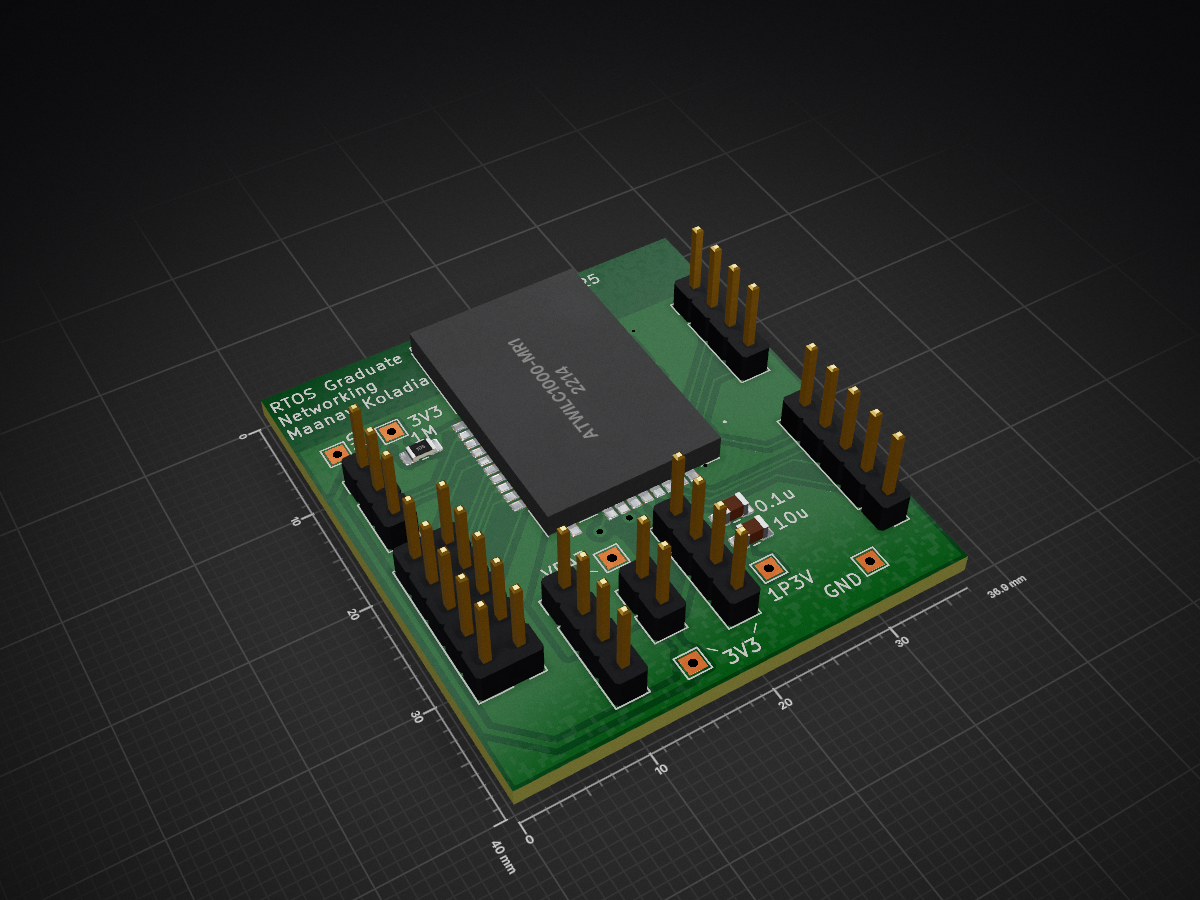
ATWILC1000 Breakout is an open-source printed circuit board by maanavkoladia, from the maanavkoladia/FreakyNetworking repository on GitHub. It is a 2-layer board of 36.9 × 40 mm with 18 parts on 26 nets, routed with 101 tracks and 10 vias.
It is built around the ATWILC1000-MR110PB-T. Its parts include 7 connectors, 2 capacitors, 1 resistor and 1 IC. It belongs with the interfaces and adapters boards of this library.
FreakyNetworking is a lightweight, embedded networking stack designed to run on FreakyRTOS. It provides essential networking protocols and integrates with FreakyRTOS. This is also an example of how to integrate FreakyRTOS into a project using GNU-ARM.
TM4C microcontroller seriesFreakyNetworking is tightly integrated with FreakyRTOS. It uses RTOS primitives such as tasks, semaphores, and timers to manage networking operations efficiently.
The FreakyRTOS and FreakyNetworking are also integrated with TivaWare and ValvanoWare, enabling low-level hardware abstraction and peripheral management on TM4C devices.
FreakyNetworking is built using the GNU ARM Toolchain, making it suitable for open-source and cross-platform development environments.
| Qty | Value | Footprint | References |
|---|---|---|---|
| 2 | 3.3V | TestPoint:TestPoint_THTPad_1.5x1.5mm_Drill0.7mm | TP1, TP4 |
| 2 | GND | TestPoint:TestPoint_THTPad_1.5x1.5mm_Drill0.7mm | TP2, TP5 |
| 1 | 0.1u | Capacitor_SMD:C_0805_2012Metric_Pad1.18x1.45mm_HandSolder | C2 |
| 1 | 10u | Capacitor_SMD:C_0805_2012Metric_Pad1.18x1.45mm_HandSolder | C1 |
| 1 | 1M | Resistor_SMD:R_0805_2012Metric_Pad1.20x1.40mm_HandSolder | R1 |
| 1 | 1P3V | TestPoint:TestPoint_THTPad_1.5x1.5mm_Drill0.7mm | TP7 |
| 1 | 3V3_Conn_01x04 | Connector_PinHeader_2.54mm:PinHeader_1x04_P2.54mm_Vertical | J1 |
| 1 | ATWILC1000-MR110PB-T | LIB_ATWILC1000-MR110PB-T:ATWILC1000MR110PBT | IC1 |
| 1 | I2C_CEN_Conn_01x04 | Connector_PinHeader_2.54mm:PinHeader_1x04_P2.54mm_Vertical | J3 |
| 1 | LOGO | hw:troll | G*** |
| 1 | Misc_Conn_01x03 | Connector_PinHeader_2.54mm:PinHeader_1x03_P2.54mm_Vertical | J4 |
| 1 | SPI_Conn_02x05 | Connector_PinHeader_2.54mm:PinHeader_2x05_P2.54mm_Vertical | J7 |
| 1 | UART_Conn_01x05 | Connector_PinHeader_2.54mm:PinHeader_1x05_P2.54mm_Vertical | J6 |
| 1 | VBAT | TestPoint:TestPoint_THTPad_1.5x1.5mm_Drill0.7mm | TP3 |
| 1 | VBAT_3V3_Jump_Conn_01x02 | Connector_PinHeader_2.54mm:PinHeader_1x02_P2.54mm_Vertical | J5 |
| 1 | VBAT_Conn_01x04 | Connector_PinHeader_2.54mm:PinHeader_1x04_P2.54mm_Vertical | J2 |

VoronDesign/Voron-Hardware
Cool Hardware designed by the Voron Design group


hackclub/OnBoard
💡 Join 1,000 teenagers and make your first PCB with a $100 grant!

VoronDesign/Voron-Tap
Tap is a nozzle-based z-probe for the V2 and Trident printer designs. The entire toolhead moves to trigger an optical switch. Tap offers many advantages:

Luos-io/luos_engine
Open-source and real-time orchestrator for cyber-physical-systems, to easily design, test and deploy embedded applications and digital twins.


Twotoz/C5VRX
Ultra-minimal, zero-CPU 5.8 GHz analog FPV video receiver using ESP32-C5 Wi-Fi 6 PHY MODEM_DIAG, BitScrambler WBFM demodulation & resistor DAC CVBS
It measures 36.9 × 40 mm and has 2 copper layers, 1.6 mm thick.
18 parts, built around the ATWILC1000-MR110PB-T. The full list of its parts is on this page, with links to each part's symbol and footprint where PCBKit's library has them.
From the maanavkoladia/FreakyNetworking repository on GitHub, at the commit this page was made from: the board is hw/ATWILC1000_Breakout.kicad_pcb and its schematic hw/ATWILC1000_Breakout.kicad_sch. PCBKit opens the board in the browser, with nothing to install.
Its repository states no licence, so its author keeps all rights: ask maanavkoladia before reusing the design.