2 layers216.9 × 86.8 mm
Sweepv2
davidphilipbarr/Sweep
Sweep - a small promicro based keyboard inspired by the Ferris.
51 parts2.1k

 ma-ha/attiny-prototype-board4
Simplifies circuit prototypying with the ATtiny1614
Attiny prototype board is an open-source printed circuit board by ma-ha, from the ma-ha/attiny-prototype-board repository on GitHub, published under the MIT licence. It is a 2-layer board of 160 × 100 mm with 51 parts on 74 nets, routed with 307 tracks and 11 vias.
Its parts include 24 connectors, 7 switches, 6 resistors, 6 diodes and 2 ICs. It belongs with the AVR (ATmega, ATtiny) boards of this library.
Simplifies circuit prototypying with the ATtiny xx14.
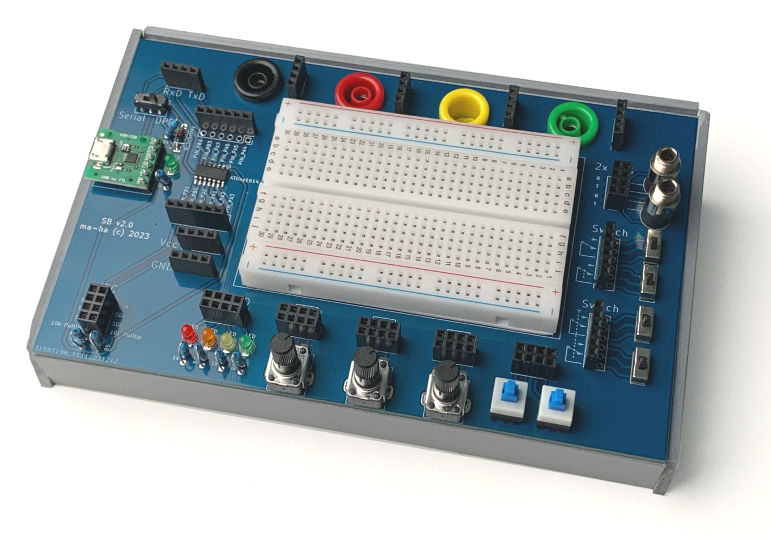
Features:
Videos:
Improvements:
Fixes:
Use this "blink" code to check proper soldering for all ATtiny pins:
// BLINK ALL ATtiny xx14

void setup() {
  pinMode( PIN_PA4, OUTPUT );
  pinMode( PIN_PA5, OUTPUT );
  pinMode( PIN_PA6, OUTPUT );
  pinMode( PIN_PA7, OUTPUT );
  pinMode( PIN_PB3, OUTPUT );
  pinMode( PIN_PB2, OUTPUT );

  pinMode( PIN_PB1, OUTPUT );
  pinMode( PIN_PB0, OUTPUT );
  pinMode( PIN_PA0, OUTPUT );
  pinMode( PIN_PA1, OUTPUT );
  pinMode( PIN_PA2, OUTPUT );
  pinMode( PIN_PA3, OUTPUT );
  Serial.begin( 9600 );
}

void loop() {
  digitalWrite( PIN_PA4, HIGH );
  digitalWrite( PIN_PA5, HIGH );
  digitalWrite( PIN_PA6, HIGH );
digitalWrite( PIN_PA7, HIGH ); | Qty | Value | Footprint | References |
|---|---|---|---|
| 5 | LED | LED_THT:LED_D3.0mm | D1, D2, D3, D5, D6 |
| 4 | 1k | Resistor_THT:R_Axial_DIN0204_L3.6mm_D1.6mm_P1.90mm_Vertical | R1, R2, R7, R8 |
| 4 | Banana | ftdi:Banana | J1, J2, J3, J4 |
| 4 | banana | Connector_PinSocket_2.54mm:PinSocket_1x04_P2.54mm_Vertical | J9, J10, J11, J12 |
| 4 | toPoti | Connector_PinSocket_2.54mm:PinSocket_2x04_P2.54mm_Vertical | J6, J15, J19, J22 |
| 3 | R_POT | ftdi:Potentiometer_Single_Vertical | RV1, RV2, RV3 |
| 3 | tinyRight | Connector_PinSocket_2.54mm:PinSocket_2x06_P2.54mm_Vertical | J5, J7, J8 |
| 2 | 1.5k | Resistor_THT:R_Axial_DIN0204_L3.6mm_D1.6mm_P1.90mm_Vertical | R5, R6 |
| 2 | 1k | Resistor_THT:R_Axial_DIN0207_L6.3mm_D2.5mm_P10.16mm_Horizontal | 1k, R4 |
| 2 | 2x Switch | ftdi:Switch_SPDT_2P2T | SW3, SW8 |
| 2 | SW_Push_DPDT | ftdi:PushBtn6x6 | SW9, SW10 |
| 2 | SW_SPDT | ftdi:Switch_SPDT_1P2T | SW1, SW4 |
| 2 | TRS35 | ftdi:Stereo3.5 | J14, J18 |
| 1 | |||
| 1 | ATtinyXX14-SS | Package_SO:SOIC-14_3.9x8.7mm_P1.27mm | U2 |
| 1 | D_Schottky | Diode_THT:D_A-405_P7.62mm_Horizontal | D4 |
| 1 | FTDI-Adapter | AudioChannel:FTDI | U1 |
| 1 | GND | Connector_PinSocket_2.54mm:PinSocket_1x04_P2.54mm_Vertical | J20 |
| 1 | I2C | Connector_PinSocket_2.54mm:PinSocket_2x04_P2.54mm_Vertical | J25 |
| 1 | Switch UPDI | ftdi:Switch_SPDT_2P2T | SW2 |
| 1 | USART | Connector_PinSocket_2.54mm:PinSocket_1x04_P2.54mm_Vertical | J17 |
| 1 | VCC | Connector_PinSocket_2.54mm:PinSocket_1x04_P2.54mm_Vertical | J23 |
| 1 | tinyLeft | Connector_PinSocket_2.54mm:PinSocket_2x06_P2.54mm_Vertical | J13 |
| 1 | toAudio | Connector_PinSocket_2.54mm:PinSocket_2x04_P2.54mm_Vertical | J16 |
| 1 | toBtn | Connector_PinSocket_2.54mm:PinSocket_2x04_P2.54mm_Vertical | J21 |
davidphilipbarr/Sweep
Sweep - a small promicro based keyboard inspired by the Ferris.


W0rthlessS0ul/nRF24_jammer
The nRF24 jammer is a powerful tool that requires an ESP32 and configurable numbers of NRF24 modules to assemble.

hackclub/OnBoard
💡 Join 1,000 teenagers and make your first PCB with a $100 grant!


Neumi/open_echo
Open Source echo sounder / depth sounder / SONAR for bathymetry and research. Arduino based and compatible.


vsfteam/vsf
Versaloon Software Framework -- a tiny preemptive-capable event-driven incremental software framework for embedded systems
It measures 160 × 100 mm and has 2 copper layers, 1.6 mm thick.
51 parts. The full list of its parts is on this page, with links to each part's symbol and footprint where PCBKit's library has them.
From the ma-ha/attiny-prototype-board repository on GitHub, at the commit this page was made from: the board is attiny-prototype-board.kicad_pcb. PCBKit opens the board in the browser, with nothing to install.
Its repository publishes it under the MIT licence: you may reuse it on that licence's terms (keep the author's notice, and for a copyleft licence share your changes alike).