6 layers
CanSat 2019
ApoapsisHGV/CanSat2019-electronics
Circuit and PCB design files related to our 2019 CanSat competition
155 parts1MIT

 lucasasselli/keychain-tiny-game7
Keychain reaction game to kill time while you wait your turn at the dentist office.
Keychain is an open-source printed circuit board by lucasasselli, from the lucasasselli/keychain-tiny-game repository on GitHub. It is a 2-layer board of 18 × 33.7 mm with 25 parts on 12 nets, routed with 196 tracks and 13 vias.
It is built around the ATTINY85-20SU, B3U-1000P and BS-7. Its parts include 16 diodes, 4 resistors, 1 capacitor, 1 IC and 1 switch. It belongs with the AVR (ATmega, ATtiny) boards of this library.


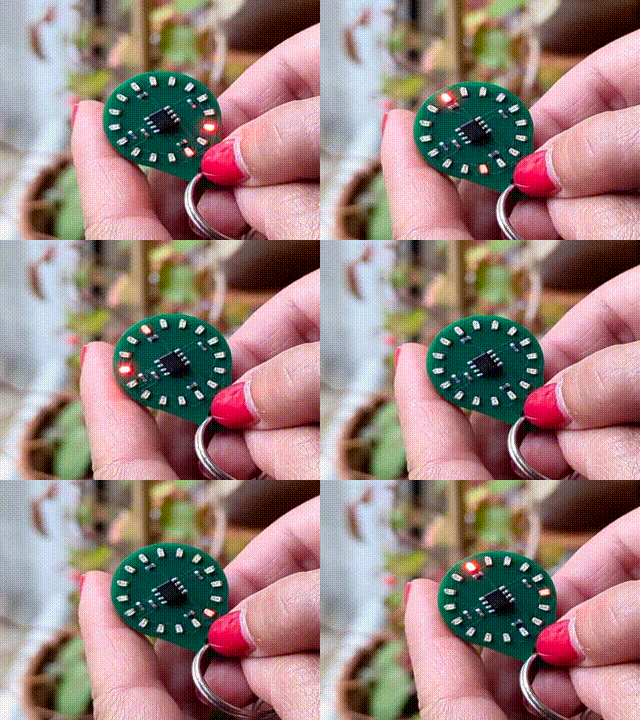
I recently bought a novelty keychain: it's a handmade leather pouch designed to protect my phone screen from scratches while adding a touch of style. Unfortunately, it’s more of a hindrance than a help, making it difficult to use my keys and turning me into a bumbling character from a horror movie that can't open the door to safety. That truth is that keys are naturally scratchy, and they seem to resent being kept away from their preferred surfaces.
This keychain isn’t just a time-wasting game for dentist appointments, it’s also a collection of 24 tiny, sharp SMD components waiting to sand down my phone screen the first time I accidentally put it in the wrong pocket.
Press the button when the spinning light reaches the target. Do it again slightly faster. Repeat until it's your turn at the dentist, doctor, barber, etc...
The board utilizes an ATtiny25 microcontroller running at 1MHz to drive 16 LEDs via Charlieplexing. A single button on the back of the board allows for game control. The device is powered by a single CR2032 coin cell battery.
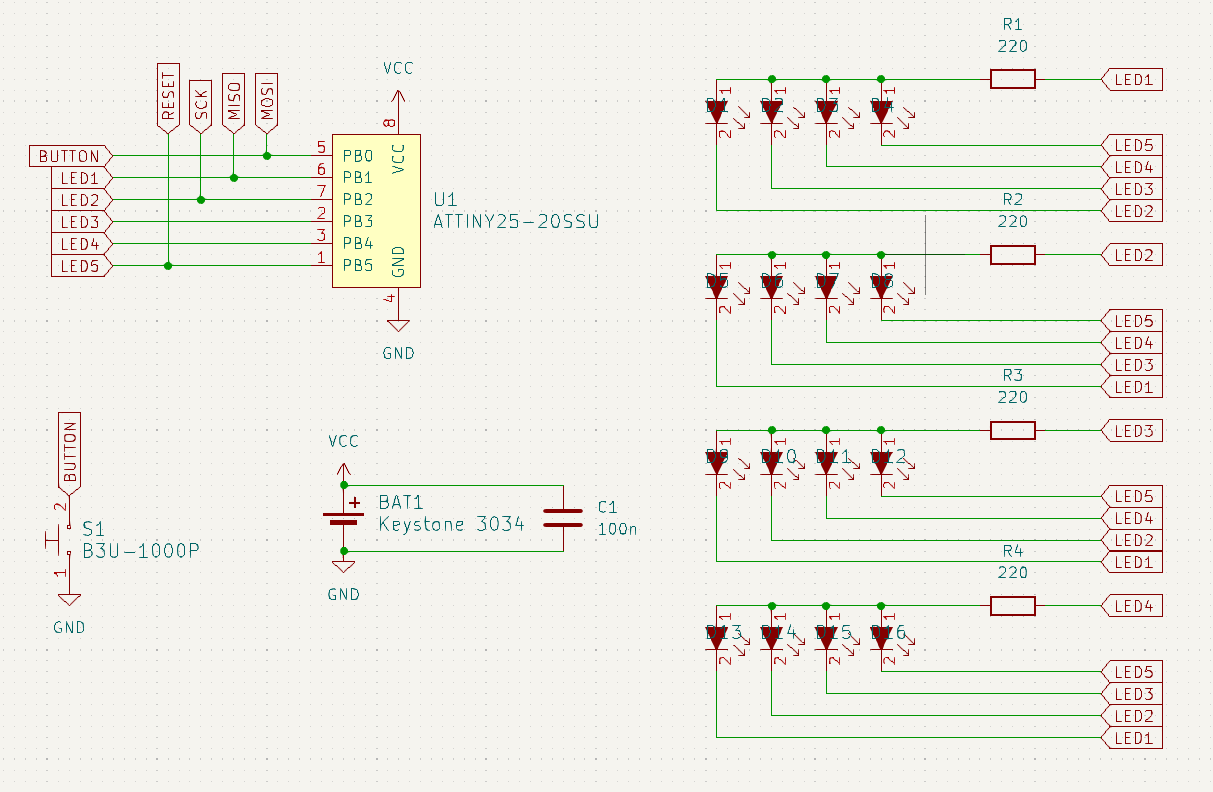
| Qty | Value | Footprint | References |
|---|---|---|---|
| 16 | LH_R974-LP-1 | LED_SMD:LED_0603_1608Metric | D1, D2, D3, D4, D5, D6, D7, D8, D9, D10, D11, D12, D13, D14, D15, D16 |
| 4 | 220 | Resistor_SMD:R_0603_1608Metric | R1, R2, R3, R4 |
| 1 | 100n | Capacitor_SMD:C_0603_1608Metric | C1 |
| 1 | ATTINY25-20SSU | digikey-footprints:SOIC-8_W5.3mm | U1 |
| 1 | B3U-1000P | digikey-footprints:Switch_Tactile_SMD_B3U-1000P | S1 |
| 1 | Keystone 3034 | Battery:BatteryHolder_Keystone_3034_1x20mm | BAT1 |
The 24 most common of 25 parts.
ApoapsisHGV/CanSat2019-electronics
Circuit and PCB design files related to our 2019 CanSat competition

0xlama/ATtiny_LED_Matrix_Display_Badge
An ATtiny85 based badge size PCB that can display alphabets and numbers .

rbaron/lir2450-charger
A tiny USB C charger for LIR2450 coin cell batteries


ShawnHymel/555_badge
555 Badge ========= Badge project based on a 555 timer circuit. Users can follow along with the Digi-Key video series to design and fabricate their own badge PCB.


It measures 18 × 33.7 mm and has 2 copper layers, 1.6 mm thick.
25 parts, built around the ATTINY85-20SU, B3U-1000P and BS-7. The full list of its parts is on this page, with links to each part's symbol and footprint where PCBKit's library has them.
From the lucasasselli/keychain-tiny-game repository on GitHub, at the commit this page was made from: the board is hardware/keychain.kicad_pcb and its schematic hardware/keychain.kicad_sch. PCBKit opens the board in the browser, with nothing to install.
Its repository states no licence, so its author keeps all rights: ask lucasasselli before reusing the design.