

2 layers63.5 × 69.3 mm
TurtlePico Leatherback
Jin-Neuron/Turtle-Pico
The development board making electronics work easier and more widely
127 parts1

 LouisVizard/NavBoard2
A full navigation solution featuring MCU, GNSS receiver, RF transceiver, and 9-DOF IMU
Navigation Board is an open-source printed circuit board by LouisVizard, from the LouisVizard/NavBoard repository on GitHub. It is a 6-layer board of 63.5 × 50.8 mm with 136 parts on 144 nets, routed with 762 tracks and 275 vias.
It is built around the NEO-M9N-00B, NRF24L01 and RFX2401C, with the 2450LP14A0100001T, ADP7142ARDZ-3.3 and BNO086 among its other parts. Its parts include 55 capacitors, 45 resistors, 11 ICs, 6 inductors and 5 diodes. It belongs with the radio and wireless boards and the STM32 boards of this library.


A compact, 6-layer embedded navigation platform for real-time sensor fusion and wireless telemetry




The Navigation Board is a custom PCB designed as a dedicated navigation and state estimation platform. It integrates GNSS positioning, inertial sensing, and wireless communication onto a single, compact board — enabling real-time vehicle attitude estimation via a Kalman filter and live data streaming to a host computer for visualization.
The hardware is complete and functional. Active development is now focused on firmware (EKF implementation) and the host-side Python visualization pipeline.
| Isometric Top | Isometric Bottom |
|---|---|
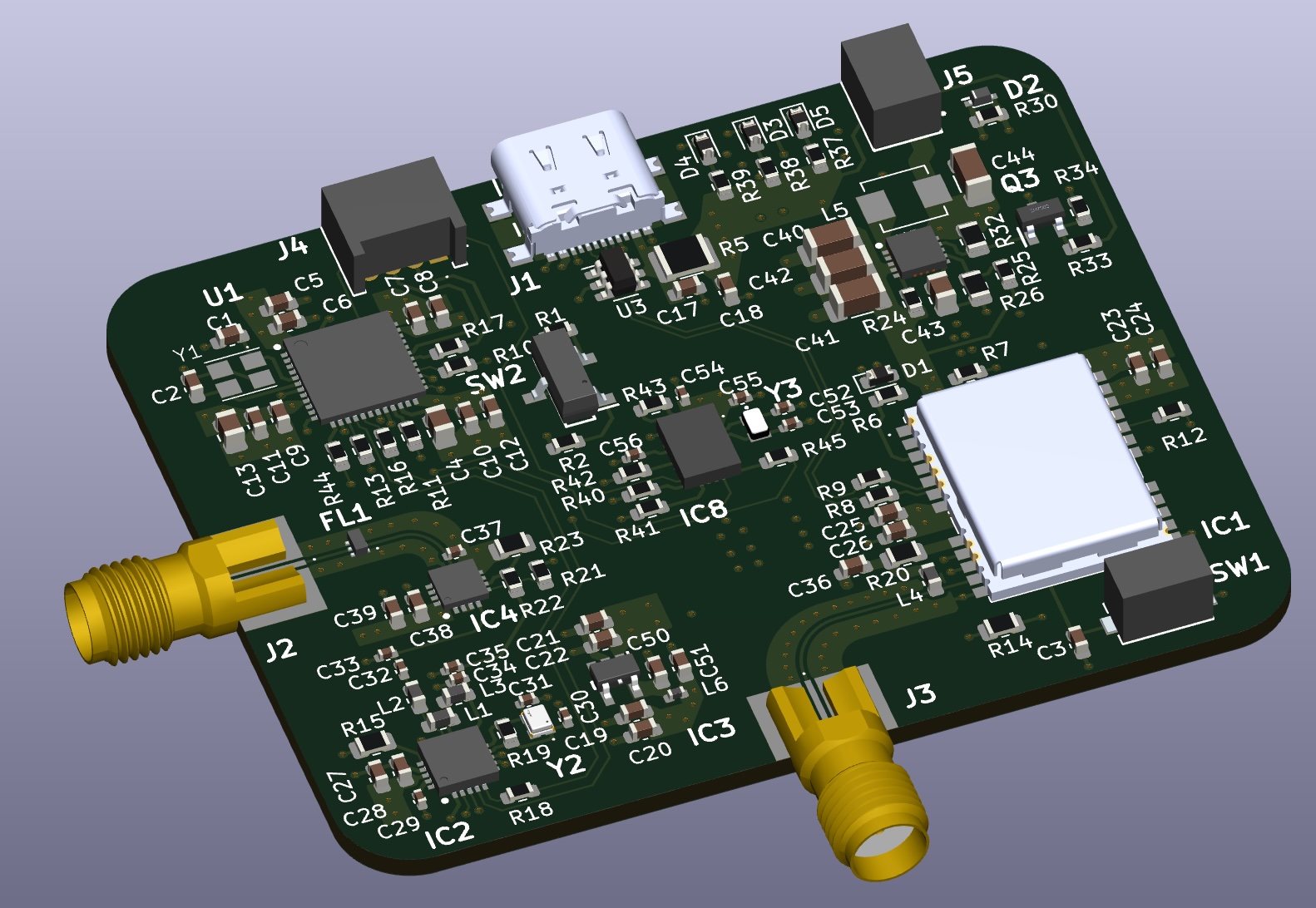 | 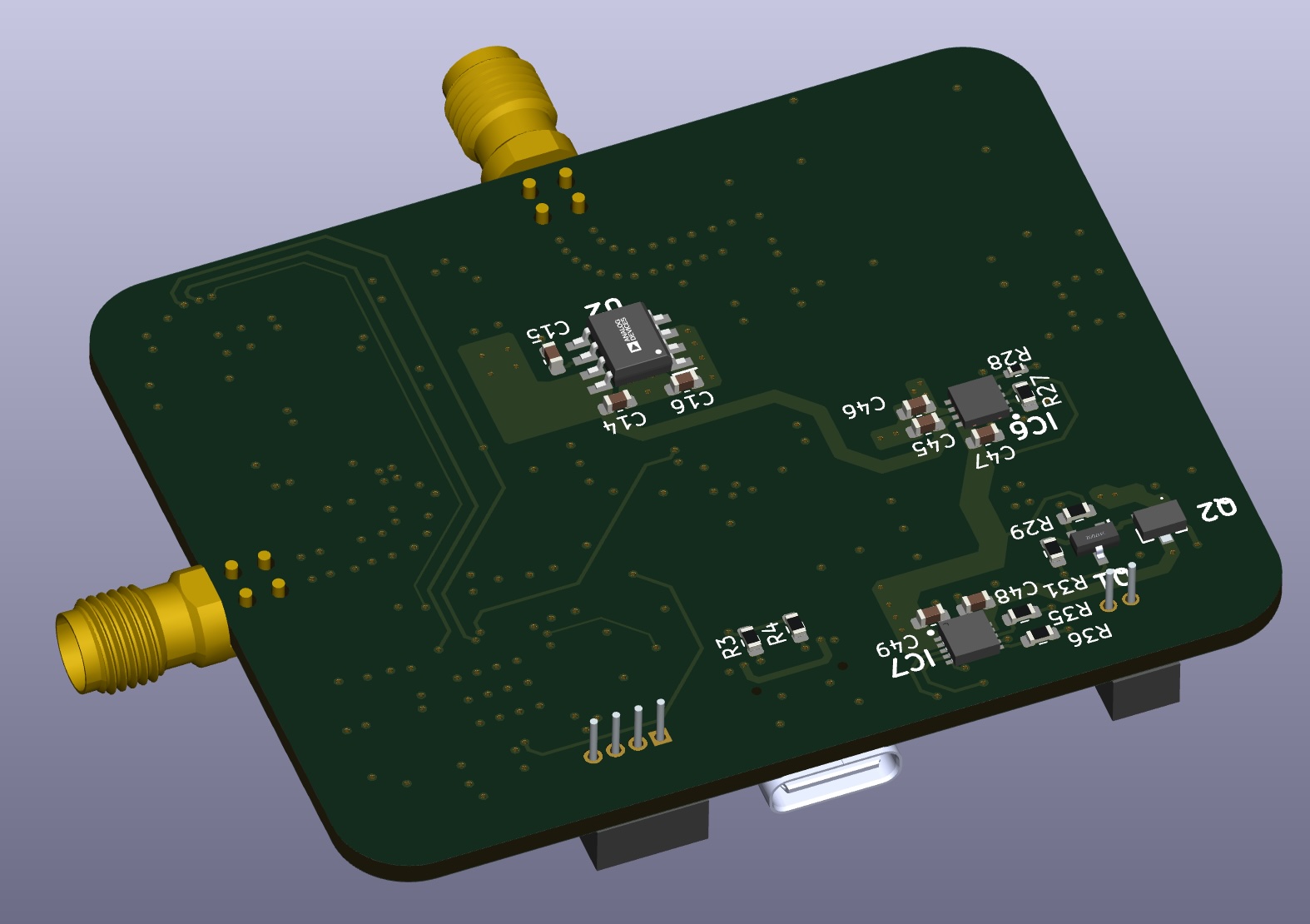 |
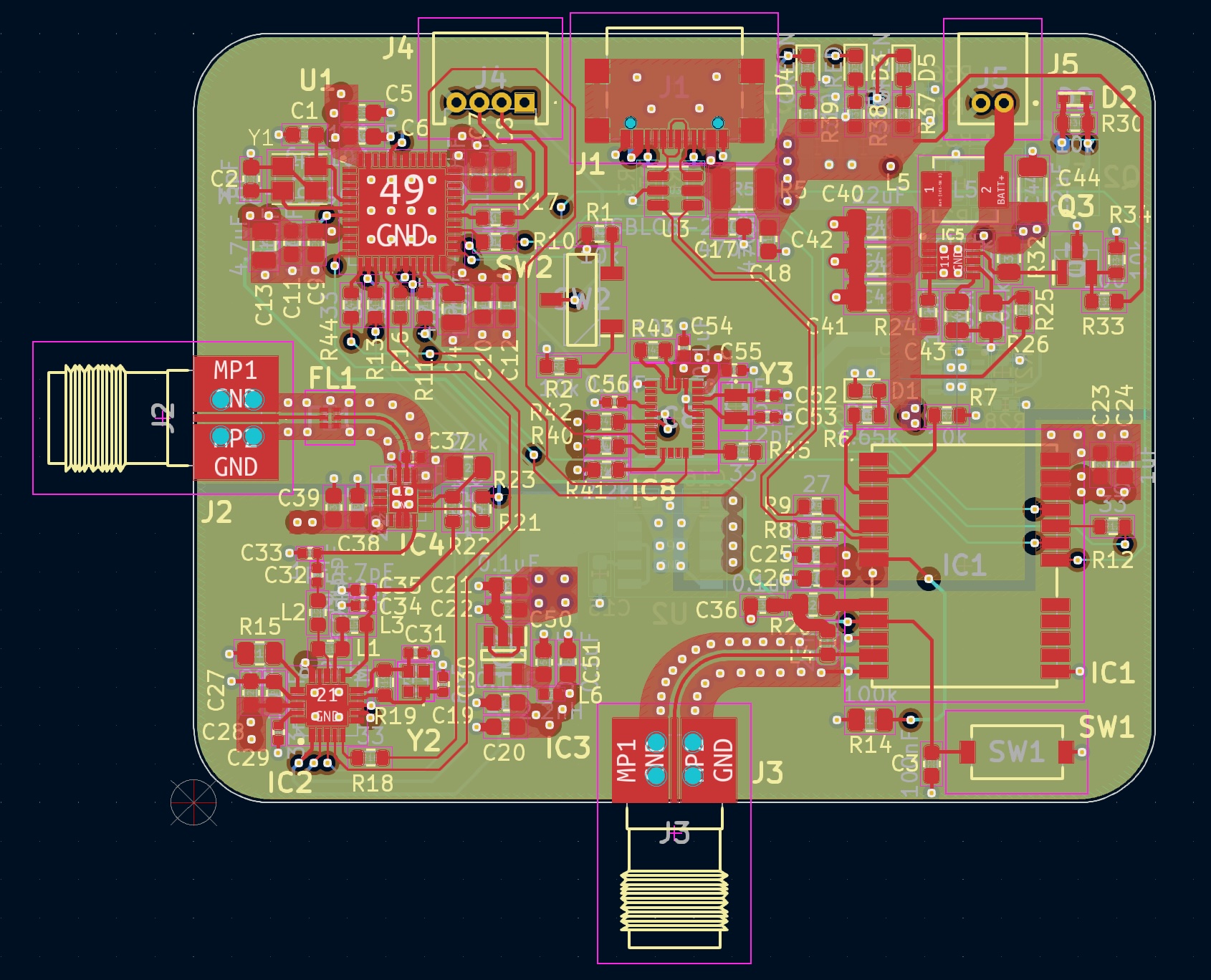
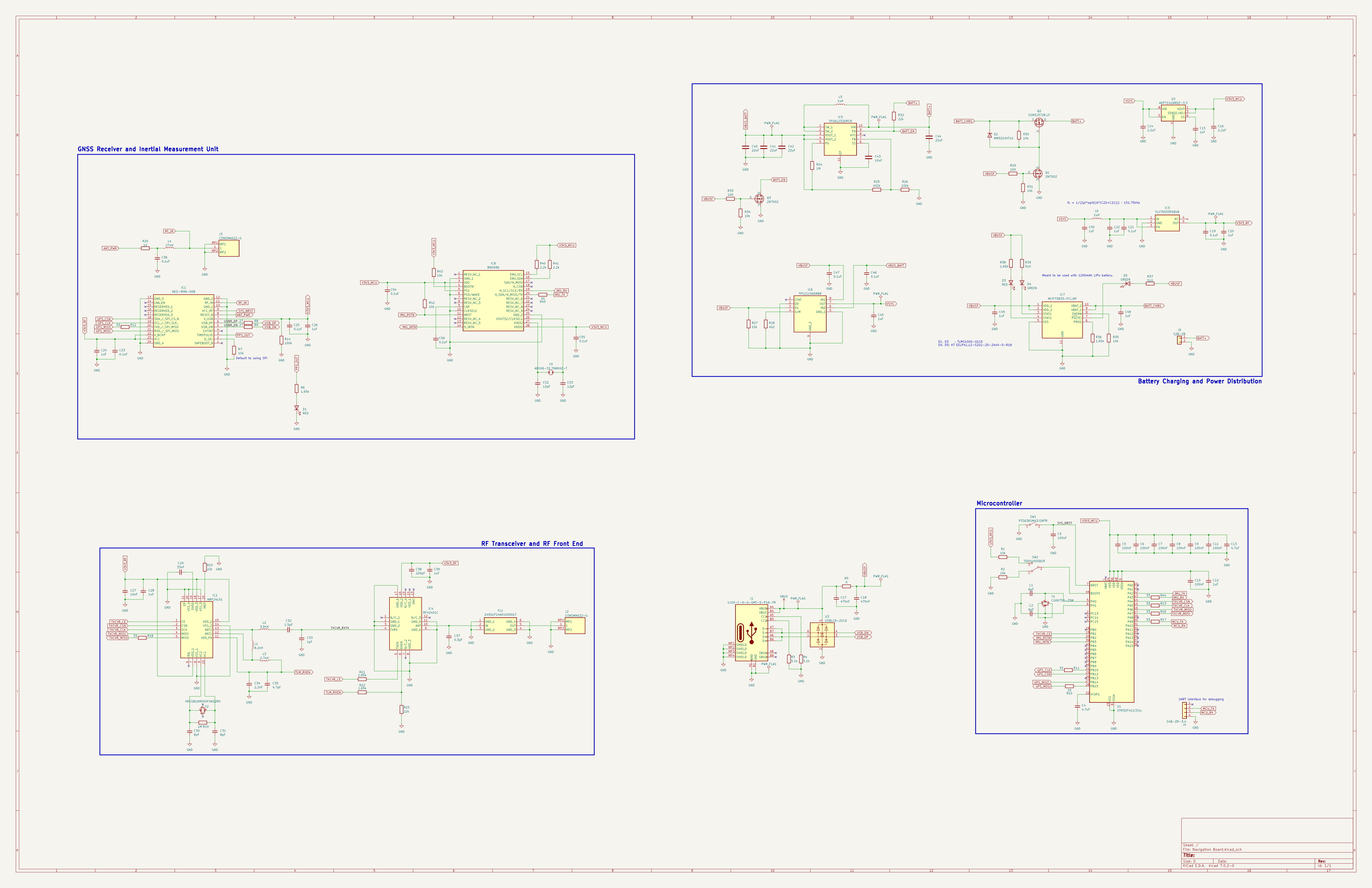
| Parameter | Value |
|---|---|
| MCU | STM32F4CEU6 |
| GNSS Receiver | u-blox NEO-M9N |
| IMU | 9DOF — Accelerometer + Gyroscope + Magnetometer |
| Wireless | nRF24L01 (2.4 GHz RF) |
| Power Input | Single-cell LiPo + USB-C charging |
| PCB Stackup | 6-layer, impedance controlled |
┌─────────────┐     ┌─────────────────────────┐     ┌──────────────────┐     ┌──────────────────┐
│  GNSS       │     │                         │     │                  │     │                  │
│  NEO-M9N    │────▶│     STM32F4CEU6         │────▶│  nRF24L01        │────▶│  Host PC         │
│  (UART)     │     │   Kalman Filter /        │     │  2.4 GHz RF Link │     │  Python Viz      │
├─────────────┤     │   Sensor Fusion          │     │                  │     │                  │
│  IMU 9DOF   │     │                         │     │                  │     │                  │
│  (SPI/I2C)  │────▶│                         │     │                  │     │                  │
└─────────────┘     └─────────────────────────┘     └──────────────────┘     └──────────────────┘
Goal: Fuse absolute positioning (GNSS) with high-rate inertial data (IMU) using an Extended Kalman Filter to estimate real-time orientation and motion, then stream state estimates wirelessly to a host computer for visualization.
The board centers around the STM32F4 MCU, which interfaces with:
Powered by a single-cell LiPo battery with onboard USB-C charging circuitry. Independent regulation stages supply stable rails for:
This architecture minimizes noise coupling into sensitive IMU measurements.
A 6-layer stackup was chosen to provide:
Dedicated power and ground planes minimize EMI and improve signal integrity throughout.
The full layer stackup with impedance targets and material specifications is documented in the design spreadsheet:
📄 View Stackup Spreadsheet (Google Sheets)
The hardware platform is complete. Next steps are focused on firmware and software:
| Layer | Technology |
|---|---|
| Hardware Design | KiCad |
| Firmware | C (STM32 HAL / bare-metal) |
| Host Software | Python |
| Comms Protocol | nRF24L01 2.4 GHz |
Luis Martinez


| Qty | Value | Footprint | References |
|---|---|---|---|
| 10 | 10k | Resistor_SMD:R_0603_1608Metric | R1, R2, R7, R27, R30, R31, R34, R35, R42, R43 |
| 10 | 1uF | Capacitor_SMD:C_0603_1608Metric | C12, C20, C22, C24, C26, C39, C45, C48, C49, C50 |
| 9 | 33 | Resistor_SMD:R_0603_1608Metric | R10, R11, R12, R13, R16, R17, R18, R44, R45 |
| 8 | 100nF | Capacitor_SMD:C_0603_1608Metric | C3, C5, C6, C7, C8, C9, C10, C11 |
| 7 | 0.1uF | Capacitor_SMD:C_0603_1608Metric | C19, C21, C23, C25, C36, C46, C47 |
| 5 | 1.65k | Resistor_SMD:R_0603_1608Metric | R6, R21, R22, R36, R38 |
| 4 | 22uF | Capacitor_SMD:C_1206_3216Metric | C40, C41, C42, C44 |
| 3 | 0.1uF | Capacitor_SMD:C_0402_1005Metric | C54, C55, C56 |
| 3 | 22k | Resistor_SMD:R_0805_2012Metric | R15, R23, R32 |
| 2 | 100 | Resistor_SMD:R_0603_1608Metric | R29, R33 |
| 2 | 100k | Resistor_SMD:R_0805_2012Metric | R14, R26 |
| 2 | 12pF | Capacitor_SMD:C_0402_1005Metric | C52, C53 |
| 2 | 1M | Resistor_SMD:R_0603_1608Metric | R19, R24 |
| 2 | 1nF | Capacitor_SMD:C_0603_1608Metric | C15, C28 |
| 2 | 1uH | Inductor_SMD:L_Vishay_IHLP-1616 | L5, L6 |
| 2 | 2.2k | Resistor_SMD:R_0603_1608Metric | R40, R41 |
| 2 | 2.2uF | Capacitor_SMD:C_0603_1608Metric | C14, C16 |
| 2 | 27 | Resistor_SMD:R_0603_1608Metric | R8, R9 |
| 2 | 2N7002 | Nav_Library:2N7002 | Q1, Q3 |
| 2 | 4.7uF | Capacitor_SMD:C_0805_2012Metric | C4, C13 |
| 2 | 470nF | Capacitor_SMD:C_0603_1608Metric | C17, C18 |
| 2 | 5.1k | Resistor_SMD:R_0603_1608Metric | R3, R4 |
| 2 | 510 | Resistor_SMD:R_0603_1608Metric | R37, R39 |
| 2 | 6pF | Capacitor_SMD:C_0603_1608Metric | C1, C2 |
| 2 | 8pF | Capacitor_SMD:C_0402_1005Metric | C30, C31 |
| 2 | CONSMA022-G | Nav_Library:CONSMA022G | J2, J3 |
| 2 | GREEN | Diode_SMD:D_0603_1608Metric | D4, D5 |
| 2 | RED | Diode_SMD:D_0603_1608Metric | D1, D3 |
| 1 | 0 | Resistor_SMD:R_1210_3225Metric | R5 |
| 1 | 0.3pF | Capacitor_SMD:C_0402_1005Metric | C37 |
| 1 | 1.5pF | Capacitor_SMD:C_0402_1005Metric | C32 |
| 1 | 10 | Resistor_SMD:R_0805_2012Metric | R20 |
| 1 | 10nF | Capacitor_SMD:C_0805_2012Metric | C43 |
| 1 | 10nF | Capacitor_SMD:C_0603_1608Metric | C27 |
| 1 | 1pF | Capacitor_SMD:C_0402_1005Metric | C33 |
| 1 | 2.2nF | Capacitor_SMD:C_0402_1005Metric | C34 |
| 1 | 2.7nH | Inductor_SMD:L_0603_1608Metric | L3 |
| 1 | 220pF | Capacitor_SMD:C_0603_1608Metric | C38 |
| 1 | 2450LP14A0100001T | Nav_Library:2450LP14A0100001T | FL1 |
| 1 | 27nH | Inductor_SMD:L_0603_1608Metric | L4 |
| 1 | 3.9nH | Inductor_SMD:L_0603_1608Metric | L2 |
| 1 | 33nF | Capacitor_SMD:C_0402_1005Metric | C29 |
| 1 | 4.7pF | Capacitor_SMD:C_0402_1005Metric | C35 |
| 1 | 402 | Resistor_SMD:R_0402_1005Metric | R28 |
| 1 | 402k | Resistor_SMD:R_0603_1608Metric | R25 |
| 1 | 8.2nH | Inductor_SMD:L_0603_1608Metric | L1 |
| 1 | ABS06-32.768KHZ-T | Nav_Library:ABS06-32.768KHZ-T | Y3 |
| 1 | ADP7142ARDZ-3.3 | Nav_Library:ADP7142ARDZ-3.3 | U2 |
| 1 | BNO086 | Nav_Library:BNO086 | IC8 |
| 1 | CG06750-25M | Nav_Library:CG06750-25M | Y1 |
| 1 | MCP73833-FCI_MF | Nav_Library:MCP73833-FCI_MF | IC7 |
| 1 | MM5Z10VT1G | Nav_Library:MM5Z10VT1G | D2 |
| 1 | NEO-M9N-00B | Nav_Library:NEOM9N00B | IC1 |
| 1 | NRF24L01 | Nav_Library:nRF24L01 | IC2 |
| 1 | PTS636SM43JSMTR | Nav_Library:PTS636SM43JSMTRLFS | SW1 |
| 1 | RFX2401C | Nav_Library:RFX2401C | IC4 |
| 1 | S2B-ZR | Nav_Library:S2B-ZR | J5 |
| 1 | S4B-ZR-3.4 | Nav_Library:S4BZR34LFSN | J4 |
| 1 | SSM3J372R,LF | Nav_Library:SSM3J372RLF | Q2 |
| 1 | STM32F411CEUx | Nav_Library:STM32F411CEU6 | U1 |
| 1 | TDD01H0SB1R | Nav_Library:TDD01H0SB1R | SW2 |
| 1 | TLV75533PDBVR | Nav_Library:TLV75533PDBVR | IC3 |
| 1 | TPS2115ADRBR | Nav_Library:TPS2115ADRBR | IC6 |
| 1 | TPS61232DRCR | Nav_Library:TPS61232DRCR | IC5 |
| 1 | UJ20-C-H-G-SMT-5-P16-TR | Nav_Library:UJ20-C-H-G-SMT-5-P16-TR | J1 |
| 1 | USBLC6-2SC6 | Package_TO_SOT_SMD:SOT-23-6 | U3 |
| 1 | XRCGB16M000FXN22R0 | Nav_Library:XRCGB16M000FXN22R0 | Y2 |
It measures 63.5 × 50.8 mm and has 6 copper layers, 1.55 mm thick.
136 parts, built around the NEO-M9N-00B, NRF24L01, RFX2401C and 2450LP14A0100001T. The full list of its parts is on this page, with links to each part's symbol and footprint where PCBKit's library has them.
From the LouisVizard/NavBoard repository on GitHub, at the commit this page was made from: the board is Navigation Board.kicad_pcb and its schematic Navigation Board.kicad_sch. PCBKit opens the board in the browser, with nothing to install.
Its repository states no licence, so its author keeps all rights: ask LouisVizard before reusing the design.
Jin-Neuron/Turtle-Pico
The development board making electronics work easier and more widely


abd-alaj/BLDC-motor-custom-inverter
Matlab, Simulink, Hardware and C-code for a custom inverter project.


mlab-modules/VCAI2C02
I2C module for measuring 0-50A current and 0-50V voltage with high accuracy and reliability.


pms67/HadesFCS
Complete flight control system designed from scratch. Hardware designed with KiCad.

ybabs/H745FCS
Quadcopter Flight Controller based on the dual core STM32H745 Microcontroller