
4 layers86 × 56 mm
 LayerDynamics/KiClaude
Browser-native, AI-native, KiCad-compatible EDA — Claude Code's hardware counterpart.
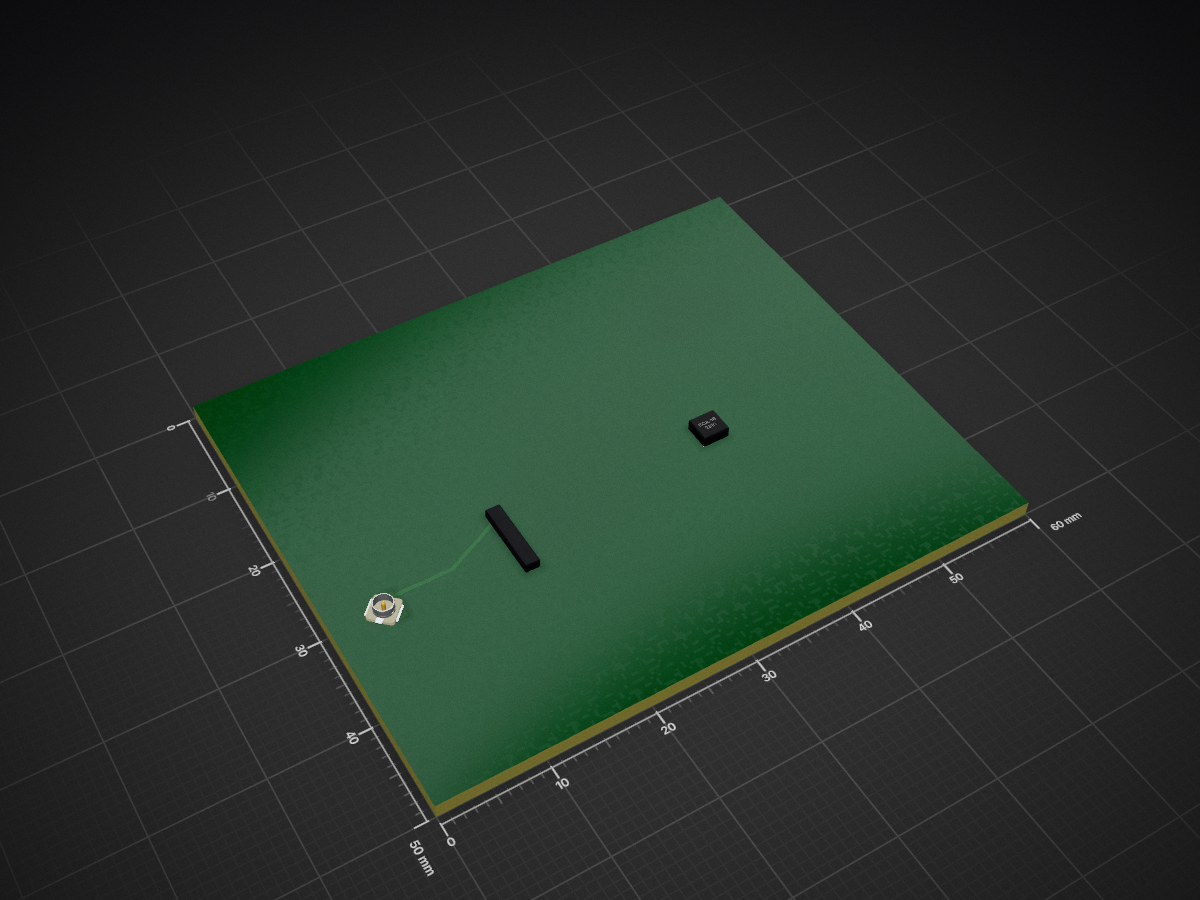
Esp32 c6 rf is an open-source printed circuit board by LayerDynamics, from the LayerDynamics/KiClaude repository on GitHub. It is a 4-layer board of 60 × 50 mm with 7 parts on 15 nets, routed with 2 tracks and 0 vias.
It is built around the ESP32-C6-MINI-1. Its parts include 4 capacitors, 2 ICs and 1 connector. It belongs with the radio and wireless boards and the ESP32 and RISC-V boards of this library.
Claude Code, but for circuit boards.
kiclaude is a browser-native, AI-native, KiCad-compatible EDA suite. You open a
.kicad_pro project in a browser tab, chat with Claude in the sidebar, and
every action — "add a USB-C PD trigger for 9 V, with proper decoupling and a
fuse", "route the high-speed pairs first, then power", "is this board ready
to fab?" — becomes a typed tool call that round-trips back to real
.kicad_sch / .kicad_pcb files on disk. Diffable. Reviewable. Yours.
Every chat lives next to a fully-featured visual editor: selection, drag, multi-layer routing, zone fills, DRC overlays. Claude is a first-class collaborator, not a chrome strip glued onto someone else's UI.
Designing a PCB today forces a hard choice:
kiclaude lives in the empty quadrant: browser-native, open file format, AI-native, local-first. The files stay on your disk. The AI ships in the box. The visual editor is real. None of those are bolted on.
kc_* for Claude, ui_* for the editor) so
every edit is auditable and gated. Claude doesn't get raw Write access to
your .kicad_pcb — it gets kc_footprint_place_hint("near MCU, south edge")
and the placer resolves it..claude/ artifacts work everywhere. Slash commands like
/add-mcu esp32-s3, /pcb-review, /diffpair, /route-power, /bom-price,
/pcb-fab run from the in-app sidebar and from Claude Code on the CLI.kiclaude CLI so anything Claude can do, CI can do.kithree) for the 3D crowd.kiconnector) so Firefox and Safari users get
filesystem access without waiting for FSA parity.If a future PR violates one of these, that's the PR that needs to lose. Not the rule.
                +-------------------------------+
                |  client/  (React + Vite +     |
                |  Radix + Tailwind + Zustand)  |
                |  kicanvas + kithree viewports |
                +---------------+---------------+
                                | WebSocket + REST :8080
                +---------------v---------------+
                |  services/server  (Hono GW)   |
                +---+-----------+-----------+---+
                    |           |           |
            :8082   |   :8083   |   :8084   |
       +------------v+ +--------v---+ +-----v----------+
       |   agent     | |  kiserver  | |  kiconnector   |
       | (Claude SDK)| | (PyO3 + ki)| | (kicad-cli)    |
       +------+------+ +-----+------+ +----------------+
              |              |
              | in-process MCP (kc_* tools)
              v              v
       +------------------------------+
       |  services/mcp                |
       |  + crates/ki  (KCIR, format) |
       |  + crates/cad (geom, DRC)    |
       +------------------------------+
^| Path | What lives there |
|---|---|
crates/ki/ | KCIR types, S-expression lexer/parser, KiCad 9 emitter, PyO3 + wasm bindings |
crates/cad/ | Geometry, R-tree index, DRC kernel, length-match, impedance solver, 3D scene |
services/agent/ | FastAPI driver around the Claude Agent SDK (:8082) |
services/mcp/ | In-process MCP server with all kc_* and ui_* tools |
services/kiserver/ | FastAPI surface around the PyO3-loaded ki_native (:8083) |
services/kiconnector/ | Local broker for kicad-cli + Freerouting (:8084) |
services/server/ | Hono WebSocket + REST gateway (:8080) |
client/ | The browser editor (React 19, Vite, Tailwind, Zustand) |
packages/cli/ | The kiclaude Node CLI |
packages/kithree/ | three.js board viewer |
examples/blinky/ | Reference project the round-trip CI runs against |
# Rust
cargo test --workspace
cargo clippy --workspace --all-targets -- -D warnings

# Wasm bindings (consumed by client/)
wasm-pack build --target web crates/ki
wasm-pack build --target web crates/cad

# Python services
uv sync --all-extras
uv run pytest

# Node side
pnpm install
pnpm -r typecheck
pnpm -F client dev          # browser editor on http://localhost:5173

# CLI
pnpm -F @kiclaude/cli build
kiclaude --version
kiclaude mcp stdio          # talk to the MCP server from any MCP-capable host
kiclaude validate examples/blinky
For end-to-end Playwright smoke (gated on ANTHROPIC_API_KEY):
pnpm -F e2e testThese ship in .claude/commands/ and work both in-app and in Claude Code:
| Command | What it does |
|---|---|
/add-mcu esp32-s3 | Adds an MCU + USB + LDO + decoupling, ERC-clean |
/add-power buck-3v3-from-vbus | Drops in a complete power subsystem |
/add-decoupling | Audits every IC for missing bypass caps, proposes one per pin |
/diffpair | Declares a diff pair, solves for impedance, routes it |
/route-power | Routes power nets at net-class width with per-net approvals |
/route-signals | Walk-around routes signal nets in dependency order |
/length-match | Analyses declared length-match groups, queues serpentine tuning |
/explore-placements | Spawns a sub-agent that tries N placements, ranks by track length × clearance headroom |
/erc-fix / /drc-fix | Reads the highest-severity issue, proposes one fix, applies on approval, loops |
/pcb-review | Full M3 design review: stackup, net classes, diff pairs, length match, decoupling, DRC |
/pcb-fab | DFM dry-run, then full fab bundle (gerbers + drill + P&P + BOM) |
/bom-price | Fan-out across Octopart / Mouser / Digi-Key / JLCPCB, returns cheapest mix |
We're tracking the M0–M3 plan —
139 of 146 tasks done as of this writing. The remaining set is the push-and-shove
router (the bottleneck), three live-distributor adapters, and a couple of UI gestures.
The full spec lives at docs/specs/SPEC-01-kiclaude.md;
if it disagrees with this README, the spec wins.
Apache-2.0. The Freerouting integration runs as a separately-installed
subprocess so the GPL doesn't bleed into the rest of the tree
(see NFR-009 in the spec, and scripts/license_audit.sh in CI).
The bar:
cargo test --workspace is greenuv run pytest is greenpnpm -r typecheck && pnpm -r test are greentests/golden/) is green — if it isn't, the file emitter
is wrong, even if KiCad opens the outputOpen an issue, open a PR, or — easiest of all — open the project in the browser and ask Claude to do it.
| Qty | Value | Footprint | References |
|---|---|---|---|
| 2 | 100nF | Capacitor_SMD:C_0402_1005Metric | C1, C2 |
| 2 | 4.7uF | Capacitor_SMD:C_0402_1005Metric | C3, C4 |
| 1 | BGA-16 | Package_BGA:BGA-16_1.92x1.92mm_Layout4x4_P0.5mm | U2 |
| 1 | ESP32-C6-MINI-1 | RF_Module:ESP32-C6-MINI-1 | U1 |
| 1 | U.FL | Connector_Coaxial:U.FL_Molex_MCRF_73412-0110_Vertical | J1 |
It measures 60 × 50 mm and has 4 copper layers, 1.6 mm thick.
7 parts, built around the ESP32-C6-MINI-1. The full list of its parts is on this page, with links to each part's symbol and footprint where PCBKit's library has them.
From the LayerDynamics/KiClaude repository on GitHub, at the commit this page was made from: the board is examples/esp32_c6_rf/esp32_c6_rf.kicad_pcb and its schematic examples/blinky/blinky.kicad_sch. PCBKit opens the board in the browser, with nothing to install.
Its repository states no licence, so its author keeps all rights: ask LayerDynamics before reusing the design.


tomasmcguinness/esp32-modbus-serial-adapter
The hardware folder contains a KiCad PCB design, designed around the ESP32-C6-MINI-1. Both the antenna and non-antenna (U1) versions will work here due to the location of the ESP32.


jernej13/Tempic
Small solarpowered ESP32 based indoor/outdoor wifi weather station.

tomasmcguinness/matter-esp32-mbus-adapter
An ESP32-C6 adapter board for wired M-Bus (EN 13757) meters, with firmware examples that expose meter readings to a Matter fabric over Thread.

wildsystems/ws-uc06
Custom ESP32-C6 development board with power input protection, relay outputs, opto-isolated I/O, NTC sensor input, and JTAG debugging. Designed as a DIY-friendly controller base.

Enderman8843/Carbon
Carbon is an open-source indoor air quality sensing board designed for accurate VOC, temperature, and humidity monitoring.