2 layers87.2 × 77.2 mm
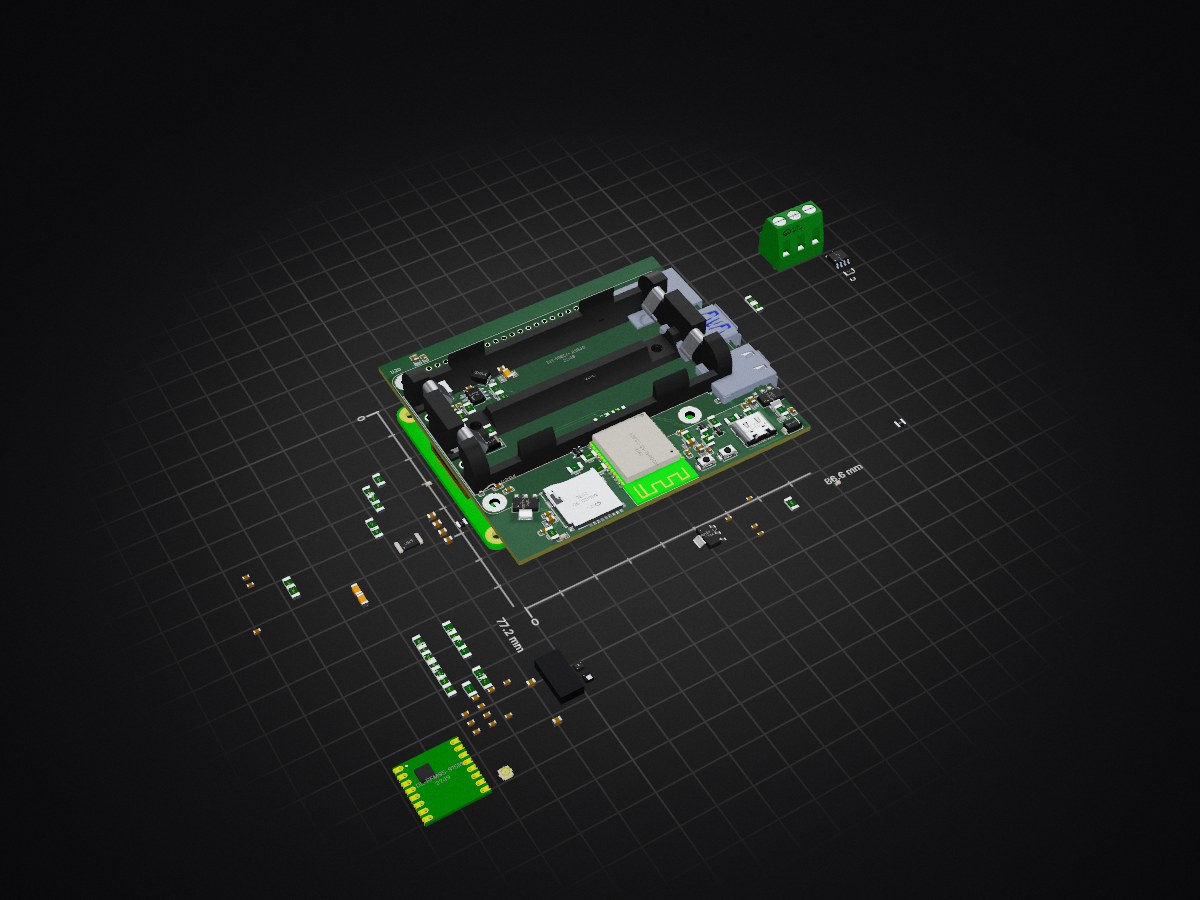
 JulCesarCorrea/Basic-EPS
PCB design para a 4 fase da obsat
Restore backup 2026-10-15T00-06-46-763 is an open-source printed circuit board by JulCesarCorrea, from the JulCesarCorrea/Basic-EPS repository on GitHub. It is a 2-layer board of 86.6 × 77.2 mm with 139 parts on 181 nets, routed with 413 tracks and 24 vias.
It is built around the DL-RFM95-915M, ESP32-S3-WROOM-1-N4 and SCT2650STER, with the AMS1117-3.3V, HX TYPE-C 16PIN and BH-18650-A1BJ021 among its other parts. Its parts include 52 capacitors, 50 resistors, 19 ICs, 8 diodes and 5 inductors. It belongs with the ESP32 boards of this library.


A Amazônia desempenha um papel estratégico de extrema relevância global e nacional, abrigando a maior biodiversidade do planeta e recursos naturais de alto valor. Contudo, essa importância é ameaçada pela proliferação de pistas de pouso clandestinas, que funcionam como vetores para atividades ilícitas como garimpo ilegal, narcotráfico e desmatamento, comprometendo o equilíbrio ambiental, social e a soberania nacional. Estudos apontam que há mais pistas não homologadas do que oficiais na Amazônia Legal, formando uma infraestrutura paralela que impulsiona essas atividades ilegais.
Apesar dos esforços de fiscalização, o monitoramento por satélites convencionais enfrenta limitações significativas:
O satélite processa as imagens diretamente em órbita e envia alertas com dados de localização e área estimada, reduzindo custos, latência e dependência de infraestrutura terrestre. O projeto reforça a pesquisa em monitoramento ambiental com tecnologias acessíveis e contribui para o avanço da IA embarcada em CubeSats, com impacto direto na soberania e proteção da Amazônia.
A Missão Samaúma é conduzida por dois estudantes de Engenharia de Computação do Instituto Nacional de Telecomunicações (INATEL), sob orientação técnica do Prof. Evandro César Vilas Boas.
Mateus Ananias Duarte Lima Software e IA embarcada Desenvolvimento do algoritmo de detecção de pistas; implementação do sistema operacional de tempo real (RTOS); integração dos subsistemas via software.
Daniele Letícia Pereira Sousa Hardware e sistemas embarcados Projeto e implementação dos subsistemas físicos (EPS, STR, Payload, COMMS, TCS, ADCS); integração e validação de hardware.
Apesar da divisão de responsabilidades, o trabalho é conduzido de forma colaborativa e integrada, permitindo que ambos mantenham visão global do projeto e contribuam em múltiplas frentes técnicas.
A Missão Samaúma é estruturada em três etapas principais:
O algoritmo embarcado processa as imagens diretamente no computador de bordo (OBC), distinguindo áreas de desmatamento comum de pistas clandestinas, e enviando alertas automáticos com coordenadas e área estimada.
| Qty | Value | Footprint | References |
|---|---|---|---|
| 26 | 100nF | EPS_PAY-Footprints:C0603 | C3, C17, C19, C20, C22, C23, C25, C26, C28, C29, C31, C32, C33, C34, C36, C37 +10 |
| 13 | 0Ω | EPS_PAY-Footprints:R0603 | R12, R13, R14, R19, R20, R21, R22, R23, R24, R27, R28, R34, R35 |
| 12 | 10uF | EPS_PAY-Footprints:C0805 | C1, C13, C18, C30, C35, C38, C39, C40, C43, C46, C47, C59 |
| 8 | 5.1KΩ | EPS_PAY-Footprints:R0603 | R25, R26, R36, R41, R45, R46, R47, R49 |
| 7 | 10KΩ | EPS_PAY-Footprints:R0603 | R4, R5, R11, R15, R16, R17, R30 |
| 6 | 1KΩ | EPS_PAY-Footprints:R0603 | R6, R7, R8, R9, R10, R51 |
| 6 | 1uF | EPS_PAY-Footprints:C0603 | C51, C52, C54, C56, C57, C58 |
| 4 | 120kΩ | EPS_PAY-Footprints:R0603 | R40, R42, R44, R48 |
| 4 | 22uF | EPS_PAY-Footprints:C1206 | C2, C9, C44, C45 |
| 4 | LED_GREEN | EPS_PAY-Footprints:LED0603-FD | D2, D3, D6, D7 |
| 3 | 2.2nH | EPS_PAY-Footprints:L1008 | L3, L4, L5 |
| 3 | AMS1117-3_3 | EPS_PAY-Footprints:SOT-223-3_L6.5-W3.4-P2.30-LS7.0-BR | U2, U3, U4 |
| 2 | HX_TYPE-C_16PIN | EPS_PAY-Footprints:TYPE-C-SMD_HX-TYPE-C-16PIN | U11, U16 |
| 2 | L8050 | EPS_PAY-Footprints:SOT-23-3_L2.9-W1.3-P1.90-LS2.4-BR | Q1, Q2 |
| 2 | SW_DPST_x2 | EPS_PAY-Footprints:SW-SMD_L3.9-W3.0-P4.45 | SW1, SW2 |
| 1 | 0.5Ω | EPS_PAY-Footprints:RES-SMD_L6.4-W3.2-R2512 | R37 |
| 1 | 100KΩ | EPS_PAY-Footprints:R0603 | R50 |
| 1 | 100uF | EPS_PAY-Footprints:C1206 | C5 |
| 1 | 100Ω | EPS_PAY-Footprints:R0603 | R39 |
| 1 | 10KΩ(NC) | EPS_PAY-Footprints:R0603 | R18 |
| 1 | 150Ω | EPS_PAY-Footprints:R0603 | R38 |
| 1 | 1uF | EPS_PAY-Footprints:C0805 | C24 |
| 1 | 2.2uH | EPS_PAY-Footprints:L1008 | L6 |
| 1 | 200KΩ | EPS_PAY-Footprints:R0603 | R2 |
| 1 | 220pF | EPS_PAY-Footprints:C0603 | C21 |
| 1 | 22KΩ | EPS_PAY-Footprints:R0603 | R3 |
| 1 | 3.3nF | EPS_PAY-Footprints:C0603 | C4 |
| 1 | 33kΩ | Resistor_SMD:R_1206_3216Metric_Pad1.30x1.75mm_HandSolder | R33 |
| 1 | 52.5KΩ | EPS_PAY-Footprints:R0402 | R1 |
| 1 | 55kΩ | Resistor_SMD:R_0603_1608Metric_Pad0.98x0.95mm_HandSolder | R31 |
| 1 | 56kΩ | EPS_PAY-Footprints:R0603 | R29 |
| 1 | 6.8uH | EPS_PAY-Footprints:IND-SMD_L5.4-W5.2 | L1 |
| 1 | 60KΩ | EPS_PAY-Footprints:R0603 | R43 |
| 1 | AO4407A_C2841482 | EPS_PAY-Footprints:SOP-8_L5.0-W4.0-P1.27-LS6.0-BL | U19 |
| 1 | BH-18650-A1BJ021 | EPS_PAY-Footprints:BAT-TH_L77.0-W39.9_BH-18650-A1BJ021 | U12 |
| 1 | BWIPX-1-001E | EPS_PAY-Footprints:IPEX-SMD_BWIPX-1-001E | U13 |
| 1 | D2F | EPS_PAY-Footprints:SW-TH_D2F-L | U18 |
| 1 | DL-RFM95-915M | EPS_PAY-Footprints:LCC-16_L16.0-W16.0-P2.00-TL | U9 |
| 1 | ESP32-S3-WROOM-1-N4 | EPS_PAY-Footprints:WIFIM-SMD_ESP32-S3-WROOM-1-N8 | U5 |
| 1 | IP2326 | EPS_PAY-Footprints:VQFN-24_L4.0-W4.0-P0.50-BL-EP2.5 | U17 |
| 1 | LIS3MDLTR | EPS_PAY-Footprints:LGA-12_L2.0-W2.0-P0.50-BL | U7 |
| 1 | LPS22HBTR | EPS_PAY-Footprints:HLGA-10L_LPS22HBTR | U8 |
| 1 | MICRO_SD | EPS_PAY-Footprints:TF-SMD_TF-PUSH | U10 |
| 1 | MMBTA06 | EPS_PAY-Footprints:SOT-23-3_L2.9-W1.6-P1.90-LS2.8-BR | Q3 |
| 1 | MPU-6050_C24112 | EPS_PAY-Footprints:QFN-24_L4.0-W4.0-P0.50-BL-EP2.7 | U6 |
| 1 | RASPBERRY_PI_4B_4GB | RASPBERRY_PI_4B_4GB:MODULE_RASPBERRY_PI_4B_4GB | U20 |
| 1 | SCT2650STER | EPS_PAY-Footprints:ESOP-8_L4.9-W3.9-P1.27-LS6.0-BL-EP-2 | U1 |
| 1 | SS34 | Diode_SMD:D_SMA | D9 |
| 1 | SS34-MS | EPS_PAY-Footprints:DO-214AC_L4.3-W2.7-LS5.0-RD | D4 |
| 1 | SS54 | EPS_PAY-Footprints:SMB_L4.3-W3.6-LS5.4-RD | D1 |
| 1 | USBLC6-2P6_C2827693 | EPS_PAY-Footprints:SOT-666-6_L1.6-W1.2-P0.50-LS1.6-BL | D5 |
| 1 | ~ | GPS:GPS_NEO-M6 | U14 |
It measures 86.6 × 77.2 mm and has 2 copper layers, 1.6 mm thick.
139 parts, built around the DL-RFM95-915M, ESP32-S3-WROOM-1-N4, SCT2650STER and AMS1117-3.3V. The full list of its parts is on this page, with links to each part's symbol and footprint where PCBKit's library has them.
From the JulCesarCorrea/Basic-EPS repository on GitHub, at the commit this page was made from: the board is Hardware/PCB/EPS&PAY/sources/_restore_backup_2026-10-15T00-06-46-763/PCB.kicad_pcb and its schematic Hardware/PCB/EPS&PAY/sources/PCB.kicad_sch. PCBKit opens the board in the browser, with nothing to install.
Its repository states no licence, so its author keeps all rights: ask JulCesarCorrea before reusing the design.


TheEinfachFelix/CampPhone
Warum habe ich mich dagegen entschieden, das Sim Modul selber zu implementieren? Ich habe kein Chip gefunden, der günstiger als das fertige Modul war, und ein Datenblatt in Englischer Sprache hat.


gabrielyoung92/gabs_microSMT_PickAndPlace
Independent reorganisation of MicroSMT feeder and PNPv3 files, previews and documentation, with upstream attribution and ChatGPT assistance.

