2 layers86.6 × 77.2 mm
Restore backup 2026-10-15T00-06-46-763
JulCesarCorrea/Basic-EPS
PCB design para a 4 fase da obsat
139 parts
 JulCesarCorrea/Basic-OBC
PCB-OBC design para a 4 fase da OBSAT
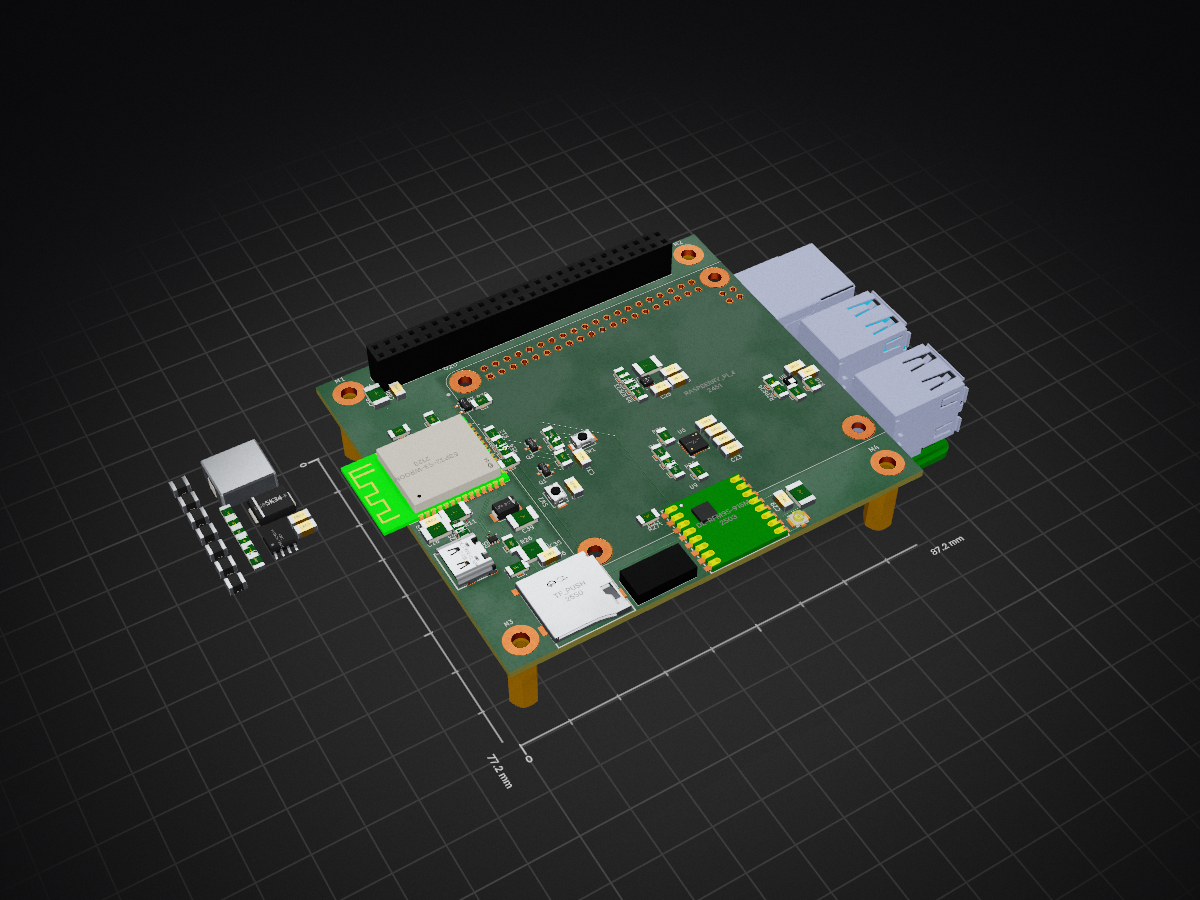
Sources is an open-source printed circuit board by JulCesarCorrea, from the JulCesarCorrea/Basic-OBC repository on GitHub. It is a 4-layer board of 87.2 × 77.2 mm with 90 parts on 181 nets, routed with 182 tracks and 3 vias.
It is built around the DL-RFM95-915M, ESP32-S3-WROOM-1-N4 and TPS54560DDAR, with the BWIPX-1-001E, HX TYPE-C 16PIN and B560C-13-F-MS among its other parts. Its parts include 34 resistors, 31 capacitors, 11 ICs, 3 diodes and 3 transistors. It belongs with the ESP32 boards of this library.


A Amazônia desempenha um papel estratégico de extrema relevância global e nacional, abrigando a maior biodiversidade do planeta e recursos naturais de alto valor. Contudo, essa importância é ameaçada pela proliferação de pistas de pouso clandestinas, que funcionam como vetores para atividades ilícitas como garimpo ilegal, narcotráfico e desmatamento, comprometendo o equilíbrio ambiental, social e a soberania nacional. Estudos apontam que há mais pistas não homologadas do que oficiais na Amazônia Legal, formando uma infraestrutura paralela que impulsiona essas atividades ilegais.
Apesar dos esforços de fiscalização, o monitoramento por satélites convencionais enfrenta limitações significativas:
O satélite processa as imagens diretamente em órbita e envia alertas com dados de localização e área estimada, reduzindo custos, latência e dependência de infraestrutura terrestre. O projeto reforça a pesquisa em monitoramento ambiental com tecnologias acessíveis e contribui para o avanço da IA embarcada em CubeSats, com impacto direto na soberania e proteção da Amazônia.
A Missão Samaúma é conduzida por dois estudantes de Engenharia de Computação do Instituto Nacional de Telecomunicações (INATEL), sob orientação técnica do Prof. Evandro César Vilas Boas.
Mateus Ananias Duarte Lima Software e IA embarcada Desenvolvimento do algoritmo de detecção de pistas; implementação do sistema operacional de tempo real (RTOS); integração dos subsistemas via software.
Daniele Letícia Pereira Sousa Hardware e sistemas embarcados Projeto e implementação dos subsistemas físicos (EPS, STR, Payload, COMMS, TCS, ADCS); integração e validação de hardware.
Apesar da divisão de responsabilidades, o trabalho é conduzido de forma colaborativa e integrada, permitindo que ambos mantenham visão global do projeto e contribuam em múltiplas frentes técnicas.
A Missão Samaúma é estruturada em três etapas principais:
O algoritmo embarcado processa as imagens diretamente no computador de bordo (OBC), distinguindo áreas de desmatamento comum de pistas clandestinas, e enviando alertas automáticos com coordenadas e área estimada.
| Qty | Value | Footprint | References |
|---|---|---|---|
| 16 | 100nF | EPS_PAY-Footprints:C0603 | C19, C20, C22, C23, C25, C26, C27, C28, C29, C31, C32, C33, C34, C36, C52, C60 |
| 13 | 0Ω | EPS_PAY-Footprints:R0603 | R12, R13, R14, R19, R20, R21, R22, R23, R24, R27, R28, R34, R35 |
| 7 | 10KΩ | EPS_PAY-Footprints:R0603 | R4, R5, R11, R16, R17, R30, R46 |
| 6 | 10uF | EPS_PAY-Footprints:C0805 | C18, C30, C35, C39, C40, C59 |
| 5 | 1KΩ | EPS_PAY-Footprints:R0603 | R6, R7, R8, R9, R10 |
| 4 | MountingHole | MountingHole:MountingHole_3.2mm_M3_Pad | M1, M2, M3, M4 |
| 3 | 47uF | EPS_PAY-Footprints:C1210 | C37, C38, C41 |
| 2 | 22uF | EPS_PAY-Footprints:C1210 | C9, C13 |
| 2 | 5.1KΩ | EPS_PAY-Footprints:R0603 | R25, R26 |
| 2 | L8050 | EPS_PAY-Footprints:SOT-23-3_L2.9-W1.3-P1.90-LS2.4-BR | Q1, Q2 |
| 2 | SW_DPST_x2 | EPS_PAY-Footprints:SW-SMD_L3.9-W3.0-P4.45 | SW1, SW2 |
| 1 | 10KΩ(NC) | EPS_PAY-Footprints:R0603 | R18 |
| 1 | 11,3KΩ | EPS_PAY-Footprints:R0603 | R44 |
| 1 | 1uF | EPS_PAY-Footprints:C0805 | C24 |
| 1 | 220pF | EPS_PAY-Footprints:C0603 | C21 |
| 1 | 235,3KΩ | EPS_PAY-Footprints:R0603 | R41 |
| 1 | 243KΩ | EPS_PAY-Footprints:R0603 | R43 |
| 1 | 31,2KΩ | EPS_PAY-Footprints:R0603 | R45 |
| 1 | 4,7nF | EPS_PAY-Footprints:C1210 | C14 |
| 1 | 47pF | EPS_PAY-Footprints:C1210 | C17 |
| 1 | 48,7KΩ | EPS_PAY-Footprints:R0603 | R42 |
| 1 | 56kΩ | EPS_PAY-Footprints:R0603 | R29 |
| 1 | B560C-13-F | EPS_PAY-Footprints:SMC_L7.1-W6.2-LS8.1-RD | D3 |
| 1 | BWIPX-1-001E | EPS_PAY-Footprints:IPEX-SMD_BWIPX-1-001E | U13 |
| 1 | DL-RFM95-915M | EPS_PAY-Footprints:LCC-16_L16.0-W16.0-P2.00-TL | U9 |
| 1 | ESP32-S3-WROOM-1-N4 | EPS_PAY-Footprints:WIFIM-SMD_ESP32-S3-WROOM-1-N8 | U5 |
| 1 | HX_TYPE-C_16PIN | EPS_PAY-Footprints:TYPE-C-SMD_HX-TYPE-C-16PIN | U11 |
| 1 | LIS3MDLTR | EPS_PAY-Footprints:LGA-12_L2.0-W2.0-P0.50-BL | U7 |
| 1 | LPS22HBTR | EPS_PAY-Footprints:HLGA-10L_LPS22HBTR | U8 |
| 1 | MMBTA06 | EPS_PAY-Footprints:SOT-23-3_L2.9-W1.6-P1.90-LS2.8-BR | Q3 |
| 1 | MPU-6050_C24112 | EPS_PAY-Footprints:QFN-24_L4.0-W4.0-P0.50-BL-EP2.7 | U6 |
| 1 | PC/104 Connector | Connector_PinSocket_2.54mm:PinSocket_2x26_P2.54mm_Vertical | H1 |
| 1 | RASPBERRY_PI_4B_4GB | RASPBERRY_PI_4B_4GB:MODULE_RASPBERRY_PI_4B_4GB | U20 |
| 1 | RS1040-6R8MS | EPS_PAY-Footprints:IND-SMD_L11.0-W10.0 | L3 |
| 1 | SS34-MS | EPS_PAY-Footprints:DO-214AC_L4.3-W2.7-LS5.0-RD | D4 |
| 1 | TF_PUSH | EPS_PAY-Footprints:TF-SMD_TF-PUSH | U10 |
| 1 | TPS54560DDAR | EPS_PAY-Footprints:SOIC-8_L5.0-W4.0-P1.27-LS6.0-BL-EP2.0 | U15 |
| 1 | USBLC6-2P6_C2827693 | EPS_PAY-Footprints:SOT-666-6_L1.6-W1.2-P0.50-LS1.6-BL | D5 |
| 1 | ~ | GPS:GPS_NEO-M6 | U14 |
It measures 87.2 × 77.2 mm and has 4 copper layers, 1.6 mm thick.
90 parts, built around the DL-RFM95-915M, ESP32-S3-WROOM-1-N4, TPS54560DDAR and BWIPX-1-001E. The full list of its parts is on this page, with links to each part's symbol and footprint where PCBKit's library has them.
From the JulCesarCorrea/Basic-OBC repository on GitHub, at the commit this page was made from: the board is Hardware/PCB/EPS&PAY/sources/PCB.kicad_pcb and its schematic Hardware/PCB/EPS&PAY/sources/Buck_3.3V.kicad_sch. PCBKit opens the board in the browser, with nothing to install.
Its repository states no licence, so its author keeps all rights: ask JulCesarCorrea before reusing the design.
JulCesarCorrea/Basic-EPS
PCB design para a 4 fase da obsat


Takazudo/zudo-pd
P15 r1 is the common 27 × 40 mm STUSB4500 15 V / 3 A module for LED first, then PD15. The same PCB, population and NVM image serve both. Source: board-p15-draft.kicadpcb and ../../scripts/schgen/boardp15spec.py.


gabrielyoung92/gabs_microSMT_PickAndPlace
Independent reorganisation of MicroSMT feeder and PNPv3 files, previews and documentation, with upstream attribution and ChatGPT assistance.

