4 layers130 × 130 mm

 jrowe88/ecoport-bridge1
CTA-2045 (EcoPort) bridge for a Rinnai REHP65 heat pump water heater
Ecoport bridge v1 is an open-source printed circuit board by jrowe88, from the jrowe88/ecoport-bridge repository on GitHub, published under the AGPL-3.0 licence. It is a 2-layer board of 51.5 × 92 mm with 74 parts on 54 nets, routed with 428 tracks and 167 vias.
It is built around the ESP32-C6-WROOM-1-N8, IRM-05-5 and SP3485EET(UMW), with the USBLC6-2SC6, SN74LV1T34DCKR and TLV75733PDBVR-MS among its other parts. Its parts include 16 capacitors, 12 resistors, 8 ICs, 7 connectors and 3 diodes. It belongs with the interfaces and adapters boards and the ESP32 and RISC-V boards of this library.


EcoPort Bridge is a hobby reverse-engineering and hardware project to build a
communication bridge for appliances using the CTA-2045 "EcoPort" interface
(AC-form-factor UCM connector, RS-485 @ 19,200 baud) — starting with a
Rinnai REHP65 heat pump water heater (CTA-2045-B / SGD, connector CN50,
physical connector part 420B2V12FL0).
The goal is to expose the appliance's CTA-2045 data (tank temperature, setpoint, operating state, energy, demand-response/shed status, faults, etc.) to home automation systems (MQTT, Matter, Home Assistant) via a small ESP32-class bridge device, built on top of a Python implementation of the CTA-2045 protocol.
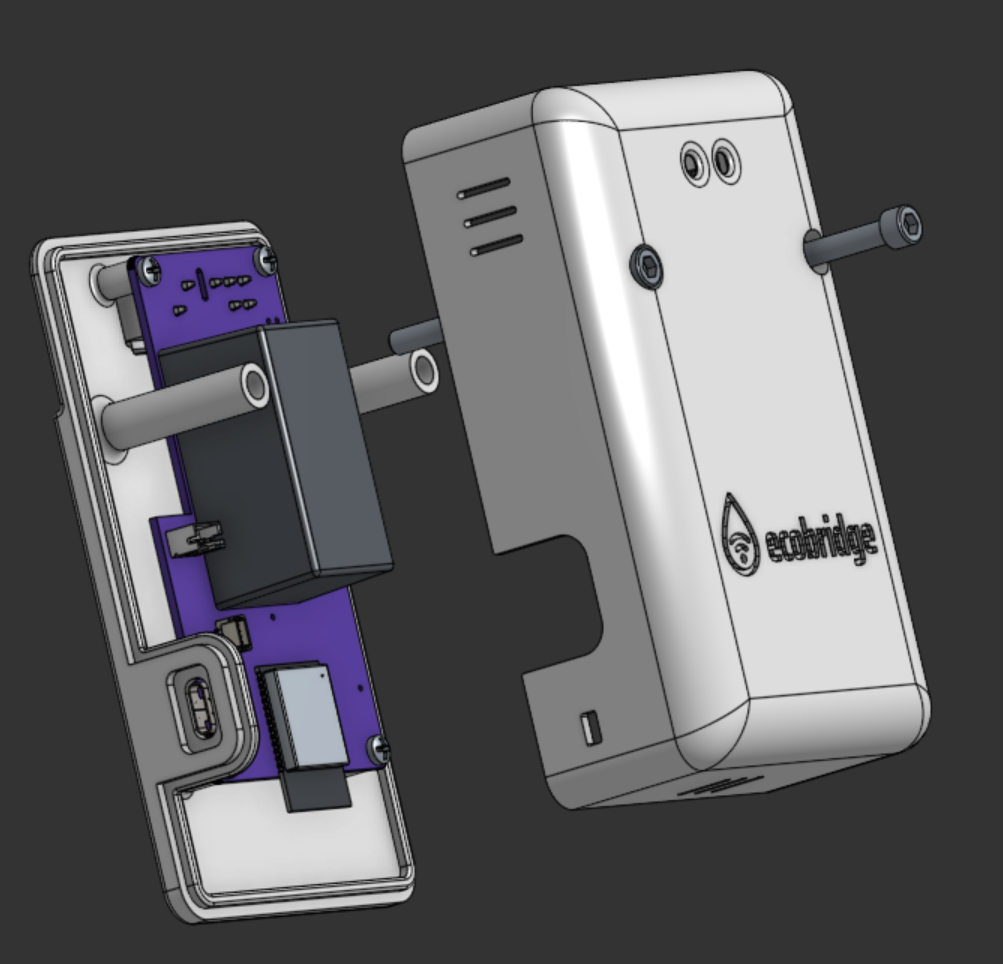
Rev A: ESP32-C6 board with an on-board mains supply, plugged straight into
the heater's CTA-2045 connector. See hardware/rev-a for
the board and hardware/enclosure for the 3D-printed
case.
cta2045 layer implements the protocol (framing, messages, CRC, link,
Basic DR / Intermediate messages). Appliance-specific behavior (e.g. Rinnai
REHP65 quirks and capability mappings) lives under appliances/rinnai (or
a Rinnai crate in firmware) so other CTA-2045/EcoPort appliances can be
supported later without untangling Rinnai assumptions from the protocol
implementation.docs/protocol.md and
per-capture notes, so reverse-engineering guesses don't quietly turn into
"the spec" later.captures/ as a reproducible dataset, not a pile of Wireshark
screenshots. ┌───────────────────────────────┐
│ Your application │
│ Home Assistant / MQTT / etc. │
└───────────────┬───────────────┘
│
Python CTA-2045 API
│
┌───────────────▼───────────────┐
│ CTA-2045 protocol │
│ link + Basic DR + Intermediate│
└───────────────┬───────────────┘
│
RS-485 UART
│
┌───────────────▼───────────────┐
│ Isolated RS-485 │
│ transceiver │
└───────────────┬───────────────┘
│
CTA-2045 AC connector
│
┌───────────────▼───────────────┐
│ Rinnai REHP65 │
│ SGD / CN50 │
└───────────────────────────────┘420B2V12FL0 (EPRI's "UCM Connector")See docs/hardware.md and docs/protocol.md for details, and captures/
for recorded traffic.
ecoport-bridge/
│
├── README.md
├── LICENSE             # AGPL-3.0 (software); hardware/LICENSE is CERN-OHL-S-2.0
├── CONTRIBUTING.md
│
├── docs/                 # architecture, hardware, protocol, HOWTOs
├── hardware/             # PCB revisions + 3D-printed enclosure
├── firmware/             # ESP32-C6 bridge firmware (Rust on ESP-IDF)
├── python/               # ecoport Python package (protocol + tooling)
├── tools/                # CLI tools: sniff, decode, query, interactive
├── captures/             # recorded protocol traffic + notes (EPRI + Rinnai)
├── test/                 # cross-cutting test fixtures/integration tests
└── scripts/ # dev setup / flashing helpersEarly planning / hardware on order. See docs/reverse-engineering.md and
captures/ as the project progresses.
docs/architecture.md — software layering and the device ↔ Azure cloud architecture (telemetry, commands, storage, dashboard, security)docs/hardware.md — connector, pinout, safety, bring-up hardwaredocs/protocol.md — CTA-2045 protocol facts, capability matrixdocs/capabilities.md — what we can see, infer, log and control on the Rinnai REHP65docs/reverse-engineering.md — staged plan (EPRI oracle → passive capture → queries → writes)docs/references.md — source material, tools, and libraries (EPRI, python-cta2045, ANSI, EcoPort DB, OpenADR, connector part numbers)docs/troubleshooting.md — common issuesBoth licenses are copyleft: you can use, modify and share this project, and anything you distribute that's based on it has to stay under the same terms.
firmware/, python/, tools/, scripts/, test/) —
GNU Affero General Public License v3.0 (AGPL-3.0-only), see
LICENSE.hardware/: KiCad board, footprints, fab outputs, enclosure
CAD) — CERN Open Hardware Licence v2, Strongly Reciprocal
(CERN-OHL-S-2.0), see hardware/LICENSE.Source location for the hardware (CERN-OHL-S §1.9): https://github.com/jrowe88/ecoport-bridge. It is also printed on the board.
| Qty | Value | Footprint | References |
|---|---|---|---|
| 9 | 0.1µF | Capacitor_SMD:C_0603_1608Metric | C2, C5, C7, C8, C9, C12, C13, C14, C15 |
| 4 | 10kΩ | Resistor_SMD:R_0603_1608Metric | R4, R5, R9, R10 |
| 4 | 1µF | Capacitor_SMD:C_0603_1608Metric | C3, C4, C10, C16 |
| 3 | 22µF | Capacitor_SMD:C_1206_3216Metric | C1, C6, C11 |
| 2 | 390Ω | Resistor_SMD:R_0603_1608Metric | R2, R3 |
| 2 | 4.7kΩ | Resistor_SMD:R_0603_1608Metric | R6, R7 |
| 2 | 5.1kΩ | Resistor_SMD:R_0603_1608Metric | R11, R12 |
| 2 | Conn_01x02 | Connector_PinHeader_2.54mm:PinHeader_1x02_P2.54mm_Vertical | J2, J5 |
| 2 | GND | Custom:TestPoint_Keystone_5000-5004_Miniature | TP1, TP2 |
| 2 | LOGO | Custom:electrical_hazard | G***, G*** |
| 2 | SK6812 | LED_SMD:LED_SK6812_PLCC4_5.0x5.0mm_P3.2mm | D2, D3 |
| 2 | USBLC6-2SC6 | Package_TO_SOT_SMD:SOT-23-6 | U4, U7 |
| 1 | 120Ω | Resistor_SMD:R_1206_3216Metric | R1 |
| 1 | 3V3 | Custom:TestPoint_Keystone_5000-5004_Miniature | TP4 |
| 1 | 420B2V12FL0 | Custom:Onshore_Header_2x06_P4.20mm_Vertical | J1 |
| 1 | 470Ω | Resistor_SMD:R_0603_1608Metric | R8 |
| 1 | 5V | Custom:TestPoint_Keystone_5000-5004_Miniature | TP3 |
| 1 | B3B-PH-K-S | Custom:JST_B3B-PH-K-S | J7 |
| 1 | BM04B-SRSS-TB | Custom:CONN4_BM04B-SRSS_JST | J3 |
| 1 | BOOT | Custom:SW_TS04-66-50-BK-260-SMT | SW2 |
| 1 | BOOT | Custom:TestPoint_Pad_D2.0mm | TP11 |
| 1 | Connector Wire | Custom:Wire_Solder_1x03_P2.54mm_Relief | J6 |
| 1 | D+ | Custom:TestPoint_Pad_D2.0mm | TP5 |
| 1 | D- | Custom:TestPoint_Pad_D2.0mm | TP6 |
| 1 | DE | Custom:TestPoint_Pad_D2.0mm | TP9 |
| 1 | EN | Custom:TestPoint_Pad_D2.0mm | TP10 |
| 1 | ESP32-C6-WROOM-1-N8 | Custom:XCVR_ESP32-C6-WROOM-1-N8 | U6 |
| 1 | EcoPort_Bridge_Marking | Custom:EcoPort_Bridge_Marking | G*** |
| 1 | IO23 | Custom:TestPoint_Keystone_5000-5004_Miniature | TP14 |
| 1 | IRM-05-5 | Converter_ACDC:Converter_ACDC_MeanWell_IRM-05-xx_THT | U1 |
| 1 | Kobee Studio | kobee-studio-6AD3E735 | kobee-studio-6AD3E735 |
| 1 | Kobee Studio | kobee-studio-6AD3D2C7 | kobee-studio-6AD3D2C7 |
| 1 | LM66100DCKR | Package_TO_SOT_SMD:SOT-363_SC-70-6 | U8 |
| 1 | RESET | Custom:SW_TS04-66-50-BK-260-SMT | SW1 |
| 1 | RX0 | Custom:TestPoint_Pad_D2.0mm | TP13 |
| 1 | RX1 | Custom:TestPoint_Pad_D2.0mm | TP8 |
| 1 | SF-2410SP100W-2 | Custom:FUSC6125X236N | F1 |
| 1 | SM712_SOT23 | Package_TO_SOT_SMD:SOT-23 | D1 |
| 1 | SN74LV1T34DCKR | Custom:SC-70-5_L2.1-W1.3-P0.65-LS2.1-BR | U5 |
| 1 | SP3485EET | Custom:TSSOP-8_L4.4-W3.0-P0.65-LS6.4-BL | U3 |
| 1 | TLV75733PDBVR | Package_TO_SOT_SMD:SOT-23-5 | U2 |
| 1 | TX0 | Custom:TestPoint_Pad_D2.0mm | TP12 |
| 1 | TX1 | Custom:TestPoint_Pad_D2.0mm | TP7 |
| 1 | USB4085-GF-A | Custom:USC-C-SMD_USB4085-GF-A | J4 |
The 68 most common of 74 parts.

cukier/LoraProgrammer
Firmware ESP32 (ESP-IDF) para programar e configurar módulos de rádio LoRa, expondo a configuração através de um servidor HTTP em Wi-Fi (SoftAP/STA), acessível também via mDNS (http:// .local/).

benkrasnow/1v2-boost-converter
Schematics and PCB layout for a boost converter 0.9V minimum input, 30A maximum input current


benwys/SparrowHawk
Open source flight controller for FPV drones. Includes two complete hardware designs (kicad) with production files. Will include custom firmware (bare-metal cpp). In progress :-)

It measures 51.5 × 92 mm and has 2 copper layers, 1.6 mm thick.
74 parts, built around the ESP32-C6-WROOM-1-N8, IRM-05-5, SP3485EET(UMW) and USBLC6-2SC6. The full list of its parts is on this page, with links to each part's symbol and footprint where PCBKit's library has them.
From the jrowe88/ecoport-bridge repository on GitHub, at the commit this page was made from: the board is hardware/board/ecoport-bridge-v1/ecoport-bridge-v1.kicad_pcb and its schematic hardware/board/ecoport-bridge-v1/ecoport-bridge-v1.kicad_sch. PCBKit opens the board in the browser, with nothing to install.
Its repository publishes it under the AGPL-3.0 licence: you may reuse it on that licence's terms (keep the author's notice, and for a copyleft licence share your changes alike).