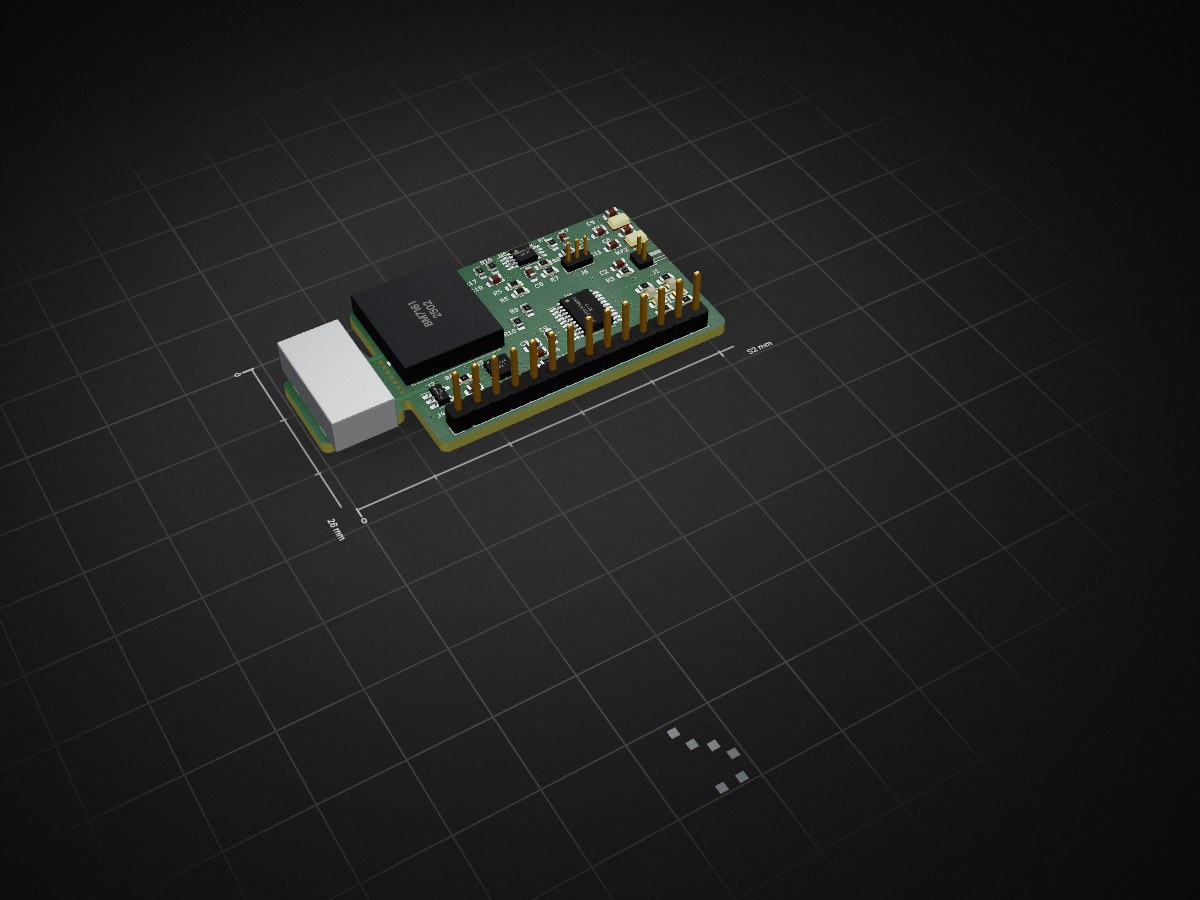
Dml10 is an open-source printed circuit board by jonnor, from the jonnor/embeddedml repository on GitHub. It is a 2-layer board of 52 × 26 mm with 51 parts on 46 nets, routed with 380 tracks and 45 vias.
It is built around the PY32F003F16P6TU, GS8632-MR and LIS3DH, with the LP4054HB5F, LMA2718B381-OA5-2 and LMA2718T421-OA5 among its other parts. Its parts include 17 resistors, 12 capacitors, 5 ICs, 4 diodes and 4 connectors. It belongs with the sensors and measurement boards of this library.
Focused primarily on running inference/prediction/feed-forward part on a microcontroller (or small embedded device).
Training phase can run on a standard computer/server, using existing tools as much as possible.
Background
What and when to use machine learning
The defaults right now are to do conventional signal processing (no learning) in sensor,
and stream raw data to the cloud for storage and processing. Machine learning happens in the cloud.
If gateways are used, they mostly forward communication (no data processing).
On-edge processing valueable when
Local response needed. Autonomy
Adaptable response needed. Over time, in context.
Low/predictable latency needed
Sending raw sensor data has privacy implications.
Audio, video.
Unreliable connection
High bandwidth sensor input.
Audio, video, accelerometer/IMU, current sensor, radiowaves.
Low bandwidth algorithm output
Events of interest are rare
Low energy usage needed
Full/raw sensor data is not valuable to store
Sensor system should be low cost
Example usecases
Predictive maintenance, using audio/vibration data
Activitity detection for people, using audio/accelerometer data. Assistive tech, medical
Appliance disaggregation, using aggregated power consumption data. "Non-Intrusive Load Monitoring" (NILM)
Anomaly/change detection for predictive maintenance, using audio/vibration data, or electrical data
Gesture recognition as human input device, using accelerometer/gyro data.
Speech/command recognition as human input device, using microphone. Keyword/Wake-word detection
Battery saving in wireless sensors. Normally sending day/week aggregates, on event/anomaly detection send data immediately
Health status of animals via activity detected using accelerometer
embedded.com: Bringing machine learning to the edge
Predictions are much lower bandwidth than the raw sensor data (e.g. video)
It allows for local adaptation in the AI logic (L-DNN)
It achieves lower latency between observed event and action resulting from AI logic
"the most important question is what is the least amount accuracy and computation complexity we can do
while still delivering the business value?"
Top mistake: "Continuing with the top down approach ‘let’s make it perform the task first and then squeeze it on device`
instead of switching to bottom up ‘let’s make it run on device and fulfill all hardware constraints first,
and then tune it for the task at hand’."
How to run deep learning model on microcontroller with CMSIS-NN.
Why run deep learning model on a microcontroller?
Sensitive data gets to the cloud, photos, and audio recordings.
The company who sells this may charge a service fee to use its service and even worse sell your private data.
It won't work without the network connection to the server.
Data traveling back and forth between the device and server introduces lag.
Require network and wireless hardware components on the circuit design which increase the cost.
It might waste bandwidth sending useless data.
emlearn. Inference engine for microcontrollers.
Supports converting scikit-learn models to plain C code.
No dynamic allocations. No runtime needed.
TensorFlow Lite for Microcontrollers.
Supports neural network models made with TensorFlow (including Keras).
Can run on wide range of platforms.
Since November 2018. Supports ARM Cortex M, RISC-V, ESP32/Xtensa and Linux/MacOS host.
Requires a runtime, aroud 20 kB.
onnx2c. Allows generating C code from ONNX models.
iree. Compiler. Has bare metal target. Around 30 kB runtime.
executorch.
C++ framework for deploying PyTorch models. Focused on custom backends, NPUs etc. Microcontroller CPU less in focus.
Around 50 kB runtime. Supports bare-metal via "Portable" operations, or specialized for Cortex M.
nnom - Fixed-point neural network compiler for microcontrollers.
Supports wide range of networks. Outputs plain C code. Can use CMSIS-NN on ARM Cortex M.
Embedded Learning Library by Microsoft. Discontinued in 2024
Set of C++ libraries for machine learning on embedded platforms. Includes code for kNN, RandomForest etc.
Also has some node-based dataflow system in place it seems. JavaScript and Python bindings.
uTensor.
Export Tensorflow model to mbed/ARM microcontrollers.
Not supported on ESP32 or RISC-V or similar. Lower activity since 2021.
sklearn-porter.
Can compile DecisionTreeClassifier and SVC models to C.
Uses dynamic memory.
Not optimized for use on embedded devices.
microTVM.
Depends only on the C standard library, and runs bare metal such as STM32 and NRF52 microcontrollers.
Is under development. Which models are supported on microcontrollers not specified.
Low-level libraries
gemmlowp.
Low-precision matrix multiplication. Only general matrix multiplication ("GEMM"). C++11
CMSIS-NN. Neural network operations for ARM Cortex M.
esp-nn. Neural Network functions Espressif ESP32 (Xtensa and RISC-V).
. Can be used bare-metal, but more focused on mobile/server grade (Cortex A+ etc).
Proprietary
X-CUBE-AI for STM32
Historical
nn4mc_cpp.
Neural Networks for Microcontrollers.
Supports Keras natively. Provides instructions for PyTorch et.c via ONNX.
Documentation for using from Python is lacking, as well as the type of networks supported.
Does not seem maintained since 2020.
ONNC project has a backend for ARM Cortex M (using CMSIS-NN)
and a C backend.
Allows to convert an ONNX models to run on devices.
Not updated since 2021.
micromlgen.
Generate C code for microcontrollers from Python's sklearn classifiers.
Archived in 2024.
Models
A range of Machine Learning models are useful in an embedded devices setting.
Classical methods are used when the amount of data is quite small,
and neural networks for large datasets and complex inputs.
Below are notes on the various models in the context of embedded Machine Learning,
including model size and compute-time optimization.
It measures 52 × 26 mm and has 2 copper layers, 1.6 mm thick.
What parts does the Dml10 use?
51 parts, built around the PY32F003F16P6TU, GS8632-MR, LIS3DH and LP4054HB5F. The full list of its parts is on this page, with links to each part's symbol and footprint where PCBKit's library has them.
Where can I download the Dml10 KiCad files?
From the jonnor/embeddedml repository on GitHub, at the commit this page was made from: the board is projects/dollar_tinyml/hardware/dml10/dml10.kicad_pcb and its schematic emlearn/pulsemeter/hardware/ledarray/ledarray.kicad_sch. PCBKit opens the board in the browser, with nothing to install.
Can I use the Dml10 design in my own project?
Its repository states no licence, so its author keeps all rights: ask jonnor before reusing the design.

 jonnor/embeddedml317


