

2 layers82 × 82 mm
Middle
johanwheeler/ch32-fireplace
Ch32 based christmas card with 8x8 screen, sound and capacitive buttons
7 parts33MIT

Ch32 based christmas card with 8x8 screen, sound and capacitive buttons
Back is an open-source printed circuit board by johanwheeler, from the johanwheeler/ch32-fireplace repository on GitHub, published under the MIT licence. It is a 2-layer board of 82 × 82 mm with 150 parts on 88 nets, routed with 604 tracks and 146 vias.
It is built around the CH32V003F4U6. Its parts include 66 capacitors, 64 diodes, 7 resistors, 3 connectors and 1 IC. It belongs with the RISC-V boards of this library.
And a happy new year! Here you will find some instructions for the christmas card, as well as some technical details.
https://github.com/johanwheeler/ch32-fireplace/assets/45564940/a2e65534-c451-412c-9a83-9337bf3cca4e
Longer demo here, Short Hackaday article
If your card has white plastic in front of the screen, remove the front plate and peel the film, then connect to any USB-C power source. The stockings above the fire are actually touch buttons! Press firmly to interact.
Sound: Toggle sound on or off.
Next: Go to next animation.
Present: Call for santa. Remember that santa will only deliver presents at night ;)
For fellow nerds.
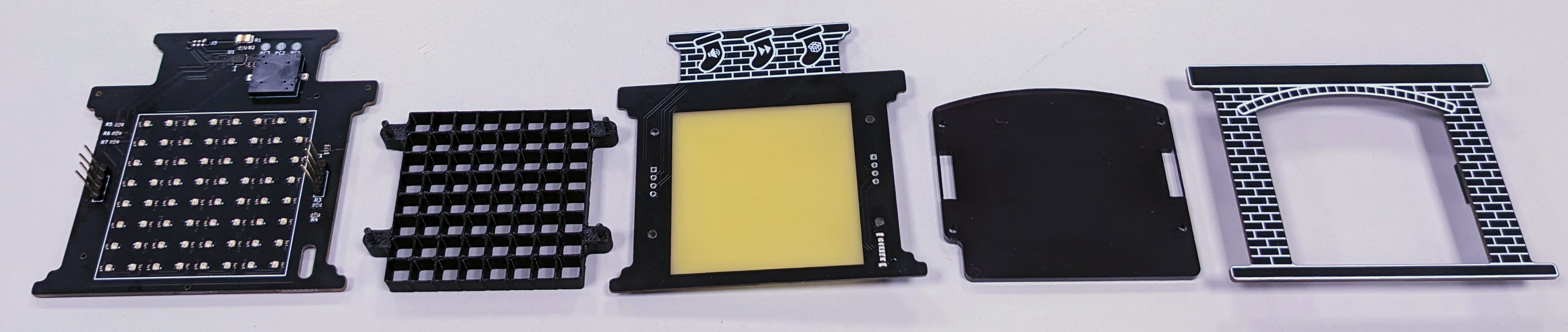
The initial shape was made in Fusion360, together with the grid and acrylic piece. The outlines were then imported into Inkscape, where the graphics were designed. To save ourselves a lot of work during the assembly process, we put an effort into minimizing part count as much as possible. We did this by combining multiple functions into one part, for example the middle PCB serves as decoration, diffuser for the LEDs, and also has buttons integrated. This way we managed to get all the looks and functionality with only 5 major mechanical components, saving us a lot of work when we eventually assembled all 50 of these.
The main electrical components are:
These are distributed on 3 PCBs for a 3D effect, KiCAD was used to design the PCBs:
The project is assembled in several steps that need to be followed in the correct order.
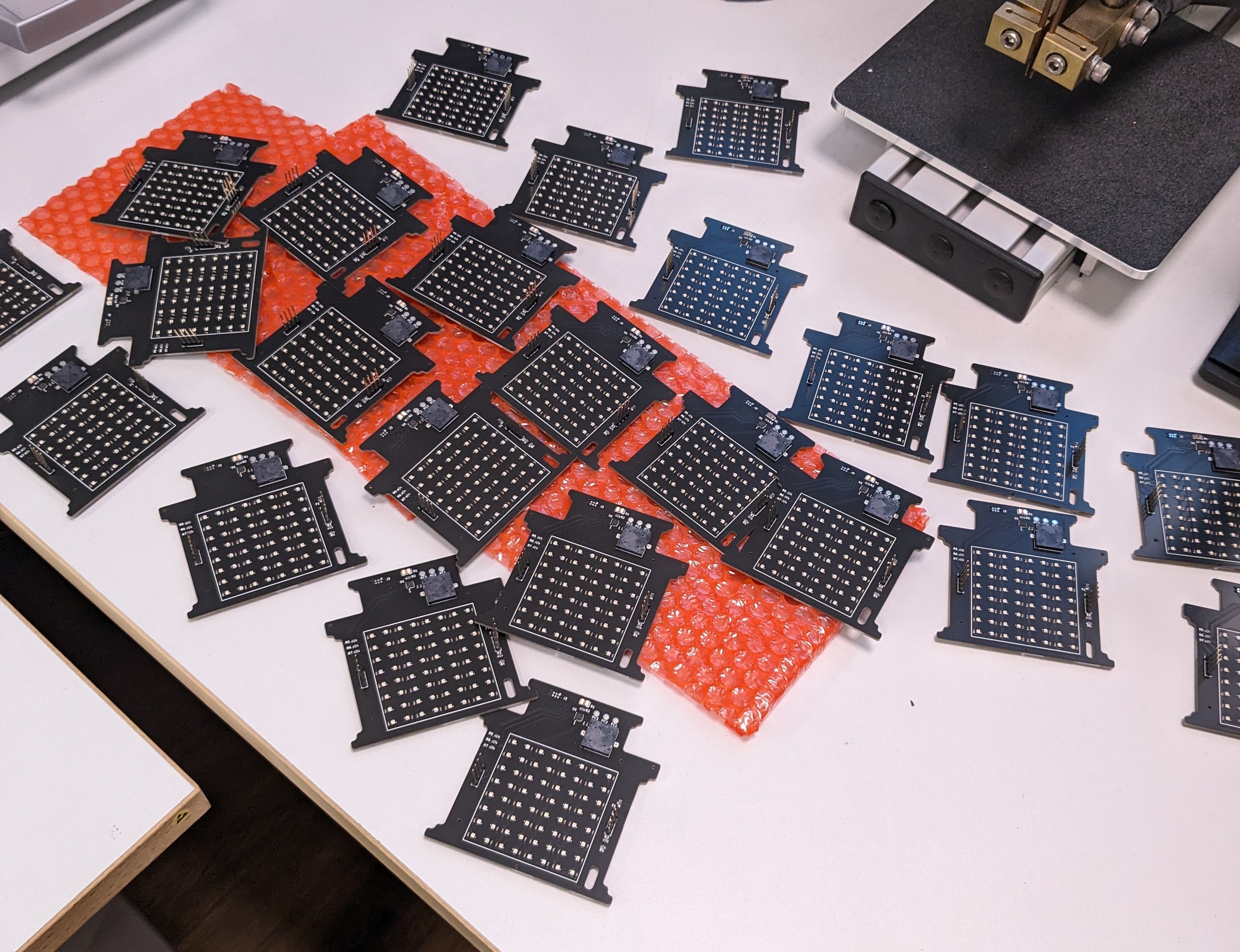
We got all of the back PCB smd components assembled by JLCPCB. We then set up a mini production line over the weekend and made 50 of these to give away to friends and family. The final cost came out to around 6$ per fireplace, manageable even with our student budgets.
All code was written in plain C using the ch32v003fun dev environment and can be compiled using PlatformIO. The main code can be found in src/main.c, and several peripheral drivers and functions can be found in the lib folder. The fire is procedurally generated, and the christmas tree has some math for the fading lights, otherwise the animations are stored frame by frame on the device. We really managed to squeeze a lot of functionality onto the 10 cent chip, with the code, animations and music filling up more than 90 percent of the 16k flash.
This was a really fun project to do, and we learned a lot about small-scale production with limited budget and a tight deadline.
The people who made this:
Additional thanks to:
@CNLohr and contributors for the great resources in ch32v003fun.
CASE (Chalmers Autonomous Sytems and Electronics) for PCB shipping, tools, and workspace.
| Qty | Value | Footprint | References |
|---|---|---|---|
| 66 | 100n | Capacitor_SMD:C_0402_1005Metric | C1, C2, C10, C11, C12, C13, C14, C15, C16, C17, C18, C19, C20, C21, C22, C23 +50 |
| 64 | RGB_1516 | fp:XL-1615_WS2812B | D1, D2, D10, D11, D12, D13, D14, D15, D16, D17, D18, D19, D20, D21, D22, D23 +48 |
| 3 | 560k | Resistor_SMD:R_0603_1608Metric | R5, R6, R7 |
| 3 | Tooling | fp:ToolingHole | H1, H2, H3 |
| 2 | 5.1k | Resistor_SMD:R_0603_1608Metric | R3, R4 |
| 1 | 10k | Resistor_SMD:R_0603_1608Metric | R2 |
| 1 | 750mA | Resistor_SMD:R_0805_2012Metric | F1 |
| 1 | Buzzer | fp:FUET-1325 | BZ1 |
| 1 | CAP_CONN | Connector_PinHeader_2.54mm:PinHeader_1x04_P2.54mm_Vertical | J4 |
| 1 | CH32V003F4U6 | Package_DFN_QFN:QFN-20-1EP_3x3mm_P0.4mm_EP1.65x1.65mm | U1 |
| 1 | LOGO | LOGO | G*** |
| 1 | PC1 | TestPoint:TestPoint_Pad_D2.0mm | TP3 |
| 1 | PC2 | TestPoint:TestPoint_Pad_D2.0mm | TP2 |
| 1 | PC3 | TestPoint:TestPoint_Pad_D2.0mm | TP1 |
| 1 | PWR_CONN | Connector_PinHeader_2.54mm:PinHeader_1x04_P2.54mm_Vertical | J1 |
| 1 | Photoresistor | fp:GT36528 | R1 |
| 1 | TC2030 | Connector:Tag-Connect_TC2030-IDC-NL_2x03_P1.27mm_Vertical | J3 |

openwch/ch32v003
CH32V003 is an ultra-cheap RISC-V MCU with 2KB SRAM, 16KB flash, and up to 18 GPIOs that sells for under $0.10

cnlohr/ch32v003_3digit_lcd_usb
ch32v003 USB Driver for 3-digit 7-segment TN LCDs with touch


Vonger/V7B_WS2812B
allow V7B or MPRO screen driver board control WS2812B by I2C interface + CH32V003


RainbowLabsDE/LightInstallationController
PCB and Firmware of our first universal RGB light installation controller.

badgeteam/hackerhotel-2024-hardware
Conference badge for Hackerhotel 2024
It measures 82 × 82 mm and has 2 copper layers, 1.6 mm thick.
150 parts, built around the CH32V003F4U6. The full list of its parts is on this page, with links to each part's symbol and footprint where PCBKit's library has them.
From the johanwheeler/ch32-fireplace repository on GitHub, at the commit this page was made from: the board is PCBs/Back/Back.kicad_pcb and its schematic PCBs/Back/Back.kicad_sch. PCBKit opens the board in the browser, with nothing to install.
Its repository publishes it under the MIT licence: you may reuse it on that licence's terms (keep the author's notice, and for a copyleft licence share your changes alike).
