4 layers99.1 × 88.9 mm

 JoachimBose/nabby-linux
An Allwinner F1C100s / F1C200s buildroot external tree for (among others) the hardware challenge for VUCTF-2026
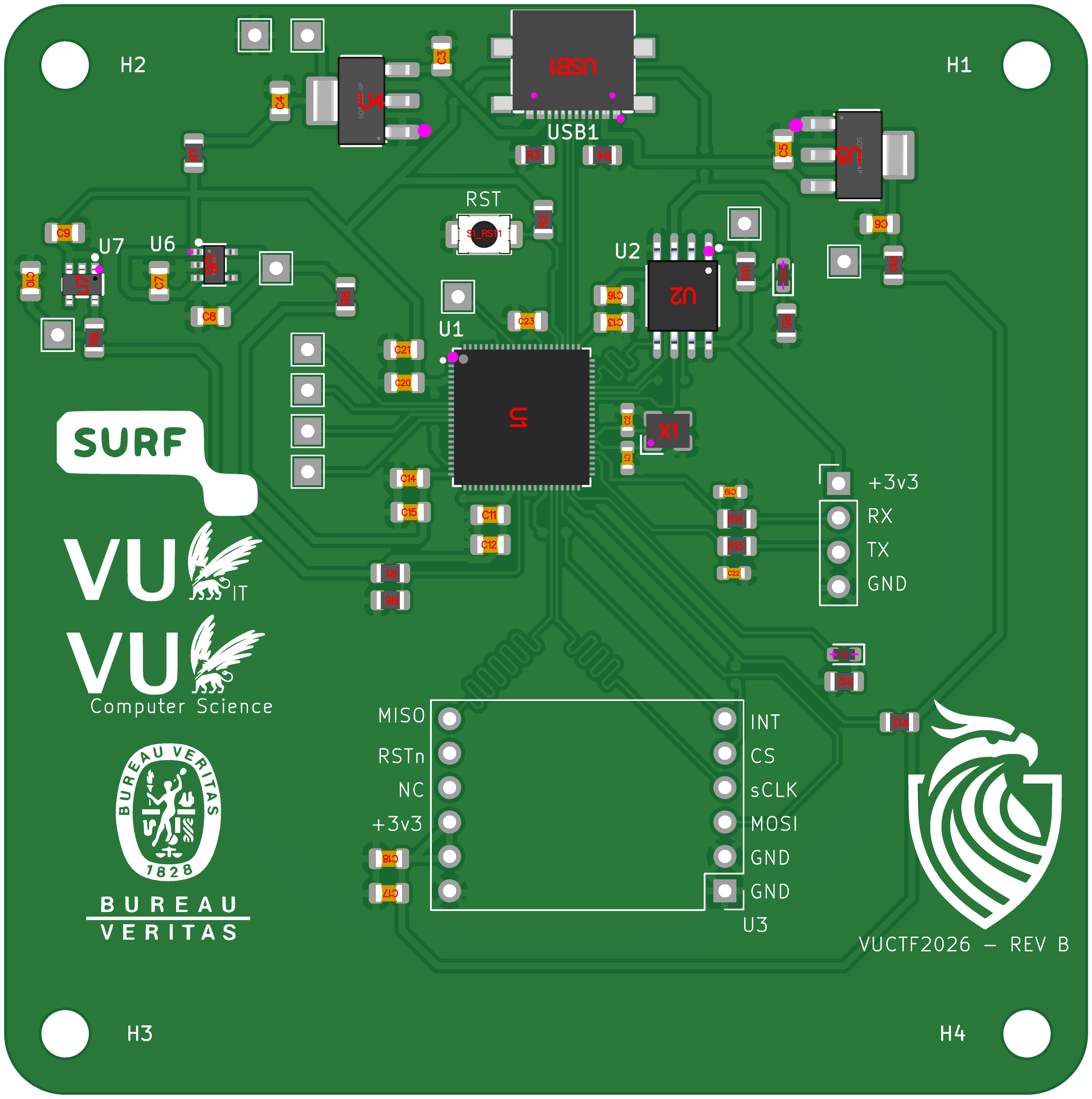
F1c200s proj is an open-source printed circuit board by JoachimBose, from the JoachimBose/nabby-linux repository on GitHub, published under the GPL-2.0 licence. It is a 2-layer board of 80 × 80.5 mm with 68 parts on 98 nets, routed with 582 tracks and 55 vias.
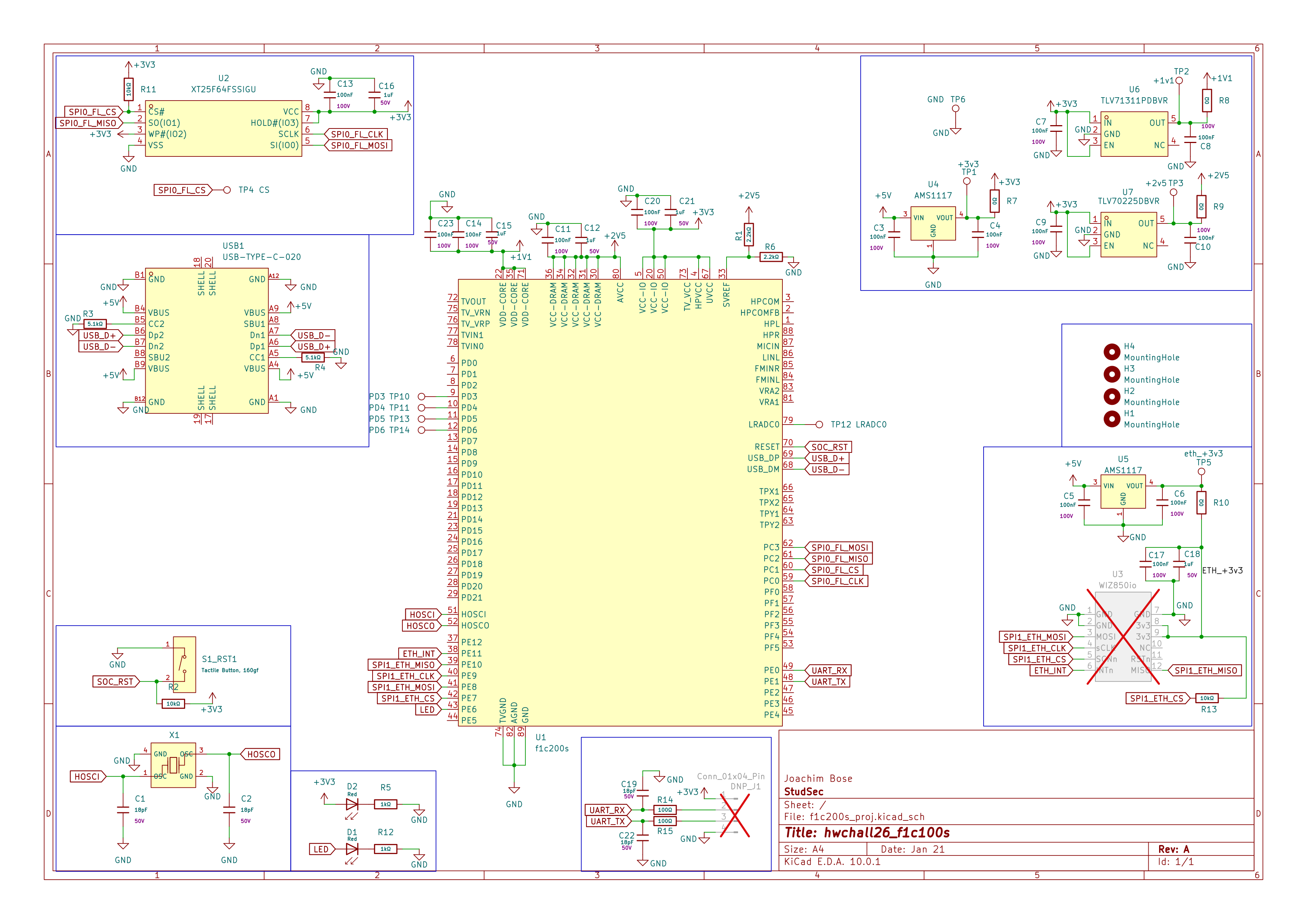
It is built around the F1C200S, WIZ850IO and AMS1117, with the TLV70225DBVR(MS), USB-TYPE-C-020 and X322524MOB4SI among its other parts. Its parts include 23 capacitors, 15 resistors, 7 ICs, 2 diodes and 1 switch.


This contains the buildroot, uboot & linux configurations for a hobby project. To get started, clone a new buildroot repository outside this one. Then, from within the buildroot repository, execute:
BR2_EXTERNAL=../nabby-linux make nabby-linux_defconfigThis will import all the files from this repository. If you are new to buildroot, consider taking a look around this repository to see what you just imported.
after you compiled your buildroot, you should get a flash.bin image as described in the genimage.cfg. To flash it, put the chip in FEL-mode.
This is done by shorting chipselect of the spiflash to 3.3 volts and powering on the device, after powerup remove the short. Now you can use:
sunxi-fel -p spiflash-write 0 flash.binto flash the board while its in FEL mode.
The VUCTF26 board has support for the w5500 dev boards like the w850io or the cheaper USR-ES1. There exist also the Spookystats vulnerable website and the portalctl privilege escalation challenge which can be compiled as a buildroot package. Any questions are welcome towards joa0405 on discord!
When we built the nabby board, we forked the repository from: BasicCode and we are very thankful for their contribution & GPL-2.0 license. In BasicCodes repository, they acknowledged help from the following authors:
This project is based heavily on the work of others; I would like to acknowledge these project in particular:
| Qty | Value | Footprint | References |
|---|---|---|---|
| 14 | 100nF | PCM_JLCPCB:C_0805 | C3, C4, C5, C6, C7, C8, C9, C10, C11, C13, C14, C17, C20, C23 |
| 5 | 1uF | PCM_JLCPCB:C_0805 | C12, C15, C16, C18, C21 |
| 4 | 0Ω | PCM_JLCPCB:R_0805 | R7, R8, R9, R10 |
| 4 | 18pF | PCM_JLCPCB:C_0603 | C1, C2, C19, C22 |
| 4 | MountingHole | MountingHole:MountingHole_3.5mm | H1, H2, H3, H4 |
| 3 | 10kΩ | PCM_JLCPCB:R_0805 | R2, R11, R13 |
| 2 | 100Ω | PCM_JLCPCB:R_0805 | R14, R15 |
| 2 | 1kΩ | PCM_JLCPCB:R_0805 | R5, R12 |
| 2 | 2.2kΩ | PCM_JLCPCB:R_0805 | R1, R6 |
| 2 | 5.1kΩ | PCM_JLCPCB:R_0805 | R3, R4 |
| 2 | AMS1117 | PCM_JLCPCB:SOT-223-3_L6.5-W3.4-P2.30-LS7.0-BR | U4, U5 |
| 2 | Red | PCM_JLCPCB:D_0603 | D1, D2 |
| 1 | +1v1 | TestPoint:TestPoint_THTPad_2.0x2.0mm_Drill1.0mm | TP2 |
| 1 | +2v5 | TestPoint:TestPoint_THTPad_2.0x2.0mm_Drill1.0mm | TP3 |
| 1 | +3v3 | TestPoint:TestPoint_THTPad_2.0x2.0mm_Drill1.0mm | TP1 |
| 1 | CS | TestPoint:TestPoint_THTPad_2.0x2.0mm_Drill1.0mm | TP4 |
| 1 | Conn_01x04_Pin | Connector_PinHeader_2.54mm:PinHeader_1x04_P2.54mm_Vertical | DNP_J1 |
| 1 | GND | TestPoint:TestPoint_THTPad_2.0x2.0mm_Drill1.0mm | TP6 |
| 1 | LOGO | Logos:studsec | G*** |
| 1 | LOGO | Logos:Radboud_inst_pwning | G*** |
| 1 | LRADC0 | TestPoint:TestPoint_THTPad_2.0x2.0mm_Drill1.0mm | TP12 |
| 1 | PD3 | TestPoint:TestPoint_THTPad_2.0x2.0mm_Drill1.0mm | TP10 |
| 1 | PD4 | TestPoint:TestPoint_THTPad_2.0x2.0mm_Drill1.0mm | TP11 |
| 1 | PD5 | TestPoint:TestPoint_THTPad_2.0x2.0mm_Drill1.0mm | TP13 |
| 1 | PD6 | TestPoint:TestPoint_THTPad_2.0x2.0mm_Drill1.0mm | TP14 |
| 1 | TLV70225DBVR | allwinners:TI-LDO-2v5 | U7 |
| 1 | TLV71311PDBVR | allwinners:TI-LDO-1v1 | U6 |
| 1 | Tactile Button, 160gf | PCM_JLCPCB:SW_TS-1088-AR02016 | S1_RST1 |
| 1 | USB-TYPE-C-020 | allwinners:USB-SMD_USB-TYPE-C-020 | USB1 |
| 1 | WIZ850io | allwinners:wiz850io-footprint | U3 |
| 1 | X322524MOB4SI | PCM_JLCPCB:OSC-SMD_4P-L3.2-W2.5-BL | X1 |
| 1 | eth_+3v3 | TestPoint:TestPoint_THTPad_2.0x2.0mm_Drill1.0mm | TP5 |
| 1 | f1c200s | allwinners:QFN-88_L10.0-W10.0-P0.40-BL-EP6.75_f1c200s | U1 |
| 1 | ~ | allwinners:FLASH-8pin | U2 |
It measures 80 × 80.5 mm and has 2 copper layers, 1.6 mm thick.
68 parts, built around the F1C200S, WIZ850IO, AMS1117 and TLV70225DBVR(MS). The full list of its parts is on this page, with links to each part's symbol and footprint where PCBKit's library has them.
From the JoachimBose/nabby-linux repository on GitHub, at the commit this page was made from: the board is board/vuctf-revA/kicad_files/f1c200s_proj/f1c200s_proj.kicad_pcb and its schematic board/vuctf-revA/kicad_files/f1c200s_proj/f1c200s_proj.kicad_sch. PCBKit opens the board in the browser, with nothing to install.
Its repository publishes it under the GPL-2.0 licence: you may reuse it on that licence's terms (keep the author's notice, and for a copyleft licence share your changes alike).

befinitiv/minidisc_cad
This repository contains the CAD files (PCB & mechanics) for the 8cm "minidisc" player project.


MillerTechnologyPeru/boysenboard
Linux capable single board computer using the F1C200s in an Arduino form-factor.

victorhook/F1C200S-Dev-board
Custom PCB with the Allwinner F1C200S SoC, built to learn more about embedded Linux!


clarkmcc/my-first-linux-board
my-first-linux-board is a small F1C200S Linux board built around removable microSD storage, USB-C power and USB device data, a 3.3 V UART console, and power/status LEDs.

JubilantMarmot/pcc5
This is my first PCB project. It took me around 20 hours. It is a small Linux computer that is the size of a business card. Based off of Allwinner F1C200s.