
2 layers33.7 × 97.8 mm
HAN ESP TSS721
UtilitechAS/amsreader-firmware
ESP8266 and ESP32 compatible firmware to read, interpret and publish data to MQTT from smart electrical meters, both DLMS and DSMR is supported
29 parts470
 jguillaumes/MeteoArduino1
An arduino-based weather station with BT reporting
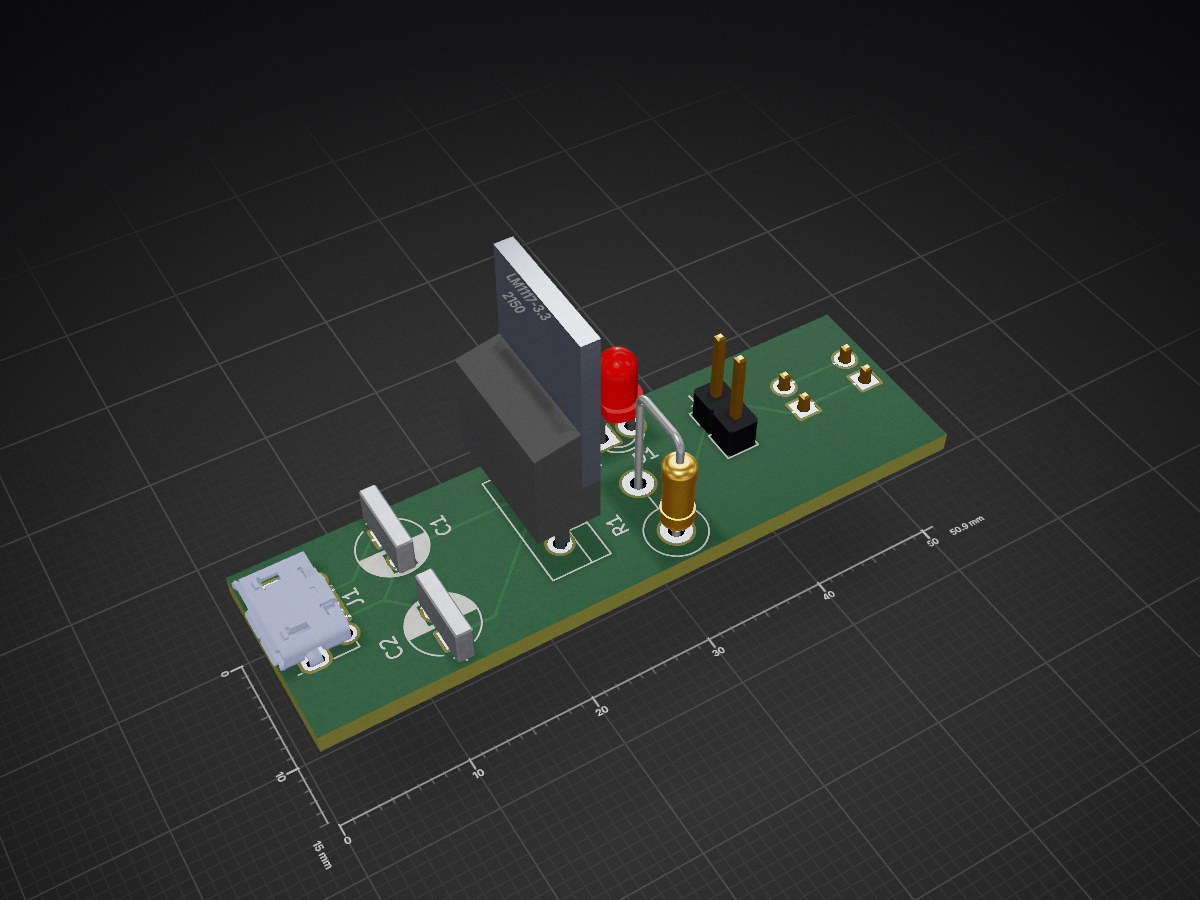
Power33 is an open-source printed circuit board by jguillaumes, from the jguillaumes/MeteoArduino repository on GitHub. It is a 2-layer board with 9 parts on 8 nets, routed with 54 tracks and 0 vias.
It is built around the LM1117-3.3. Its parts include 4 connectors, 2 capacitors, 1 resistor, 1 IC and 1 diode.
This project consists on building a basic meteorological monitoring and registering station using an Arduino and a few sensors.
It measures the basic weather parameters:
The data is logged into a microSD card and sent to a nearby receiver using a bluetooth link. The "station" has no user interface, apart from a RESET and a TEST button.
The device will use an HC-06 based Serial-to-Bluetooth transceiver to send the data it gets to a nearby computer which will do the graphing and reporting.
Initial plans called to use a local microSD to store the data in case it could not be transmitted. This is being re-evaluated. The first version will not store any data locally.
The device will use a nano-Arduino clone as microcontroller. The possibility of using a raw MCU will be considered.
Due to the author soldering (dis)abilities, the different sensors will be bought in ready-to-use format. There are plenty of sources available for that, and they are very cheap.
The initial design called for a BMP-280 based barometric sensor. Unfortunately that piece of hardware does not tolerate the 5V level of the Arduino board. A bi-directional level converted capable of supporting I2C must be used, and I had no one available. So I switched to the less precise (but good enough) BMP-180, in a breakout form which includes resistors to make it able to stand a 5V signal level. The specific piece is this: https://www.amazon.es/gp/product/B00M1PMSF2/ref=oh_aui_detailpage_o00_s00?ie=UTF8&psc=1
The second version of this project will use a stand-alone ATMega328P running at 8MHz in an all 3.3V circuit so the use of the BMP-280 will be reconsidered.
The BMP-180 branch of this project contains the software adapted for the BMP-180. The master branch uses the BMP-280.
| Qty | Value | Footprint | References |
|---|---|---|---|
| 3 | Conn_01x02_Male | Pin_Headers:Pin_Header_Straight_1x02_Pitch2.54mm | J2, J3, J4 |
| 1 | 10uF | Capacitors_THT:CP_Radial_D5.0mm_P2.50mm | C2 |
| 1 | 10uf | Capacitors_THT:CP_Radial_D5.0mm_P2.50mm | C1 |
| 1 | 470 | Resistors_THT:R_Axial_DIN0414_L11.9mm_D4.5mm_P5.08mm_Vertical | R1 |
| 1 | LED | LEDs:LED-3MM | D1 |
| 1 | LM1117-3.3 | TO_SOT_Packages_THT:TO-220_Vertical | U1 |
| 1 | USB_OTG | Connectors_USB:USB_Micro-B_Molex-105017-0001 | J1 |
UtilitechAS/amsreader-firmware
ESP8266 and ESP32 compatible firmware to read, interpret and publish data to MQTT from smart electrical meters, both DLMS and DSMR is supported

karawin/Ka-Radio
A wifi webradio with only low cost boards ESP8266 and VS1053 by Jp Cocatrix


doudar/SmartSpin2k
Transform your spin bike into a Smart Trainer!

plinkysynth/plinky_public
a public release of the plinky sw and hw

eddyem/stm32samples
Code samples and ready projects based on bare-metal STM32


9 parts, built around the LM1117-3.3. The full list of its parts is on this page, with links to each part's symbol and footprint where PCBKit's library has them.
From the jguillaumes/MeteoArduino repository on GitHub, at the commit this page was made from: the board is electronics/Power33/Power33.kicad_pcb. PCBKit opens the board in the browser, with nothing to install.
Its repository states no licence, so its author keeps all rights: ask jguillaumes before reusing the design.