2 layers71.4 × 47 mm
Svp eeprom board
jdesiloniz/svpdev
A collection of development tools targetting SEGA's SVP chip found in the Mega Drive/Genesis version of Virtua Racing.
6 parts97MIT

 jdesiloniz/svpdev97
A collection of development tools targetting SEGA's SVP chip found in the Mega Drive/Genesis version of Virtua Racing.
Rom access board is an open-source printed circuit board by jdesiloniz, from the jdesiloniz/svpdev repository on GitHub, published under the MIT licence. It is a 2-layer board of 50.8 × 61 mm with 3 parts on 44 nets, routed with 115 tracks and 0 vias.
Its parts include 2 connectors and 1 IC. It belongs with the retro computing and games boards of this library.
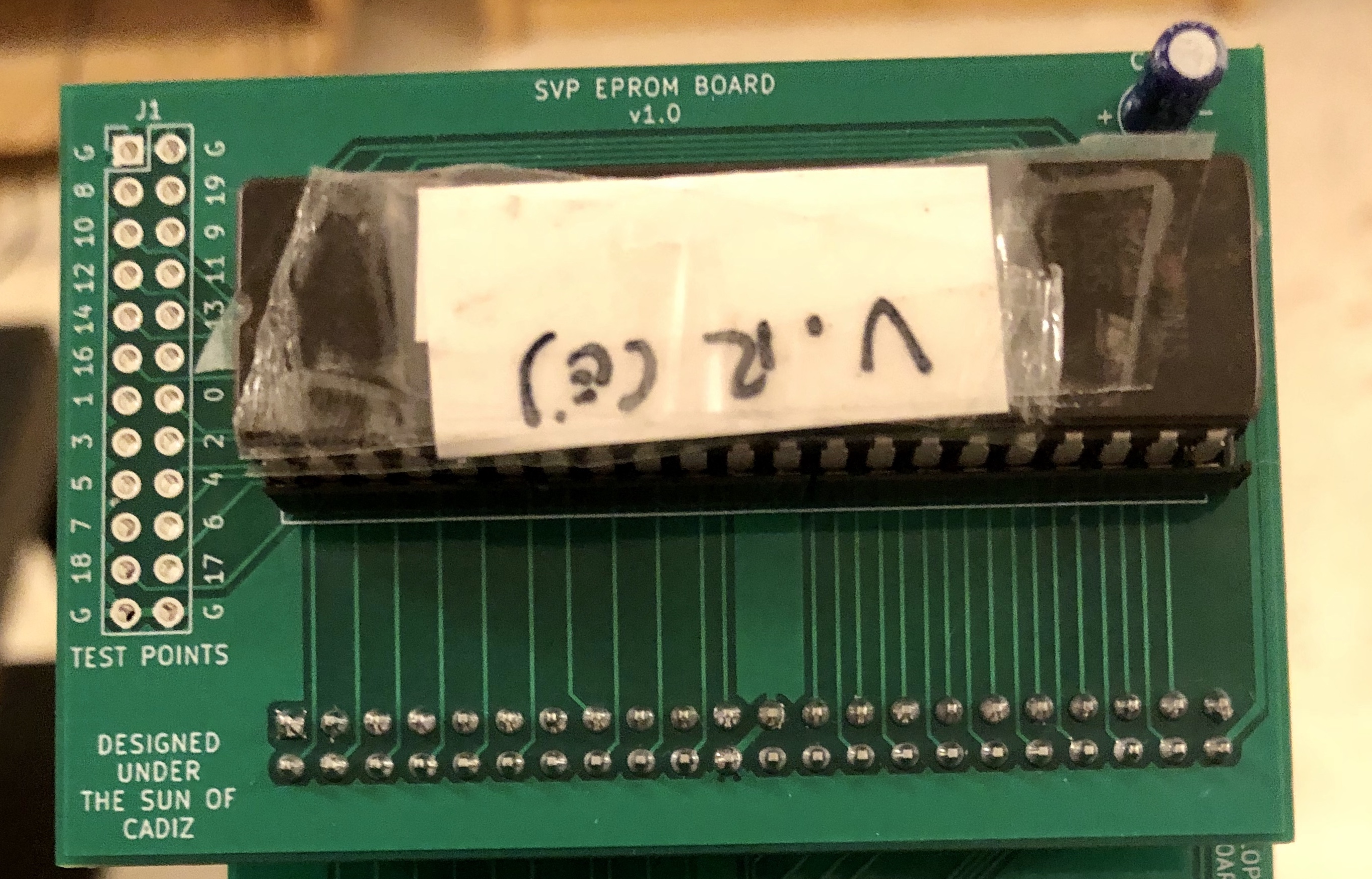
This board attaches to the SVP adapter board and allows feeding code to the SVP from a 27C160 EPROM (or probably from any pin-compatible EEPROM like the MX29F1615PC-10 by Macronix - not tested).
Designed with KiCAD 5.1.
Even though the board is just rewiring the original ROM pins in the cartridge to the pinout of the EPROM, I added the following passive devices for good measure:
I guess the bypass capacitors could be optional but the resistor is required. Anyway these are chip and not that hard to solder so please use them :).
Regarding the DIP42 socket, if you can't find these in your area just using a couple of smaller sockets (i.e.: two DIP24 sockets and cutting the extra pins from one of them) should do the trick.
There's also connectors for test pins. You probably don't need to do anything with these, but I plan to use them to measure access speeds from the SVP with my oscilloscope. But the EPROM will work just fine without them in the board.
From what can be seen in Virtua Racing prototype boards, the SVP was meant to be used with ROMs with an access speed of 120ns or faster. The EPROMs that I used with these (27C160-100) have an access time of 100ns and they ran Virtua Racing without issues.
Any PCB manufacturer for hobbyists should be able to build this board.
There's not much to this board really. Just be careful with the bigger bypass capacitor polarity, and placing the EPROM in the right position.
The designs for these boards is open source and MIT-licensed. Also take into account the following conditions of use:
taiyou[at]gmail.com.You'll find that most of my boards here have this text somewhere in their layout. I was born in Cádiz, the southernmost city in Spain (and the oldest city in Western Europe). It's not a city that's usually associated to technology or these kind of projects so for me it's really important that cool things some of us do here related to tech are considered as part of the legacy of this town too. These designs are open source so you're free to modify them at your will, but I'd ask you kindly not to remove this label if you will. Please help us to spread the name of our wonderful city all around the tech world!
| Qty | Value | Footprint | References |
|---|---|---|---|
| 2 | Conn_01x22_Male | Connector_PinHeader_2.54mm:PinHeader_1x22_P2.54mm_Vertical | J1, J2 |
| 1 | MR-16420-T-RevIng | vr_rom_footprint:VR_ROM_EU_44pin | U1 |
It measures 50.8 × 61 mm and has 2 copper layers, 1.6 mm thick.
3 parts. The full list of its parts is on this page, with links to each part's symbol and footprint where PCBKit's library has them.
From the jdesiloniz/svpdev repository on GitHub, at the commit this page was made from: the board is boards/rom-access-board/rom-access-board.kicad_pcb. PCBKit opens the board in the browser, with nothing to install.
Its repository publishes it under the MIT licence: you may reuse it on that licence's terms (keep the author's notice, and for a copyleft licence share your changes alike).
jdesiloniz/svpdev
A collection of development tools targetting SEGA's SVP chip found in the Mega Drive/Genesis version of Virtua Racing.

jdesiloniz/svpdev
A collection of development tools targetting SEGA's SVP chip found in the Mega Drive/Genesis version of Virtua Racing.


hzeller/rpi-rgb-led-matrix
Controlling up to three chains of 64x64, 32x32, 16x32 or similar RGB LED displays using Raspberry Pi GPIO


atopile/atopile
Design circuit boards with code! ✨ Get software-like design reuse 🚀, validation, version control and collaboration in hardware; starting with electronics ⚡️


hackclub/sprig
🍃 Learn to code by making games in a JavaScript web-based game editor.