
2 layers18.5 × 11.1 mm
Switch
byrantech/laptop
anyon_e, a highly integrated, high end, open source laptop. Attempt the impossible.
6 parts4.3kMIT
 Jcparkyn/dpoint1.1k
Open-source digital stylus using camera tracking and inertial measurements
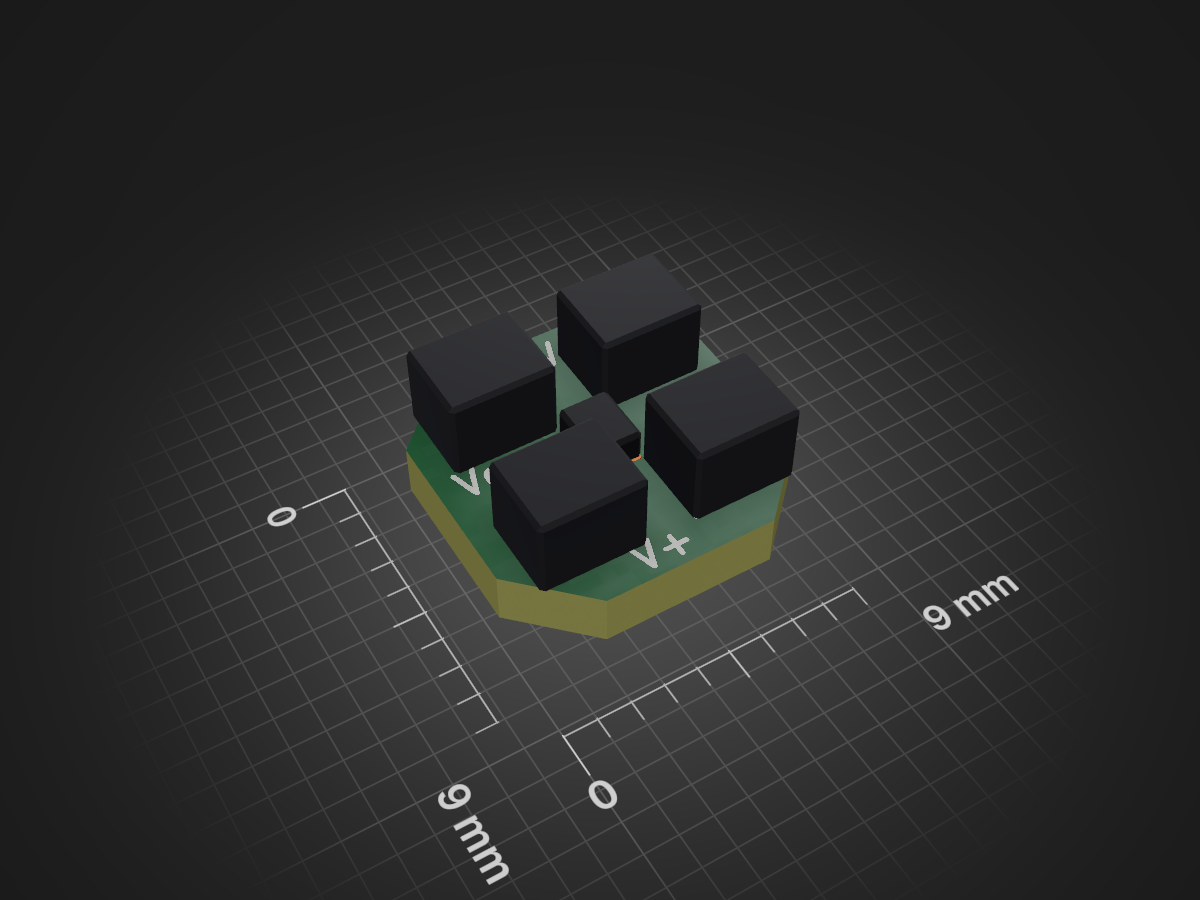
Dpoint is an open-source printed circuit board by Jcparkyn, from the Jcparkyn/dpoint repository on GitHub, published under the MIT licence. It is a 2-layer board of 9 × 9 mm with 6 parts on 4 nets, routed with 14 tracks and 0 vias.
It is built around the HSFPAR003A. Its parts include 4 connectors, 1 capacitor and 1 IC.
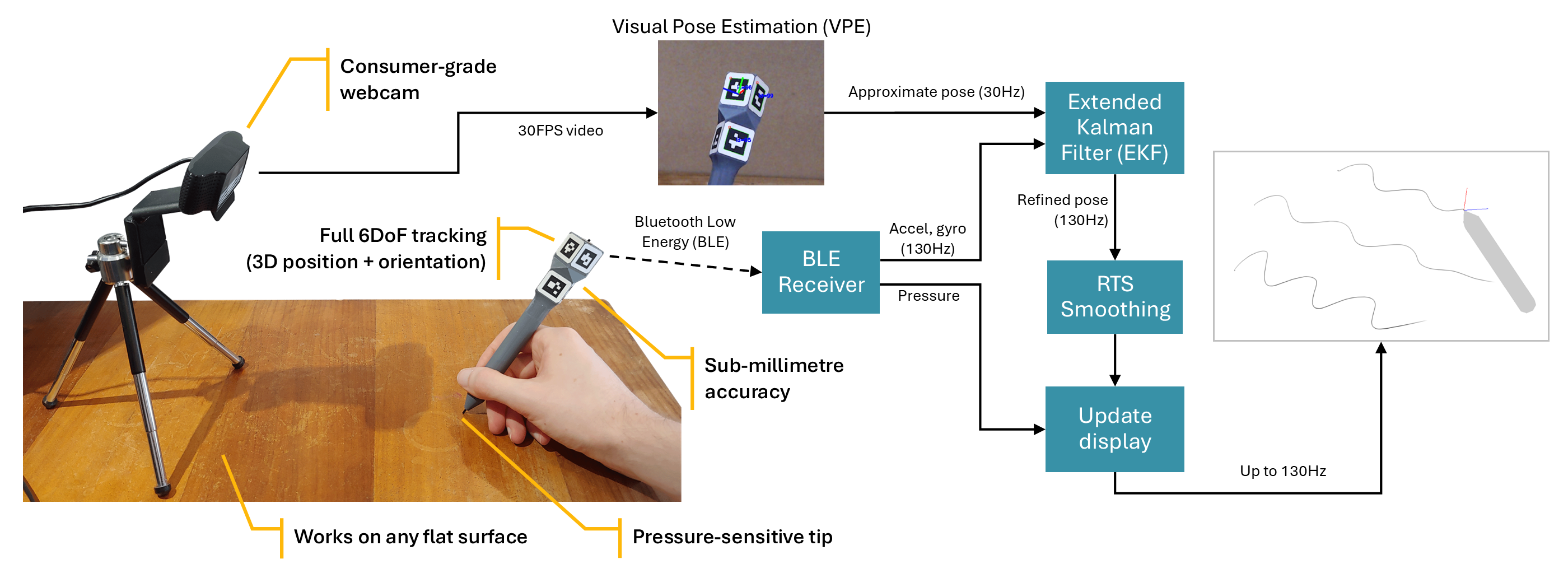
D-POINT is an open-source digital stylus that uses camera tracking and inertial measurements to achieve 6DoF (six degrees of freedom) inputs, with low latency, pressure sensitivity, and sub-millimetre accuracy. The stylus can be used on any flat surface, and works with consumer-grade webcams.
This project was part of my undergraduate thesis for electrical engineering. I've open-sourced the code and design files in the hopes that they might be useful to somebody, but it's not intended to be a "plug and play" DIY project. If you want to try building it anyway, follow the setup guide.
This is a very brief overview of how the system works. For all the details, plus literature review and lots of evaluation, read the full thesis (note: I haven't published this online yet).
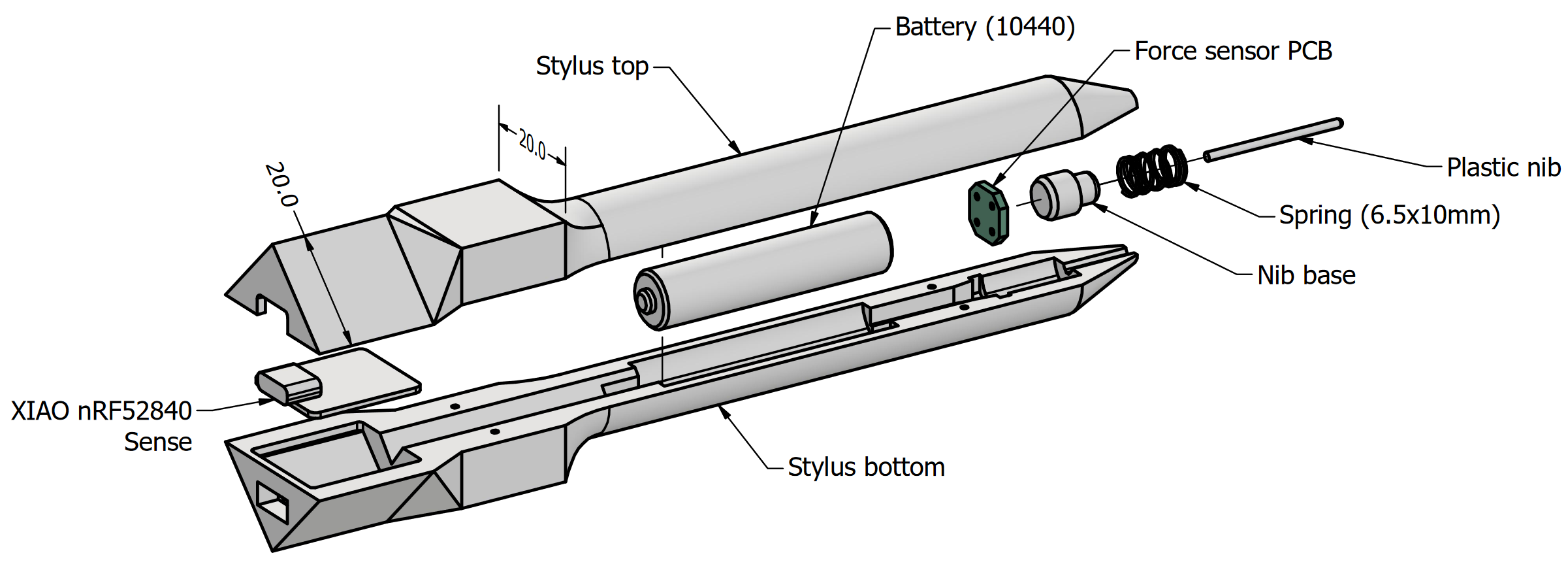
The main body of the stylus was 3D printed as two halves, shown below. The stylus contains a force sensor, a Li-ion battery which charges over USB-C, and an Arduino-based development board for logic and Bluetooth. Eight printed ArUco markers are glued to the back of the stylus, for visual pose estimation.
The VPE process involves the four main steps:
We use an Extended Kalman Filter (EKF) to fuse the VPE estimates with the inertial data from the accelerometer and gyroscope, and refine the estimates in real-time using the Rauch-Tung-Striebel (RTS) algorithm. To account for time delay from the camera frames, we use a negative-time measurement update algorithm. The EKF is implemented using NumPy and Numba.
Using inertial measurements allows us to dramatically reduce latency compared to a camera-only implementation, while also improving accuracy and report rate for fast movements.
| Qty | Value | Footprint | References |
|---|---|---|---|
| 4 | Conn_01x01_Socket | Connector_Wire:SolderWire-0.5sqmm_1x01_D0.9mm_OD2.1mm | J1, J2, J3, J4 |
| 1 | 0.1u | Capacitor_SMD:C_0805_2012Metric_Pad1.18x1.45mm_HandSolder | C1 |
| 1 | HSFPAR003A | Footprints:Alps_HSFPAR003A | U1 |
It measures 9 × 9 mm and has 2 copper layers, 1.6 mm thick.
6 parts, built around the HSFPAR003A. The full list of its parts is on this page, with links to each part's symbol and footprint where PCBKit's library has them.
From the Jcparkyn/dpoint repository on GitHub, at the commit this page was made from: the board is electronics/dpoint.kicad_pcb and its schematic electronics/dpoint.kicad_sch. PCBKit opens the board in the browser, with nothing to install.
Its repository publishes it under the MIT licence: you may reuse it on that licence's terms (keep the author's notice, and for a copyleft licence share your changes alike).
byrantech/laptop
anyon_e, a highly integrated, high end, open source laptop. Attempt the impossible.


VoronDesign/Voron-Hardware
Cool Hardware designed by the Voron Design group

hoglet67/RGBtoHDMI
Bare-metal Raspberry Pi project that provides pixel-perfect sampling of Retro Computer RGB/YUV video and conversion to HDMI

hackclub/OnBoard
💡 Join 1,000 teenagers and make your first PCB with a $100 grant!

Luos-io/luos_engine
Open-source and real-time orchestrator for cyber-physical-systems, to easily design, test and deploy embedded applications and digital twins.


NVNTLabs/switch2-SDEX2M2
Micro SD Express to M.2 NVME Adapter for Nintendo Switch 2