4 layers85 × 55 mm
Device
jayis1/hacker-devices
Full-cycle hardware designs for security research devices — each device is a subfolder with its own README, schematics, PCB layout, and software stack
29 parts2

 jayis1/hacker-devices2
Full-cycle hardware designs for security research devices — each device is a subfolder with its own README, schematics, PCB layout, and software stack
Device is an open-source printed circuit board by jayis1, from the jayis1/hacker-devices repository on GitHub. It is a 4-layer board of 18 × 12 mm with 12 parts on 64 nets.
It is built around the STM32H743VIT6, BT840F and IS42S16160G-5BL, with the TLV75533DRV among its other parts. Its parts include 4 ICs, 3 connectors, 2 capacitors, 2 diodes and 1 crystal. It belongs with the STM32 boards of this library.


A collection of fully open-source hardware designs for legitimate security research and pentesting. Every device is complete end-to-end: engineering docs, KiCad schematics & PCB layouts, production C/Python firmware, and React Native companion apps. Build it, flash it, run the app, start researching.
No half-finished reference designs. Each device folder contains the full stack:
| Category | Files | Description |
|---|---|---|
| Engineering Docs | phase1_conceptual_architecture.md → phase4_software_stack.md | 4-phase design process: requirements, BOM & netlists, PCB layout rules, software stack |
| KiCad Schematics | kicad/*.kicad_pro, *.kicad_sch, *.kicad_pcb | Full schematic with real component symbols, net labels, power flags, and board outline with placed footprints |
| C/Python Firmware | firmware/main.c, registers.h, board.h, drivers/, Makefile | Production-quality MCU firmware — init code, drivers with DMA, USB descriptors, wire protocol |
| React Native App | app/App.js, screens/, components/, utils/protocol.js, package.json | Companion mobile app for device control, configuration, real-time status, and data capture |
Every device follows a rigorous 4-phase process:
| Phase | Document | Contents |
|---|---|---|
| Phase 1 | phase1_conceptual_architecture.md | Purpose, performance targets, constraints, block diagram, bus topology, power domains |
| Phase 2 | phase2_component_selection_schematics.md | BOM with real part numbers, pinouts/MUX tables, decoupling networks, netlists, impedance matching |
| Phase 3 | phase3_pcb_blueprints_layout.md | PCB stackup, routing rules, length matching, via strategy, thermal management, DFM notes |
| Phase 4 | phase4_software_stack.md | MMIO/register defs, clock & GPIO init (production C), critical device driver, device tree, bootloader |
| # | Device | Status | Description |
|---|---|---|---|
| 1 | wifi-pentest-dongle/ | ✅ Complete | 802.11ax monitor/inject, deauth, PMKID capture |
| 2 | rf-transceiver-tool/ | ✅ Complete | Sub-GHz + 2.4GHz multi-protocol (CC1101 + nRF24) |
| 3 | badusb-injector | ⏳ Queued | HID emulation payload injector, multi-profile |
| 4 | nfc-rfid-cloner | ⏳ Queued | 13.56MHz + 125kHz, Mifare/EM4100 |
| 5 | network-tap-mitm | ⏳ Queued | 2× GbE transparent bridge, packet capture |
| 6 | can-bus-analyzer | ⏳ Queued | OBD-II + CAN-FD, automotive pentest |
| 7 | sdr-keyfob-replay | ⏳ Queued | 433/315MHz keyfob capture & replay |
| 8 | ble-sniffer-spoofer | ⏳ Queued | nRF52, advertisement inject, GATT fuzz |
| 9 | imsi-catcher-detector | ⏳ Queued | LTE/4G SDR analysis |
| 10 | biometric-bypass-toolkit | ⏳ Queued | Fingerprint emulation, RFID clone for access control |
| Component | License |
|---|---|
| Hardware design (KiCad) | CERN-OHL-S v2 |
| C firmware & drivers | GPL-2.0 |
| Python tools & scripts | MIT |
| React Native companion apps | MIT |
| Qty | Value | Footprint | References |
|---|---|---|---|
| 1 | 100nF | Capacitor_SMD:C_0402_1005Metric | C1 |
| 1 | 10uF | Capacitor_SMD:C_0603_1608Metric | C2 |
| 1 | 25 MHz | Crystal:Crystal_SMD_3225-4Pin_3.2x2.5mm | Y1 |
| 1 | BT840F | RF_Module:Fanstel_BT840F | U2 |
| 1 | Blue | LED_SMD:LED_0402_1005Metric | D2 |
| 1 | Host I²S | Connector_FFC-FPC:Hirose_FH12-6S-0.5SH_1x06-1MP_P0.50mm_Horizontal | J2 |
| 1 | IS42S16160G | Package_SO:TSOP-II-54_10.16x22.22mm_P0.8mm | U3 |
| 1 | Red | LED_SMD:LED_0402_1005Metric | D1 |
| 1 | STM32H743VIT6 | Package_QFP:LQFP-100_14x14mm_P0.5mm | U1 |
| 1 | TLV75533 | Package_TO_SOT_SMD:SOT-23-5 | U4 |
| 1 | Target I²S | Connector_FFC-FPC:Hirose_FH12-6S-0.5SH_1x06-1MP_P0.50mm_Horizontal | J1 |
| 1 | USB-C | Connector_USB:USB_C_Receptacle_GCT_USB4105 | J3 |
jayis1/hacker-devices
Full-cycle hardware designs for security research devices — each device is a subfolder with its own README, schematics, PCB layout, and software stack

jayis1/hacker-devices
Full-cycle hardware designs for security research devices — each device is a subfolder with its own README, schematics, PCB layout, and software stack

jayis1/hacker-devices
Full-cycle hardware designs for security research devices — each device is a subfolder with its own README, schematics, PCB layout, and software stack

jayis1/hacker-devices
Full-cycle hardware designs for security research devices — each device is a subfolder with its own README, schematics, PCB layout, and software stack

jayis1/hacker-devices
Full-cycle hardware designs for security research devices — each device is a subfolder with its own README, schematics, PCB layout, and software stack

jayis1/hacker-devices
Full-cycle hardware designs for security research devices — each device is a subfolder with its own README, schematics, PCB layout, and software stack

jayis1/hacker-devices
Full-cycle hardware designs for security research devices — each device is a subfolder with its own README, schematics, PCB layout, and software stack

jayis1/hacker-devices
Full-cycle hardware designs for security research devices — each device is a subfolder with its own README, schematics, PCB layout, and software stack

jayis1/hacker-devices
Full-cycle hardware designs for security research devices — each device is a subfolder with its own README, schematics, PCB layout, and software stack

jayis1/hacker-devices
Full-cycle hardware designs for security research devices — each device is a subfolder with its own README, schematics, PCB layout, and software stack

jayis1/hacker-devices
Full-cycle hardware designs for security research devices — each device is a subfolder with its own README, schematics, PCB layout, and software stack

jayis1/hacker-devices
Full-cycle hardware designs for security research devices — each device is a subfolder with its own README, schematics, PCB layout, and software stack

FreeSK8/FreeSK8-NRF52-BLE-Hardware
KiCAD Design Files for NRF52 BLE Module - Based on Fanstel 840

OpenGUT/OpenGUT
Open-source platform for gut–computer interaction research with a wearable sensing system, real-time audio/haptic feedback, and tools for visualization, annotation, and analysis.

yohummus/nordic-clicker
Simple and small remote control based on the nRF52840 SoC

acornelissen/IDENTIDEM.design-MRF2
Open hardware medium-format rangefinder for Mamiya Press lenses: ESP32-S3 firmware, LiDAR-coupled focusing, custom PCBs, printed parts.
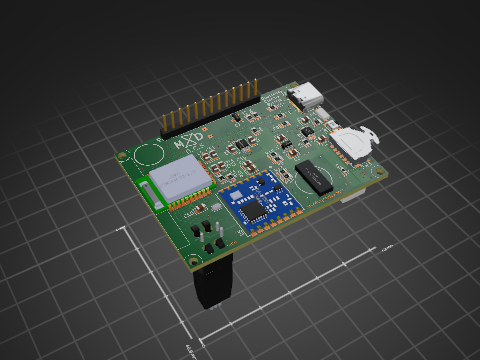
MixedSignalDevelopment/K2601-Doomsday-Comms-System
Editable source design for the Doomsday Comms System (D.C.S., SKU OS2601), board rev B.

AwesomeSno/Hux
A desktop AI companion and Home Assistant controller with an expressive face display and Jarvis personality.


drunken-octopus/ao-usb-drive-reader-rev-c
Revision C of the Aleph Objects USB reader.
It measures 18 × 12 mm and has 4 copper layers, 1.6 mm thick.
12 parts, built around the STM32H743VIT6, BT840F, IS42S16160G-5BL and TLV75533DRV. The full list of its parts is on this page, with links to each part's symbol and footprint where PCBKit's library has them.
From the jayis1/hacker-devices repository on GitHub, at the commit this page was made from: the board is echo-phantom/kicad/device.kicad_pcb. PCBKit opens the board in the browser, with nothing to install.
Its repository states no licence, so its author keeps all rights: ask jayis1 before reusing the design.