
2 layers21 × 15.5 mm
MRF Pro v8-breakout
acornelissen/IDENTIDEM.design-MRF2
Open hardware medium-format rangefinder for Mamiya Press lenses: ESP32-S3 firmware, LiDAR-coupled focusing, custom PCBs, printed parts.
13 parts158GPL-3.0

A desktop AI companion and Home Assistant controller with an expressive face display and Jarvis personality.
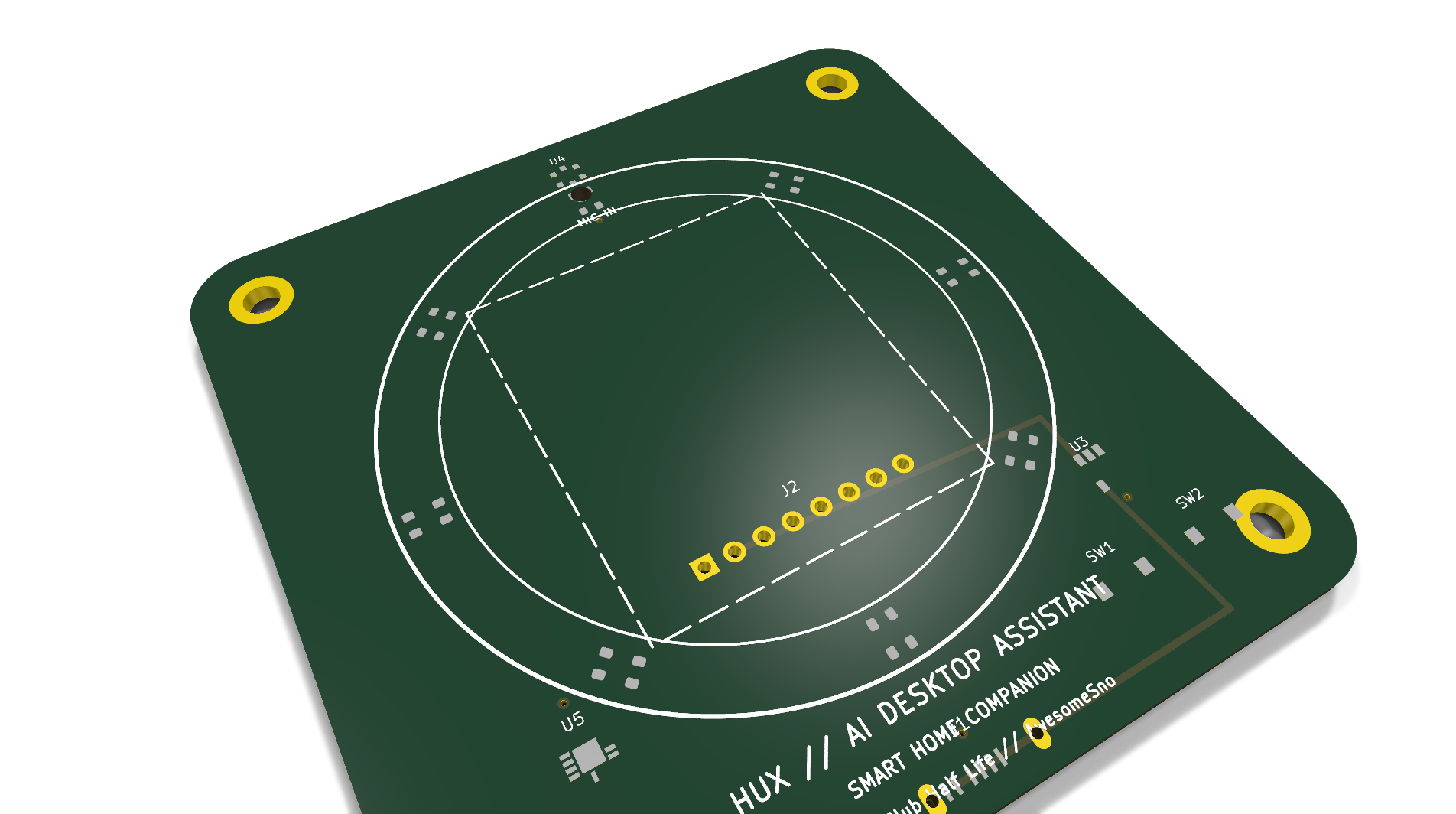
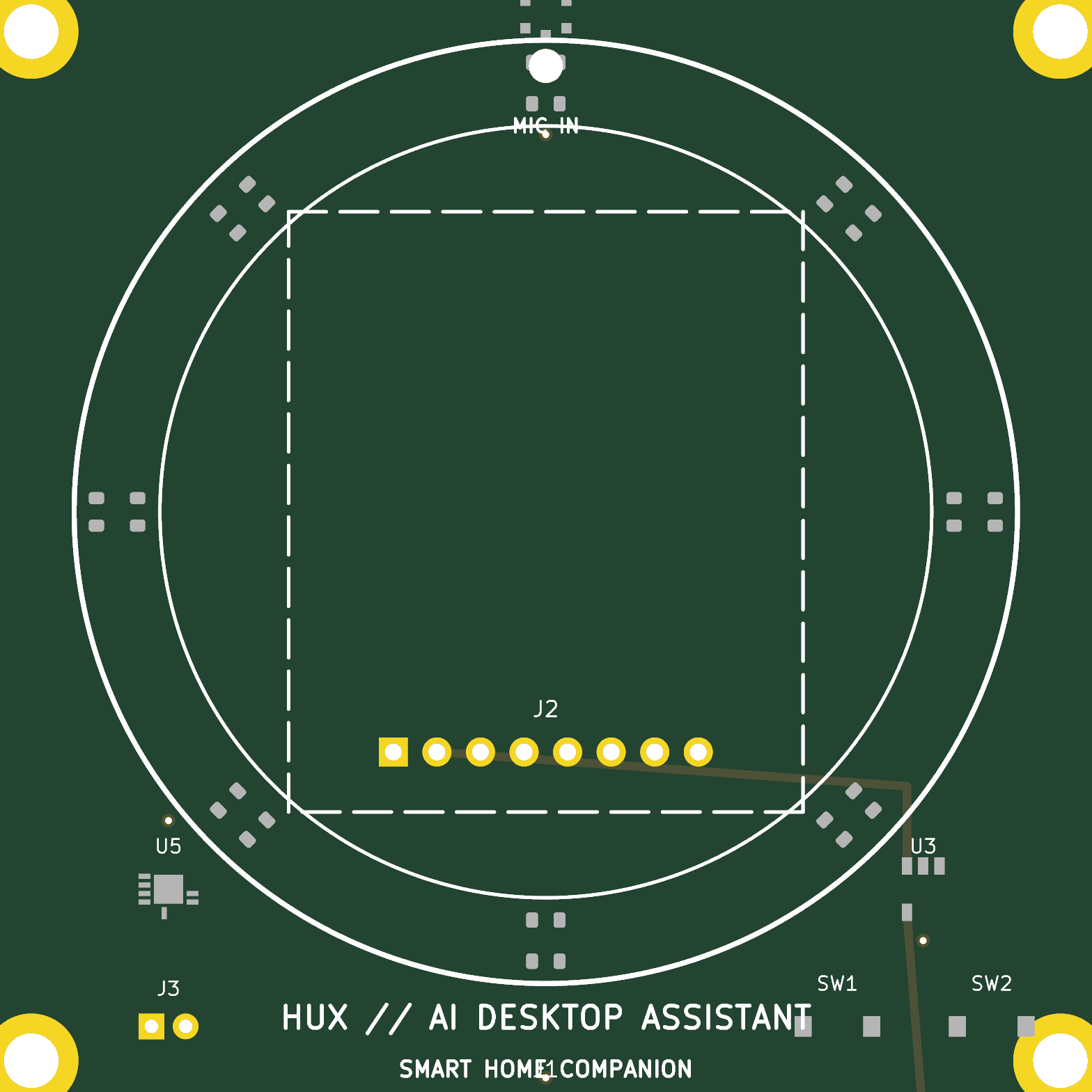
Hux is an open-source printed circuit board by AwesomeSno, from the AwesomeSno/Hux repository on GitHub. It is a 2-layer board of 72 × 72 mm with 21 parts on 31 nets, routed with 4 tracks and 4 vias.
It is built around the ESP32-S3-WROOM-1-N8, INMP441 and TLV75533DRV, with the SK6812MINI-E among its other parts. Its parts include 8 diodes, 4 ICs, 3 connectors and 2 switches. It belongs with the home automation and IoT and lEDs and displays boards and the ESP32 boards of this library.


A desktop AI smart home companion built with an ESP32-S3, featuring an animated expressive face display, an addressable RGB status ring, dual I2S voice I/O, and native local integration with Home Assistant. Inspired by Jarvis from Iron Man.
Most smart home speakers on the market are completely lifeless: they are just boring black plastic pucks sitting on your desk that listen to you with zero personality and no visual feedback beyond a single blinking LED.
For Hack Club's Half Life, I wanted to build something with actual life and presence on my desk: Hux. It's a custom desktop hardware companion powered by an ESP32-S3 microcontroller with a crisp color IPS display running expressive animated eyes and reactive facial emotions.
When you speak to Hux or trigger automations around your room, it talks back, controls your Home Assistant entities (lights, plugs, AC, media) over local Wi-Fi, and dynamically switches its screen into a live telemetry HUD showing room sensor readings, weather, or device toggles.
| Component | Part / Spec | Role |
|---|---|---|
| MCU | ESP32-S3-WROOM-1 (16MB Flash, 8MB PSRAM) | Dual-core 240MHz controller handling Wi-Fi, display, and dual I2S audio |
| Display | 1.69" or 2.0" ST7789 IPS SPI LCD (240×280) | Animated vector face and smart home telemetry cards |
| Microphone | INMP441 I2S Digital MEMS Mic | High-SNR voice input with front acoustic port |
| Audio Out | MAX98357A I2S Class-D DAC + 3W 4Ω Speaker | Voice synthesis and feedback playback |
| Halo Lighting | 8x SK6812 MINI-E Addressable RGB LEDs | Circular Arc-Reactor status glow |
| Power & Circuit | USB-C 16-pin, TLV75533 3.3V LDO, USBLC6-2SC6 ESD | Clean desktop USB 5V power and transient ESD protection |
| Dimensions | 72mm × 72mm × 1.6mm FR4 (6mm corner radii) | Standard M3 standoff mounting holes |
The hardware is designed as a clean 2-layer board in KiCad 10:
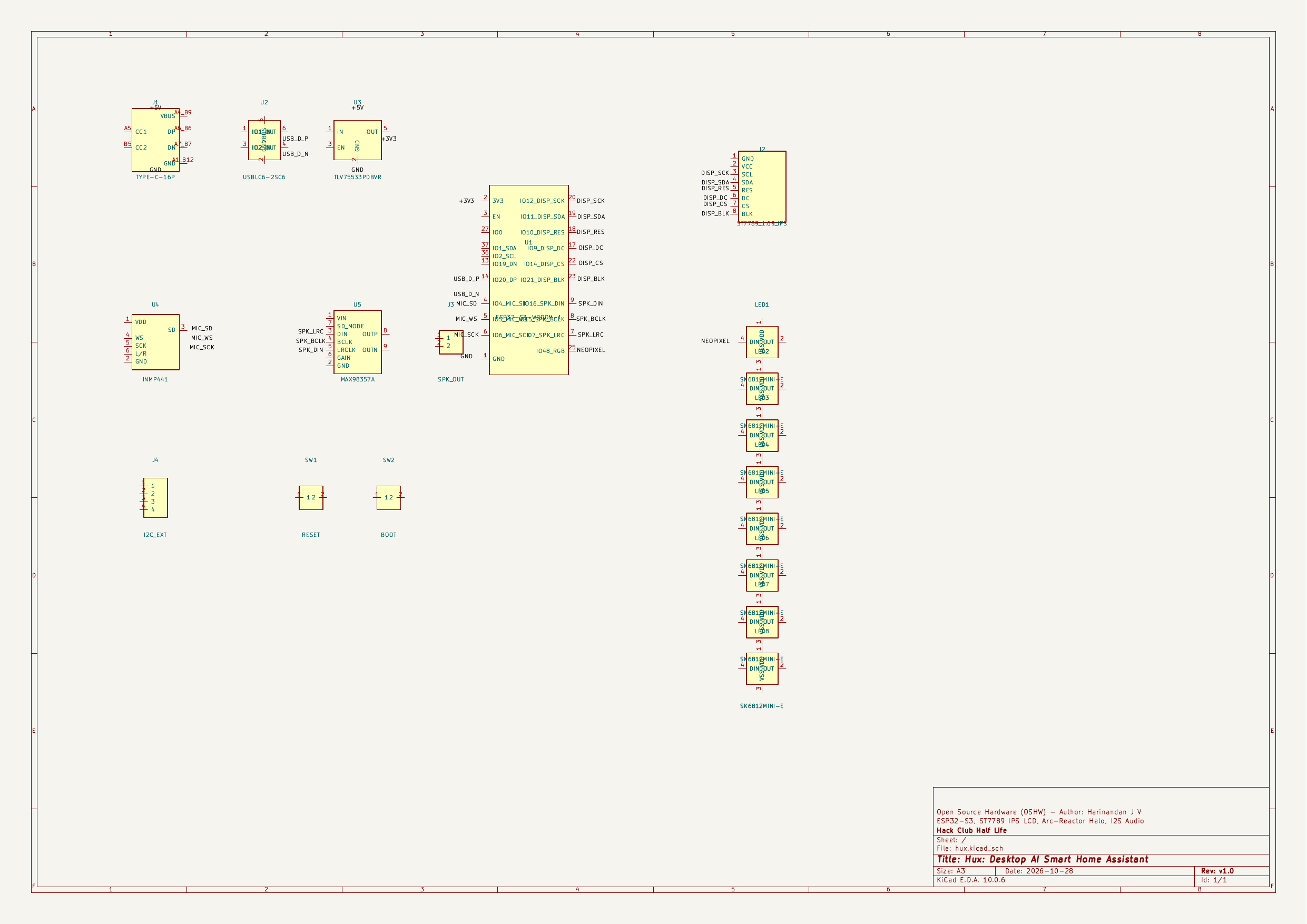
All hardware design and manufacturing files are located in kicad/:
kicad/hux.kicad_prokicad/hux.kicad_sch (Printable: kicad/hux_schematic.pdf)kicad/hux.kicad_pcbkicad/bom.csv (JLCPCB pre-formatted with LCSC parts)kicad/cpl.csvkicad/hux_gerbers.zip| Item | Part / Designation | Supplier Code (LCSC / Mfg) | Package | Qty | Role |
|---|---|---|---|---|---|
| Microcontroller | ESP32-S3-WROOM-1-N16R8 | LCSC: C5180337 | SMD Module | 1 | 240MHz dual-core MCU, 16MB Flash, 8MB PSRAM, Wi-Fi & BLE |
| Color IPS Display | ST7789 1.69" / 2.0" IPS LCD | LCSC: C2903565 / ST7789V | 8-Pin Header / SPI | 1 | Expressive face animations & telemetry dashboard |
| Digital MEMS Mic | INMP441 | LCSC: C444583 | SMD Acoustic | 1 | Omnidirectional I2S microphone for voice commands |
| Audio Amplifier | MAX98357AETE+T | LCSC: C268261 | QFN-16 | 1 | 3.2W Mono Class-D I2S DAC amplifier |
| Micro Speaker | 4Ω 3W Cavity Speaker | JST-PH 2.0mm / C131337 | 28mm / 31mm | 1 | Voice responses and sound effects |
| Arc-Reactor Halo | SK6812 MINI-E | LCSC: C2890040 | SMD-3535 | 8 | Circular addressable RGB NeoPixels for status cues |
| Voltage Regulator | TLV75533PDBVR | LCSC: C397683 | SOT-23-5 | 1 | Low-dropout 3.3V 500mA LDO regulator |
| ESD Protection | USBLC6-2SC6 | LCSC: C7519 | SOT-23-6 | 1 | High-speed USB D+/D- transient ESD suppressor |
| USB-C Receptacle | TYPE-C-31-M-12 (16-Pin) | LCSC: C165948 | 16-Pin SMD | 1 | 5V DC power and native USB-CDC programming |
| Tactile Buttons | TL3342F160QG | LCSC: C318884 | SMD SPST | 2 | Hardware Reset (EN) and Bootloader (IO0) |
| Ceramic Capacitors | 10µF 16V X7R (0805) | LCSC: C15849 | 0805 | 3 | Bulk power input/output filters |
| Decoupling Caps | 100nF 50V X7R (0805) | LCSC: C14663 | 0805 | 11 | IC supply decoupling & LED smoothing |
| Resistors | 5.1kΩ 1% (0805) | LCSC: C17704 | 0805 | 2 | USB-C CC1/CC2 5V pull-downs |
| Resistors | 10kΩ 1% (0805) | LCSC: C17414 | 0805 | 3 | Pull-ups for EN, BOOT, SD_MODE |
| Resistors | 330Ω 1% (0805) | LCSC: C17632 | 0805 | 1 | NeoPixel DIN data line protection |
| Telemetry Header | 4-Pin 2.54mm Header | LCSC: C22548 | 1x04 P2.54mm | 1 | I2C sensor expansion (SDA, SCL, 3V3, GND) |
The firmware is written in modular C++ targeting the ESP32-S3 dual-core microcontroller, supporting both PlatformIO and the Arduino IDE:
firmware/hux_firmware.inofirmware/platformio.inifirmware/include/config.hfirmware/src/eyes.cppfirmware/src/halo.cppfirmware/src/audio.cppfirmware/src/home_assistant.cppfirmware/src/main.cppfirmware/README.mdDesigned and built by Harinandan J V (@AwesomeSno) for Hack Club's Half Life.
| Qty | Value | Footprint | References |
|---|---|---|---|
| 8 | SK6812MINI-E | LED_SMD:LED_SK6812MINI-E | LED1, LED2, LED3, LED4, LED5, LED6, LED7, LED8 |
| 1 | BOOT | Button_Switch_SMD:SW_SPST_TL3342 | SW2 |
| 1 | ESP32-S3-WROOM-1 | RF_Module:ESP32-S3-WROOM-1 | U1 |
| 1 | INMP441 | Sensor_Audio:INMP441 | U4 |
| 1 | MAX98357A | Package_DFN_QFN:QFN-16-1EP_3x3mm_P0.5mm_EP1.7x1.7mm | U5 |
| 1 | RST | Button_Switch_SMD:SW_SPST_TL3342 | SW1 |
| 1 | SPK_OUT | Connector_JST:JST_PH_S2B-PH-K_1x02_P2.00mm_Horizontal | J3 |
| 1 | ST7789_1.69_IPS | Connector_PinHeader_2.54mm:PinHeader_1x08_P2.54mm_Vertical | J2 |
| 1 | TLV75533 | Package_TO_SOT_SMD:SOT-23-5 | U3 |
| 1 | USB-C-16P | Connector_USB:USB_C_Receptacle_16P | J1 |
The 17 most common of 21 parts.
acornelissen/IDENTIDEM.design-MRF2
Open hardware medium-format rangefinder for Mamiya Press lenses: ESP32-S3 firmware, LiDAR-coupled focusing, custom PCBs, printed parts.
MixedSignalDevelopment/K2601-Doomsday-Comms-System
Editable source design for the Doomsday Comms System (D.C.S., SKU OS2601), board rev B.


drunken-octopus/ao-usb-drive-reader-rev-c
Revision C of the Aleph Objects USB reader.


jayis1/hacker-devices
Full-cycle hardware designs for security research devices — each device is a subfolder with its own README, schematics, PCB layout, and software stack

crzhacko/rove-esp32s3
ROVE — ESP32-S3 voice-controlled RC car platform (monorepo: firmware + electronics)

ri-buni/Wild-clock-with-Emnny
Emnny is a small AI powered mascot. When I say the wake word, he wakes up, listens to me and answers in his own voice. The rest of the time, he just shows current time and quietly exists!
It measures 72 × 72 mm and has 2 copper layers, 1.6 mm thick.
21 parts, built around the ESP32-S3-WROOM-1-N8, INMP441, TLV75533DRV and SK6812MINI-E. The full list of its parts is on this page, with links to each part's symbol and footprint where PCBKit's library has them.
From the AwesomeSno/Hux repository on GitHub, at the commit this page was made from: the board is kicad/hux.kicad_pcb and its schematic kicad/hux.kicad_sch. PCBKit opens the board in the browser, with nothing to install.
Its repository states no licence, so its author keeps all rights: ask AwesomeSno before reusing the design.