2 layers57 × 55.2 mm
LogicAnalyzer
gusmanb/logicanalyzer
24 channel, 100Msps logic analyzer hardware and software
10 parts5.1kGPL-3.0

 jaggerzhong/microduck-hub-board
Microduck(飞特 HD1910)无源四路舵机总线 HUB 分线板:23×34 mm、2 层 1.0 mm、4×M2 孔对齐髋舵机外壳;含 Gerber、KiCad 与生成脚本 | Passive 4-port servo bus hub for the Microduck biped
Microduck HUB RevC is an open-source printed circuit board by jaggerzhong, from the jaggerzhong/microduck-hub-board repository on GitHub, published under the CERN-OHL-S-2.0 licence. It is a 2-layer board of 23 × 34 mm with 10 parts on 3 nets, routed with 23 tracks and 0 vias.
Its parts include 5 connectors and 1 capacitor. It belongs with the robots and motor control boards of this library.
简体中文 | English
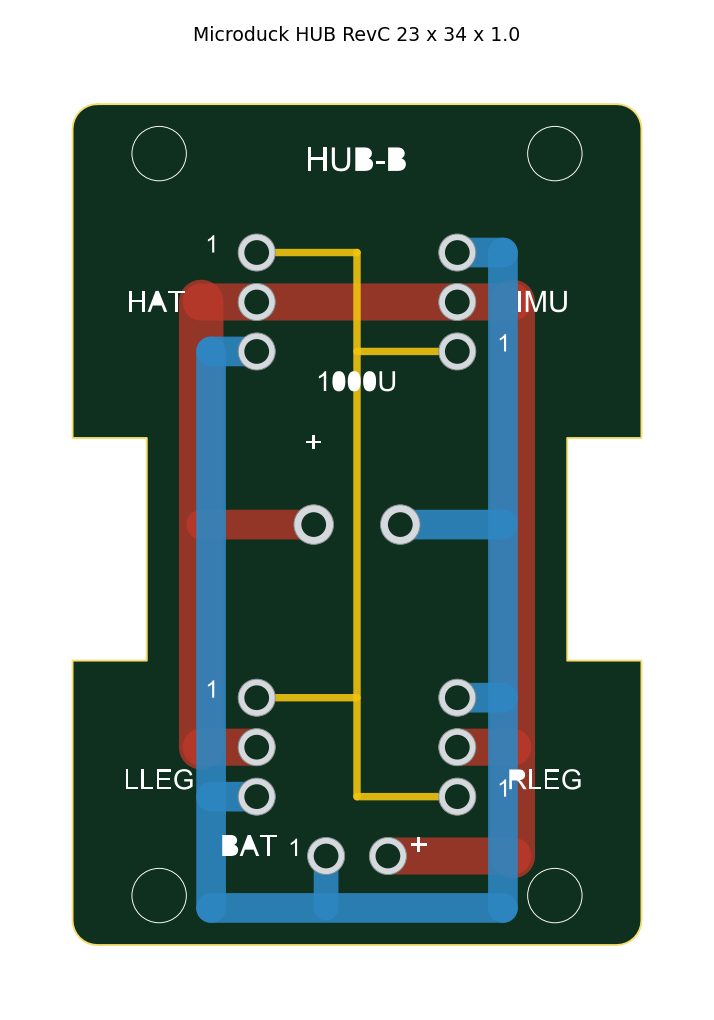
给 Microduck(飞特 Feetech HD1910,15 个舵机) 用的纯无源四路总线 HUB。 电池、HAT、IMU、左右腿四条线汇到一块 23 × 34 mm 的小板上,板上预留 1000 µF 总电源缓冲电容位置。
HD1910 是串联总线舵机:15 个舵机、HAT、IMU 和电池其实挂在同一条三线总线上,缺的只是"把线分成几路"的地方。 官方的做法是在两个髋舵机外壳顶上放一块分线板;这份开源工程就是那类分线板的另一份从零实现的版本:同样的外形轮廓和端口定义,但布局、丝印、Gerber 和生成脚本都是独立写的,方便你改孔位、改端口数、自己打样。
| 项 | 值 |
|---|---|
| 外形 | 23.0 × 34.0 mm(两侧有让位缺口,照 HD1910 结构件轮廓) |
| 层数 / 板厚 | 2 层 / 1.0 mm(1.6 mm 会顶到舵机,见下方警告) |
| 安装孔 | 4 × Ø2.2(M2 通孔),孔距 30 × 16,和 HD1910 外壳 Ø1.6 孔位同心 |
| 端口 | 4 × AMP2.0-3P 直插母座(底面)+ 1 × 2P 电池座(顶面) |
| 电容 | 1000 µF / 16 V,脚距 3.5 mm,Ø8 × 8~9 mm(底面) |
| 走线 | B 面整层 VBAT 主干(1.8 mm)、F 面 GND 环 + DATA 星形(0.3 mm) |
| 过孔 / 跳线 | 0 / 0(两面各走各的,不借过孔) |
| 元器件总数 | 6(4 个 3P 母座 + 1 个 2P 座 + 1 个电容) |
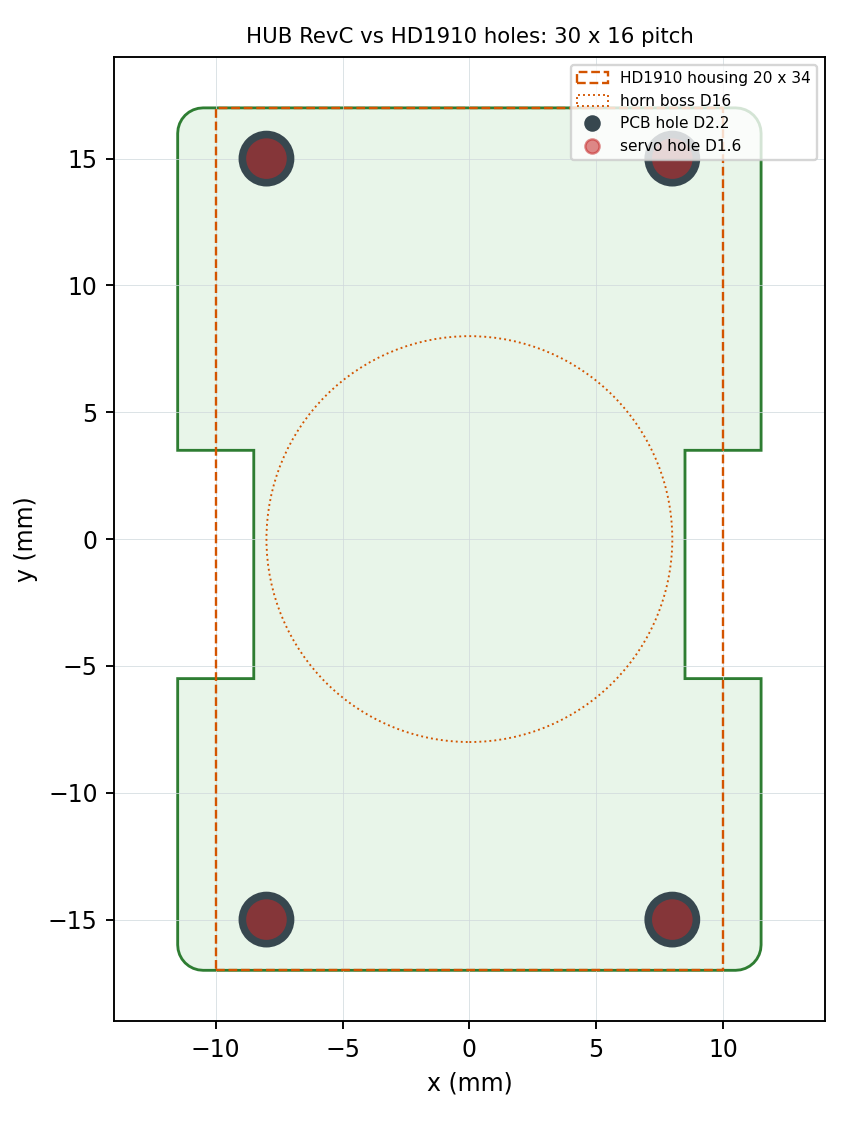
上面这张图是孔位核验:橙色虚线是舵机 20 × 34 的安装面,红点是舵机外壳 Ø1.6,深灰是板上 Ø2.2,四个孔同心。
四个 3P 口的针序不是四个都一样,是两个方向镜像的,1 号针 = DATA:
| 端口 | 位置 | pin1(DATA)在 | pin2 | pin3 |
|---|---|---|---|---|
| HAT | 左上 | 最上 | VBAT | GND |
| IMU | 右上 | 最下 | VBAT | GND |
| LLEG | 左下 | 最上 | VBAT | GND |
| RLEG | 右下 | 最下 | VBAT | GND |
| BAT | 底部中间(顶面) | 左 = GND(−) | 右 = VBAT(+) | — |
| C1 | 板中心(底面) | 左焊盘 = +(VBAT) | 右焊盘 = GND | — |
板子上每个 3P 口旁边都有丝印名和一个数字 1,以丝印为准,不要靠插头的防呆凸起来判断方向。 详细的接线方式见 docs/WIRING.md。
直接上传 hardware/gerber/Microduck-HUB-RevC-Gerber.zip:
| 项 | 值 |
|---|---|
| 尺寸 / 层数 | 23 × 34 mm / 2 层 |
| 板厚 | 1.0 mm |
| 铜厚 | 1 oz 够用,2 oz 更稳 |
| 表面处理 | 有铅喷锡 / 无铅喷锡 / OSP 都可以,无铅 OSP 最省 |
| 阻焊 / 字符 | 绿色 / 白色 |
| 数量 | 5 片(样板价 30 元上下;有免费打样券时可以做到 0 元,券只能在嘉立创下单小助手或手机 APP 里核销) |
板厚别随手改成 1.6 mm。舵机安装面中间有 Ø16 的出力轴凸台,板子必须垫高约 6.3 mm 才能平放; 结构件是按 1.0 mm 板厚 + 6.3 mm 垫高算的余量,换成 1.6 mm 会顶到舵机,需要自己把垫高改小 0.6 mm、螺丝相应短 0.6 mm。
| 位号 | 器件 | 规格 | 数量 |
|---|---|---|---|
| CN2–CN5 | AMP2.0 3P 直插母座 | A2007WV-3P("AMP2.0-3P"),脚距 2.0 | 4 |
| CN1 | 2P 直插 | 脚距 2.5(EH2.5 / XH2.54 偏差 0.02 mm 也能插),或直接焊电池线 | 1 |
| C1 | 电解电容 | 1000 µF / 16 V,脚距 3.5,优先选矮的(8 × 8 mm) | 1 |
装配和自检细节见 docs/BOM.md 与 docs/ASSEMBLY.md。
README.md
README.en.md                        英文说明 / English documentation
LICENSE                             CERN-OHL-S-2.0
hardware/
  Microduck-HUB-RevC.kicad_pcb      KiCad 工程(可直接导入嘉立创专业版 / LCEDA)
  board.json                        外形轮廓、焊盘、走线的机器可读描述
  pads.csv                          16 个焊盘的坐标 / 钻径 / 网络
  gerber/                           Gerber RS-274X + Excellon 钻孔 + 打包好的 zip
  img/preview.png                   顶面布线预览
  img/servo-fit.png                 板孔与舵机外壳孔位对位核验图
docs/
  WIRING.md                         端口定义、整机接线、线序核对方法
  BOM.md                            元器件清单与替代件
  ASSEMBLY.md                       焊接顺序、装机、万用表自检表
  DESIGN-NOTES.md                   为什么这么布、几何与 DRC 复核数据、版本历史
tools/ 生成脚本(改孔位、重新出 Gerber)孔距、孔径、端口位置都在 tools/gen_hub_v2.py 里,改完跑三条命令重出全套产物:
pip install -r tools/requirements.txt
python tools/gen_hub_v2.py         # Gerber + 钻孔 + preview.png + pads.csv + board.json
python tools/gen_hub_v2_kicad.py   # Microduck-HUB-RevC.kicad_pcb
python tools/hub_v3_servo_check.py # servo-fit.png 对位核验图
脚本会把产物写回 hardware/ 目录。
CERN-OHL-S-2.0(强互惠开源硬件许可)。
| Qty | Value | Footprint | References |
|---|---|---|---|
| 4 | MountingHole | Microduck:HUB_Mount_M2 | MH1, MH2, MH3, MH4 |
| 1 | AMP20_3P_HAT | Microduck:AMP20_3P_HAT | CN2 |
| 1 | AMP20_3P_IMU | Microduck:AMP20_3P_IMU | CN3 |
| 1 | AMP20_3P_LLEG | Microduck:AMP20_3P_LLEG | CN5 |
| 1 | AMP20_3P_RLEG | Microduck:AMP20_3P_RLEG | CN4 |
| 1 | BAT_2P | Microduck:BAT_2P | CN1 |
| 1 | CP_1000uF_16V | Microduck:CP_1000uF_16V | C1 |
gusmanb/logicanalyzer
24 channel, 100Msps logic analyzer hardware and software

byrantech/laptop
anyon_e, a highly integrated, high end, open source laptop. Attempt the impossible.

joeycastillo/Sensor-Watch
A board replacement for the classic Casio F-91W wristwatch


OLIMEX/OLINUXINO
OLINUXINO is Open Source / Open Hardware, low cost from EUR 24 Linux Industrial grade Single Board Computer capable to operate -25+85C

rusefi/rusefi
rusefi - GPL internal combustion engine control unit

VoronDesign/Voron-Hardware
Cool Hardware designed by the Voron Design group

hoglet67/RGBtoHDMI
Bare-metal Raspberry Pi project that provides pixel-perfect sampling of Retro Computer RGB/YUV video and conversion to HDMI
It measures 23 × 34 mm and has 2 copper layers, 1 mm thick.
10 parts. The full list of its parts is on this page, with links to each part's symbol and footprint where PCBKit's library has them.
From the jaggerzhong/microduck-hub-board repository on GitHub, at the commit this page was made from: the board is hardware/Microduck-HUB-RevC.kicad_pcb. PCBKit opens the board in the browser, with nothing to install.
Its repository publishes it under the CERN-OHL-S-2.0 licence: you may reuse it on that licence's terms (keep the author's notice, and for a copyleft licence share your changes alike).