
2 layers
GCS98v0.2
iratium/GCS98
A collection of PCB and case designs for a modified 1800 layout I call GCS98.
201 parts

 iratium/GCS98
A collection of PCB and case designs for a modified 1800 layout I call GCS98.
GCS98v1 is an open-source printed circuit board by iratium, from the iratium/GCS98 repository on GitHub. It is a 2-layer board of 376.2 × 133.4 mm with 229 parts on 234 nets, routed with 980 tracks and 18 vias.
It is built around the BAT60A. Its parts include 101 diodes, 67 switches, 18 capacitors, 6 resistors and 1 IC.
A collection of PCB and case designs for a modified 1800 layout I call GCS98.
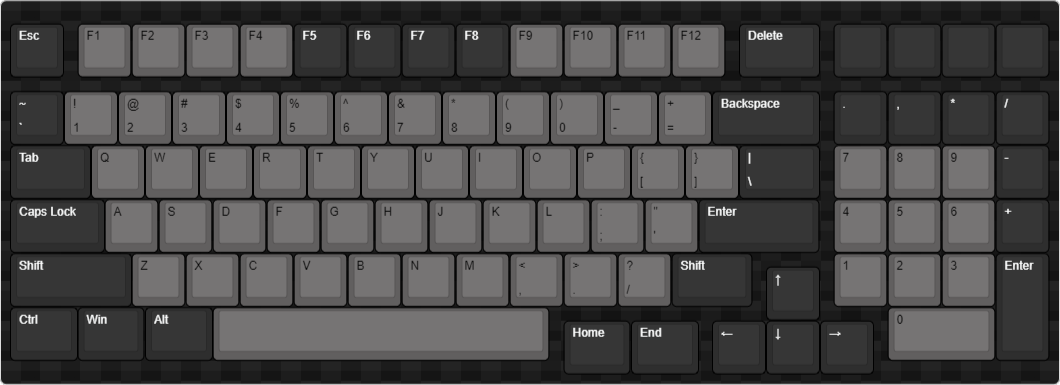
I enjoy the flexibility of a full-size keyboard, but in my decade or so of using keyboards (including software for general home use, programming, gaming, and engineering work), I have never found a use for certain keys in and around the navigation cluster, namely Page Up, Page Down, Insert, Scroll Lock, Num Lock, and Pause Break. Additionally, the full size layout is not ergonomic in terms of gaming.
I discovered the 96% and 1800 layouts and felt I had discovered the perfect out-of-the-box solution in the 1800 layout specifically, but was disappointed to find that the layout is somewhat rare. My searches led me to the Keychron K4 (with this specific configuration https://www.keychron.com/products/keychron-k4-wireless-mechanical-keyboard-version-2?variant=32287344427097), and after substituting in Glorious Panda Switches for most keys and upgrading to PBT keys for the first time, I finally had a keyboard that felt like mine. Unfortunately, the K4 still has one major drawback being a compact 96% layout as opposed to a proper 1800: the remaining navigation keys, arrow keys, and delete key are not easily accessible by touch.
To get the last 4% of customization that the compact 96% layout leaves in the aether, the only option forward is to do a fully custom build. I am a mechanical engineer by trade and I am familiar with the kinds of tools to design and manufacture a housed PCB; my specialty is not in electronics though, so I will inevitably be following tutorials and asking for help.
Feel free to share this project with others, I've already been asked a couple of times whether I'd consider doing a group buy around this layout. You can also contact me over Discord Iratium#4718 or email at gavinshehan@gmail.com.
| Qty | Value | Footprint | References |
|---|---|---|---|
| 98 | D | Diode_SMD:D_0805_2012Metric_Pad1.15x1.40mm_HandSolder | D1, D2, D10, D11, D12, D13, D14, D15, D16, D17, D18, D19, D20, D21, D22, D23 +82 |
| 8 | 100nF | Capacitor_SMD:C_0805_2012Metric_Pad1.18x1.45mm_HandSolder | C8, C9, C11, C12, C13, C14, C15, C18 |
| 6 | 100µF | Capacitor_SMD:C_0805_2012Metric_Pad1.18x1.45mm_HandSolder | C1, C2, C3, C4, C5, C6 |
| 3 | BAT60A | Diode_SMD:D_SOD-323 | D99, D197, D198 |
| 2 | 10K | Resistor_SMD:R_0805_2012Metric_Pad1.20x1.40mm_HandSolder | R2, R4 |
| 2 | 1K5 | Resistor_SMD:R_0805_2012Metric_Pad1.20x1.40mm_HandSolder | R1, R5 |
| 2 | 20pF | Capacitor_SMD:C_0805_2012Metric_Pad1.18x1.45mm_HandSolder | C16, C17 |
| 1 | 0 | MX_Alps_Hybrid:MX-1U-NoLED | SW29 |
| 1 | 0.5K | Resistor_SMD:R_0805_2012Metric_Pad1.20x1.40mm_HandSolder | R1 |
| 1 | 1 | MX_Alps_Hybrid:MX-1U-NoLED | SW20 |
| 1 | 100K | Resistor_SMD:R_0805_2012Metric_Pad1.20x1.40mm_HandSolder | R3 |
| 1 | 10nF | Capacitor_SMD:C_0805_2012Metric_Pad1.18x1.45mm_HandSolder | C10 |
| 1 | 16MHz | Crystal:Crystal_SMD_3225-4Pin_3.2x2.5mm_HandSoldering | Y1 |
| 1 | 1µF | Capacitor_SMD:C_0805_2012Metric_Pad1.18x1.45mm_HandSolder | C7 |
| 1 | 2 | MX_Alps_Hybrid:MX-1U-NoLED | SW21 |
| 1 | 3 | MX_Alps_Hybrid:MX-1U-NoLED | SW22 |
| 1 | 4 | MX_Alps_Hybrid:MX-1U-NoLED | SW23 |
| 1 | 5 | MX_Alps_Hybrid:MX-1U-NoLED | SW24 |
| 1 | 6 | MX_Alps_Hybrid:MX-1U-NoLED | SW25 |
| 1 | 7 | MX_Alps_Hybrid:MX-1U-NoLED | SW26 |
| 1 | 8 | MX_Alps_Hybrid:MX-1U-NoLED | SW27 |
| 1 | 9 | MX_Alps_Hybrid:MX-1U-NoLED | SW28 |
| 1 | A | MX_Alps_Hybrid:MX-1U-NoLED | SW56 |
| 1 | ALT | MX_Alps_Hybrid:MX-1.25U-NoLED | SW91 |
| 1 | APOST | MX_Alps_Hybrid:MX-1U-NoLED | SW66 |
| 1 | B | MX_Alps_Hybrid:MX-1U-NoLED | SW77 |
| 1 | BKSPC | MX_Alps_Hybrid:MX-2U-NoLED | SW32 |
| 1 | BSLSH | MX_Alps_Hybrid:MX-1.5U-NoLED | SW50 |
| 1 | C | MX_Alps_Hybrid:MX-1U-NoLED | SW75 |
| 1 | CAPS | MX_Alps_Hybrid:MX-1.75U-NoLED | SW55 |
| 1 | COMMA | MX_Alps_Hybrid:MX-1U-NoLED | SW80 |
| 1 | CTRL | MX_Alps_Hybrid:MX-1.25U-NoLED | SW89 |
| 1 | D | MX_Alps_Hybrid:MX-1U-NoLED | SW58 |
| 1 | DASH | MX_Alps_Hybrid:MX-1U-NoLED | SW30 |
| 1 | DEL | MX_Alps_Hybrid:MX-1.5U-NoLED | SW14 |
| 1 | DOWN | MX_Alps_Hybrid:MX-1U-NoLED | SW96 |
| 1 | E | MX_Alps_Hybrid:MX-1U-NoLED | SW40 |
| 1 | END | MX_Alps_Hybrid:MX-1.25U-NoLED | SW94 |
| 1 | ENTER | MX_Alps_Hybrid:MX-2.25U-NoLED | SW67 |
| 1 | EQUAL | MX_Alps_Hybrid:MX-1U-NoLED | SW31 |
| 1 | ESC | MX_Alps_Hybrid:MX-1U-NoLED | SW1 |
| 1 | F | MX_Alps_Hybrid:MX-1U-NoLED | SW59 |
| 1 | F1 | MX_Alps_Hybrid:MX-1U-NoLED | SW2 |
| 1 | F10 | MX_Alps_Hybrid:MX-1U-NoLED | SW11 |
| 1 | F11 | MX_Alps_Hybrid:MX-1U-NoLED | SW12 |
| 1 | F12 | MX_Alps_Hybrid:MX-1U-NoLED | SW13 |
| 1 | F13 | MX_Alps_Hybrid:MX-1U-NoLED | SW15 |
| 1 | F14 | MX_Alps_Hybrid:MX-1U-NoLED | SW16 |
| 1 | F15 | MX_Alps_Hybrid:MX-1U-NoLED | SW17 |
| 1 | F16 | MX_Alps_Hybrid:MX-1U-NoLED | SW18 |
| 1 | F2 | MX_Alps_Hybrid:MX-1U-NoLED | SW3 |
| 1 | F3 | MX_Alps_Hybrid:MX-1U-NoLED | SW4 |
| 1 | F4 | MX_Alps_Hybrid:MX-1U-NoLED | SW5 |
| 1 | F5 | MX_Alps_Hybrid:MX-1U-NoLED | SW6 |
| 1 | F6 | MX_Alps_Hybrid:MX-1U-NoLED | SW7 |
| 1 | F7 | MX_Alps_Hybrid:MX-1U-NoLED | SW8 |
| 1 | F8 | MX_Alps_Hybrid:MX-1U-NoLED | SW9 |
| 1 | F9 | MX_Alps_Hybrid:MX-1U-NoLED | SW10 |
| 1 | G | MX_Alps_Hybrid:MX-1U-NoLED | SW60 |
| 1 | H | MX_Alps_Hybrid:MX-1U-NoLED | SW61 |
| 1 | HOME | MX_Alps_Hybrid:MX-1.25U-NoLED | SW93 |
| 1 | I | MX_Alps_Hybrid:MX-1U-NoLED | SW45 |
| 1 | J | MX_Alps_Hybrid:MX-1U-NoLED | SW62 |
| 1 | K | MX_Alps_Hybrid:MX-1U-NoLED | SW63 |
| 1 | L | MX_Alps_Hybrid:MX-1U-NoLED | SW64 |
| 1 | LBRKT | MX_Alps_Hybrid:MX-1U-NoLED | SW48 |
| 1 | LD3985M33R_SOT23 | Package_TO_SOT_SMD:SOT-23-5 | U2 |
| 1 | LEFT | MX_Alps_Hybrid:MX-1U-NoLED | SW95 |
| 1 | LSHFT | MX_Alps_Hybrid:MX-2.25U-NoLED | SW72 |
| 1 | M | MX_Alps_Hybrid:MX-1U-NoLED | SW79 |
| 1 | MOP1 | MX_Alps_Hybrid:MX-1U-NoLED | SW33 |
| 1 | MOP2 | MX_Alps_Hybrid:MX-1U-NoLED | SW34 |
| 1 | MOP3 | MX_Alps_Hybrid:MX-1U-NoLED | SW35 |
| 1 | MOP4 | MX_Alps_Hybrid:MX-1U-NoLED | SW36 |
| 1 | MOP5 | MX_Alps_Hybrid:MX-1U-NoLED | SW54 |
| 1 | MOP6 | MX_Alps_Hybrid:MX-1U-NoLED | SW71 |
| 1 | N | MX_Alps_Hybrid:MX-1U-NoLED | SW78 |
| 1 | NUM0 | MX_Alps_Hybrid:MX-2U-NoLED | SW98 |
| 1 | NUM1 | MX_Alps_Hybrid:MX-1U-NoLED | SW85 |
| 1 | NUM2 | MX_Alps_Hybrid:MX-1U-NoLED | SW86 |
The 194 most common of 229 parts.
iratium/GCS98
A collection of PCB and case designs for a modified 1800 layout I call GCS98.
M17-Project/Module_17
M17 modem board for 9600-baud capable radios


crgarcia12/electronics-homeassistant-lightscontroll
A smart lighting controller PCB that integrates seamlessly with ESPHome and Home Assistant while maintaining full compatibility with traditional mechanical switches.


OnionDAO-git/oniondao-badge
An open-source, hacker-conference-style electronic badge built around the ESP32-S3-WROOM-1-N8R8 (8 MB flash + 8 MB Octal PSRAM), with swappable RF / audio / storage modules, an e-paper (or TFT) display socket, a secure…

It measures 376.2 × 133.4 mm and has 2 copper layers, 1.6 mm thick.
229 parts, built around the BAT60A. The full list of its parts is on this page, with links to each part's symbol and footprint where PCBKit's library has them.
From the iratium/GCS98 repository on GitHub, at the commit this page was made from: the board is GCSv1/GCS98v1.kicad_pcb. PCBKit opens the board in the browser, with nothing to install.
Its repository states no licence, so its author keeps all rights: ask iratium before reusing the design.